Upcoming dates

There is a moment near the start of every run that tells you whether you are going to enjoy the Soldier Hollow Classic. A handler stands at a post at the bottom of the hill. A dog sits beside them, vibrating. Several hundred yards up the Olympic slope, four or five sheep are grazing and have not noticed anything.
The handler says a word. The dog leaves.
And then for the next thirty seconds the dog runs away from the sheep — out and wide, in an enormous arc, disappearing behind a fold in the ground — because the entire point is to arrive behind them without ever letting them feel hunted. If it does that right, the sheep look up, see a dog where a dog should be, and begin to walk calmly down the hill. If it does it wrong, they scatter across an unfenced mountainside and the run is effectively over in the first minute.
That is a sheepdog trial. It is one of the great spectator sports nobody tells you about, it happens forty-five minutes from Provo, and almost everything published about attending it in Utah Valley is out of date.
First, the thing most guides still have wrong
The Classic is on Memorial Day weekend. It is not on Labor Day.
From its founding in 2003 through 2022 it ran over Labor Day, alongside Swiss Days in Midway, and a generation of Utah Valley families learned that pairing. The 2023 edition was canceled because of construction at the Nordic Center, and organizers used the gap to make a change that had been under discussion for years. From 2024 it has run over Memorial Day weekend permanently.
2026: 22–25 May. 2027: 28–31 May, as announced by the organizers.
The reason given was heat. A championship run is long — the final course can take the better part of half an hour — and Labor Day editions had been run in temperatures over a hundred degrees, which is hard on sheep and harder on a dog working flat out at altitude. The Swiss Days collision was the second argument.
The practical consequence: Swiss Days is still Labor Day. The sheepdogs are in May. If you are planning one trip, it is now two trips.
What is actually happening on that hillside
A trial is a test of one thing: whether a dog and a handler can move livestock calmly and precisely over ground, at distance, without force. Everything about the course is designed to make that hard.
Here is the sequence, which is broadly standard at trials of this level and is what you will be watching.
The outrun. The dog is sent from the handler's post and must run a wide arc to get behind the sheep. Wide is the whole point — a dog that cuts in too close applies pressure from the side, and the sheep break. This is where a lot of runs are quietly lost, and the outrun at Soldier Hollow is long and uphill across broken ground where the dog loses sight of the sheep entirely for stretches.
The lift. The moment the dog comes into the sheep's awareness and starts them moving. It is judged, and it is the most delicate few seconds of the run. A good lift barely looks like anything happened.
The fetch. Bringing the sheep straight down the hill to the handler, through a set of gates. The ideal line is dead straight, and the judge is deducting for every wobble off it. Sheep, being sheep, would prefer a different route.
The drive. The handler turns the sheep and the dog now pushes them away, across the field, through further gates — which is much harder than the fetch, because the dog is working on the far side of the sheep from the handler and taking commands at distance for something it cannot always see well.
The shed. Inside a marked ring, the dog and handler must separate a specified number of sheep from the group and hold them apart. This is where you will hear the crowd make a noise, because it looks impossible until it suddenly works.
The pen. The handler moves to a small pen, holds a rope on the gate, and the dog puts the sheep inside. Handler and dog are working in tight quarters now and the sheep have opinions.
The handler controls all of this with whistles and voice commands from a fixed post. There is a traditional vocabulary — commands for clockwise, counter-clockwise, stop, walk on — and each handler's whistle is their own. Once you know that the two most common commands are "go around one way" and "go around the other way," a great deal of what sounded like birdsong resolves into instructions.
How the scoring works, which makes it a sport
Points are deducted, not awarded. Every run begins on a maximum, and judges take points off for every departure from the ideal: an outrun that is too tight or too wide, a rough lift, sheep that drift off the straight line, a missed gate, a dog that grips or over-pressures, a shed that takes too many attempts.
A perfect score is theoretically possible and effectively never happens. What you are watching is an exercise in losing as little as possible.
There is a time limit, and this is the source of most of the drama. A run that reaches it is stopped wherever it has got to. That is why you will occasionally see a handler abandon a shed that is not working and run for the pen, gambling that the points for a completed pen beat the points for a half-done shed. It is also why a run that is going beautifully can become visibly tense in the last two minutes.
A handler may also retire — walk off rather than finish — and it is not treated as a disgrace. If the sheep have gone and the run is unrecoverable, the humane and professional thing is to take the dog off. You will see it, and the crowd will applaud anyway.
Once you have the deduction logic, the whole thing changes character. You stop watching a dog run around and start watching a sequence of small decisions with a running cost attached, which is exactly what makes any sport worth watching.
Why Soldier Hollow is a hard trial
Three things make this one of the more respected trials in the world, and all three are visible from the stands.
It is unfenced. The sheep are on open mountain terrain with nothing to keep them in. At a trial on a flat, bounded field, a mistake costs points. Here, a mistake can cost the whole run, because sheep that break have somewhere to go.
The ground is Olympic hillside. Soldier Hollow was a 2002 Winter Olympics venue and is slated to host events again in 2034. The terrain that makes it a good biathlon and cross-country course — long, sloped, uneven, with folds that hide things — makes it a brutal sheepdog field. Distance and gradient are working against the dog the whole way.
The sheep are range sheep. More than three hundred Rambouillets are worked across the weekend, in small groups. Rambouillets are a substantial, flighty, range-bred animal rather than a placid farm flock, and they do not concede anything to a dog they do not respect.
Put those together and you get an event that draws handlers from around nineteen countries, because winning here means something.
The festival, which is half the day
If you turn up for the trial alone you will have a good time. If you turn up for the day, there is a great deal more.
Dog agility exhibitions — a completely different discipline, fast and loud and easy to enjoy with no background knowledge.
Duck herding, which is exactly what it sounds like, is usually done with a smaller dog and a handful of ducks, and is the single most reliably delightful thing at the whole event.
Sheep shearing demonstrations, which are far more interesting than expected and take about three minutes per animal in the hands of someone who knows what they are doing.
Children's activities and a petting zoo.
Food and artisan vendors.
The right way to build a family day: watch one complete run from start to finish so that everybody understands what the hillside is for, then go and do everything else and drift back for the last runs of the day.
Which day, and when to arrive
Friday is the quiet day. Preliminary rounds, space on the hill, short queues, and handlers who have time to talk. If you want to understand the sport, this is the day to ask somebody a question.
Saturday and Sunday are the busiest, with the fullest festival programming and the largest crowds. Still preliminary rounds.
Monday is the championship round, and only the top qualifiers from the preliminaries get there. The standard is the highest of the weekend, the course is the hardest, and the atmosphere is completely different. If you are going once, go on the Monday — but go early, because it is also the most attended day.
Competition runs from about 8 a.m. to 5 p.m. daily. Mornings are cooler, calmer and better for the dogs; the light on the hillside in the early part of the day is also the best of it.
What to bring, which matters more here than at most events
Soldier Hollow is an exposed hillside at altitude, and people underestimate all three words.
Sun protection. There is very little shade and you are higher than you are used to. Hats, sunscreen, and reapplication.
Layers. A Memorial Day weekend in the Wasatch Back can deliver eighty degrees at noon and a cold wind by four, sometimes on the same afternoon.
Water, more than you think.
Something to sit on. A folding chair or a blanket. You are going to be sitting for hours and the ground is a slope.
Binoculars. This is the single item that changes the day. The action starts several hundred yards away and a great deal of the subtlety — what the dog's ears are doing, where its eye is, the exact moment the sheep decide to cooperate — is invisible to the naked eye at that distance.
Cash, for vendors.
And think carefully before bringing your own dog. This is a working livestock environment with hundreds of sheep and a field of intensely focused competition dogs. Check the event's policy before you load the car rather than after, and if there is any doubt, leave the dog at home — it is a long day and a hot car park is not an alternative.
The dogs, and the thing called eye
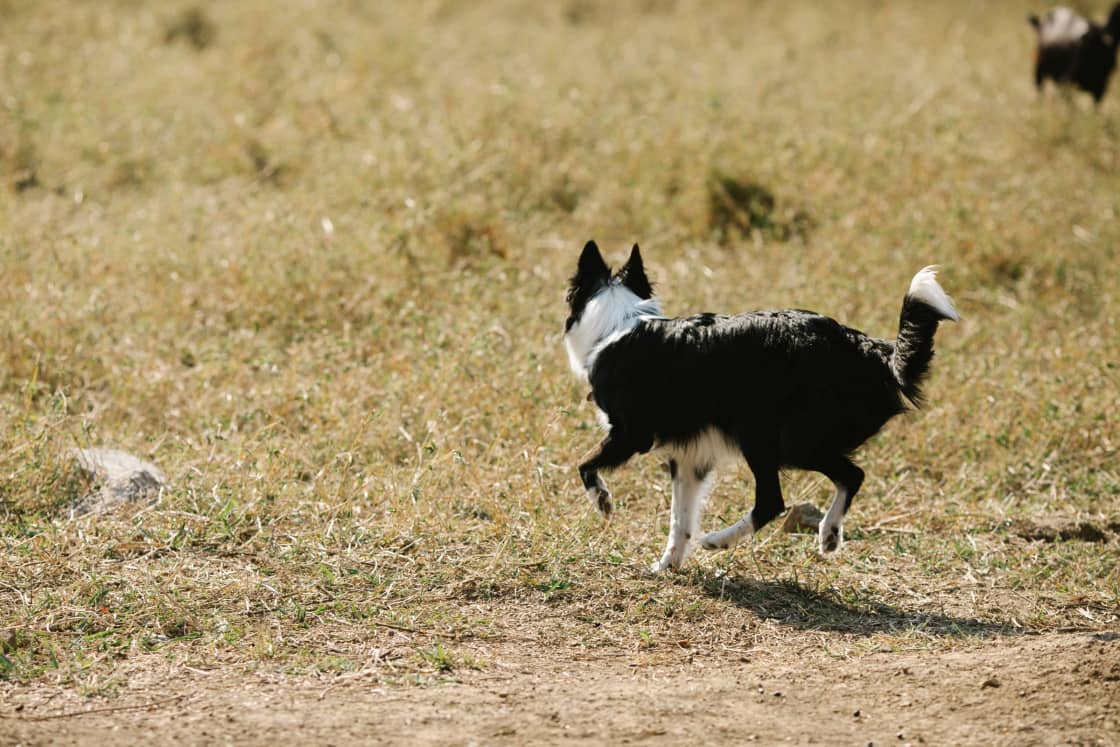
Nearly every dog on that hillside will be a border collie, and there is a reason that is not simply fashion.
They were bred for exactly this and nothing else. Not for looks, not for temperament in a living room, not for a breed standard — for the ability to move livestock at distance under direction. A working line is selected on whether the dog can do the job, generation after generation, and the physical uniformity people associate with pedigree dogs is largely absent. Working collies come in a range of sizes, coats and colors, because none of that was ever what was being selected for.
The trait that defines them is called eye. It is the intense, low, stalking stare a collie fixes on stock, and it is a modified predatory behavior: the pattern of a wolf stalking prey, with the final kill sequence bred out and the earlier stages amplified. Sheep read that stare exactly as they were meant to, which is why a good collie can move a flock without touching it or making a sound. Too much eye and a dog can lock up, fixated, unable to move; too little and the sheep ignore it.
They also have what handlers call balance — an instinct for the point behind the flock that keeps it moving toward the handler. A young dog with good balance will find that point without being taught it. Much of training is not installing the instinct but shaping it: teaching the dog to take direction, to widen out, to stop on command in the middle of a stalk, and to override its own excellent judgment when the human can see something it cannot.
Training takes years. A dog may start on stock at around a year old and will not be competitive at this level for several more. The partnership on display at a championship is the product of a very long apprenticeship on both ends of the field, and it is normal for a handler to have raised and trained the dog from a puppy.
And they are not pets that also work. A trial dog lives to work and is frequently difficult to live with if it cannot. It is worth knowing this before a family watches a weekend of border collies being astonishing and concludes that one would be lovely in a suburban back garden. The honest version is that these are athletes with a job, and the ones you are watching have one.
Where it came from
The Classic was founded in 2003, the idea of a Park City man who thought the Olympic venue could hold a sheepdog trial. The first edition drew around five thousand people, which for a first-year event about working dogs is a remarkable number and tells you the appetite was already there.
It has grown into one of the premier trials internationally, drawing competitors from around nineteen countries and — depending on whose figure you use — somewhere north of ten thousand spectators a year. Attendance numbers vary wildly between sources, including between the organizers' own materials at different times, so treat any single figure you read with suspicion, this page included.
What has not changed is the format. It is still a handler, a dog, some sheep and a hillside.
Getting there, and making a weekend of it
Soldier Hollow Nordic Center sits at 2002 Soldier Hollow Lane in Midway, about forty-five minutes from Provo up Provo Canyon on US-189 and over into the Heber Valley. It is one of the better drives in the state and late May is one of the better times to do it, with the canyon green and the high peaks still holding snow.
Tickets are sold through the event's own channels; buy in advance rather than at the gate, particularly for the Monday.
Parking is on site and fills on the busier days, which is one more argument for a morning arrival.
Memorial Day weekend gives you three other days, and the valley is worth them. Our guide to Heber Valley and Midway from Provo covers the trip, Deer Creek and Jordanelle are both minutes away and open by late May, the Heber Valley Railroad is running, and Soldier Hollow itself has a summer life beyond the trial. Heber's own big week, Wasatch County Fair Days, comes two months later at the end of July.
Why this is worth an afternoon even if you do not like dog shows
This is not a dog show. Nobody is being judged on their coat.
What you are watching is a working relationship that took years to build, tested at the outer edge of what it can do, at a distance where the handler cannot physically intervene and has to trust an animal three hundred yards away to make its own decisions inside a plan. The dog is not obeying so much as collaborating — there are moments in every good run where the dog reads the sheep better than the handler can from the post, ignores or modifies a command, and is right.
That is the thing people come back for. It is quiet, it is slow, almost nothing happens loudly, and then a dog does something in open country that you would not have believed was possible, and ten thousand people on a hillside make a noise like a football crowd.
The short version
Memorial Day weekend, not Labor Day. Four days at Soldier Hollow in Midway, 8 to 5 daily, championship round on the Monday. Learn the six parts of a run before you go and the whole thing opens up. Bring binoculars, a hat, layers and something to sit on. Watch one full run properly, then let the children loose on the duck herding. Leave the family dog at home.
Related Guides
- Soldier Hollow: the complete guide — the venue, the Olympic history and the rest of its year
- Heber Valley and Midway from Provo — the drive and the valley
- Wasatch County Fair Days — Heber's big week, two months later
- Swiss Days in Midway — the Labor Day festival the Classic used to share a weekend with
- Deer Creek and Jordanelle reservoirs
- The Heber Valley Railroad
- Festivals and celebrations in Utah Valley
Dates, ticketing and the festival program are set by the organizers and change year to year. Everything here was checked against the organizers' published information and contemporaneous reporting on 17 September 2026. The course description is how trials at this level generally run; confirm the current year's format and the dog policy with the event before you go.
Frequently Asked Questions
When is the Soldier Hollow Classic?
Why did it move off Labor Day?
Which day should I go?
What am I actually looking at?
How does the scoring work?
Is it good with children?
What should I bring?
Can I bring my dog?