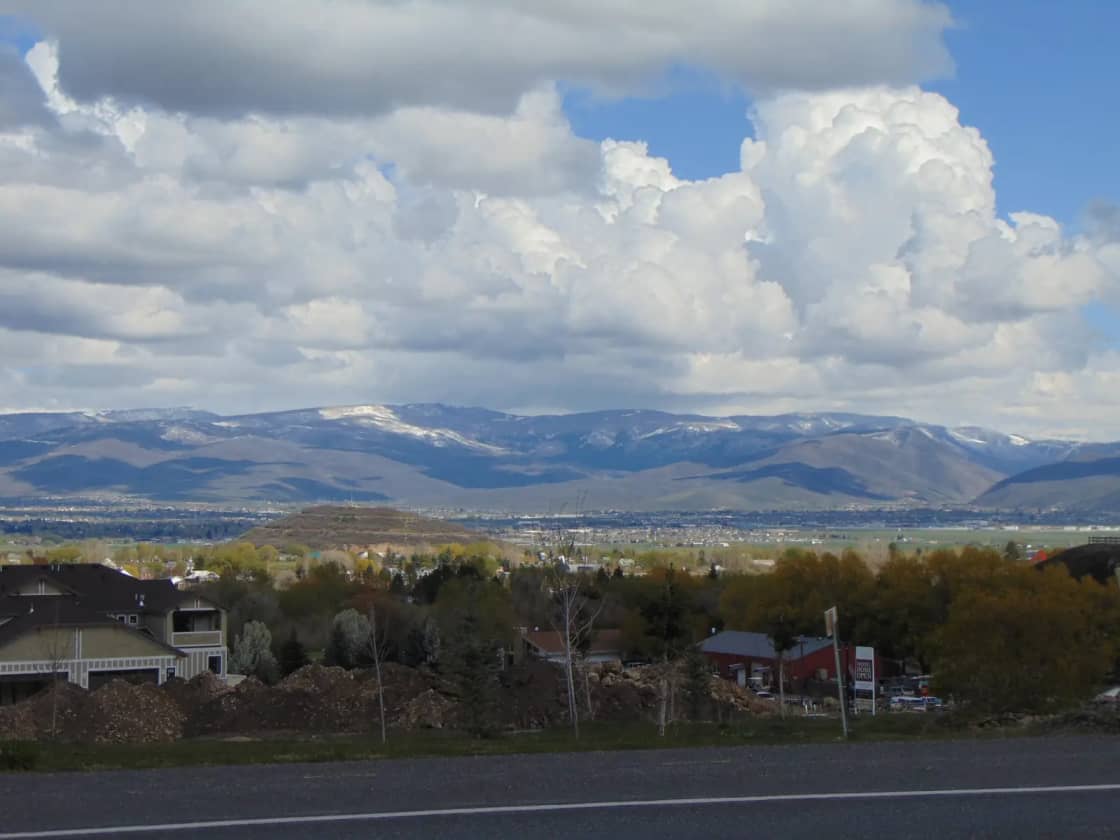

Most Provo day trips make you choose between the drive and the destination. Heber Valley gives you both: the road there is US-189 through Provo Canyon — past Bridal Veil Falls, under Mount Timpanogos, along the shore of Deer Creek Reservoir — and then the canyon opens onto a high mountain valley of ranch land, Swiss-flavored streets, geothermal springs, and an Olympic venue. It is 45 minutes from downtown Provo, close enough for a half-day, rich enough for a full one.
This guide covers the whole valley — Midway, Heber City, Soldier Hollow, and the reservoirs — plus the one thing nearly every other guide still gets wrong about it. For a numbered list of the valley's stops, see things to do in Heber and Midway.
The drive is the first attraction
From Provo, take US-189 up Provo Canyon. The mileage is about 28 and the time about 45 minutes, but budget more, because the canyon invites stopping: Bridal Veil Falls is right off the highway, Vivian Park has picnic tables on the Provo River, and the Sundance turnoff at the Alpine Loop junction tempts a detour all by itself. Past the top of the canyon the road runs along Deer Creek Reservoir, and the view across the water to Timpanogos's east face is the one that ends up on phones.
The road splits the valley at Charleston: left to Midway, straight into Heber City. They sit ten minutes apart and feel like different towns on purpose — Midway leans into its Swiss settler heritage with chalet trim and a manicured town square, while Heber City is the working county seat with the wide Main Street, the ranch supply stores, and the burger joint with a train on the ceiling.
There's a second way in worth knowing: in summer and early fall, the Cascade Springs scenic road connects the Alpine Loop side of the mountains to Midway through Wasatch Mountain State Park. It is slow, winding, and seasonal — closed by snow much of the year — but it lets you make the trip a loop: up American Fork Canyon, over past the springs, down into Midway, and home through Provo Canyon.
Midway: the Swiss quarter
Midway was settled in the 1860s largely by Swiss converts to the Church of Jesus Christ of Latter-day Saints, and it has spent the last 160 years deciding that was the best thing that ever happened to it. The chalet architecture on Main Street is a choice, not a theme park — the town square, the painted shutters, and Memorial Hill rising behind town (drive or walk up for the best free view in the valley) give Midway a character no other Utah Valley-adjacent town has.
The Homestead Crater
Midway's headline attraction is a geological one-off. The Crater at Homestead is a natural hot spring that spent 10,000 years building its own building: mineral-rich water percolated up, deposited limestone, and raised a 55-foot beehive-shaped dome around itself. Inside, the water holds 90–96°F year-round, and you get in through a tunnel cut through the rock wall in the 1990s — before that, the only way in was rappelling through the hole in the top.
You can soak, swim, snorkel, take a stand-up paddleboard yoga class, or scuba dive — the Crater bills itself as the only warm-water dive destination in the continental United States, though divers should know it is a warm blue cylinder, not a reef; there is nothing living down there to see. Sessions run in small timed groups, so reserve ahead, especially on weekends. Bring towels unless you are staying at the resort, and expect tight changing stalls. The surrounding property — long known as the Homestead Resort, now branded Homestead Midway Utah — has said the Crater experience is being upgraded in phases leading up to Summer 2027, so some details may shift; check before you go. Our hot springs guide puts the Crater alongside the valley's free, wild alternatives if you want to compare.
The Ice Castles: what happened
Here is the fact most "winter in Midway" guides still have wrong. The Ice Castles — the hand-built, LED-lit frozen palace that drew crowds to Soldier Hollow every winter — did not operate in the 2025-26 season and has not announced a Utah return. The company said in October 2025 that it was pausing its Midway location to rework its build process "to better adapt for future weather conditions," after unseasonably warm temperatures forced an early February melt the season before. Its castles in Colorado, Minnesota, New Hampshire, and Edmonton carried on; Utah's went dark.
The pause stings locally because Utah is where the whole thing started: founder Brent Christensen built the first ice castle in his front yard in Alpine, as a winter playground for his kids, and the crowds that showed up to see it became a company. Ice Castles insists the pause is "most certainly NOT a goodbye for good," but as of August 2026 there is no announced comeback, no announced location, and no announced date. If a winter itinerary you are reading sells you the Ice Castles, it was written before October 2025. Check icecastles.com for the current word.
Soldier Hollow: the Olympic venue you can play on
On the bench above Midway, inside Wasatch Mountain State Park, sits Soldier Hollow Nordic Center — the 2002 Winter Olympics venue for biathlon and cross-country skiing, and one of the sites named on the official venue list for the 2034 Games, when the biathlon and cross-country events return. It hosted the cross-country events of the 2026 NCAA Skiing Championships in March, so the "legacy venue" label is not decorative; world-class racing still happens here.
For everyone else, Soldier Hollow is a public playground:
Winter brings the longest lift-served tubing lanes in Utah — runs up to 1,200 feet with a lift to tow you back up, plus night tubing under lights. Fair warning from the honest end of the reviews: the lanes are long and straight rather than steep and wild, and conditions depend on real snow — in a warm stretch, speeds drop. The Nordic trail network is the real crown jewel, with groomed cross-country and snowshoe trails at every level and rentals on site.
Summer flips the venue to mountain biking, e-bike rentals, hiking, and the 36-hole Soldier Hollow Golf Course — the Gold and Silver courses stacked on the mountainside with Timpanogos filling the horizon between shots.
This section is the valley-level summary. For the venue in full — how the tubing pricing works now, why there is night tubing but no night skiing, the biathlon range the public can shoot on, and the Legacy Fund arrangement that is the reason any of it still exists — see our dedicated Soldier Hollow guide.
Heber City: the county seat with the train
Heber City does not do chalet trim. It does a wide, functional Main Street, and two institutions that make the trip.
Dairy Keen — Home of the Train (199 S Main St) is the family-run burger-and-shake landmark where a model train circles the ceiling while you eat. Order the Train Burger, pick from a shake menu that runs to something like a hundred flavor combinations, and know before you drive over that it is closed Sundays — the single most common way visitors get burned here.
The Heber Valley Railroad — the "Heber Creeper," named for the crawling pace the original line kept through the narrow canyon — runs vintage trains from the Heber depot along Deer Creek Reservoir toward Provo Canyon. The line dates to 1899, hauled livestock and lumber until the last Rio Grande freight train left Heber in 1968, and survives today because rail enthusiasts and preservationists saved the canyon grade when the widening of US-189 could have erased it. It is a scenic, relaxed ride — Timpanogos, the reservoir, the river — with themed trains through the year (pumpkin trains in October, the North Pole Express at Christmas). One practical note: the railroad has been in a stretch of track replacement work, and routes and trip lengths have shifted with it — the full run to Vivian Park in Provo Canyon has been suspended at times, with shorter reservoir trips running instead. Book the specific trip you want off the current schedule at hebertrain.com rather than assuming the ride a blog described is the ride on sale. Active-duty military and veterans ride the scenic trains free.
Also in Heber: the Commemorative Air Force's Utah Wing keeps a museum of restored warbirds at the Heber airport — worth a stop for aviation families, though hours are limited, so check ahead.
The water: three reservoirs, three personalities
Deer Creek Reservoir is the one you drive along on the way in — a state park with boating, paddleboarding, fishing, and shoreline you can reach. It catches consistent afternoon wind off the canyon, which is why you will see sailboats and windsurfers here more than on any other Utah Valley-area water.
Jordanelle Reservoir, ten minutes past Heber on US-40 toward Park City, is bigger, newer, and boat-forward, with a large marina and a quieter east-side arm for paddlers. Our guide to both reservoirs covers ramps, beaches, and which one suits which kind of day.
Strawberry Reservoir, 25 minutes southeast of Heber up Daniels Canyon on US-40, is a different animal: high, cold, and famous — one of the premier trout fisheries in the western United States. If someone in your car owns a fly rod, you were never going to skip it.
And that fly rod has one more claim on this valley: the Middle Provo River — the stretch of the Provo flowing through the valley floor between Jordanelle and Deer Creek — is one of Utah's designated Blue Ribbon fisheries and among the most heavily fished trout water in the state, wadeable, public-access, and productive year-round. On any weekday you will see more people standing in this river than boating on the reservoirs. Our fishing guide covers the whole river system; the short version is that if your Provo-side experience of the river is the lower canyon, the Middle is the same river at half the gradient and twice the elbow room. Our Middle Provo fly-fishing page has the access details.
Wasatch Mountain State Park: the backyard nobody budgets time for
Soldier Hollow technically sits inside Wasatch Mountain State Park, but the park is much bigger than its Olympic tenant — a mountainside of more than 20,000 acres rising directly behind Midway, and one of the most-visited state parks in Utah. It runs its own 36 holes of golf, the Lake and Mountain courses, separate from Soldier Hollow's two — meaning this one small valley holds 72 holes of public mountain golf, which is most of the reason golfers here smile all summer. The park adds campgrounds within a short walk of Midway's square, an OHV trail network up Pine Canyon, and, in winter, groomed snowmobile terrain that makes it one of the closest sledding-and-snowmobiling zones to Utah Valley. The seasonal Cascade Springs road described earlier leaves from here.
One more thing Heber does that nowhere else near Provo does: the air. The valley's shape and reliable mountain lift have made Russ McDonald Field — the Heber airport — a longtime base for glider and scenic-flight operations, and drifting silently over the valley with Timpanogos filling the windscreen is the most memorable splurge on this list. Operators and offerings change, so search current outfits and book ahead rather than showing up.
Where to eat
Everything below was verified operating as of August 2026 — but Heber Valley restaurants keep small-town hours, so check before driving over for a specific meal.
Dairy Keen (Heber City) — covered above; the essential stop; closed Sundays. Midway Mercantile (99 E Main St, Midway) — upscale American comfort food in a restored historic building; the dinner reservation of the valley. Lola's Street Kitchen (24 E Main St, Midway) — scratch-made tacos, burgers, and rotating specials; started as a food truck and became a local anchor. The Blue Boar Inn (1235 Warm Springs Rd, Midway) — European chateau-styled inn near the Homestead with the valley's white-tablecloth dining room; rooms are named for authors and poets. Café Galleria (Midway) — wood-fired pizza and bagels, the casual family default on the square.
When to go
Labor Day weekend is the valley's biggest moment: Swiss Days takes over Midway the Friday and Saturday before the holiday — September 4–5 in 2026 — with hundreds of craft booths, Swiss food, and a parade. It is wonderful and it is packed; our Swiss Days guide covers parking and timing.
One correction worth making loudly, because most guides still have it wrong. The Soldier Hollow Classic sheepdog championship used to run that same Labor Day weekend, and the pairing was a fixture of how this valley's late summer was described. It moved. The 2023 edition was canceled for construction at the venue, and from 2024 the Classic has run over Memorial Day weekend instead — the 2026 edition was 22 to 25 May — because the late-summer heat was hard on the sheep and the dogs. Border collies moving sheep across an unfenced mountainside is more gripping than it has any right to be, and it is a May trip now, not a September one. Our Soldier Hollow guide has the full picture.
Fall is the sleeper pick: the US-189 drive through the canyon in late September and early October is one of the best leaf drives in the state, and Guardsman Pass to Park City is still open. Winter is tubing-and-Crater season — a soak in 95-degree water while snow sits on the dome is the valley's best cold-weather trick, Ice Castles or no Ice Castles. Summer belongs to the reservoirs and the railroad. The statewide list is things to do in Utah in winter.
One more thing on the horizon: the Heber Valley Utah Temple of the Church of Jesus Christ of Latter-day Saints has been under construction south of Heber City since October 2022. It will be the first temple in Wasatch County; no open house or dedication dates have been announced as of August 2026, but when they are, expect the valley's biggest public event in years.
The honest verdict
Heber Valley is the day trip for people who want the mountain-town experience without the Park City price of admission, forty-five minutes closer to home. Ride the train or soak in the Crater, eat at Dairy Keen, drive up Memorial Hill, and come home through the canyon at golden hour. If you are weighing it against the other directions out of Provo, our day trips guide puts every option side by side — and if you decide one day is not enough, Park City is twenty minutes further up US-40. For eating cheaply in Park City itself, see Park City without the Park City price.
Related Guides
- The Heber Creeper: A Complete Guide to the Heber Valley Railroad
- Logan and Cache Valley from Provo: The Other College Valley
- The Lavender Farm in Mona: What to Know Before You Drive Down
- Bear Lake from Provo: Turquoise Water, Raspberry Shakes, Real Distance
- Capitol Reef from Provo: The Closest National Park Nobody Plans For
- Moab from Provo: Planning the Drive, Arches and Canyonlands
- Zion and St. George from Provo: The Southern Utah Weekend
- Mirror Lake Highway and the Uintas from Provo
- US-189 at Deer Creek: the widening now runs into 2028
- Canyon & commute conditions — US-189 is maintained year-round; the scenic alternatives are not
- Wasatch County Fair Days: the Heber derby, the PRCA rodeo and how to get tickets
- The Heber Valley Cowboy Poetry Gathering: what it was, and why it stopped
- The Soldier Hollow Classic: how to watch a sheepdog trial
Frequently Asked Questions
How far is Heber Valley from Provo?
Are the Midway Ice Castles open?
Is the Homestead Crater worth it?
What is the Heber Creeper?
What is Soldier Hollow known for?
When is Swiss Days in Midway?
Is anything in Heber Valley open on Sunday?
Can you drive from Midway to Park City?
Sources
The facts in this guide were checked against these sources. Hours, fees and rules change, so confirm anything time-sensitive with the source before you go. How we make Provo.com.
- Midway City: Swiss Days, Midway City. Checked October 12, 2026.
- Heber Valley Railroad: Our History, Heber Valley Railroad. Checked October 12, 2026.
- Ice Castles. Checked October 12, 2026.
- Soldier Hollow Classic. Checked October 12, 2026.