Upcoming dates

Over the top of Provo Canyon, forty-five minutes from Provo, there is a county fair that most of Utah Valley has never attended. It runs for ten days at the end of July. It has three nights of demolition derby, three nights of a professionally sanctioned rodeo, a carnival, a country market, a special-needs rodeo, an outdoor movie in a park, and a parade with a bike parade in front of it.
The derby sells out. So does the rodeo. Tickets go on sale in early June and the organizers post a specific warning about resellers.
Wasatch County Fair Days is the sort of event that Utah Valley residents drive past the turning for every summer without registering, and it is close enough to be an ordinary evening out.
The ten days, in shape
Fair Days runs Thursday to the following Saturday at the Wasatch County Event Complex in Heber City. In 2026 that was 23 July to 1 August. The structure has been consistent enough for long enough that you can plan against it before the schedule is published.
The first weekend belongs to the derby. Three nights, Thursday, Friday and Saturday, 7 to 10 p.m. at the outdoor arena. This is the part that sells out first.
The middle of the week is the quiet, local half and it is the part outsiders never see. A party in the park with a talent competition on the Monday. A country market and carnival opening on the Wednesday with a barbecue, live entertainment and an outdoor movie after dark at Southfield Park. This is the fair as the county actually experiences it — a week of evenings rather than a weekend event.
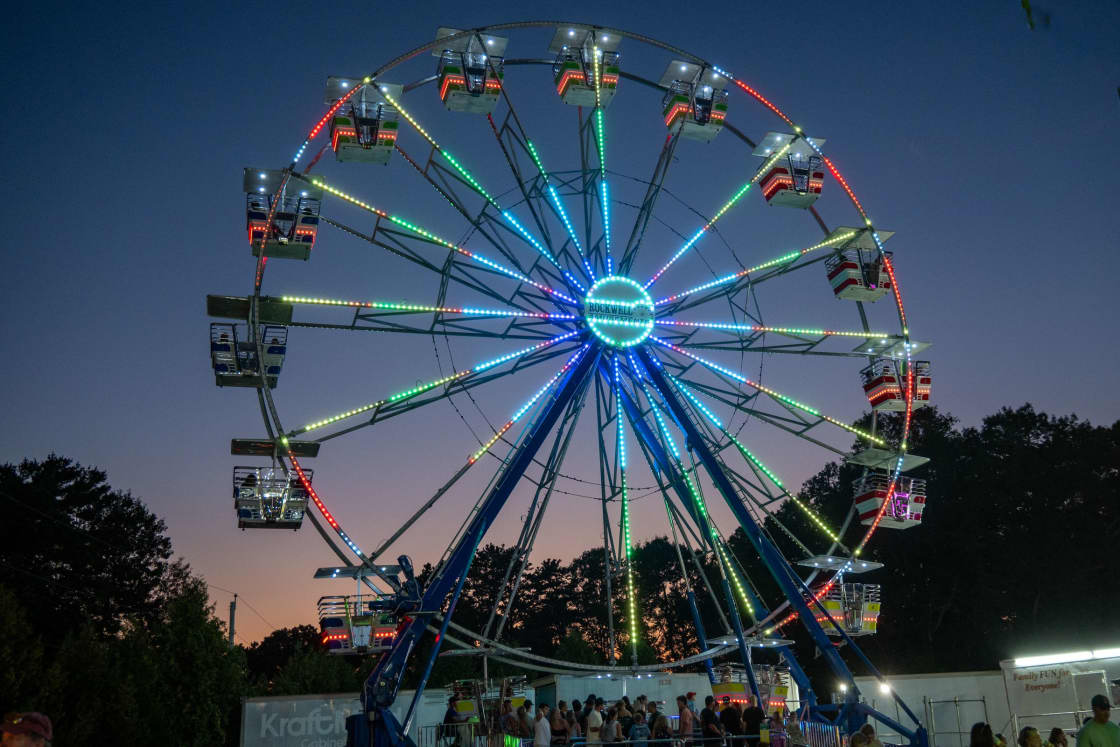
The second weekend is the fair proper. From Thursday the fair exhibits, the country market and the carnival run through the afternoon and evening. The Mountain Valley Stampede rodeo runs at 7:30 p.m. on the Thursday, Friday and Saturday. A live concert has followed the Thursday rodeo. Friday morning opens with the Round Up Special Needs Rodeo. And the final Saturday is the big one: exhibits and carnival from ten in the morning, a bike parade at 3:30, the parade at 4:00, the last rodeo at 7:30, and a balloon event to close it out.
Schedules are published as tentative and move. The shape does not.
The derby, and why you cannot buy a ticket in July
The Wasatch County Demolition Derby is the single most in-demand thing in the valley's summer, and the reason is straightforward: it is three nights, in a finite arena, in a county of not very many people, and a large number of those people have been going since childhood.
Tickets go on sale in early June. In 2026 the sale ran in person first — two windows, an evening and a morning — with whatever remained released online a few days later through Wasatch County Parks and Recreation. Both the derby and the rodeo go on sale in the same window.
Buy from the county and nobody else. The organizers publish an explicit warning about ticket scams and third-party resellers, and state plainly that only tickets purchased through Wasatch County Parks and Rec will be accepted. That is an unusually direct thing for a county fair to have to say, and it exists because people have been caught.
If you are reading this in July, you are probably too late for the derby. That is not a scare tactic; it is the normal state of affairs. Put a reminder in your phone for the first week of June and treat it like any other on-sale.
What the derby actually is, for anybody who has never been: cars that have been stripped, reinforced and painted, driven into each other in a dirt arena until only one is still moving, in heats, with a crowd that is entirely on its feet by the end. It is loud, it is genuinely funny, and it is over faster than you expect. A significant part of the evening is the wait between heats while wrecks are cleared, which is the thing first-timers are least prepared for and locals treat as the social part.
The Mountain Valley Stampede, and why PRCA matters
The rodeo is PRCA-sanctioned, and for a Utah Valley reader that is the detail worth understanding, because it is the difference between this and the rodeo at a city celebration.
A sanctioned rodeo is a stop on a professional circuit. The competitors are working cowboys and cowgirls chasing points and money across a season, the entry standards are set by the association, and the stock — the bucking horses and bulls — is contracted from professional stock contractors whose animals are themselves a known quantity on the circuit. A good bucking horse has a name and a reputation.
The practical consequence is that the riding is better and the events run tighter. If your reference point is a small-city rodeo where half the field is local, this will look and feel different, and the eight seconds will feel considerably longer.
Three nights at 7:30 p.m., at the rodeo grounds, at the end of the fair.
The Round Up Special Needs Rodeo on the Friday morning is the other thing worth naming here. It is a separate event that puts riders with disabilities into the arena with volunteers, and by every account it is the most affecting hour of the whole ten days. It is free to watch.
What is free, which is more than people assume
The two ticketed things are the derby and the rodeo. Almost everything else is not.
The fair exhibits — the livestock, the produce, the baking, the quilts, the 4-H and FFA work — are the actual county fair, and they are the part most likely to be skipped by a visitor who came for the rodeo. They are also the only part that tells you anything true about the valley. Somebody's daughter has raised a steer for a year.
The country market and the parade are free. The carnival charges by ride or wristband.
The park events in the middle week have historically been free or nearly so.
So a Utah Valley family can drive over on the final Saturday, walk the exhibits, watch the bike parade and the parade, buy lunch and some carnival tickets, and drive home over the canyon at dusk, having paid for food and petrol. That is a good Saturday and it costs less than a film.
Getting there, and the canyon
Heber is about forty-five minutes from Provo up US-189 through Provo Canyon, and the drive is a material part of the outing rather than a cost of it. You come up past Bridal Veil Falls, along Deer Creek, and over into a green valley with mountains on three sides.
Two practical notes. The canyon is busy on July weekend evenings, so if you are aiming at a 7:30 rodeo, leave earlier than the map suggests. And parking at the event complex fills on rodeo and derby nights, which is an argument for arriving early and eating there rather than arriving at 7:25.
Our guide to Heber Valley and Midway from Provo covers the drive and the wider valley.
Making a day of it
The fair is an evening. The valley is a day, and this is the strongest argument for going.
The Heber Valley Railroad runs heritage excursions out of Heber and is the single best thing in the valley with small children.
Deer Creek and Jordanelle are both minutes from town, and a July afternoon on either before an evening rodeo is close to a perfect Utah summer day.
Wasatch Mountain State Park sits above Midway with golf, trails and campgrounds.
Soldier Hollow, the 2002 Olympic venue and a 2034 venue in waiting, is five minutes from Midway.
Midway itself is the Swiss-themed village five minutes west of Heber, and it is a lunch rather than a detour.
Not to be confused with Swiss Days
This trips people up every year, so it is worth stating clearly.
Swiss Days is Midway's festival, on Labor Day weekend, and it is enormous — crowds well into six figures, hundreds of craft booths, and a traffic situation that is itself a local legend.
Wasatch County Fair Days is Heber's, at the end of July, and it is a county agricultural fair with a derby and a rodeo attached.
Six weeks apart, two towns five minutes apart, completely different events. Both are worth doing. Do not plan for one and arrive at the other, and do not assume a Labor Day trip will catch the fair.
How to watch a rodeo if you have never been
Most Utah Valley residents have been to a rodeo. A good many have never really watched one, in the sense of knowing what is being judged. The events are short and the scoring is invisible unless somebody explains it, so here is the explanation.
The rough stock events — bareback riding, saddle bronc riding and bull riding — are the ones people come for, and they are scored rather than timed. The ride must last eight seconds, and if it does, two judges score it out of 50 each: half the marks for the rider and half for the animal. That last part surprises people. A rider on a horse that does not buck hard cannot score well no matter how good they are, which is why a draw is partly luck and why stock contractors matter so much.
The timed events — tie-down roping, steer wrestling, team roping and barrel racing — are exactly what they sound like, and they are won and lost in fractions of a second. The subtlety is in the penalties: a barrel knocked over costs five seconds, which is an eternity in a race decided by hundredths, and a roper who breaks the barrier before the calf has its head start takes a ten-second penalty.
The reason everything looks so fast is that most of the work happened before the gate opened. The rider has assessed the animal, the roper has judged the calf's speed, the horse knows the job. What the crowd sees is the last few seconds of a long preparation.
Bullfighters are not clowns. The people in the arena during bull riding are there to put themselves between a loose bull and a rider on the ground, and they are athletes doing a dangerous job. The entertainer with the microphone is a separate role.
And the animals are the expensive part. A proven bucking bull or bronc is a valuable animal with a career, a record and in many cases a following. They work a handful of times a year for a few seconds each. That is the part of the economics that makes least sense until somebody explains it and most sense afterwards.
Knowing that much turns a rodeo from a spectacle into a sport, and it takes about four minutes to learn.
What a county fair is actually for
It is worth saying, because a visitor can walk the whole thing and miss it.
A county fair is a judging event. The exhibit halls are not a display; they are the results of a competition that has been running all year, in barns and kitchens and vegetable patches across the county. A child in 4-H or FFA has spent months on an animal, has records to submit, has shown it in a ring and been placed against their neighbors. The quilts and the bottled fruit and the largest zucchini are the same thing at a different scale.
That is why the fair is at the center of a rural county's year and why the calendar bends around it. It is the week the county assesses itself in public, in categories it decided on, judged by people it knows.
Utah County's own fair works the same way and our guide to it covers the version closer to home. What Wasatch County has that Utah County does not is scale relative to population: this is a small county, and Fair Days is the thing that happens there.
For a Utah Valley family, the value is precisely that it is not your fair. You are watching a small agricultural county do the thing it does best, forty-five minutes from your house, and you can buy a corn dog while you do it.
Practical notes for an evening at the complex
Seating is bleachers. Bring something to sit on if you value your back, and expect to be closer to your neighbors than you would choose.
It gets cold. Heber sits well above the valley floor and a July evening that starts at eighty degrees can be in the fifties by the time you walk out at ten. The single most reliable mistake visitors from Utah Valley make is dressing for Provo weather.
Cash is still useful. A county fair is a lot of small independent operators, and while most take cards now, the queue moves faster when you do not need one.
Arrive an hour before a ticketed event. Parking, walking in, finding seats and getting food all take longer than the map implies, and the arena fills from the good seats outward.
There is dust. It is a dirt arena and there is a breeze. Anybody with a respiratory condition should sit higher and upwind, and contact lenses are worse than glasses for this.
Hearing protection for small children, at the derby especially. Cheap, tiny, and the difference between a child who loves it and a child who wants to leave in ten minutes.
And check the schedule the same week. Fair schedules are published as tentative and genuinely change — times shift, a concert gets added, weather moves something. The county's own recreation site is the place to look, not an aggregator.
The short version
Ten days at the end of July in Heber. Derby on the first weekend, fair and rodeo on the second, parade on the final Saturday. Tickets for the derby and rodeo go on sale in early June through Wasatch County Parks and Rec and nowhere else — set a reminder, because they sell out. Everything else is largely free. Drive up the canyon in the afternoon, do the lake or the railroad first, and make a day of it.
Related Guides
- Heber Valley and Midway from Provo — the drive and the whole valley
- Swiss Days in Midway — the Labor Day one, which this is not
- The Heber Valley Railroad
- Soldier Hollow — the Olympic venue five minutes away
- Deer Creek and Jordanelle reservoirs
- The Utah County Fair — the version closer to home
- Festivals and celebrations in Utah Valley
- The Soldier Hollow Classic: how to actually watch a sheepdog trial
Dates, schedules and on-sale windows are set by Wasatch County and change every year, and the published schedule is explicitly tentative. Everything here was checked against county and Heber Valley sources on 17 September 2026. Buy tickets only through Wasatch County Parks and Recreation.
Frequently Asked Questions
When is Wasatch County Fair Days?
How do I get tickets to the derby and the rodeo?
What is the Mountain Valley Stampede?
Is there anything free?
How long does it take to get there from Provo?
Is the demolition derby suitable for children?
What else is there to do in Heber the same day?
Is this the same as Swiss Days?