
Food work is where most people in Utah Valley start volunteering, and there are good reasons for that. The shifts are short. The tasks are learnable in five minutes. The need does not fluctuate with anybody's enthusiasm. And unlike most service, you can see the output of a two-hour shift stacked on a pallet at the end of it.
What almost nobody explains is the legal machinery underneath the whole sector — the reason a pantry can hand out a dented can, the reason a grocery chain will give away a pallet rather than dumpster it, and the reason the food bank can send you home with a box of groceries without accidentally hiring you. That machinery is worth understanding, because it also explains the rules you will be asked to follow.
The statute the entire sector rests on
In 1996 Congress passed what is now the Bill Emerson Good Samaritan Food Donation Act, codified at 42 U.S.C. 1791. Before it, food donation in America was governed by a patchwork of state laws and a great deal of corporate caution. Legal departments at grocery chains and restaurants routinely concluded that the safest thing to do with surplus food was destroy it.
The Act's central move is to define a category of food that is safe to give away even though it is no longer saleable. "Apparently wholesome food" means food that meets all quality and labeling standards imposed by federal, state and local laws and regulations even though the food may not be readily marketable due to appearance, age, freshness, grade, size, surplus, or other conditions.
Read that list slowly, because it is the entire reason a food pantry looks the way it does. Appearance. Age. Freshness. Grade. Size. Surplus. A crate of undersized peppers, a pallet of correctly labeled soup two months from a best-by date, bread baked yesterday — all of it meets the standard, and none of it will sell.
The protection then runs in three directions:
- The donor. A person or gleaner who donates apparently wholesome food in good faith to a nonprofit for ultimate distribution to needy individuals is not subject to civil or criminal liability arising from the food's nature, age, packaging or condition.
- The nonprofit. An organization that received such a donation in good faith gets the same protection when it distributes.
- The landowner. Under subsection (d), someone who allows gleaning on their property by gleaners or by a nonprofit's representatives is not liable for injury or death of the gleaner or representative.
And then the limit, at subsection (c)(4): none of that applies to injury to or death of an ultimate recipient resulting from an act or omission constituting gross negligence or intentional misconduct. The statute defines intentional misconduct as conduct by a person who knows at the time that the conduct is harmful to the health or well-being of another.
That exception is the sentence behind every rule you will be handed at orientation. Wash your hands. Do not taste anything. Pull anything with a compromised seal. Log the cooler temperature. Those are not corporate box-ticking — they are the difference between ordinary error, which the statute forgives, and gross negligence, which it does not.
What changed in 2023, and why it matters to a college town
For most of the Act's life the protection ran through a nonprofit. A restaurant with forty untouched catering trays at 9pm could give them to a food bank with confidence, and could not give them to the people standing outside with anything like the same confidence.
The Food Donation Improvement Act, Pub. L. 117-362, signed January 5, 2023, changed that. It added a qualified direct donor to the statute — defined as a retail grocer, wholesaler, agricultural producer, agricultural processor, agricultural distributor, restaurant, caterer, school food authority, or institution of higher education — and gave that donor the same immunity for donating apparently wholesome food in good faith directly to a needy individual at zero cost.
The same amendment added the concept of a good Samaritan reduced price: a price no greater than the cost of handling, administering, harvesting, processing, packaging, transporting and distributing the food. Donations at that kind of cost-recovery price now sit inside the protection rather than outside it, which matters for the pallet-level transfers that keep a regional food bank supplied.
Two categories in that list should get attention in this valley specifically. School food authority and institution of higher education are named donors. In a county with two large universities, several district food services and a dense layer of church and community kitchens, the 2023 amendment removed a legal reason for surplus campus food to go in a bin. Whether any given institution has changed its practice is a separate question, and a fair one to ask.
The rule that lets you take a box home
This one surprises people, including some coordinators.
Volunteers are not employees, but the line is thinner than it looks — the Fair Labor Standards Act cares a great deal about people who "volunteer" in exchange for something of value. Give a volunteer groceries and you are, on a strict reading, giving them in-kind compensation.
Congress wrote a specific exclusion for this. Under 29 U.S.C. 203(e)(5), the FLSA definition of "employee" does not include individuals who volunteer their services solely for humanitarian purposes to private nonprofit food banks and who receive groceries from the food banks.
It is worth being precise about how narrow that is. It names food banks, not nonprofits generally. It names groceries, not gift cards or stipends. And it requires the service to be solely for humanitarian purposes. Within those limits it is a clean answer, and it is why a pantry can offer you a box at the end of a shift without a payroll conversation. Outside those limits, the general volunteer rules apply, and those are covered in our guide to volunteer liability law in Utah.
Who runs food in this valley
Four organizations carry most of the load, and they are not interchangeable.
Community Action Services and Food Bank has operated out of Provo since 1967 and runs one of the largest food banks in the state — the only one serving Utah, Wasatch and Summit counties together. The headquarters and Provo pantry are at 815 S Freedom Blvd, Suite 100, and the main line is (801) 373-8200. Volunteers stock shelves, sort incoming donations, and walk guests through the pantry as they shop, which at a client-choice pantry is a genuine role rather than a courtesy. Spanish speakers are specifically and repeatedly requested. Individual and group shifts are booked through different processes.
Food and Care Coalition at 299 E 900 S in Provo is the closest thing the county has to a single door for people experiencing homelessness — meals, showers, laundry, hygiene, day services, and on-site medical, dental and mental health care through partner agencies. It runs on a small paid staff; by the organization's own accounting volunteers contributed roughly fifty thousand hours in a recent year, covering more than half its labor needs. Recurring breakfast and lunch service asks for about a three-month commitment, closed-toe shoes, and staying for the full shift. Sorting donations and running a collection drive are the lower-commitment routes in. The volunteer coordinator is reachable at volunteer@foodandcare.org or (801) 373-1825.
Tabitha's Way runs three pantries and is the main food resource at both ends of the valley. The Spanish Fork pantry serves the south end; the Pleasant Grove pantry at 675 W Garden Drive serves the north end from Lehi and American Fork through Alpine, Highland, Cedar Hills, Lindon and Vineyard; a third, smaller pantry operates in Saratoga Springs. The Spanish Fork pantry moved in January 2026 to 50 E 100 N, and several third-party directories still list the old address across the street. Groups should go to Pleasant Grove — the satellite sites cannot hold more than a few volunteers at once. Minimum age is 12, with under-16s accompanied, and the organization is honest that much of the work is repetitive lifting. The general line is (801) 709-8573.
Church-run and neighborhood pantries fill the gaps, including bishops' storehouse operations that work through local ecclesiastical referral rather than public sign-up. If you are trying to help at that layer, the route in is the local congregation, not a website.
What a shift is like
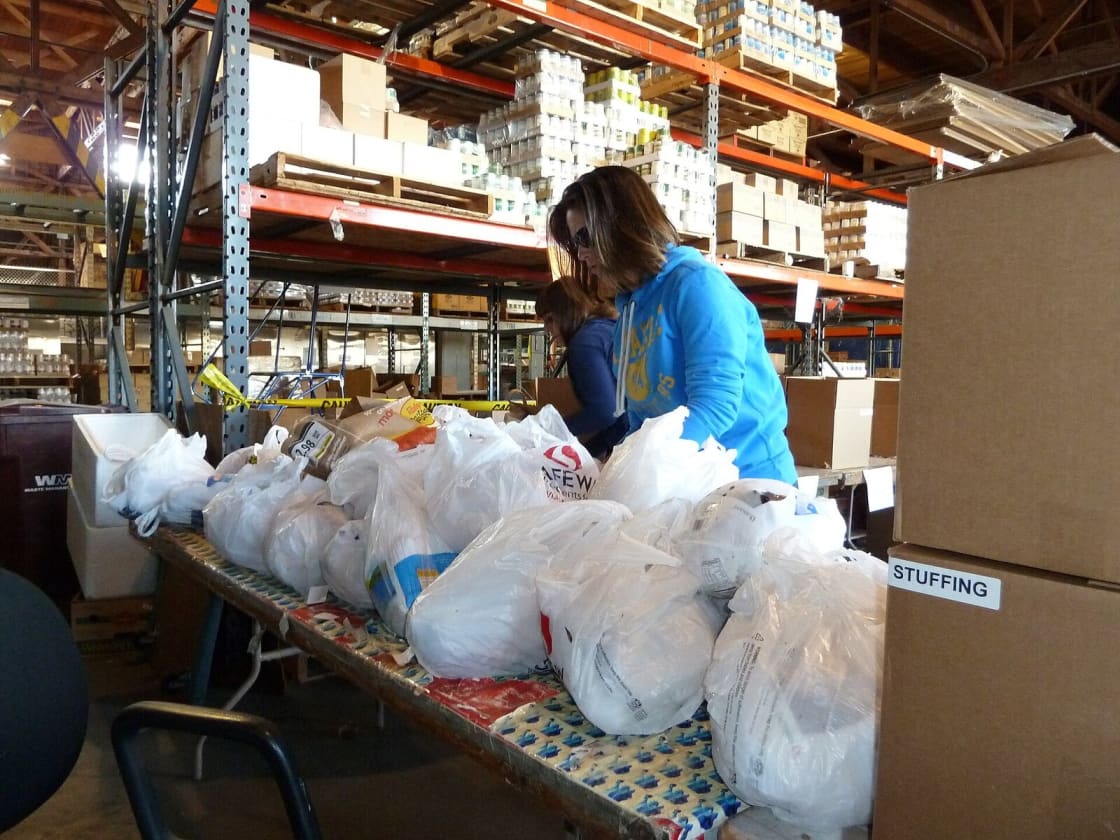
Sorting is the default first assignment and it is more interesting than it sounds. Incoming donations arrive mixed: retail rescue pallets, food drive boxes, agricultural surplus. Your job is to separate what can go on a shelf from what cannot, by category and by date, and the judgment calls come faster than you expect. Dented cans are usually fine unless the dent is on a seam. Anything with a broken seal goes. Home-canned goods go, without exception and regardless of how good they look.
Distribution shifts put you in front of clients. Most Utah County pantries have moved to a client-choice model, where people shop rather than receive a prepacked box, and the volunteer role is closer to a grocery-store floor than to a serving line. The etiquette matters here: no commentary on what someone takes, no questions beyond what the intake sheet asks, and no photographs.
Warehouse work is the least visible and often the most needed — pallet breakdown, inventory, loading. It is also where the age minimums and the closed-toe-shoe rules come from.
Drives are the one thing you can run without a shift at all. The useful version is a targeted drive: call the pantry, ask what they are short of this month, and collect only that. The unhelpful version is a general canned-food drive in December, which arrives alongside everyone else's and often costs the organization more staff time to sort than the food is worth.
Where the food comes from, and why that shapes your shift
A food bank is a logistics operation before it is anything else, and the mix of inbound supply explains why the work varies so much week to week.
Retail rescue is the largest and least predictable stream. Grocery stores pull product that is close to date, cosmetically imperfect, overstocked, or seasonal, and a food bank collects it on a route. This is the stream the Emerson Act was written to unlock, and it arrives mixed, unsorted and on a clock — which is why sorting is the job most often needed at short notice.
Agricultural donation and gleaning is seasonal and arrives in volume. A grower with a crop that will not make grade can donate it, and the gleaning provisions discussed above protect both the grower and the people picking. When a harvest lands, a food bank needs many hands for a short window, and those calls go out with little warning.
Federal commodity programs supply a baseline of shelf-stable product through state distribution. It is the most predictable stream and the most paperwork-bound; volunteers handling it will notice stricter inventory rules, because the accounting is reported upward.
Food drives and individual donation are the most visible stream and the smallest by weight. They are also the most labor-intensive per pound, because a box of assorted household donations has to be opened, checked, dated and sorted individually.
Purchased food fills the gaps the other streams leave, which is why organizations keep saying that a dollar goes further than a can. It is not a brush-off. A food bank buys at wholesale on a pallet, and its purchasing power per dollar is several times what a retail shopper achieves.
Understanding that mix tells you what your two hours are worth on a given day. On a retail-rescue morning, sorting speed is the constraint. During a harvest, hands in a field are. In December, when the drive boxes stack up, the constraint is floor space and people willing to open boxes rather than pose for photographs.
Distribution etiquette, which nobody writes down
Client-choice pantries put volunteers in direct contact with neighbors who are having a hard month. Most orientation programs cover the food-safety rules thoroughly and the human rules barely at all, so here they are.
Do not comment on what anyone takes. Not approvingly, not curiously. A remark about how much someone is taking, or what they chose, lands very differently than the speaker intends.
Do not ask questions beyond the intake sheet. Curiosity about someone's circumstances is not kindness. If they want to talk, follow rather than lead.
No photographs of clients, ever, including background shots for a group's social media. If a photo is wanted for a drive, take it of the pallets.
Assume you will recognize someone. In a valley this interconnected, volunteers regularly serve a neighbor, a former colleague, or a family from their congregation. The correct response is the same greeting you would give at a grocery store and no acknowledgment of the setting. If discretion feels impossible, ask to work in the warehouse instead — that is a reasonable request and coordinators hear it often.
Let people take the food they will eat. Volunteers new to client choice sometimes steer people toward what seems healthiest or most economical. A household knows its own appliances, storage, schedule and dietary constraints better than the person on the other side of the table.
The general principle underneath all five: a pantry works best when it feels like a shop and worst when it feels like an inspection.
The seasonality problem, stated plainly
Every food organization in this valley has more help than it can use in late November and December, and a thin sheet in February and July.
Summer is the harder of the two, and the reason is structural. School meal programs stop, which removes ten meals a week per child from the household budget in a county with a very high proportion of households with children. Utility bills climb at the same time. Demand goes up exactly when the volunteer base goes on vacation.
If you have flexibility about when you serve, this is the single highest-leverage decision you can make. Call in January and ask which weeks in the next six months they expect to be short. They will know, and they will be glad someone asked.
A last note on the difference between helping and being seen to help. Food organizations here are unfailingly polite about December, and privately they would trade three holiday group shifts for one reliable person in March. If your household or congregation wants to make a real dent, pick an unfashionable month, commit to it, and keep it.
Related Guides
- How to Actually Volunteer in Utah Valley — the front door
- Volunteer Liability in Utah — the two statutes behind the waiver
- Homeless Resources in Utah County — how the day facility and voucher system fit together
- Service Hours for Students and Student Groups
- Thanksgiving in Utah Valley — the season the drives all land in
Frequently Asked Questions
Where do I sign up to volunteer at a food bank in Utah County?
Why can a food pantry give away food that a store would have thrown out?
Does the food bank get sued if donated food makes someone ill?
Can a restaurant or a campus dining hall donate leftover food directly to people?
Can I take home food from the food bank I volunteer at?
What is the minimum age to volunteer at a Utah County food pantry?
Is gleaning — picking leftover produce from a field or an orchard — covered too?
When do food banks need volunteers most?
Sources
The facts in this guide were checked against these sources. Hours, fees and rules change, so confirm anything time-sensitive with the source before you go. How we make Provo.com.
- 42 U.S. Code § 1791 - Bill Emerson Good Samaritan Food Donation Act, Legal Information Institute, Cornell Law School. Checked October 12, 2026.
- Tabitha's Way Local Food Pantry: Tabitha's Way, Tabitha's Way Local Food Pantry. Checked October 12, 2026.