
Thanksgiving in Utah Valley looks straightforward until you try to plan it here. Then a set of local peculiarities shows up: a valley that closes harder than most on holidays, a place literally named Thanksgiving that is shut on the day, an enormous student population that splits between going home and having nowhere to go, and a grocery Wednesday that has to be seen to be believed.
This guide is written early on purpose. Almost everything below has a deadline in it.
The closure problem, and why it is worse here
Utah Valley closes more thoroughly on holidays than most American metros of similar size.
Part of that is the same Sunday-closure culture that visitors notice year-round: a large share of independent restaurants here are closed Sundays, and businesses whose staff and owners observe the day extend the same logic to major holidays. Part of it is that this is a valley with a strong family-gathering culture, and restaurant workers here are as likely as anyone to have somewhere to be.
The practical result is that on Thanksgiving Day the open list is short. It is generally some combination of hotel restaurants — which serve holiday buffets or fixed menus, usually by reservation and usually booked out — a subset of national chains, and a small number of independents that make a deliberate decision to open.
Do not trust listings. Holiday hours are the least reliable data on the internet, and a business's own website is frequently not updated for a single day of the year. Call. If you cannot get an answer, assume closed.
This applies with equal force to the day after. Some businesses close Thursday and Friday both, and some close for the whole weekend.
Thanksgiving Point is closed on Thanksgiving
Every November this catches people, so it is worth putting plainly.
Thanksgiving Point in Lehi is closed on Thanksgiving Day. It is also closed on Christmas Day and every Sunday of the year — not reduced hours, closed.
The name is a historical coincidence rather than a holiday connection, and it produces a completely reasonable assumption that a place called Thanksgiving Point would be a Thanksgiving destination. It is a wonderful destination on most other days, and our Thanksgiving Point guide covers the campus, its separate venues and their varying hours.
If you are hosting out-of-town family over the long weekend and want an outing, aim for Friday or Saturday, and check the specific venue rather than the campus as a whole.
The student problem, which is the real local story
Here is what makes Thanksgiving in this valley different from Thanksgiving in a comparable city elsewhere.
Provo and Orem hold two large universities, and a substantial share of their students are from outside Utah — from other states, and in large numbers from other countries. Thanksgiving break is short. For a student from California it is a drive. For a student from Brazil, Korea, Ghana or the Philippines it is neither affordable nor long enough to be worth it.
So the town half-empties and then does not. Thousands of students remain in a valley where their friends have gone home, the campus food service has scaled back, and the entire surrounding culture is doing an intensely family-centered holiday.
What has grown up in response is one of the better things about this place. Faculty families host. Wards and congregations organize gatherings. Neighbors invite the students renting the basement. International student offices coordinate. Friend groups who are all stranded together cook an ambitious and structurally unsound meal in a student apartment kitchen, which is its own tradition and produces better stories than the well-organized version.
If you live here and have room at your table, this is the need. It does not require organizing anything. It requires asking a student you already know, or telling your congregation you have four seats. Our guide to student life in Provo covers the wider picture of what the student calendar does to this valley, and the late-November version of it is the most acute.
Order deadlines, which are earlier than you think
If you intend to buy any part of the meal prepared, the calendar is tighter than instinct suggests.
Pies from local bakeries are ordered, not bought. The good ones close their books well ahead, and walking in on the Tuesday before is a plan that works only by luck.
Fresh birds, heritage breeds, and anything from a local farm or butcher are ordered weeks out. Frozen supermarket turkeys are the thing you can buy late; fresh ones generally are not.
Smoked or fried turkeys from local operators are a genuine Utah Valley category, and they sell a finite number of slots.
Full prepared meals from grocery chains and caterers have hard cutoffs, typically at least a week ahead and sometimes more.
Restaurant reservations for holiday service, where it exists, open early and fill.
The workable rule: make your calls in the first week of November. If you are reading this in August, put a reminder somewhere. Being early costs nothing and being late costs the specific thing you wanted.
The Wednesday grocery run
The day before Thanksgiving is one of the busiest grocery days of the year everywhere, and in a valley with this many large households it is intense.
Go early or go Tuesday. Expect the perishable items to be picked over by afternoon — cream, fresh herbs, specific produce, and whatever the year's viral recipe requires. Expect long checkout lines and full parking lots at the big stores on the main corridors.
Our guide to grocery stores in Provo covers which stores serve which purpose here, and holiday week is exactly when the smaller and more specialized ones earn their place — a butcher, an international market or a smaller neighborhood store often has what the big chains have run out of.
One local note: stores close early on Thanksgiving Day itself where they open at all, and the reliable late option is a gas station or convenience store. Every year someone here drives around at eight in the evening looking for evaporated milk. Do not be that person; buy the backup can.
Turkey trots and Thanksgiving morning
Utah Valley reliably produces several Thanksgiving-morning runs across different cities — short-distance charity events, usually organized by a city recreation department or a local cause, often with same-day registration.
They are family events rather than competitive ones, and they exist mostly so that a large meal feels earned. Specific dates, distances and organizers vary year to year and tend to be announced in October rather than months ahead, so check city recreation departments and local charity pages in early November.
If you would rather run alone, the valley's paved trails are unusually pleasant that morning and unusually empty. Our guide to running routes in Provo covers the paved spine along the river and the canal corridor, both of which are plowed and usable in late November most years.
Giving, and how to be useful
Food insecurity does not spike at Thanksgiving; attention to it does. That mismatch is worth understanding if you want to help effectively.
Community Action Services and Food Bank serves Utah County broadly, and Tabitha's Way Local Food Pantry runs pantries in Spanish Fork, Pleasant Grove and Saratoga Springs. Church and community groups run distributions alongside them. Demand does rise through the late autumn and winter, driven partly by heating costs.
Three things worth knowing before you volunteer:
Thanksgiving Day slots fill first and fill early. Serving a meal on the holiday itself is the most requested volunteer shift of the year at most organizations, and it is often oversubscribed weeks in advance. Ordinary weekday shifts in January are much harder to staff, and are worth more.
Money usually goes further than food. Food banks buy at scale and at prices individuals cannot access, and they can buy exactly what is short rather than what happened to be in your cupboard. This is not a reason to skip a food drive, but it is a reason not to assume canned goods are the most helpful contribution.
Ask what is needed. Organizations publish current needs lists, and those lists change.
Our guide to volunteering and service in Utah Valley covers the organizations, the seasonal pattern, and how to find something that is not a one-day commitment.
Hosting here, practically
A few things specific to this valley if you are the one cooking.
Altitude changes baking. At roughly 4,500 feet, leavening acts faster, liquids evaporate more quickly and things dry out sooner. The standard adjustments — slightly less leavening, slightly more liquid, a modest oven temperature increase and a shorter bake — matter most for pies, rolls and anything custard-based. Pumpkin pie in particular is prone to cracking here, and a lower, slower bake helps.
Water boils cooler, which lengthens the time for anything boiled or simmered. Potatoes take longer than the recipe says.
Households are frequently large. Table capacity, oven capacity and refrigerator capacity are the three constraints, and the second is the one people forget. An oven doing a turkey for hours is an oven not doing anything else, and the local workaround — a smoker, an outdoor fryer, or borrowing a neighbor's oven — is standard practice here rather than an emergency measure.
It gets dark early and it gets cold. Late November in the valley means sunset in the late afternoon and overnight temperatures well below freezing. If your plan involves anything outdoors, it involves it before about four in the afternoon.
What is on a Utah Valley Thanksgiving table
Regional food traditions are real, and this valley's version of the meal has recognizable local features that visiting relatives comment on.
Funeral potatoes appear at Thanksgiving as readily as at the occasion that named them — a cheesy potato casserole with a crushed cornflake or crumbled cracker topping, which is a genuine Intermountain West institution and which our guide to Utah food culture covers alongside the rest of the local vocabulary.
Green Jell-O, usually in a mold and frequently containing something structurally surprising, is either a beloved tradition or an inherited obligation depending on who you ask.
Rolls are taken seriously. Homemade rolls are a competitive category at a Utah Valley holiday table in a way they are not everywhere, and altitude makes them harder, which is presumably why the good ones carry status.
Ham alongside turkey, in households large enough that one bird does not go far.
Something with a can of cream soup in it, which is a broader American convention but which persists here with unusual conviction.
Sparkling cider and soda in quantity, because most tables here are not serving alcohol, and the beverage course is correspondingly more elaborate. The valley's soda shop culture is a year-round version of the same instinct.
None of this is universal and plenty of local families do a straightforwardly conventional meal. But if you have moved here recently and find yourself at someone else's table, these are the dishes you may not recognize.
Travel, and the days that hurt
If you are leaving the valley or collecting people who are arriving, two logistical facts are worth planning around.
The Wednesday before and the Sunday after are the heaviest travel days of the year, and I-15 through the valley carries the load along with everyone driving to Salt Lake City International. Building in a substantial buffer for an airport run on either of those days is not pessimism.
Canyon weather is a real variable by late November. Anyone driving over a pass — up Provo Canyon, over Daniels toward Heber and beyond, or through Spanish Fork Canyon on US-6 — should check conditions rather than assume, and should have appropriate tires. Our guide to winter tires and canyon driving covers what matters on these specific roads and when the requirements apply.
For anyone flying, the valley's ground-transport options to the airport are covered in our intercity bus guide, and the holiday is precisely when the parking situation makes the alternatives worth considering.
The weekend after, which is the real hinge
Thanksgiving weekend in Utah Valley is when the Christmas season formally begins, and a remarkable amount starts within about seventy-two hours.
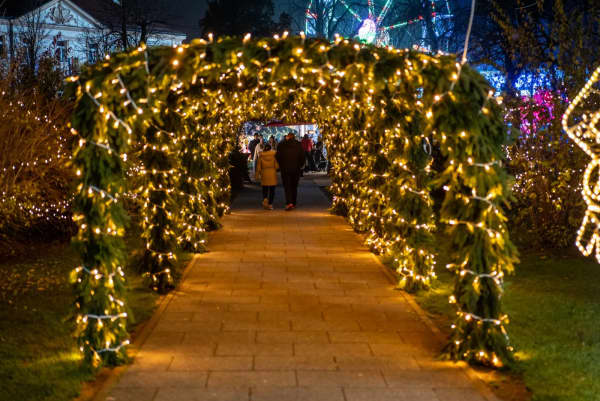
Light displays open their runs. Downtown tree lightings and holiday markets get going. The ski resorts up the canyon are usually opening or open depending on the year's snow, and our skiing near Provo guide covers what tends to be running that early. Our Christmas in Provo guide covers the full calendar of what opens when, and the Christmas lights map covers the displays specifically, including which ones are ticketed, which are drive-through and which close on Sundays.
For shopping, the Friday and Saturday are the busiest retail days of the local year, and the alternative — supporting the valley's independents and makers rather than the malls — is a genuine option here. Our guide to shopping in Provo covers downtown and the smaller districts.
And the least crowded thing available that weekend is a canyon. Everyone is at the outlets.
The shape of the week, day by day
Thanksgiving in this valley is not one day, it is about six, and they each behave differently.
Saturday and Sunday before. Quiet, and the last comfortable moment to do anything requiring a shop that is not overrun. Universities are still in session.
Monday and Tuesday. Classes wind down and students start leaving, which is when the traffic on the university corridors changes character and when parking suddenly becomes available. Tuesday evening is the smart grocery run.
Wednesday. The busiest grocery day of the year and one of the busiest travel days. Many workplaces run a half day. Bakery and butcher pickups happen. By evening the valley is noticeably emptier of students and noticeably fuller of visiting family.
Thursday. Almost everything is closed. The morning has races; the afternoon has kitchens; the evening has a lot of people watching football in a town that mostly cares about a different team.
Friday. The retail day, the light displays start, and the canyons are empty. This is the best day of the week to do something outdoors.
Saturday. Rivalry-adjacent sports, holiday markets, tree lightings, and the beginning of the Christmas calendar in earnest.
Sunday. Travel day out, and the valley resets. Students return through the evening.
Knowing this rhythm is most of what makes the week manageable, particularly if you are hosting people who do not live here and who will otherwise want to do the outdoor thing on the day when everything is shut.
If this is your first Thanksgiving here
A few orienting notes for newcomers, because this holiday reveals more about the local culture than most.
Expect invitations, and expect them to be sincere. A newcomer, a single person or a student who mentions having no plans will frequently be invited somewhere by someone they barely know. That is not politeness requiring a polite refusal; it is how this works, and accepting is the correct response.
Expect large gatherings. Household sizes here run above the national average and extended families often live within a short drive of one another, so a Thanksgiving table of twenty-five is unremarkable rather than an event.
Expect almost no alcohol at most tables, and no awkwardness about it. Bringing wine to a house where you do not know the practice is a well-meant misstep; bringing a dessert, a side dish or sparkling cider never is.
And expect to be fed considerably more than you planned to eat, then sent home with a plate. Refusing the plate is not an option available to you.
The three-line version
Order anything prepared by the first week of November. Assume everything is closed on the day and verify anything you are counting on. And if you have space at your table, invite a student — that is the part of Thanksgiving this valley does better than anywhere else.
Frequently Asked Questions
Are restaurants open on Thanksgiving in Utah Valley?
Is Thanksgiving Point open on Thanksgiving?
When do I need to order a Thanksgiving turkey or pie locally?
What do students do for Thanksgiving in Provo?
Are there turkey trots or races in Utah Valley on Thanksgiving?
Where can I volunteer or donate around Thanksgiving?
Do stores open on Thanksgiving Day here?
What is there to do in Utah Valley over the Thanksgiving weekend?
Sources
The facts in this guide were checked against these sources. Hours, fees and rules change, so confirm anything time-sensitive with the source before you go. How we make Provo.com.
- Elevation Point Query Service, U.S. Geological Survey. Checked October 12, 2026.
- Curiosity Farms, Thanksgiving Point. Checked October 12, 2026.
- Community Action Services and Food Bank. Checked October 12, 2026.
- Tabitha's Way Local Food Pantry, Tabitha's Way. Checked October 12, 2026.