
At some point every regular hiker in this valley has the same thought on the same eroded switchback: somebody should fix this. The instinct is right and the follow-through is where it usually stops, because the next question — who do I even ask? — turns out to have five different answers depending on where your boots are.
That is not a bureaucratic annoyance. It is the actual first fact of trail volunteering here, and getting it wrong is how well-meant work becomes damage.
The land question comes first
Within a short drive of downtown Provo you can stand on ground managed by at least five different kinds of owner.
The Forest Service. The canyon walls and high country above the valley are largely within the Uinta-Wasatch-Cache National Forest. This is the manager for most of the steep, high-consequence trail mileage people think of when they think of hiking here.
The Bureau of Land Management. Lower-elevation and west-side parcels around the valley can be BLM ground. It looks like unremarkable foothill country, which is precisely why people assume it belongs to nobody.
State agencies. Utah Lake, its shoreline, and state park land bring in state management, with their own volunteer programs and their own permissions.
Cities and the county. Trailheads, parks, and the foothill routes that start at the end of a residential street are frequently municipal. Provo, Orem, and the north-valley cities each run parks operations with their own volunteer processes.
Water districts and special districts. The paved valley-floor corridors — the Murdock Canal Trail being the obvious one — exist on infrastructure corridors, and the entity that owns the water infrastructure has a say in what happens on top of it.
Two trails a mile apart can therefore have entirely different answers to "can I organize a cleanup here?" If you take one thing from this page, take this: establish the manager before you plan anything. A district office or parks department will tell you in one phone call, and they would much rather have that call than discover your work afterward.
The federal statute was rewritten in 2025, and most guides have not noticed
The authority for volunteer programs on Forest Service and BLM land has been on the books since 1972 as the Volunteers in the National Forests Act. The version in force is not the one most secondary sources describe.
The Act was amended generally by Pub. L. 118-234, Title III, Section 341, on January 4, 2025, and now runs across 16 U.S.C. 558a through 558g under the name the Volunteers in the National Forests and Public Lands Act. The prior sections were replaced rather than edited.
Two provisions of the current text are worth reading directly.
Section 558a — purpose. The purpose is to leverage volunteer engagement to supplement projects that are carried out by the Secretaries to fulfill the missions of the Forest Service and the Bureau of Land Management and are accomplished with appropriated funds.
Section 558b — who "the Secretaries" are. The Secretary of Agriculture, acting through the Chief of the Forest Service, and the Secretary of the Interior, acting through the Director of the Bureau of Land Management.
That second one is the substantive change most likely to matter locally. The 1972 statute was a Forest Service instrument. The current one names the BLM alongside it, which puts the two dominant federal landowners around this valley under a single volunteer authority.
Section 558d then authorizes the Secretaries to provide for incidental expenses — transportation, uniforms, lodging, training, equipment and subsistence. Authorized, note, not required. In practice this is why an organized project can hand you tools, gloves and a training session, and why it usually cannot hand you mileage.
The park-service rule that explains what volunteers do not do
If your project lands on National Park Service ground, the governing provision is 54 U.S.C. 102301, and it contains the clearest statement in federal law of what a volunteer program is for.
The Secretary may recruit, train and accept the services of individuals without compensation as volunteers for interpretive functions, visitor services and related activities. But in accepting those services, the Secretary shall not permit the use of volunteers in hazardous duty or law enforcement work, or in policymaking processes, or to displace any employee — with an exception allowing the services of individuals the Secretary determines are skilled in performing hazardous activities.
The displacement clause deserves attention from anyone who volunteers seriously. Volunteer labor is meant to supplement what appropriated funds already pay for, not to quietly replace it. When an agency declines an offer of help, this is often why, and it is a legitimate reason rather than an obstructive one.
Why unauthorized trail work does damage
The single most common freelance intervention is the well-intentioned one: moving rocks to "improve" a section, stacking a cairn to mark a faint route, cutting a switchback that seems unnecessary, or clearing deadfall with a saw.
Every one of those is a water decision. A trail survives or fails on where water goes when it rains. Trail design is largely the practice of getting water off the tread quickly and predictably — grade reversals, outslope, drains placed where the hydrology wants them. Rock moved without understanding that pattern concentrates flow instead of shedding it, and a concentrated flow will cut a trench through a trail in one storm season. Cut switchbacks do the same thing faster, because they run straight down the fall line.
Cairns have a second problem: they are navigation infrastructure. An unofficial cairn on a faint route sends someone somewhere the agency did not intend, in terrain where that can be consequential.
None of this means amateurs cannot do trail work. It means trail work is a trained activity, and the training is a morning, not a certification. Show up to a sanctioned project and you will get it.
What the work is
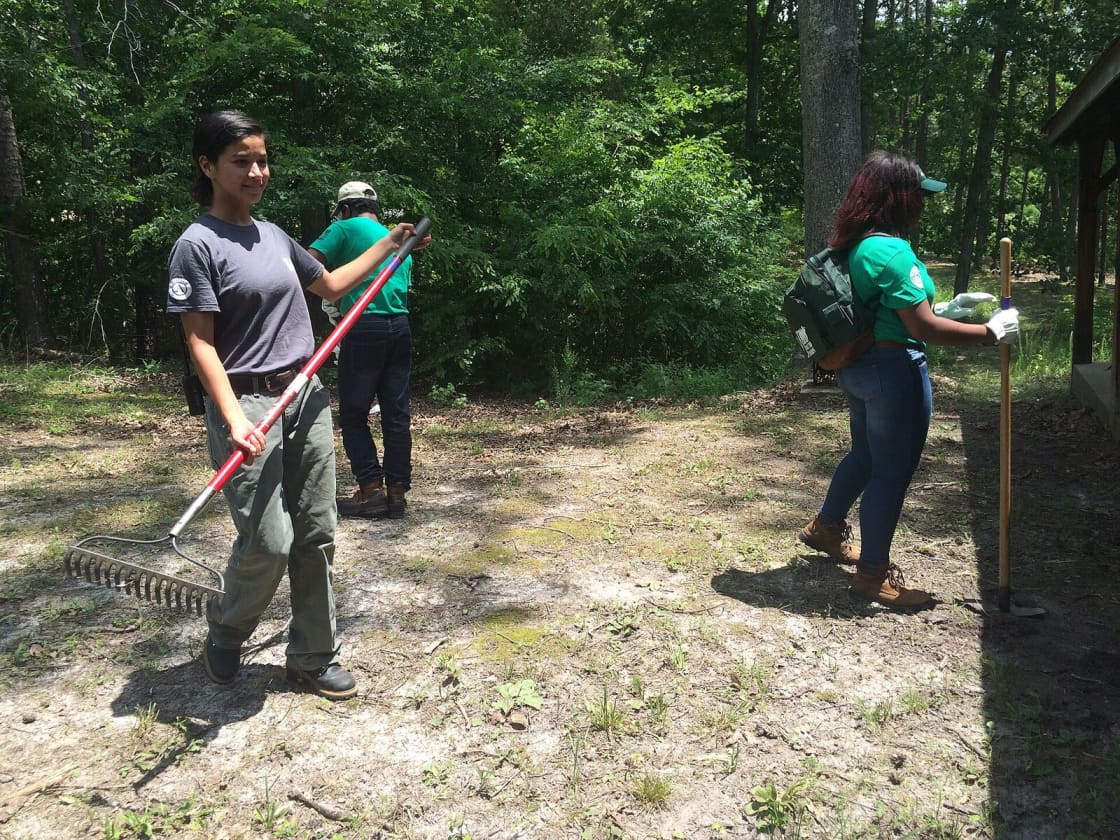
Tread work — restoring the walking surface, rebuilding the outslope, cutting drains. Hand tools, sustained effort, the bulk of most work days.
Drainage structures — rock or timber features that move water off the trail. Skilled work, usually led by someone experienced with a small crew assisting.
Brushing and corridor clearing — cutting back encroaching vegetation to the standard the manager specifies. Note the phrase to the standard: over-clearing is a real failure mode.
Erosion control and revegetation — seeding, planting, and closing social trails so they recover.
Cleanups — the lowest-barrier entry point, requiring least training and available to almost any age group with supervision.
Trailhead and access work — signage, kiosks, fence repair, parking-area maintenance. Unglamorous, constantly needed, and frequently the thing a city parks department most wants help with.
If you are new, a cleanup or a brushing day is the right first outing. If you find you like it, the crews that do tread and structure work are almost always short of people who will come back a second time.
Watershed work is a separate discipline
Provo Canyon and the Provo River are not scenery — they are a working watershed feeding drinking water to a very large number of people, and the volunteer activity around them reflects that.
Riparian planting and invasive removal along waterways is physical, seasonal, and typically run by a conservation district, a state agency, or a partnering nonprofit.
Storm-drain marking is the classic low-barrier project for youth groups: labeling drains to make the connection between a parking lot and a river visible to whoever is standing over it.
Volunteer water-quality monitoring is the one that requires genuine discipline. Programs that train citizen samplers do so because sampling protocol determines whether the data can be used at all. Wrong container, wrong hold time, wrong technique, and the sample is not merely useless — it can be misleading. If you sign up for monitoring, expect the training to be the point.
The seasonality is worth planning around. High-elevation trail work is compressed into a short window once snow clears and before it returns. Valley-floor and riparian work runs far longer. Spring and autumn national service days concentrate most of the organized projects, which is why a search for opportunities in March or September finds a great deal more than the same search in midsummer.
Who to approach, agency by agency
Knowing the manager only helps if you know what a productive first contact looks like. These differ more than you would expect.
Forest Service district offices work through partnership agreements. An individual can join a project a partner organization has already arranged far more easily than they can start one. The realistic route in is to find a group with a standing agreement and turn up to their work day. If you truly want to organize something new, expect a lead time measured in months, a written agreement, and a conversation about crew leadership and tool certification before a date is set.
BLM field offices operate similarly and, since the 2025 amendment placed both agencies under the same volunteer authority, increasingly with the same paperwork. BLM ground around this valley is less obviously "recreational" than the canyons, so the projects skew toward cleanups, fence work, and habitat rather than tread.
State parks and state land run their own volunteer programs with their own applications, and tend to be the most accessible for individuals rather than groups — a park will often take a single reliable person for a recurring shift in a way a federal district cannot.
City parks departments are the fastest yes in the valley. A city has a maintenance backlog, a small crew, and no partnership-agreement apparatus standing between an offer of help and a Saturday. If you want to do useful physical work within the next three weeks rather than the next three months, call a city.
Conservation districts and watershed partnerships own the riparian and water-quality work, and they are the layer most people have never heard of. They are also frequently the best-equipped to train a newcomer properly, because their projects depend on data quality rather than volume.
Bringing a group, and the mistake groups make
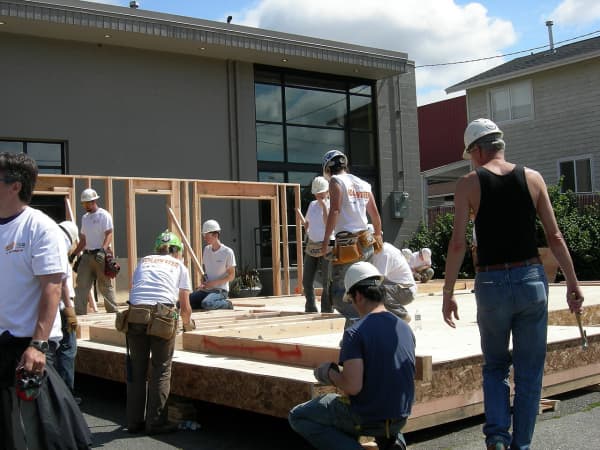
Youth groups, church congregations, corporate teams and student clubs all want the same thing: a large number of people doing visible work in a single morning. Land managers want something quite different, and the gap between those two is where most group projects go wrong.
A crew of forty untrained people is not four times as useful as a crew of ten, and on technical tread work it can be actively negative. What large groups are good at is work that parallelizes safely: litter collection over a wide area, invasive species pulling, seeding, fence-line work, staging and hauling material, trailhead cleanup.
Three things make a group project land well. Book early — a month is short notice, and a season is comfortable. Give a real headcount and a real age range, because tool allocation and supervision ratios are calculated from it, and a group that arrives twenty people larger than promised is a safety problem rather than a bonus. Bring adult supervision at the ratio the manager asks for, not the ratio your organization normally uses.
The other thing worth internalizing: ask what they need rather than proposing what you would like to do. A group that opens with "we have thirty people and a Saturday in October, what would help?" gets a far better answer than one that arrives with a plan.
The seasons, and what is possible in each
Spring. The single busiest window. Snowmelt exposes winter damage, national service days cluster here, and low-elevation work is comfortable. High country is often still inaccessible or too wet to work — walking a saturated trail does more damage than leaving it alone.
Summer. High-elevation work opens up and valley-floor work becomes brutal by mid-morning. Projects shift earlier; a 6am start in July is normal and not an affectation. This is also the thinnest volunteer season, because everyone is on vacation, so it is the most useful time to be available.
Autumn. The best working conditions of the year and the second cluster of organized service days. Cooler temperatures, stable ground, and a long list of things that need finishing before snow.
Winter. Trail work largely stops. What continues is planning, trailhead and facility work, and indoor tasks — and a surprising number of organizations would welcome help with mapping, data entry, grant support and outreach in the months when nobody offers.
What a first work day teaches you about the trails you already walk
There is a side effect of doing this once that nobody mentions in the recruitment material, and it is probably the strongest argument for going.
After a morning of building a single drain, you cannot un-see drainage. Every trail in the valley becomes legible in a way it was not before. The braided mess on a steep pitch stops being a nuisance and becomes an obvious symptom of water running down the tread instead of off it. The rock steps that felt arbitrary reveal themselves as a deliberate structure holding a hillside in place. A trail that stays good through a wet spring stops looking like luck.
That legibility changes how people use trails, which is arguably worth more than the labor. Volunteers walk around puddles rather than widening a trail by skirting them. They stay on the tread through the switchback rather than cutting it. They notice a blocked drain and report it. In a valley where trail use has grown far faster than trail budgets — a pressure the Provo Canyon guide describes from the visitor side — that shift in behavior across even a few hundred people compounds.
It also recalibrates expectations in a useful direction. A morning of eight people working steadily might rebuild sixty meters of tread. Sixty meters. Set against the mileage in the Wasatch above this valley, that number is either demoralizing or clarifying, depending on how you hold it. The crews who keep coming back hold it the second way: the work is not a solution to a backlog, it is the maintenance a trail system requires in perpetuity, and it either happens or the system degrades. Nobody finishes. That is not a failure state, it is the nature of infrastructure.
The last thing worth saying is about who turns up. Trail crews in this valley skew toward two groups — retirees with weekday availability and students doing a one-off through a club — with a thin middle. The people managers most need are the ones who come back three or four times a season without a program attached, because that is the point where someone becomes useful enough to lead a small crew, and crew leadership is the actual bottleneck. Almost every organization here is short of leaders, not of hands.
Before you go
Boots with ankle support and a lug sole. Gloves you do not mind ruining. Long trousers regardless of temperature. Eye protection. Substantially more water than the same distance as a hike would need, because sustained tool work at altitude is a different physiological event from walking. Sun cover, in a valley where the UV at elevation is punishing.
Do not bring your own chainsaw or power equipment. Certification requirements attach to that on public land, and turning up with a saw creates a problem for the crew leader rather than solving one.
Then find the actual project. Start with the managing agency, then check the two aggregators that carry local one-off listings — JustServe.org and the United Way of Utah County volunteer portal. Our guide to volunteering in Utah Valley covers how those two overlap, and the volunteer liability guide covers the approval step that turns an informal offer of help into a covered one.
Related Guides
- How to Actually Volunteer in Utah Valley
- Volunteer Liability in Utah — the approval rule for agency volunteers
- Rock Canyon Trail Guide
- Bonneville Shoreline Trail Guide
- Service Hours for Students and Student Groups
- Team-Building and Corporate Activities in Utah Valley
Frequently Asked Questions
Who owns the trails around Provo?
Can I just go out and fix a trail myself?
What is the Volunteers in the National Forests and Public Lands Act?
Does the government pay for anything when I volunteer on federal land?
Are there things volunteers are not allowed to do on public land?
What should I bring to a trail work day?
Is watershed and water-quality volunteering different from trail work?
How do I find an actual project date near Provo?
Sources
The facts in this guide were checked against these sources. Hours, fees and rules change, so confirm anything time-sensitive with the source before you go. How we make Provo.com.
- GovInfo (U.S. Code). Checked October 12, 2026.
- GovInfo (U.S. Code). Checked October 12, 2026.
- GovInfo (U.S. Code). Checked October 12, 2026.
- GovInfo (U.S. Code). Checked October 12, 2026.