
Provo sits roughly 700 miles from the nearest ocean, at 4,500 feet, in a state better known for what grows on land. It is not where anyone plans a seafood trip.
Seafood is a narrow category here by definition; the broad one is our guide to the best restaurants in Provo.
And yet the category has quietly become one of the valley's more interesting corners, for a reason that is worth stating up front: the formats that have taken hold here are the ones that work when fish arrives frozen or flown.
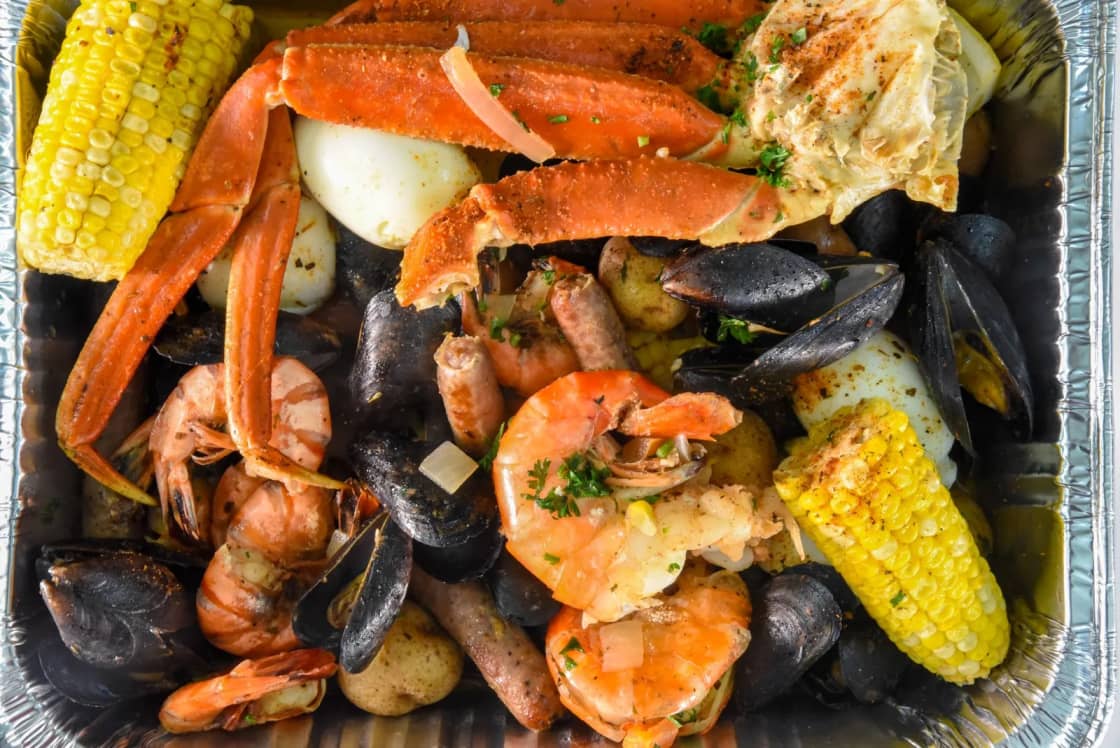
A Cajun boil is built on shrimp, crab legs, mussels, corn, potato and sausage drowned in seasoned butter. It is delicious and it is forgiving. Ceviche is built on acid and freshness of preparation rather than proximity to a dock. A grilled fillet with lemon, where there is nowhere for the fish to hide, is the hard case — and it is the thing Utah Valley has least of.
Once you see that pattern, the local scene stops looking like a compromise and starts looking like an adaptation.
The boils, which are the valley's real strength
Kickin Seafood in Orem is the established local answer, and reviewers who have worked through the Cajun options in both Utah and Salt Lake counties often rate it at the top of that comparison.
The kitchen uses a pressure cooker, which means the food comes out faster than the format usually allows. Seasoning draws consistent praise for tasting like actual Cajun seasoning rather than generic heat. The full messy-eating kit is provided — bibs, gloves, paper towels, scissors, plastic table covering — which is the mark of a place that takes the format seriously.
Hours throughout this guide change with the season and with staffing, and this category runs short-handed more often than most, so confirm with the specific restaurant before driving rather than relying on the times printed here.
Mr. & Mrs. Crab Juicy Seafood & Bar in Orem is the newer arrival in the same format, and a newer restaurant's handful of reviews is a different kind of number from an established one's and should be read as such. Reviewers describe a clean, heavily decorated room, generous portions, a rich Cajun sauce, and staff who handle children well. The fried items get mentioned as often as the boil.
It has typically kept later hours than the rest of this list; confirm them before you go.
One honest note from reviewers: this address has changed hands several times over the years. That is not a criticism of the current operation, which is rating well, but it is a reason to check that it is still trading before driving over.
What a boil involves
If you have not done this, the mechanics matter more than the menu.
You pick a protein — shrimp, snow crab, king crab, Dungeness, mussels, crawfish, lobster — then a seasoning blend and a heat level. It arrives in a sealed bag or a bucket, coated in sauce, with corn, potatoes and sausage. You eat it with your hands, over about an hour, wearing a bib.
Three pieces of advice from people who have made the mistakes:
- Snow crab is usually better value than king crab. More meat for the money, and easier to work.
- Dungeness is the common regret. It looks impressive and delivers relatively little meat for the effort, particularly when it arrives without being pre-cracked.
- Order one heat level below your instinct on the first visit. Cajun seasoning at these places is not decorative, and the sauce coats everything including the potatoes.
The format also makes an excellent group meal and a poor first date, unless you have established that both people find eating with their hands charming.
The conventional option
Red Lobster in Orem is the valley's only large conventional seafood restaurant, and the chain's closures elsewhere have led plenty of people to assume it is gone, so confirm its status before you drive.
Reviewers consistently mention the lobster, the biscuits, the jambalaya and the seafood boil, and the service comments are notably warmer than chain restaurants usually attract — several describe staff helping select and then shell a whole lobster as an occasion in itself.
Check current hours with the restaurant.
For a knife-and-fork seafood dinner with no mess and no surprises, this is the answer, and there is no point being snobbish about it in a market this size.
Ceviche and the Peruvian route
Peruvian's Bunker in Orem is the valley's most interesting seafood answer that is not a boil.
It is a Peruvian restaurant with an open kitchen — reviewers specifically note being able to watch the cooking, which they read as a mark of confidence. The best-known order is lomo saltado, which is beef, but reviewers familiar with the cuisine single out the seafood, and at least one describes it as the best in the state.
That is a strong claim and worth understanding rather than simply repeating. Peruvian seafood cooking centers on ceviche and related preparations where citrus, chili and onion do the work. It is a cuisine adapted to preparation rather than proximity, which is exactly the adaptation a landlocked valley needs.
Its own website does not publish hours or an address, so confirm both before you go.
Seafood inside restaurants that are not seafood restaurants
Some of the best individual seafood dishes in the valley are on menus filed under other cuisines, and limiting a search to seafood restaurants misses them.
La Vaca in Provo, the Argentinian steakhouse, draws repeated review praise for its mussels, clams and shrimp — one reviewer visiting from the East Coast singled out the calamari specifically. It is covered in our steakhouse guide.
Tucanos carries seafood in its churrascaria rotation alongside the meats, so a fixed-price meal there is not a beef-only proposition.
Sizzler in Provo pairs steak and seafood in the older American style and remains one of the cheapest ways to get either.
And the valley's substantial sushi scene is a separate world with its own guides — sushi in Provo and Orem and the wider Asian and sushi roundup cover it, along with the dedicated write-up of Five Sushi Brothers. Sushi is arguably the valley's strongest seafood category by volume, and it deserves treating on its own terms rather than being folded in here.
Sunday, for once, is not the problem
Utah Valley's Sunday closures are a running constraint across the food scene, and seafood is a rare category that mostly escapes it.
Kickin Seafood, Mr. & Mrs. Crab, Red Lobster and Peruvian's Bunker are all open Sunday. That makes this a useful category to keep in mind on the day when most of the valley's restaurants are closed, particularly for visiting families who have discovered their first-choice list is dark.
What the valley does not have
Being straightforward about the gaps is more useful than pretending they are not there.
There is no oyster bar in the ordinary sense, and no raw bar culture. There is no fish market selling to the public in the way coastal cities have. There is little in the way of simply grilled whole fish, and the higher-end seafood tasting menu does not exist here.
These are consequences of geography and market size rather than failures of ambition. A raw bar needs volume to keep product moving, and a valley this size cannot generate it for that specific format. Salt Lake City supports a bit more of this, which is a 45-minute drive rather than a solution.
What the valley has instead is a category with real depth in two formats and reliable options in a third, at moderate prices, mostly open Sunday. That is a fair outcome for a place 700 miles inland.
Why the boil format won here specifically
The Cajun seafood boil spread across American inland markets over the last decade, and Utah Valley is close to a textbook case of why.
The format is built on ingredients that ship and freeze well. Shrimp, snow crab legs, crawfish and mussels all arrive frozen almost everywhere in the country, including in coastal cities, so a landlocked restaurant is not working at the disadvantage it would face serving fresh fillets. The seasoning does the heavy lifting. And the eating experience is social, photogenic and lengthy, which suits a market with a lot of large families, a lot of students, and a strong preference for group meals over solo dining.
It also fits the valley's alcohol landscape. A meal that runs an hour and delivers its own entertainment does not depend on a bar to justify the time at the table, which is a real structural advantage in a market where many restaurants do not serve alcohol at all.
The result is that a category which should be weak here is instead one of the more reliable places to eat in Orem.
Freshness, and how to judge it without expertise
Since almost everything here arrives frozen or flown, the useful question is not whether seafood is fresh off a boat but whether the kitchen handles it well.
A few signals travel reasonably well for a non-expert. Turnover matters more than menu length — a busy room selling the same six proteins all evening is moving product, while a long seafood menu at a quiet restaurant means individual items sit. Smell is decisive and non-negotiable; properly handled shellfish smells of salt and not much else, and anything that reads as ammonia or sourness should go back immediately and without embarrassment. Shellfish that arrives already opened before cooking, or that stays closed after, should not be eaten.
Any restaurant worth returning to will replace a dish on that basis without argument. Raising it is doing them a favor as well as yourself, because kitchens cannot fix a batch they were never told about.
Cost, and where it escalates
Most of this category sits in the moderate price bracket, but the boils behave differently from a normal menu because they are priced by weight and protein.
A pound of shrimp with sausage, corn and potatoes lands in ordinary casual-dining territory. The same order swapped to king crab can double or triple the bill without doubling the food. This is not a markup trick — king crab costs what it costs — but it does mean two people at the same table can be looking at very different totals, and that the format's reputation for being expensive comes almost entirely from one ingredient.
Snow crab is the value pick. Shrimp is the value floor. Lobster and king crab are the occasion items. Knowing that before you order is most of the budgeting.
Eating seafood in a valley that eats early
One structural quirk shapes seafood dining here more than the geography does: Utah Valley eats early and empties early.
Kitchens that close at 9:00pm or 9:30pm on a weeknight are the norm rather than the exception, and this category follows the pattern. A boil takes an hour to eat properly, which means arriving at 8:45pm is not really arriving at all.
Mr. & Mrs. Crab has typically been the late option on this list, which makes it the one to check first for a meal after a game or a performance.
The other timing note is that boils are labor-intensive to prepare, so a large table arriving at once on a Friday will wait. Ordering ahead for collection is a good option with this format, since the food travels well in its own sealed bag and loses very little between the restaurant and a kitchen table you do not mind covering in newspaper.
Ordering well here, in short
- Group, hungry, willing to get messy — Kickin Seafood or Mr. & Mrs. Crab, snow crab, one heat level down.
- Family with mixed tastes — Red Lobster, which handles children and non-seafood eaters.
- Curious and adventurous — Peruvian's Bunker, and ask what the ceviche is that day.
- Seafood as one dish in a nicer dinner — La Vaca's mussels, or a churrascaria plate.
- Raw fish — go to the sushi guides; that is a different and stronger category.
One more reason to keep expectations local
It is worth naming a bias that shapes a lot of online opinion about seafood in Utah: people compare it to where they are from.
Reviews of these restaurants frequently open with a coastal credential — the reviewer is from the East Coast, or the Gulf, or the Pacific Northwest — and the verdict follows from the comparison. Those reviews are honest and they are also measuring the wrong thing. Nothing in Utah Valley is competing with a dockside restaurant, and nothing is trying to.
The right comparison is with other inland markets of similar size, and against that standard the valley does well: two solid boil restaurants, a large reliable chain, a Peruvian kitchen doing something interesting, a deep sushi scene, and seafood dishes scattered across restaurants filed under other cuisines. That is a reasonable spread, mostly open on Sunday, at moderate prices.
What has to have happened to raw fish before it reaches you
Landlocked seafood raises an obvious question, and most guides answer it with reassurance. There is a better answer, which is that a specific rule governs raw fish and it is unusually precise about time and temperature.
Utah does not write its own food safety code from scratch. Utah Admin. Code R392-100-4(1)(b) incorporates by reference the 2022 FDA Food Code, Chapters 1 through 8, with a list of Utah amendments. So the rule that decides whether the poke, ceviche or crudo in front of you was lawfully served is a federal model text with a Utah wrapper, and it is worth knowing what it says.
Food Code § 3-402.11 requires that before service or sale in ready-to-eat form, raw, raw-marinated, partially cooked or marinated-partially-cooked fish be frozen by one of three methods. Frozen and stored at -4°F or below for at least 168 hours — seven full days. Or frozen at -31°F or below until solid and stored at -31°F or below for at least 15 hours. Or frozen at -31°F until solid and then stored at -4°F or below for at least 24 hours. The point of the freeze is parasite destruction, not bacterial control, and the seven-day figure is the one most kitchens use because ordinary freezers reach -4°F and almost nothing outside a commercial blast operation reaches -31°F.
The exemptions in ¶ 3-402.11(B) are as informative as the rule. Molluscan shellfish are exempt. So is a scallop product consisting only of the shucked adductor muscle. So are six named tuna species — Thunnus alalunga, albacares, atlanticus, maccoyii, obesus and thynnus — which is the technical reason you can be served tuna that was never frozen for parasites while the salmon beside it must have been. Aquacultured fish raised on formulated feed containing no live parasites is also exempt, which covers a large share of farmed salmon.
The paperwork is the part a diner can use. Where the establishment does the freezing itself, records of the freezing temperature and time must be kept for 90 calendar days beyond the date of sale or service. Where a supplier did the freezing, a dated written statement from that supplier stipulating the time and temperature substitutes for those records. Either way, a document exists, an inspector reads it, and a kitchen that cannot produce it is not supposed to be serving the dish. If you want to know whether a room is serious about raw fish, that is the question to ask — not where the fish is from.
Shellfish carry a tag, and the tag has a shelf life
Oysters, clams and mussels are governed separately, through the National Shellfish Sanitation Program. Live molluscan shellfish arrive as shellstock in a container bearing a dealer's certification number — a one-to-five-digit number preceded by the two-letter state abbreviation and followed by a code for the activity, such as SS for shellstock shipper, SP for shucker packer or RP for repacker. The Food Code requires the establishment to keep that identification, in the order the containers are used, for 90 calendar days from the date the last shellfish from the container was served. That is a traceback mechanism: when a norovirus cluster appears, the tags are how the harvest area is found.
Utah adds a small, cheerful amendment here. R392-100-4(3)(m) rewrites Food Code ¶ 6-501.115(B) on live animals to permit, among other things, edible fish or decorative fish in aquariums, shellfish or crustacea on ice or under refrigeration, and shellfish and crustacea in display tank systems. The live crab and lobster tanks that a couple of rooms in this valley run are explicitly contemplated by the rule rather than tolerated in spite of it.
The asterisk on the menu is a legal instrument
Food Code § 3-603.11 requires a consumer advisory wherever an animal food is served raw or undercooked. It has two halves, and menus routinely run one and skip the other. The disclosure identifies which items are or can be ordered raw or undercooked — usually the asterisk, or a footnote naming the dishes. The reminder states the health risk, and must point to a further statement about the increased risk of foodborne illness. A menu with an asterisk and no reminder text at the bottom is not compliant; a menu with the boilerplate and no marked items is not either.
Food Code § 3-801.11 goes further for facilities serving highly susceptible populations — preschool children, older adults and immunocompromised people in custodial, health care or assisted living settings. Those operations may not use the consumer advisory as a workaround at all, and raw or undercooked animal food is simply off the table. A restaurant is not such a facility; it is worth knowing the distinction exists, because it explains why a hospital cafeteria and the room next door follow different rules with the same fish.
None of this tells you whether a place cooks well. It tells you what a kitchen serving raw fish in a landlocked county has already had to do, and it gives you two specific, answerable questions — who froze it, and can you show me the letter — that are worth more than any amount of reassurance about air freight. For the permitting and inspection side of this, see our guide to food permits and inspections in Utah County.
Seafood Delivery in a Landlocked Valley
Seafood in Utah Valley already involves one time problem — everything here has traveled a long way before a kitchen touches it — and delivery stacks a second one on top.
That does not make it a bad idea, but it does narrow what is worth ordering.
Fried seafood fails hardest and fastest. Battered fish, calamari, coconut shrimp and anything breaded lose their crust to trapped steam within about fifteen minutes, and fish is more delicate than chicken to begin with. Delicate white fish served plain suffers too: it continues cooking in its own heat inside the container and arrives firmer and drier than it left.
What travels well is anything wet. Chowders and bisques are excellent delivery food and arguably improve on the drive. Rolls — lobster, shrimp, crab — hold up because the bread is doing the structural work. Pasta with seafood is fine. Boils and anything in a bag of sauce are fine. Rich, saucy and stewed is the pattern to look for.
Raw is a pickup proposition. Oysters, crudo, poke and ceviche are all served cold for good reason, and a warm insulated bag is the wrong environment for them.
The other honest note is price. Seafood carries the highest menu prices in this category, and the platform markup is applied as a percentage, so the gap between the app price and the restaurant's own price is widest on exactly these dishes.
Our food delivery guide explains that markup and when ordering direct is worth the extra step.
Related Guides
- The Best Steakhouses in Utah Valley
- Sushi in Provo & Orem
- Asian Food & Sushi in Utah Valley
- The Best Restaurants in Orem
- Restaurants Open on Sunday in Provo
- The History of Provo's Food Scene
- Root's Place Burgers & More: American Fork's Gourmet Burger Counter
- Black Sheep Cafe: The Provo Restaurant Built on a Navajo Nation Childhood
- Brick Oven: Seventy Years on One Provo Corner
- The BYU Creamery: History, Flavors, and Which Location to Actually Go To
- Strap Tank: The Brewery Named After a Motorcycle
Frequently Asked Questions
Where is the best seafood in Provo or Orem?
Is seafood in Utah any good, being this far from the ocean?
What is a seafood boil like?
Which seafood restaurants are open Sunday?
Where can I get ceviche?
Is Red Lobster still open in Orem?
How expensive is seafood here?
What should I order if I do not like messy food?
Sources
The facts in this guide were checked against these sources. Hours, fees and rules change, so confirm anything time-sensitive with the source before you go. How we make Provo.com.
- R392-100 Food Service Sanitation, Utah Office of Administrative Rules. Checked October 12, 2026.
- Food Code 2022, U.S. Food and Drug Administration. Checked October 12, 2026.
- Peruvian's Bunker. Checked October 12, 2026.