
There is a mismatch at the center of this category, and once you see it the whole restaurant landscape makes more sense.
Utah County has one of the largest Pacific Islander communities of any county in the mainland United States. In the 2020 Census, about 1 percent of Utah County residents (6,722 people) identified as Native Hawaiian or Pacific Islander alone, before counting those who reported more than one race. That is the second-highest share of any county in the state, behind Salt Lake County. Statewide, Samoans are the largest detailed group and Tongans the second, together accounting for the substantial majority of Utah's Pacific Islanders — and the Samoan population more than doubled in Orem between 2010 and 2020.
Now look at the restaurants. Almost every one of them cooks Hawaiian plate lunch.
That is not a criticism of anybody. It is just a fact worth knowing before you go looking for something you will not find, and it explains why a dozen menus in this valley read so similarly: teriyaki chicken, katsu, kalua pork, two scoops of rice, one scoop of macaroni salad. The plate lunch is a commercially proven format that travels well. Tongan and Samoan home cooking mostly stayed home, in family kitchens and at church functions, and only one restaurant in Utah County has really brought it onto a public menu.
First, what a plate lunch is
If you have not eaten one, the format is more specific than "Hawaiian food."
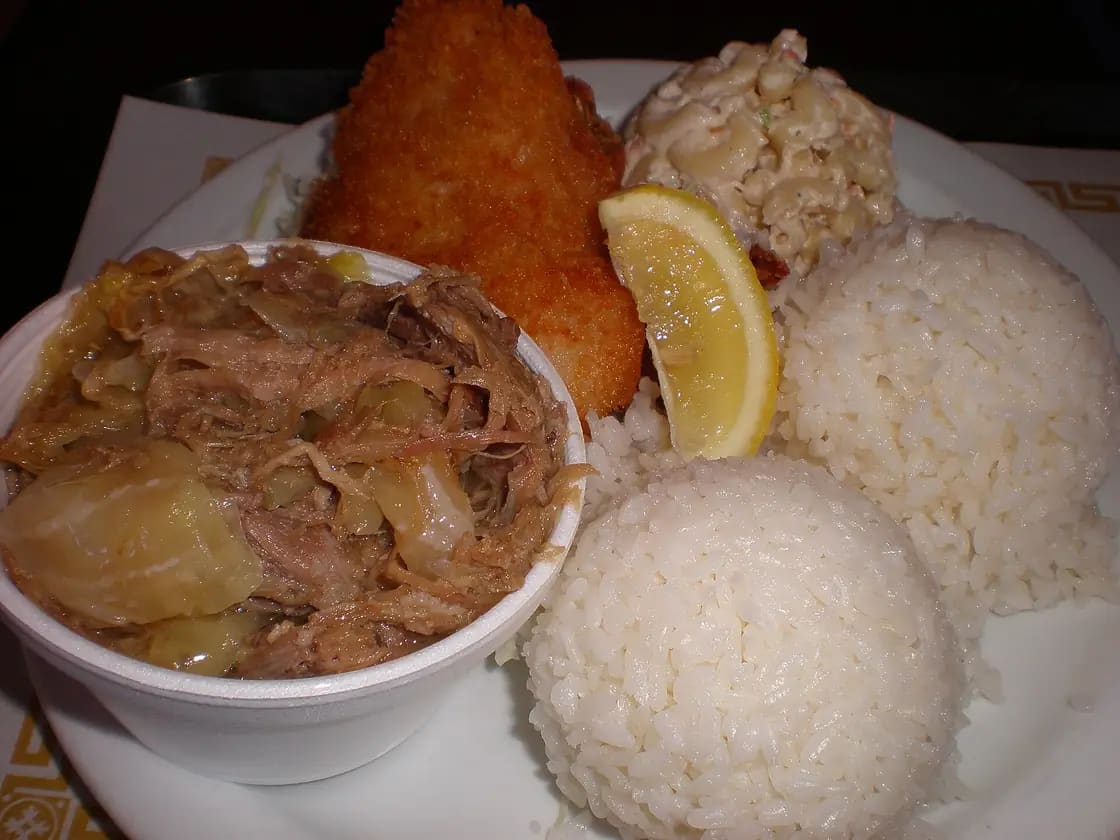
A plate lunch is one or two proteins, two scoops of white rice, and one scoop of macaroni salad, served in a takeout container regardless of whether you are eating in. It descends from the meals carried by plantation workers in Hawaii and it is built to be filling and cheap rather than delicate. The mac salad is not a side thought — it is structural, mayonnaise-heavy and deliberately plain, there to cool and carry the sauce from the meat.
The proteins rotate through a standard set: teriyaki chicken or beef, katsu (panko-breaded and fried, usually chicken, served with a tangy brown sauce), kalua pork (salt-cured and slow-cooked, smoky rather than sweet), garlic shrimp, kalbi short ribs, and often loco moco, which is a hamburger patty over rice under brown gravy and a fried egg.
Knowing those six words is most of what you need to order confidently anywhere in this guide.
The plate lunch restaurants, ranked by how they differ
Sweet's Island Place at 711 West Columbia Lane in Provo has one of the deepest local followings for Hawaiian food in the valley. Reviews return again and again to portion size and to the family running the front of house, which is the profile of a place people go back to rather than try once.
The constraint is the clock. It opens 11:00am and closes 4:00pm, Monday through Saturday, and is closed Sunday. It is a lunch restaurant. Plan accordingly, because arriving at six is a common and avoidable disappointment. Phone is 801-374-0000.
Hungry Hawaiian at 180 North University Avenue, Suite 135 in downtown Provo — inside the Zions Bank building — is the practical Provo dinner answer, open 11:00am to 9:00pm Monday through Saturday and closed Sunday. It is a small counter operation rather than a dining room, and it does furikake chicken and lau lau alongside the standard set, which widens the menu past what most competitors attempt. Reviews from customers who grew up in Hawaii are notably positive, which is the review subset worth weighting here. Phone is 801-607-1927.
Mo' Bettahs at 1385 South State Street in Orem is the chain, and it is a Utah-founded one rather than an import — which is itself a comment on how deep this food runs in the local market. Expect consistency, drive-through convenience, generous portions and no surprises. It is closed Sunday and runs late otherwise, to 10:00pm.
LoLo Hawaiian BBQ at 366 East University Parkway in Orem has one decisive advantage: it is open on Sunday, 11:00am to 9:30pm. In a valley where nearly everything in this category shuts, that alone makes it the default answer one day a week. Phone is 801-607-5092.
Aloha Plate in the Cougareat food court at BYU is worth naming for students specifically. It is on meal plans, it is fast, and it is the only Hawaiian food you can reach between classes without leaving campus. Weekday hours only — closed Saturday and Sunday.
The one restaurant cooking the other thing
Leilani's Polynesian Place at 135 South State Street, Suite 8 in Lindon is the exception this whole guide is organized around, and it is easy to miss because it sits inside a convenience store with minimal decor.
Its reviews are unusual, dominated by people describing food they grew up eating and had not found on a menu since moving to the mainland. That is a different signal than "this was tasty." It is a community saying a gap got filled.
What to order that you will not find at the plate lunch places:
- Povi masima — Samoan salted beef brisket, cured and boiled. It is genuinely, aggressively salty by design, traditionally eaten in small amounts with a lot of rice and taro. First-timers routinely underestimate this. Order it, but order rice with it.
- Lu sipi — lamb or mutton baked in taro leaves with coconut cream. Distinctly gamey; that is the dish, not a flaw.
- Otai — a chilled fresh fruit drink, usually watermelon or mango with coconut, closer to a light slushy than a smoothie. The mango version comes up constantly in reviews.
They also cook the standard teriyaki plates, so a table can split between the familiar and the unfamiliar without anyone going hungry. Hours are 11:00am to 7:00pm Monday through Saturday, closed Sunday. Phone is 801-785-4338.
Poke is a separate category, not a lighter version
Poke is Hawaiian in origin — cubed raw fish dressed with shoyu, sesame oil and sweet onion — but the poke restaurants here operate on the build-your-own-bowl model and generally share no menu overlap with the plate lunch kitchens.
Savage Fish Poke at 1110 South State Street in Orem is the standout, and it is open every day, including Sunday, 11:00am to 7:00pm. Staff letting customers taste the fish before committing comes up repeatedly in reviews, which is a reasonable proxy for confidence in freshness.
TAICHI at 1280 North University Avenue in Provo does poke alongside boba, sushi and ramen, and its value here is hours — it runs to 11:00pm most nights and is open Sunday afternoon and evening, which almost nothing else in this guide does.
If you want raw fish, go to these. If you want kalua pork, do not.
The grocery gap, stated plainly
There is no established Polynesian grocery in Utah County.
The markets that serve the Wasatch Front community — the ones carrying taro leaf, green bananas, coconut cream by the case, island soft drinks, fresh keke and prepared Sunday plates — are in West Valley City, roughly forty-five minutes north depending on traffic. For a family cooking for a funeral, a wedding or a Sunday gathering, that drive is a routine part of the month.
Within the valley, the international aisles at the larger supermarkets and the Asian markets will get you coconut milk, some frozen fish and occasionally spam by the flat, but not taro leaf and not fresh otai fruit. This is a real gap in a county with a Pacific Islander population this size, and it is the kind of gap that usually closes eventually. It has not yet.
The Sunday problem
Same pattern as the rest of Utah Valley dining, and slightly worse in this category because so many of these are family-run.
Open Sunday: LoLo Hawaiian BBQ (Orem), Savage Fish Poke (Orem), TAICHI (Provo, afternoon and evening).
Closed Sunday: Sweet's Island Place, Hungry Hawaiian, Leilani's, Mo' Bettahs, Aloha Plate.
There is a certain irony in it. Sunday is the day this food is most cooked in Utah County — after church, in volume, for extended family — and it is the day you can least easily buy it. Hours shift around holidays and the BYU calendar, so treat the list above as the shape of a normal week.
Reading the rest of the menu
Past the six core proteins, a handful of words show up repeatedly and trip people up. None of them are difficult once you have seen them.
Spam musubi is a block of rice topped with a slice of grilled, glazed Spam and belted with a strip of nori. It is a snack rather than a meal, it is good, and the eye-rolling that Spam provokes on the mainland misses the history — canned meat became a staple across the Pacific during and after the Second World War and stayed there. Nearly every counter in this guide sells it.
Laulau is pork wrapped in taro leaves and steamed until both collapse. The leaves are edible and are the point. It is one of the harder things to do well outside the islands because the leaf supply is the constraint, which is exactly why it appears on so few menus here.
Furikake is a dry seasoning of seaweed, sesame and salt, used here mostly as a crust on fried chicken. Hungry Hawaiian's version comes up often enough in reviews to be worth ordering specifically.
Haupia is the standard dessert: coconut milk thickened and set firm, cut into squares, somewhere between a custard and a firm jelly. Mild, not very sweet, and a reasonable palate reset after a salty plate.
POG is passion fruit, orange and guava juice, and it is the default drink order. Several places also stock canned Hawaiian Sun drinks, which are worth trying purely because they do not turn up anywhere else in the valley.
Feeding a crowd
This is a category people turn to specifically for large orders — ward activities, team dinners, funerals, receptions — and it handles them better than most.
The economics are the reason. Plate lunch is built on rice and a fixed protein portion, so the cost per person stays predictable in a way that a restaurant with entrées does not, and the food travels and holds temperature well. Sweet's Island Place, Hungry Hawaiian and Mo' Bettahs all cater, and the two independents are the ones worth calling first if the group cares about the food rather than just the logistics.
Two practical notes. Order earlier in the day than feels necessary — several of these are small kitchens with a single grill line, and a hundred-plate order placed at 11:00am on a Saturday is a different request than the same order placed on Wednesday. And if the gathering is on a Sunday, plan around the closures above; the usual solution here is a Saturday pickup and a warming tray.
Where these are, geographically
The valley's Pacific Islander food splits across three clusters, and they are not close to one another.
Downtown Provo has Hungry Hawaiian on University Avenue and Yummy's on Center Street, both walkable from the courthouse and the Utah Valley Convention Center. West Provo has Sweet's on Columbia Lane, which is a drive rather than a walk from campus and closes mid-afternoon. The Orem State Street corridor carries Mo' Bettahs and Savage Fish Poke within a few blocks of each other, with LoLo a short distance east on University Parkway. Lindon, further north, has Leilani's on its own.
Nothing in this category is meaningfully close to BYU campus except Aloha Plate inside the Cougareat. Students without a car should know that before planning an evening around it, and should note that the campus option is the weakest-rated of the set and closed at weekends.
Why Utah, and why Tongan and Samoan specifically
The composition here is unusual and worth understanding, because it is the reason the community is as large and as concentrated as it is.
Latter-day Saint missionary work in the Pacific began in the nineteenth century and ran continuously through the twentieth, producing sustained migration toward church headquarters in Salt Lake City and toward Brigham Young University. Family networks then compounded it: people came because relatives were already here. The result is a population profile unlike the national one — Tongans and Samoans are the two largest Polynesian groups in Utah at 39 and 30 percent of Pacific Islanders respectively, while nationally the two combined account for fewer than a quarter. Utah's Pacific Islander population of more than 60,000 is the third-largest in the nation by percentage.
Nationally, "Pacific Islander" skews Native Hawaiian and Micronesian. In Utah it skews Tongan and Samoan, and heavily. Which brings the mismatch back around: the food most available here represents the group least represented in the population.
What to order the first time
If you have never eaten any of this, a reasonable first order at any plate lunch counter is one teriyaki chicken and one kalua pork, two scoops rice, mac salad. It costs little, it covers the sweet end and the salty end of the menu, and it gives you a baseline to judge everywhere else against.
If you have eaten plenty of plate lunch and want the thing you have not had, drive to Lindon and order the povi masima at Leilani's with extra rice.
Kalua pork, raw fish and the rules that reach an underground oven
Two of the defining techniques in this cuisine — pork cooked whole for many hours, and fish served raw — sit at opposite ends of the food safety code, and both are worth understanding because they explain what a Utah Valley kitchen can and cannot offer.
Utah enforces the 2022 FDA Food Code through Utah Admin. Code R392-100-4.
Whole cuts and ground meat are different numbers. Under Food Code § 3-401.11, a whole cut of pork must reach 145°F for 15 seconds; comminuted meat — ground, chopped, flaked or minced, or injected or mechanically tenderized — must reach 155°F for 17 seconds; poultry is 165°F, instantaneous. And ¶ 3-401.11(B) carries the roast table, which permits whole pork roasts and beef roasts to be cooked as low as 130°F held for 112 minutes, with a chart of shorter holds at higher temperatures. Kalua pork is a whole-cut roast cooked for many hours, which is the version of the rule it lives under: lethality by time at temperature rather than by a single high reading.
Once the pork is shredded, the clock starts. Pulled kalua pork held for service sits at 135°F or above under § 3-501.16(A)(1). Pork cooled for the next day follows the two-stage rule at § 3-501.14 — from 135°F to 70°F within two hours, then to 41°F within four more, six hours total. Reheating for hot holding must hit 165°F for 15 seconds within two hours under § 3-403.11. A large volume of shredded meat in a deep pan is one of the hardest things in a kitchen to move through those windows, which is why the plate-lunch format — cook in the morning, hold hot, sell out — exists at all.
An imu is a specialized process. Cooking in a sealed underground pit is not something the model code contemplates in the ordinary run of provisions, and a kitchen that wants to do it commercially is in § 3-502.11 territory — the section requiring a variance before an establishment engages in a specialized processing method. Utah wrote the application requirements itself, at R392-100-4(3)(o): ten enumerated items including the citation of each Food Code provision the variance touches, a statement of why compliance is not possible, technical justification, the active managerial controls proposed, and a HACCP plan where one is required under ¶ 8-201.13(A).
The practical consequence is the honest answer to a question people ask about this cuisine in Utah: authentic imu-cooked kalua pork is rare here not because nobody knows how, but because doing it in a permitted commercial operation means filing a document that most small restaurants will reasonably decide is not worth it. The oven-and-liquid-smoke version is what you will mostly find, and knowing why is more useful than being disappointed by it.
Poke, and the freeze that has to have happened first
Raw fish served ready to eat is governed by Food Code § 3-402.11, which requires that before service in ready-to-eat form, raw or raw-marinated fish be frozen and stored at -4°F or below for at least 168 hours, or at -31°F or below until solid and then held at -31°F for at least 15 hours, or at -31°F until solid and then at -4°F for at least 24 hours. Records of the freezing time and temperature — or a dated supplier letter stipulating them — must be kept for 90 calendar days past the date of service.
The exemptions at ¶ (B) explain the composition of most poke menus. Molluscan shellfish are exempt. So are six named tuna species — Thunnus alalunga, albacares, atlanticus, maccoyii, obesus and thynnus — which is why ahi is the default poke protein in a landlocked state and salmon is the one that has to have been frozen. Aquacultured fish raised on formulated feed containing no live parasites is also exempt, which covers much farmed salmon, but the exemption depends on documentation the supplier provides rather than on the species alone.
Raw fish on a menu also triggers the consumer advisory at § 3-603.11, which has two required halves: a disclosure naming the items that are or can be served raw or undercooked, and a reminder pointing to a statement about the increased risk of foodborne illness. The asterisk without the footnote is not compliance.
What this means for eating here
The plate lunch is the format this cuisine takes in Utah Valley, and it is the format the code rewards: cooked in the morning, held hot at a temperature you can feel through the container, sold within the day. Ordering early in a service is genuinely better here than ordering late, and not only for the reason people assume — a hot-held item has been on the clock since it went in the pan.
For poke, the useful question is the same one worth asking at any raw-fish counter: who did the freezing, and is there a letter. For the permitting layer behind all of it, see food permits and inspections in Utah County, and for the wider raw-fish picture see our seafood guide.
Plate Lunch Delivery: A Natural Fit
The plate lunch is close to a perfect delivery food, and the reasons are structural.
It is built on rice, which is essentially indestructible in transit. Its proteins are typically braised, smoked or sauced rather than crisped, so nothing depends on a texture that a closed container will ruin. Macaroni salad is served cold and does not care. The whole format was designed to be packed in a box and eaten somewhere else, which is exactly what a delivery order is.
Kalua pork, teriyaki chicken, chicken katsu with the sauce separate, lau lau, and anything in a sauce all arrive close to how they left. Portions in this cuisine are generous enough that the fees amortize better than they do on a single small entree.
There are two exceptions. Anything fried and served unsauced — katsu is the obvious case — loses its crust to steam within fifteen minutes, so ask for the sauce on the side and open the container promptly. And poke is a cold-chain item sitting in a bag built to keep food warm, which is the wrong environment for raw fish on a long route. Poke is better collected than delivered, and better ordered early in a day's service than late.
Portion size is the other practical note. These plates are large, and a delivered plate lunch frequently makes two meals, which quietly improves the value of the order.
Our food delivery guide covers the platforms and the cost stack.
Related Guides
- The Best Barbecue in Utah Valley
- Best Korean Food in Provo & Orem
- Best Chinese & Asian Food in Provo & Orem
- Best Grocery Stores in Provo
- The Best Restaurants in Provo
- The Best Restaurants in Orem
- Restaurants Open on Sunday in Provo
- Best Food Near BYU
- The Provo & Orem restaurant directory — every place we cover in these two cities, with its address, filterable by cuisine
Frequently Asked Questions
What is the best Hawaiian food in Provo?
Is there Tongan or Samoan food in Utah Valley?
What is a Hawaiian plate lunch?
Which Polynesian restaurants near Provo are open on Sunday?
What does kalua pork mean, and is it the same as pulled pork?
Where can I buy Polynesian groceries near Provo?
Is poke Hawaiian food?
Why does Utah have such a large Pacific Islander population?
Sources
The facts in this guide were checked against these sources. Hours, fees and rules change, so confirm anything time-sensitive with the source before you go. How we make Provo.com.
- 2020 Census Redistricting Data (PL 94-171) Table P1: Utah counties, U.S. Census Bureau (via USAFacts Government Data Connector). Checked October 12, 2026.
- Utah Rule R392-100 Food Service Sanitation, Utah Office of Administrative Rules. Checked October 12, 2026.