
Every college town has a restaurant that exists because of a specific structural problem, and in Provo the problem is well documented: it gets late, you are hungry, and the options are fast food or nothing. There is no bar scene to absorb the evening. The good kitchens close.
Five Sushi Brothers was built directly at that gap, and the origin story is unusually literal — two brothers were hungry at eleven at night, decided that was a business, and were wrong about almost everything except that.
It is now named in fourteen different guides on this site and has never had a page of its own. This is that page.
The obvious question, answered by the restaurant
There are not five brothers running Five Sushi Brothers. There are two.
But the name is not invented, and the restaurant's own FAQ is refreshingly direct about it: there are five brothers in the family — the youngest two started the business and run it. That is Ammon Chung, the older of the two, and Jacob Chung, his younger brother.
It is a small thing, but it is the question everyone asks and almost nobody answers, because answering it requires reading a restaurant's FAQ page rather than a review aggregator.
The second half of the joke is the one people miss: the restaurants have Super Smash Bros. consoles set up for people waiting on food. Five Sushi Brothers, Super Smash Bros. The founders have said plainly that the games are there because they personally love them and wanted other people to enjoy them too. The pun is the business plan.
It started in someone else's kitchen
In May 2016, Ammon Chung — by his brother's account, having had one too many nights wanting something better than pizza after hours — floated the idea of a late-night sushi delivery service in Provo. Jacob was a BYU student at the time. Neither had restaurant experience.
They had no money for a location, so they did the only thing available: they rented a local Mexican restaurant's kitchen during the hours it was closed. The restaurant was Mi Lindo Guadalajara, and the rent was $250 a month for the off-hours. Ammon's own assessment later was blunt — it turned out to be a terrible idea because of how little space there was, but it was all they could afford.
The startup money came from a crowdfunding campaign promoted with a party where the first 400 people got free sushi. Hundreds of students turned up. By Jacob's account the goal was $5,000 and they hit it in a couple of days; a contemporaneous 2016 report in BYU's student paper put the total raised nearer $8,000, against roughly $25,000 spent getting the business going. (Both figures are on the record and this page is not going to pick one — a fundraising goal and a fundraising total are different numbers, which is the likeliest explanation.)
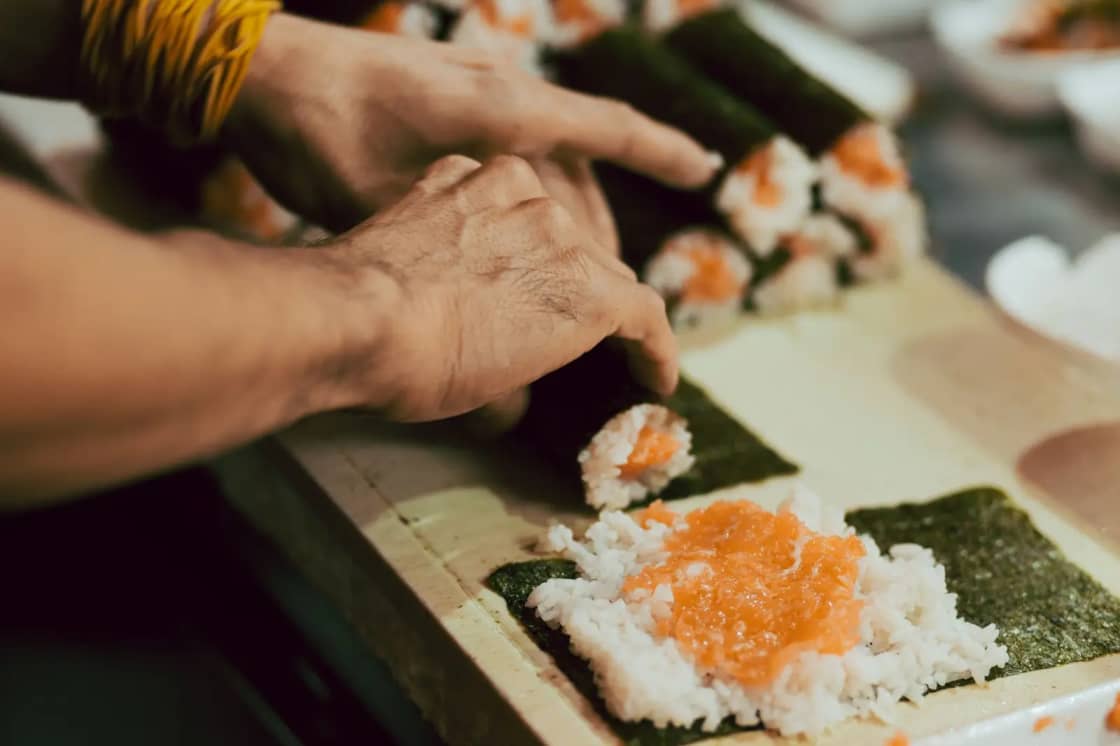
The early operation was 9 p.m. to midnight: hand-rolling sushi, packing orders, and delivering them personally.
The next step was a second borrowed kitchen — Landmark Catering, at $500 a month. The rent was low because the brothers' father, Bo Song Chung Jr., is a general contractor and agreed to renovate the building in exchange. Jacob's assessment at the time was that cheap rent was the entire reason they survived: most Provo restaurants, he said, fail because rent outruns them before they can break even.
That is the part of the story worth holding onto. It is not a story about sushi. It is a story about a fixed-cost problem in a college town, solved twice with someone else's building.
Three locations, then one
Five Sushi Brothers is often described as a success story, and it is, but the shape of it is less tidy than the version that circulates.
The company reached three locations and closed two.
The Salt Lake City restaurant, on West 100 South, opened with promise and then met the pandemic within months. Jacob has described the decision to cut losses and preserve Provo as the hardest thing that happened to the business — not commercially, but because of the people who had to be let go, including a friendship he has said publicly did not survive it.
The Orem outlet was a different format entirely, trading as Five Sushi Brothers Go! from a counter inside the Walmart on Sandhill Road. It has also closed.
Provo is the only remaining location. This is worth stating plainly because directories have not caught up: listings and roundups still describe the business as "Provo/Orem," and the Orem and Salt Lake entries are still findable with old hours attached. If a source sends you anywhere but 445 N Freedom Boulevard, it is stale.
Finding it, which is harder than it should be
The address is 445 N Freedom Boulevard, Provo. Two traps sit around that.
First, the street. Freedom Boulevard is 200 West — Provo's address grid runs off Center Street and University Avenue rather than a Main Street, and Freedom Boulevard is the named version of a numbered street. One business listing for this very restaurant renders the address as "Freedom Boulevard 200 West," which is the grid quietly asserting itself. Our guide to Freedom Boulevard explains why Provo's street naming works this way and why it confuses everyone who did not grow up here.
Second, the name. At least one major review platform lists the business as Five Brothers Sushi rather than Five Sushi Brothers. Same address, same restaurant, transposed words — and searching the two phrasings can surface different listings with different ratings and review counts. If you are judging the place by its stars, make sure you are looking at the listing with the two thousand-plus reviews rather than the one with seven.
One more, smaller: at least one professional-network listing gives the street number as 425 rather than 445. The restaurant's own channels, and the platforms that matter, say 445.
What to order
The house framing is "fresh-fordable" — their coinage, and an accurate summary of the positioning. This is not an omakase counter and does not pretend to be. It is generous, creative, sauced, American-style roll sushi at prices built for students.
The rolls run from the single digits into the low teens, with daily specials cheaper still. The founders name the Dylan From Vegas as a signature creative roll; regulars elsewhere in our coverage point to the Friend Roll and the Mucha. If you are ordering for a table, a spread of several rolls is the intended mode and the reason the room is loud.
The gyoza is the actual insider order. Six pieces, inexpensive, and served with a house sauce the family makes from its own recipe. Several of our guides land on the curry gyoza specifically. It is the thing to add to an order even when nobody asked for an appetiser.
For a lighter meal, the sashimi and the simpler rolls are the ones to build around; the tempura and cream-cheese-heavy rolls are the ones that turn a light dinner into a heavy one. Our healthy eating guide treats it the same way.
The restaurant also serves ramen and udon, which are competent rather than the reason to come — if noodles are the goal, our ramen guide points at the specialists instead.
It is a delivery company that grew a dining room
This is the structural fact that explains the restaurant, and it is backwards from how almost every other restaurant works.
Most restaurants open a room and later bolt on delivery, usually through a third-party app that takes a substantial cut. Five Sushi Brothers was a delivery service first — for its first stretch it had no dining room at all, because it had no building. The room came later, built onto an operation whose whole competence was getting food to people who were not going to leave the house.
Two things follow from that, and both are to your advantage.
Delivery is a first-class product here, not an afterthought. The business has historically promoted delivery with no delivery fee, which is close to unheard of and is a direct inheritance from the original model.
Ordering direct is the better move. The restaurant runs its own online ordering. Going through it rather than a third-party aggregator means the restaurant keeps materially more of what you pay, and on a business whose founders have been explicit that margin is what killed their peers, that is not a trivial consideration.
The dining room, when it came, was built around the same instinct that produced the free video games: it is loud, casual, cheap, and designed for people to stay in. Somewhere north of two thousand Google reviews have accumulated on the Provo location, which for an independent restaurant in a city this size is an enormous number and tells you the volume it does.
The landlocked sushi question
The restaurant's own promotional line is that it uses "only the freshest fish, a rare commodity in Utah" — which is a marketing claim, but it points at something real that nobody planning a sushi dinner in Provo tends to think about.
Utah is about as far from an ocean as the continental United States gets. Every piece of raw fish served in Utah Valley arrived by air freight or refrigerated truck, on a delivery schedule, from a supplier. Nothing about that makes good sushi impossible — Denver, Chicago and Las Vegas all manage — but it does change what the consumer should optimize for.
In a landlocked market, turnover matters more than reputation. A busy restaurant working through its fish quickly is a better bet than a quiet one with a prettier room, because the constraint is not skill, it is how long the product has been sitting. This is the honest argument for a place like Five Sushi Brothers over a more refined competitor doing a fraction of the covers: whatever else is true, the fish is not sitting.
The corollary is the practical one. The day of the week matters more here than it would on a coast. Restaurants take deliveries on a cadence, and the end of a cycle is not the same as the start of one. Nobody publishes that schedule, and asking a server directly is both reasonable and, in our experience, usually answered.
Our sushi roundup for Provo and Orem covers how the rest of the field handles the same problem, and our wider Asian and sushi guide puts the valley's whole bench in order.
The late-night thing, properly explained
The reason this restaurant matters to Provo is the clock.
The kitchen runs to midnight, Monday through Saturday. In a city where a large share of independent kitchens close by nine and the whole town closes on Sunday, that is close to a category of one for anything you would describe as a real meal. Our late-night food guide covers what else is genuinely available after ten, and the list is short.
There is also a late-night Saturday happy hour, historically the last hour or so before close, with rolls dropped to a flat price. ⚠ The window is published two different ways — one of the restaurant's own pages has given 10:30 to 11:30 p.m., while customer accounts describe 11 p.m. to midnight. It is a small discrepancy on a genuinely good deal, so confirm it on the night rather than driving out on a schedule from a web page.
And note the afternoon gap. Service runs roughly 11 to 2, then stops, then resumes at 5. This is not unique to Five Sushi Brothers — it is a pattern across Provo's better independents, several of which shut in the middle of the afternoon on purpose to reset the kitchen. Arriving downtown hungry at 3:30 is the single most reliable way to have a bad time eating in this city.
Closed Sundays, like most of Provo.
Who it is for, and when to go somewhere else
Being clear about this saves people a bad evening.
Go here if you are feeding a group and want everyone fed cheaply and well; if you are eating late; if you have children who will be entertained by a fish-shaped roll and a game console; if you want a first date that will not be awkward because there is something to do while you wait; or if you want delivery that does not arrive lukewarm.
Go somewhere else if you want a quiet room and a conversation, if you are eating on a Sunday, if you need a reservation you can rely on, or if what you actually want is precise traditional nigiri served in silence. None of those are failures of this restaurant. They are simply not what it is.
The room is bright, busy and loud by design, with the video games running and a queue that moves. It is a college restaurant in the best sense of the phrase, and it does not apologize for it.
Catering is a real part of the business — the restaurant lists it alongside the late-night delivery it is known for, which for a Provo ward activity, a student club or an office lunch makes it an unusually easy call. Our group and catering guide covers the alternatives.
Dietary notes: the menu marks vegetarian and vegan options, which is not universal among sushi restaurants and is worth knowing in a town where a fair number of people are eating around something.
Parking is the usual Freedom Boulevard situation — a lot, and street parking that gets competitive on a weekend evening, particularly during BYU event weeks. Budget an extra five minutes rather than circling.
Whether it is actually the best sushi in Provo
Our own guides land on it as the default recommendation, and that is a fair reflection of what it is: the most popular sushi restaurant in the city, reliably good, generous, and the one that works for a group.
It is worth being honest about what that means. This is creative-roll sushi — multiple sauces, crunchy toppings, ingredients a traditionalist would raise an eyebrow at. If you want quiet, precise nigiri and a calm room, this is the wrong restaurant and our sushi roundup points at the alternatives, several of which do that better.
What Five Sushi Brothers is unmatched at is a specific combination: good enough fish, low prices, a genuinely fun room, open at 11:30 at night, and no pretense whatsoever. For a college town, that is not a compromise. That is exactly the right restaurant.
The practical version
445 N Freedom Boulevard, Provo. Lunch roughly 11 to 2, dinner 5 to midnight, closed Sundays and closed through the afternoon. No reservations, so expect a wait on a Friday evening and treat the video games as the intended solution rather than an apology. Order a spread of rolls, add the gyoza, and if it is Saturday, ask what time the happy hour actually starts.
And if a listing tells you there is one in Orem: there was. There isn't.
Related Guides
- Hogi Yogi: The Provo Chain That Went National, Sold, and Came Back to Four Stores
- Tommy's Burgers: The Provo Chili Burger Institution That Became a Truck
- Black Sheep Cafe: The Provo Restaurant Built on a Navajo Nation Childhood
- The Best Seafood in Utah Valley: Boils, Ceviche & Eating Fish 700 Miles From the Ocean
- Brick Oven: Seventy Years on One Provo Corner
- The Kolache Place: Why Hruska's Changed Its Name
- 30 Best Restaurants in Provo (2026)
- The BYU Creamery: History, Flavors, and Which Location to Actually Go To
- The Provo & Orem restaurant directory — where this place sits among everything else we cover, with the address and the city
Frequently Asked Questions
Are there actually five Five Sushi Brothers?
Where is Five Sushi Brothers and what are the hours?
Does Five Sushi Brothers deliver?
Why is Five Sushi Brothers closed in the afternoon?
Is Five Sushi Brothers expensive?
Does Five Sushi Brothers take reservations?
Is there a Five Sushi Brothers in Orem or Salt Lake City?
Why do some sites call it Five Brothers Sushi?