Utah treats a bicycle as a vehicle, so most of the traffic code applies to you the moment you ride onto a road. But the state has also written a handful of rules just for bikes, and two of them surprise people who learned to ride somewhere else: you can treat a stop sign as a yield sign, and you can go through a red light that won't change for you after a 90-second wait.
This guide uses the current text of the bicycle part of the Utah traffic code (Title 41, Chapter 6a, Part 11), the red-light and passing sections, Provo's micromobility ordinance, the Utah Highway Safety Office's bicycle safety page and news coverage of the 2025 bike lane law, all checked Nov. 24, 2026. For riding in town, see our Provo bike commuting guide; for e-bikes, which have their own age and helmet rules, see e-bikes in Utah Valley.
The short version
| Rule | What it says | Code |
|---|---|---|
| Stop signs | Slow down and yield; a full stop isn't required | 41-6a-1105 |
| Red lights | Ages 16+: stop, wait 90 seconds, then proceed with care if the signal won't detect you | 41-6a-305 |
| Lane position | As far right as practicable when slower than traffic, with exceptions | 41-6a-1105 |
| Side by side | No more than two abreast, in one lane, without impeding traffic | 41-6a-1105 |
| Night lights | White front lamp and red rear reflector or lamp, each visible at 500 feet | 41-6a-1114 |
| Brakes | Able to stop within 25 feet from 10 mph | 41-6a-1113 |
| Hands | At least one hand on the handlebars | 41-6a-1112 |
| Sidewalks | Yield to pedestrians; cities may ban adults | 41-6a-1106 |
| Passing distance | Drivers stay 3 feet away | 41-6a-706.5 |
Stop signs: the Utah yield
In 2021 the Legislature passed H.B. 142, and since May 5, 2021, Utah Code 41-6a-1105 has let a person on a bicycle go through a stop sign without stopping, as long as the rider:
- slows to a reasonable speed, and
- yields to any pedestrian in the intersection or an adjacent crosswalk, to other traffic in the intersection, and to oncoming traffic close enough to be an "immediate hazard."
The law defines that hazard as a vehicle approaching at a distance and speed that would tell a reasonable person a collision is possible. If a car has reached the intersection first, it goes first. The yield rule doesn't apply at an active railroad crossing, where you stop like everyone else. It applies to bicycles; e-bikes are treated as bicycles under state law, but scooters and other devices have their own sections.
Red lights: the 90-second rule
Many signals find vehicles with a loop in the pavement that a bicycle doesn't trigger. Utah Code 41-6a-305 gives riders 16 and older a way out. It's an affirmative defense to a red-light ticket if you:
- come to a complete stop at the intersection or stop line;
- wait at least 90 seconds without the signal detecting you;
- make sure no vehicle with the right-of-way is waiting, crossing or approaching, and no pedestrian is crossing in your direction; and
- then enter cautiously.
An affirmative defense means you can still be cited and would raise the rule in court. It doesn't cover railroad crossings, and it isn't a general right to run a red light. Motorcycles and mopeds get the same rule.
Where to ride on the road
When you're slower than traffic, Utah Code 41-6a-1105 says to ride as near as practicable to the right-hand edge, except when you're:
- passing another bike or vehicle;
- getting ready to turn left;
- going straight through an intersection that has a right-turn-only lane; or
- avoiding something that makes the edge unsafe: parked or moving cars, debris, animals, pedestrians, surface hazards, or a lane too narrow for a bike and a car to share side by side.
Always ride with traffic. Ride no more than two abreast, within a single lane, and not in a way that holds up traffic. For left turns you can merge and turn like a car, or make a two-stage turn: ride to the far corner, stop out of the way, and cross with the new direction of traffic (41-6a-1108).
Signal your turns. The Highway Safety Office says to signal at least three seconds ahead, but 41-6a-1109 lets you stop signaling when you need the hand to control the bike, and you don't have to signal from inside a turn-only lane.
Equipment the law requires
- Lights after dark. From sunset to sunrise, or whenever you can't see people and vehicles 1,000 feet ahead, Utah Code 41-6a-1114 requires a white front lamp visible from 500 feet, a red rear reflector or red rear lamp visible from 500 feet (a flashing light is fine), and reflective material or a lamp visible from both sides at 500 feet. Provo's code requires lights or reflective material from half an hour after sunset.
- Brakes strong enough to stop within 25 feet from 10 mph on dry, level pavement (41-6a-1113).
- No siren or whistle on the bike (41-6a-1113).
- One hand on the bars at all times, and nothing in your arms that keeps you from using both hands when you need to (41-6a-1112).
- No extra riders beyond what the bike is built for. An adult may carry a child secured in a backpack or sling, and trailers built for bikes are allowed (41-6a-1103 and 41-6a-1104).
There's no helmet law for adults on ordinary bicycles in this part of the code. The helmet rule Utah does have is for e-bikes: since May 6, 2026, riders under 21 must wear one on any e-bike on a public road.
A police officer can stop a rider and inspect a bike that seems unsafe or not equipped as required (41-6a-1110), and a parent may not knowingly let a child break the traffic code (41-6a-1101).
Sidewalks, paths and Provo's rules
On a sidewalk, path or trail, Utah Code 41-6a-1106 says you must yield to every pedestrian, give an audible signal before passing one, and ride no faster than is reasonable. Otherwise you have the rights and duties of a pedestrian. State law lets a city ban riders 18 and older from sidewalks and crosswalks by ordinance or sign.
Provo's micromobility code (section 9.32.170), which covers bikes, e-bikes, scooters, skateboards and similar devices:
- No riding on the sidewalks of University Avenue between 400 North and 100 South or Center Street between 100 East and 500 West, the downtown blocks.
- 10 mph limit on every other public sidewalk.
- Yield to pedestrians and give an audible signal before passing.
- Don't leave a device where it blocks a sidewalk, crosswalk or roadway.
Provo's code also still requires a bicycle license, with the fee set in the city's fee schedule; dealers can issue them, and a license lasts until the bike changes hands.
On campus, BYU limits rideables to 5 mph on sidewalks and restricts riding inside Campus Drive during class breaks; our e-bike guide has the details.
What drivers owe cyclists
- Three feet. Utah Code 41-6a-706.5 makes it an infraction to drive within three feet of a cyclist, pedestrian or other "vulnerable user of a highway," or to try to distract one, force one off the road or blast exhaust at one. If someone is hurt, it's a class C misdemeanor.
- Bike lanes stay clear. H.B. 290, in effect since May 7, 2025, made driving in or blocking a bike lane an infraction statewide. KPCW reported that drivers can still cross a bike lane to turn, government vehicles are exempt, and shared lanes marked with sharrows aren't covered. Utah Code 41-6a-710 lets a school bus or transit bus briefly impede a bike lane along its route.
The Deseret News, reporting on that law in July 2025, counted 2,457 bicycle crashes in Utah from 2019 to 2023, including a five-year high of 548 in 2023, and 44 deaths.
Parking your bike
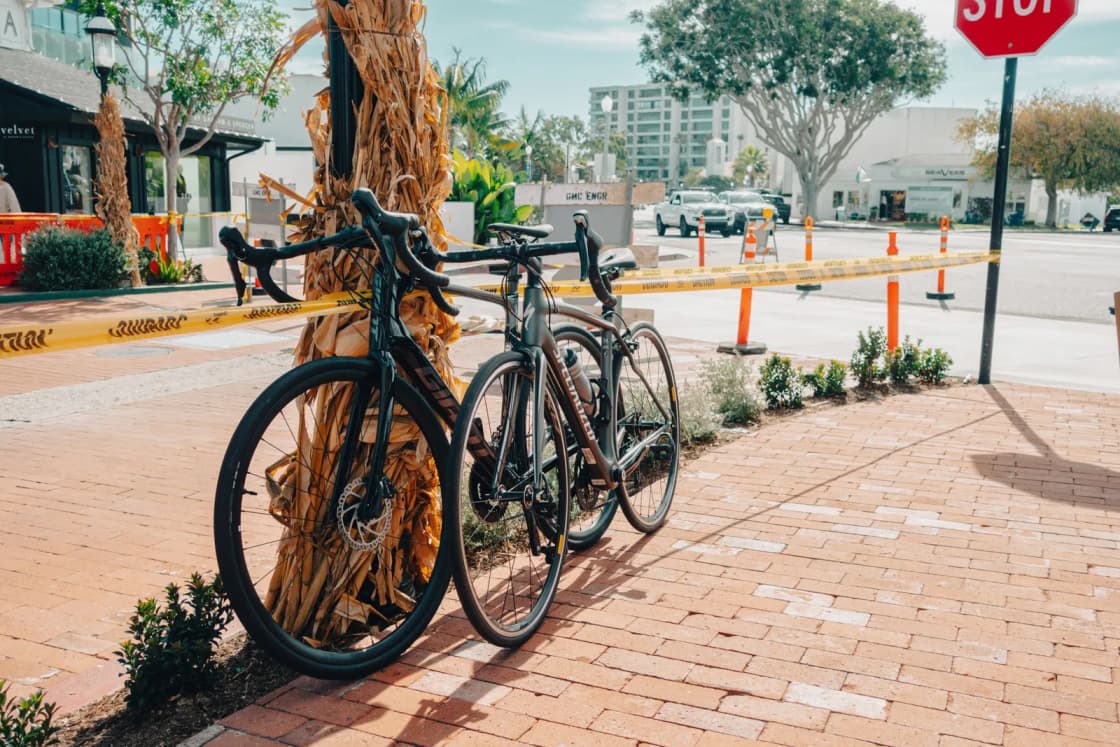
You can park on a sidewalk unless a sign says otherwise, as long as the bike doesn't block pedestrians (41-6a-1107). On a street, a bike can park anywhere a car could, at any angle and next to other bikes, but not in a way that blocks a legally parked car.
Related guides
- Bike commuting in Provo
- E-bikes in Utah Valley: classes, helmets and where to ride
- Bike shops in Provo
- Cycling clubs and group rides
- Got a traffic ticket in Utah County?
- Utah's hands-free driving law
Frequently Asked Questions
Can cyclists roll through stop signs in Utah?
Can a cyclist go through a red light in Utah?
Do you need lights on a bike at night in Utah?
Is it legal to ride a bike on the sidewalk in Provo?
How much room must drivers give cyclists in Utah?
Is there a bike helmet law in Utah?
Can cars park or drive in a bike lane in Utah?
Can two cyclists ride side by side in Utah?
Sources
The facts in this guide were checked against these sources. Hours, fees and rules change, so confirm anything time-sensitive with the source before you go. How we make Provo.com.
- Utah Code 41-6a-1105: Operation of bicycle or moped on and use of roadway, Utah State Legislature. Checked November 24, 2026.
- Utah Code 41-6a-305: Traffic-control signal (bicycle red-light defense), Utah State Legislature. Checked November 24, 2026.
- Utah Code 41-6a-1114: Bicycles, lamps and reflective material required, Utah State Legislature. Checked November 24, 2026.
- Utah Code 41-6a-1106: Bicycles to yield to pedestrians on sidewalks, paths or trails, Utah State Legislature. Checked November 24, 2026.
- Utah Code 41-6a-706.5: Operation of motor vehicle near a vulnerable user of a highway, Utah State Legislature. Checked November 24, 2026.
- Utah Code 41-6a-710: Roadway divided into marked lanes, Utah State Legislature. Checked November 24, 2026.
- Provo City Code 9.32.170: Micromobility Devices, Provo City. Checked November 24, 2026.
- Bicycle and Micromobility Safety, Utah Department of Public Safety, Highway Safety Office. Checked November 24, 2026.
- New law allows Utahns to be ticketed for driving in bike lane (April 4, 2025), KPCW. Checked November 24, 2026.
- Does this new Utah law make roads safer for cyclists? (July 14, 2025), Deseret News via KSL.com. Checked November 24, 2026.