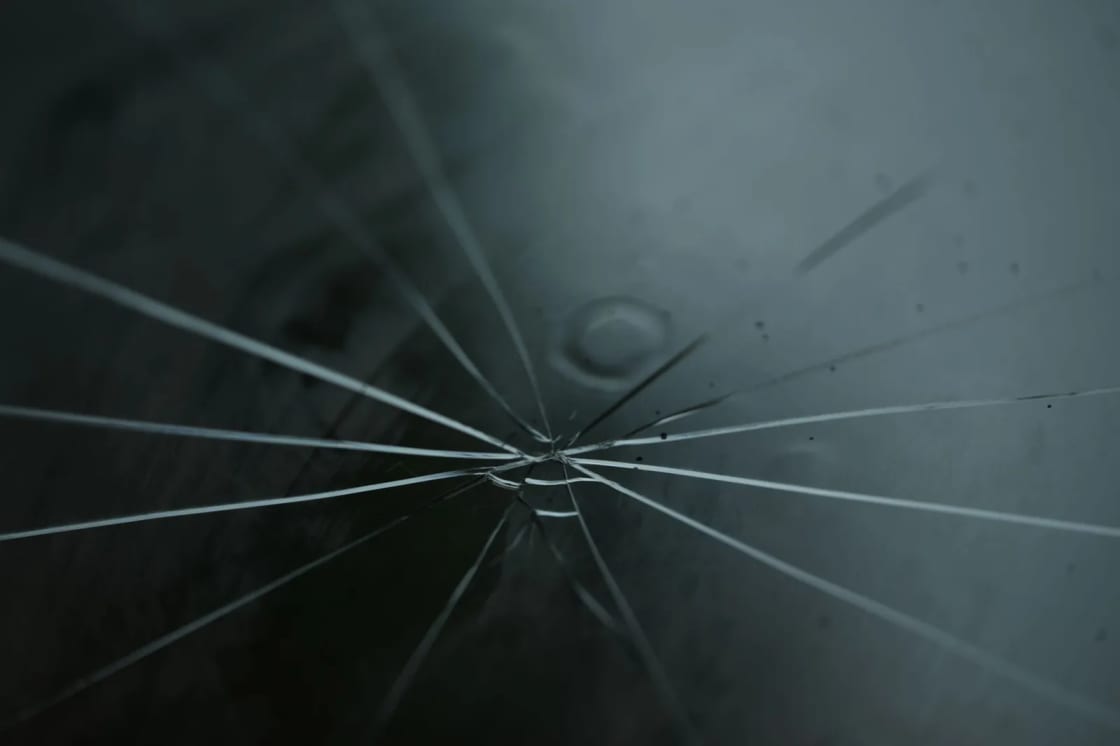

There is a rule about windshields that nearly everyone in Utah believes. It goes something like this: damage bigger than a penny, or bigger than a quarter, or anywhere in a particular zone in front of the driver, makes the vehicle illegal to drive.
Go looking for that rule in the statute and it is not there.
The section governing windshields and windows in Utah is 41-6a-1635, and what it sets is a standard rather than a measurement. No coin. No inches. No dimension of any kind attached to glass damage.
That gap between what people believe and what the law says is worth closing, because it changes how you should think about a chip on your way down Provo Canyon.
What the statute prohibits
The section covers several distinct things, and separating them helps.
It sets light transmittance minimums — a windshield may not allow less than 70% light transmittance, and a front side window may not allow less than 35%, with a 5% variance for the officer's meter. Those are the tint rules, and they are the only hard numbers in the neighborhood.
It prohibits windshields and windows that are composed of, covered by, or treated with material presenting a metallic or mirrored appearance.
It prohibits signs, posters and other nontransparent material on the windshield or front side windows, with narrow exceptions for a certificate required by law to be displayed and for a vehicle identification number displayed or etched under department rules. There are permitted zones for certain materials — along the top edge of the windshield if they do not extend more than four inches down or below the AS-1 line, whichever is lower; in the lower left-hand corner within stated limits; and on rear windows.
It prohibits debris, frost or other substance that materially obstructs the operator's view.
It separately prohibits operating a vehicle with an object or device hanging or mounted in a manner that materially obstructs the operator's view — the provision that covers air fresheners, parking permits and phone mounts.
It requires a working windshield wiper system, operable by the driver and maintained in good working order.
And it states that a violation of the section is an infraction.
The standard is materiality, not size
Notice what the operative phrase is in the parts that could apply to a crack: materially obstructs the operator's view.
That is a judgment standard. It asks whether the thing in question interferes with seeing the road, not whether it exceeds a published dimension. A long crack low across the passenger side may not obstruct the driver's view at all. A smaller star fracture directly in the driver's sightline plausibly does.
This has two practical consequences.
The first is that you cannot measure your way to certainty. Anyone quoting you a specific size for Utah is quoting something that is not in the text.
The second is that the discretion runs both directions. Because the standard is materiality, a modest chip out of the sightline is unlikely to be treated as a violation — and a spectacular crack across the driver's field of view is a problem regardless of how you would like to characterize it.
One caution on currency. This section has been amended repeatedly, including a 2022 amendment and at least one later change with a 2025 effective date. The description above follows the version in effect since May 7, 2025, on the Legislature's own site. The materiality standard and the infraction classification are stable across those versions; if you need the operative text for a citation you are contesting, get the current version from the Legislature rather than from us or anyone else summarizing it.
Nobody is inspecting it for you
Here is the part that changes behavior more than the legal question does.
There is no routine mechanism in Utah that catches a deteriorating windshield on your behalf. In many states, an annual safety inspection functions as a forced checkpoint — someone looks at the glass once a year and tells you it has to be dealt with. Utah does not run that kind of general periodic safety inspection for ordinary passenger vehicles.
So the crack propagates on your schedule and nobody intervenes. The chip you noticed in March is still there in November, four inches longer, and the only event that will force the issue is either an officer's judgment or the day it finally spreads across your line of sight.
Which means the deadline is yours to set. Nobody else is going to set it.
Repair beats replacement, and the window is short
A rock chip is a small cone of fractured glass in the outer laminate layer. Repair works by drawing the air out of that void and injecting resin under pressure, which fills the fracture, bonds the glass, restores much of the strength and stops the crack from running further.
The result is not invisible. A good repair leaves a faint mark and considerable improvement in clarity, and it prevents the far more expensive outcome.
Repair is generally possible while the damage is small, not too deep, and outside the driver's primary sightline. Once a crack has run out into a line, reached the edge of the glass, penetrated both laminate layers, or landed directly in front of the driver, the calculus shifts to replacement.
The mistake is waiting. Every temperature cycle and every pothole is another chance for a repairable chip to become a replacement. If you take one thing from this: a chip is a same-week problem, not a someday problem.
Why chips spread so aggressively in Utah Valley
Glass expands when it warms and contracts when it cools. A chip is a stress concentrator, and repeated expansion and contraction across a stress concentrator is precisely how a crack propagates.
Utah Valley supplies the conditions generously. Clear high-desert air produces large day-to-night temperature swings for much of the year. Cars sit in full sun and then cool rapidly after dark. Winter mornings start well below freezing.
And then people apply thermal shock deliberately. Full-heat defrost on a frozen windshield puts a steep temperature gradient across glass that already contains a flaw. Maximum air conditioning aimed at a windshield that has been baking in an August parking lot does the same thing in reverse. Warm the glass gradually, and if you have a chip, be especially careful about both.
Add the gravel and road-treatment material that gets thrown on I-15 and up the canyons, and the frequency of chips here is not your imagination.
Where the rocks come from
Anyone commuting on I-15 through Utah County knows the sound. Construction zones, gravel trucks and the general debris load of a busy interstate produce most of the damage.
Following distance is the only effective countermeasure. A rock thrown by the vehicle ahead loses energy quickly, and the difference between two seconds and four seconds of gap is substantial. Give gravel haulers and dump trucks a wide berth rather than sitting directly behind them.
Canyon driving adds rockfall and, in winter, the sand and cinder used for traction. Our guide to winter tires and canyon driving in Utah covers the seasonal side of that in more detail.
Insurance: comprehensive, deductibles, and what Utah does not require
Glass damage from road debris is a comprehensive claim, not a collision claim. If you carry liability only, there is nothing to claim against and the repair is yours.
Utah does not mandate zero-deductible glass coverage. Some states require insurers to waive the deductible for windshield claims; Utah leaves it to the policy. What that means in practice is that a replacement can fall entirely under your deductible and never touch the insurer at all.
Two things soften that. Many insurers voluntarily cover chip repair at little or no cost, because paying for a resin injection is dramatically cheaper than paying for a replacement later. And a glass endorsement — an add-on that reduces or eliminates the deductible for glass specifically — is available from many carriers for a modest premium.
The move is to read your declarations page before you need it. You are looking for whether you have comprehensive, what the deductible is, whether a separate glass deductible applies, and whether chip repair is covered outright.
Our guide to car insurance costs in Utah covers the broader coverage picture, including the state's minimum liability requirements.
The calibration question nobody asks in time
If your vehicle was built in roughly the last decade, there is a reasonable chance a forward-facing camera is mounted to the inside of the windshield. That camera feeds lane-keeping assistance, automatic emergency braking, adaptive cruise control and similar systems.
Replace the windshield and the camera's position and aim change, even slightly. The system then has to be recalibrated so that what the software thinks it is looking at matches what the lens is looking at. Calibration comes in static forms performed in a shop against targets, dynamic forms performed by driving a prescribed route, and combinations of both, depending on manufacturer.
Ask three questions before booking: does my vehicle require calibration, do you perform it in-house or subcontract it, and is it included in this quote. A driver-assistance system that has not been recalibrated does not announce itself as broken. It simply becomes less accurate at the job you are trusting it to do.
Choosing a shop without getting steered
You may choose your own auto glass shop in Utah. Insurers commonly have network arrangements and may recommend one, and if your chosen shop charges more than what the insurer has agreed to pay, you can be responsible for the difference.
That is a manageable problem if you handle it in the right order: ask the insurer what it will pay, ask the shop what it charges, and settle the gap before work begins rather than after.
Worth asking about glass origin, too. Replacement glass may be original equipment from the vehicle manufacturer, or aftermarket glass built to fit. Quality varies within both categories, and on a vehicle with a windshield-mounted camera, optical quality and bracket precision are not cosmetic concerns. You are entitled to know what is going onto your car before it is installed.
Mobile service, and the thing about cure time
Mobile installation is convenient and generally fine, with one caveat that is about safety rather than convenience.
The windshield is bonded to the body with urethane adhesive, and that bond is structural. It helps the roof resist crushing in a rollover and it gives the passenger airbag a surface to deploy against. Adhesives publish a safe drive-away time, and that time depends on temperature and humidity.
In warm, dry conditions it may be short. In a cold January driveway it is longer, sometimes considerably. A shop that hands you the keys without telling you the safe drive-away time has skipped the most safety-relevant sentence in the transaction. Ask for it, and wait it out.
Side windows are a different product entirely
People use "auto glass" as one category. Physically it is two.
A windshield is laminated — two layers of glass bonded to a plastic interlayer. That is why a windshield cracks rather than shattering, why the pieces stay put after an impact, and why it can carry structural load. It is also why chip repair is possible at all: the resin has something to bond into.
Side and rear windows are usually tempered. Tempered glass is heat-treated so that it holds enormous stress, and when it finally fails it fails completely, breaking into small blunt granules all at once. There is no such thing as repairing a chip in a tempered side window, because a tempered window does not chip. It is intact or it is a pile of pebbles on your seat.
That difference matters when a break-in happens. A smashed side window is a full replacement and a vacuum job, and glass fragments work their way into seat rails and door cavities for weeks. It also matters for expectations: nobody is going to fill your rear quarter glass with resin, and a shop offering to is not describing a real repair.
Some newer vehicles use laminated side glass for noise reduction and security. If a shop quotes an unexpectedly high figure for a door window, that may be why, and it is a fair question to ask.
What drives the price
Windshield quotes vary far more than people expect for what looks like the same part, and the variation is mostly explained by four things.
Sensors and features. A camera bracket, rain sensor, humidity sensor, heating element, acoustic interlayer, heads-up display area or embedded antenna each add cost, and a heads-up display windshield in particular is a specialist part.
Calibration. Where required, it is real labor with real equipment and it is sometimes billed separately. This is the line item most likely to turn a quote you liked into an invoice you did not expect.
Glass source. Manufacturer-branded glass generally costs more than aftermarket equivalents.
Vehicle popularity. Common vehicles have competitive parts supply; unusual ones do not.
Get itemized quotes rather than a single number, from more than one shop, and make sure each quote states the same scope — glass, moldings and clips, adhesive, calibration, and disposal. Two quotes that differ by a large margin are often quoting different work rather than different prices for the same work.
Related guides
- Driving Schools in Provo: Driver Ed, Road Tests & the Third-Party Shortcut
- Finding a Trustworthy Mechanic in Utah Valley
- Housing Assistance in Utah County: Two Housing Authorities, Both in Provo, and the One You Need
- Martial Arts in Provo & Utah Valley: Choosing a School Without Signing the Wrong Contract
- The Provo DMV, Decoded: Two Agencies, Two Buildings
- Buses From Provo to Vegas, St. George & Beyond: The Intercity Guide
- Towed in Provo: The Sign at the Entrance Decides Whether They Were Allowed To
- Parking in Downtown Provo Without Getting a Ticket
- Scooters & Bike Share in Provo: What's Actually on the Street (2026)
- The UVX Is the Best Thing About Getting Around Provo
- Car Washes & Detailing in Utah Valley: Where to Go and What to Know
- PVU or SLC: Which Airport Should You Fly From? Car insurance costs in Utah covers coverage and minimums, buying a used car in Utah Valley covers what to inspect before you own the glass in question, and winter tires and canyon driving covers the roads that break the most windshields around here.
The short answer
Utah's windshield statute sets a materiality standard, not a size limit — the widely repeated penny rule is not in the text, and a violation of the section is an infraction. Nobody runs a periodic safety inspection that will catch a spreading crack for you.
So treat a chip as a this-week item. Repair is cheap, fast and preserves the glass; replacement is what you get for waiting. Check whether you carry comprehensive and whether a glass endorsement makes sense before you need it.
And if your car has a camera behind the mirror, do not let anyone replace that windshield without telling you how the calibration is getting done.
Frequently Asked Questions
Is it illegal to drive with a cracked windshield in Utah?
Is there a penny-sized limit for windshield chips in Utah?
Will insurance pay for my windshield in Utah?
Should I repair the chip or replace the windshield?
Why do chips spread so fast here?
What is ADAS calibration and do I need it?
Can I choose my own auto glass shop?
How long before I can drive after a windshield replacement?
Sources
The facts in this guide were checked against these sources. Hours, fees and rules change, so confirm anything time-sensitive with the source before you go. How we make Provo.com.
- Utah Code 41-6a-1635, Windshields and windows (effective 5/7/2025), Utah Legislature. Checked October 12, 2026.