On the morning of Monday, Feb. 14, 1870, a 23-year-old schoolteacher named Seraph Young stopped at Council Hall in Salt Lake City on her way to work and voted in the city election. Two days earlier, Utah Territory had given women the vote. Historians now describe her ballot as the first cast by a woman anywhere in the United States under an equal suffrage law. What followed was not a straight line. Utah women voted for 17 years, lost the vote by act of Congress in 1887, won it back in the state constitution of 1895, sent the first woman state senator in the country to the Legislature in 1896, and then helped ratify the 19th Amendment in 1919.
This guide lays out that timeline with the date sources attached, because several popular retellings get pieces of it wrong, and because the official sources themselves sometimes disagree by a day or a year. Where they disagree, we say so. The story is also tied up with plural marriage, which shaped why Utah women got the vote, why they lost it and how the national movement saw them. We describe those arguments as the sources do, without taking sides in them.
The timeline at a glance
| Date | What happened | Where the date comes from |
|---|---|---|
| Dec. 10, 1869 | Wyoming Territory grants women suffrage | National Park Service suffrage timeline |
| Jan. 6, 1870 | Women's mass meeting in Salt Lake City's 15th Ward moves to "demand" the franchise | Better Days, citing the meeting minutes |
| Feb. 10, 1870 | Both houses of the territorial legislature pass the suffrage act unanimously | Church Historian's Press |
| Feb. 12, 1870 | Acting Governor Stephen A. Mann signs the act | Utah State Archives; National Park Service |
| Feb. 14, 1870 | Seraph Young and about 25 other women vote in the Salt Lake City election | Better Days; KSL |
| March 3, 1887 | Edmunds-Tucker Act takes effect, ending the vote for all Utah women | National Park Service suffrage timeline |
| March 1895 | Constitutional convention opens with 107 male delegates | Utah State Archives |
| April 18, 1895 | Convention adopts equal suffrage language | Better Days timeline |
| Nov. 5, 1895 | Voters approve the state constitution | Utah History Encyclopedia (Utah Historical Society) |
| Jan. 4, 1896 | Utah becomes a state; women's vote restored | Utah Division of State History |
| Nov. 3, 1896 | Martha Hughes Cannon elected first woman state senator in the U.S. | Utah History Encyclopedia |
| Sept. 29-30, 1919 | Utah Legislature ratifies the 19th Amendment in a special session | Better Days; National Park Service |
| Aug. 26, 1920 | 19th Amendment certified nationally | National Park Service suffrage timeline |
Before the law: Wyoming, the Cullom Bill and the January meetings
Wyoming moved first. The National Park Service's national suffrage timeline says women in Wyoming Territory were granted unrestricted suffrage on Dec. 10, 1869. Utah's Division of State History, on its "I Love History" site, says Utah's territorial legislature followed about two months later and approved its own law unanimously, making Utah the second territory to do so.
Utah's law did not come out of nowhere. In January 1870, Congress was considering the Cullom Bill, a proposed crackdown on plural marriage in Utah. Better Days, the Utah nonprofit that ran the state's suffrage-centennial history project, says Sarah M. Kimball chaired a large gathering of women at her 15th Ward Relief Society hall to oppose the bill, and the women passed a motion to "demand of the Gov the right of Franchise." The minutes are dated Jan. 6, 1870. When the Deseret News printed those minutes on Jan. 12, it left the franchise motion out. The Church Historian's Press collection "The First Fifty Years of Relief Society" lists a second, larger "Great Indignation Meeting" on Jan. 13, 1870.
The act: passed Feb. 10, signed Feb. 12, 1870
The Church Historian's Press says the territorial legislature debated woman suffrage from Jan. 27 until Feb. 10, 1870, when both chambers, the House and the Council, passed it unanimously. Acting Governor Stephen A. Mann, the territorial secretary who was filling in for the governor, signed it two days later. The Utah State Archives holds the original, cataloged as "1870; Acts and Bills; 12 Feb; 14, Act conferring upon women the elective franchise," in its territorial legislative records (Series 3150). The National Park Service timeline gives the same date: "February 12: The Utah Territory grants all women over the age of 21 years suffrage in any election."
The Park Service's Utah suffrage article says the act covered roughly 43,000 women: those at least 21 years old who were U.S. citizens or the wife, daughter or widow of a citizen.
One source to read carefully: the Utah History Encyclopedia entry on woman suffrage, written by historian Jean Bickmore White and posted on the Utah Historical Society's History To Go site, prints the passage date as "10 February 1869" while elsewhere saying suffrage was "granted first in 1870." The archives' original document is dated 1870, and every other source we checked uses 1870, so the 1869 in that entry looks like a typo.
On Feb. 19, 1870, a committee from the Ladies' Cooperative Retrenchment Society, led by Eliza R. Snow, delivered a letter thanking Mann for signing the bill. The Church Historian's Press reproduces that letter and Mann's same-day reply, both printed in the Deseret News weekly on March 2, 1870.
Why the legislature did it
This is where neutral framing matters. The sources describe more than one motive, and they don't line up neatly.
The National Park Service article on Utah suffrage says plural marriage "is central" to the story. Some eastern suffrage advocates hoped that once Utah women could vote, they would vote polygamy out. Utah's Division of State History says some Latter-day Saint leaders and members of the territorial legislature backed suffrage partly to show that plural marriage did not oppress women and partly to increase church members' political strength. The January meetings show that many Latter-day Saint women were also asking for the vote themselves. All of these things can be true at once, and historians weigh them differently. What the sources agree on: the expectation that Utah women would vote against plural marriage did not come true, and that disappointment shaped what Congress did in 1887.
Feb. 14, 1870: Seraph Young's ballot
Seraph Young was born Nov. 6, 1846, at Winter Quarters in what was then Nebraska Territory, and came to Utah as an infant in October 1847, according to a biography by Better Days historian Rebekah Clark. In 1870 she taught at the University of Deseret's model school. Better Days describes her as a grandniece of Brigham Young; the state's "I Love History" page calls her a niece. We follow the more detailed biography.
The Salt Lake City municipal election fell on Feb. 14, 1870, two days after the act was signed. Better Days says Young voted early at Council Hall, amid stump speeches and music from the Tenth Ward brass band, and that about 25 women voted in that election. Six months later, in the August 1870 territorial general election, a few thousand women voted.
How do we know she was first? Not with certainty. KSL reported in 2020 that there is no exact proof. The identification rests on the Deseret News, which reported after the election: "we believe the first one who recorded her vote was Miss Seraph Young." Better Days historian Katherine Kitterman told KSL that historians believe it was Young partly because of her work schedule: she was a teacher who had to vote before class. The 1994 Utah History Encyclopedia entry gives the name as "Sarah Young," a variant you may see in older material; current state and archives sources use Seraph.
Then there is the Wyoming question. Wyoming passed its law first, but Utah held an election first. The Division of State History puts it plainly: Utah held a local election before Wyoming did, so Utah was the first place where women cast ballots under a suffrage law. That is why the careful phrasing is "first woman to vote under an equal suffrage law," not "first woman ever to vote in America."
Young's later life went far from Utah. Better Days says she married Seth L. Ford, a printer and Civil War veteran, on Feb. 11, 1872. The family moved to New York in the late 1870s and later to Maryland, where she cared for her husband, who was blind and paralyzed, for nearly three decades. She never returned to Utah. She died in 1938 and is buried beside her husband at Arlington National Cemetery. Her name was misspelled on the headstone for decades; it was corrected, with a small ceremony at the grave on Sept. 29, 2020.
Seventeen years of voting, and a national stage
For 17 years, Utah women voted in territorial and local elections. The National Park Service notes that Susan B. Anthony and Elizabeth Cady Stanton visited Utah Territory in 1871 and spoke to Latter-day Saint women in the Old Salt Lake Tabernacle on Temple Square.
Emmeline B. Wells became the best-known voice of that era. Born in New England in 1828, she joined the church as a young woman and crossed the plains to Salt Lake in 1848, according to the Utah State Capitol's biography. Better Days says she edited the Woman's Exponent, a newspaper for Utah women, from 1877 to 1914. In 1879 she went to the National Woman Suffrage Association convention in Washington, where she spoke and was seated as a voting woman from Utah. She later led Utah's suffrage association and, in 1910, became general president of the Relief Society, serving until shortly before her death in 1921.
1887: Congress takes the vote away
The National Park Service timeline says the Edmunds-Tucker Act took effect March 3, 1887. The Utah State Archives quotes its key line on voting: "It shall not be lawful for any female to vote." The Park Service says the act disfranchised polygamous men and all women in the territory, including women who were not in plural marriages and women who were not Latter-day Saints. The Division of State History's brief history of Utah adds that the act dissolved the church corporation and threatened Latter-day Saint institutions.
Utah women responded by organizing. The Park Service says they formed suffrage organizations. According to the Better Days timeline, Utah's territorial suffrage association held its first annual convention in 1890, and Wells was elected its president in October 1893. That same year, a Utah delegation went to the Chicago World's Fair, where Dr. Martha Hughes Cannon spoke.
In September 1890, church President Wilford Woodruff issued the Manifesto renouncing the practice of plural marriage, according to the Division of State History. The Park Service ties both Edmunds-Tucker and the Manifesto to the suffrage question; the Manifesto came four years before Congress passed the act that let Utah write a state constitution.
1895: Writing the vote back in
President Grover Cleveland signed the Enabling Act in July 1894, opening the door to statehood. The Utah State Archives says the act called for 107 delegates to a constitutional convention beginning in March 1895. All of them were men. Better Days notes that Susan B. Anthony had urged Utah in 1894 to put suffrage in its constitution, and that both major parties' platforms addressed it.
The debate in the convention was serious. Jean Bickmore White's encyclopedia entry says opponents were led by B.H. Roberts, a member of the church's First Council of the Seventy, who feared Congress would reject a constitution with woman suffrage in it and so delay statehood again. Some non-Latter-day Saint delegates worried that husbands and church leaders would control women's votes. Others argued that women were too good for politics. Supporters won by what White calls a comfortable majority. The Better Days timeline says the convention adopted the suffrage language on April 18, 1895. The Utah State Archives dates the finished constitution May 8, 1895. The debates took place in the Salt Lake City and County Building.
The language, in Article IV of the constitution, reads as engraved on the Capitol's suffrage memorial: "The rights of citizens of the State of Utah to vote and hold office shall not be denied or abridged on account of sex. Both male and female citizens shall enjoy equally all civil, political and religious rights and privileges."
White's entry says the constitution was adopted by the voters on Nov. 5, 1895, and Better Days reports the tally as 31,305 for and 7,687 against. Those voters were all men. Utah became a state on Jan. 4, 1896, and Utah women had the vote again. The Park Service counts Utah as the third state with equal suffrage, after Wyoming and Colorado.
The guarantee had limits that the sources are careful to note. Utah's Division of State History says Native Americans and immigrants from Asia and the Pacific Islands were not eligible for citizenship at the time, so many women from those communities could not vote even after 1896. The "A Path Forward" memorial at the Capitol marks some of the later milestones, including the Indian Citizenship Act of 1924 and Utah's 1957 repeal of its law blocking reservation residents from voting.
1896: Martha Hughes Cannon wins a seat
Martha Hughes Cannon was born July 1, 1857, near Llandudno, Wales, according to the Utah History Encyclopedia entry by John Sillito and Constance Lieber. Her family emigrated in 1860. She earned a chemistry degree from the University of Deseret in 1875, attended medical school at the University of Michigan from 1878 to 1881, and earned another degree from the University of Pennsylvania in 1882. She was resident physician at Deseret Hospital from 1882 to 1886.
On Oct. 6, 1884, she married Angus M. Cannon, becoming the fourth of his six plural wives. In April 1886 she began a two-year voluntary exile in England, Switzerland and Michigan, in part to avoid being called to testify about plural marriage, and returned in June 1888.
In November 1896, she was one of five Democrats running at large for the state senate from Salt Lake County. Her husband was among the Republicans running for the same office. She was elected on Nov. 3, 1896, and the encyclopedia calls her "the first woman ever elected to that office in the United States." The Better Days timeline notes that two other Democratic women, Eurithe LaBarthe and Sarah E. Anderson, won seats in the state House that year, and eleven women won county offices.
In the Senate she focused on public health. The Architect of the Capitol says she was instrumental in passing the law that created the Utah Board of Health, on which she served until 1903. She also served on the board of the state school for the deaf. She died July 10, 1932, in Los Angeles.
Susa Young Gates and the Provo connection
Susa Young Gates, born March 18, 1856, in Salt Lake City, was a daughter of Brigham Young and Lucy Bigelow Young. Her entry in the Encyclopedia of Mormonism, hosted by BYU, says she entered Brigham Young Academy in Provo in 1878, where she founded the music department and conducted a choir. She founded the Young Woman's Journal in 1889 and later the Relief Society Magazine, which she edited until 1922. She founded the Utah Woman's Press Club and served as press chairman of the National Council of Women, representing Utah at women's congresses in Denver, Washington, D.C., Toronto and London. Later she became a leading figure in genealogy, heading the Genealogical Society of Utah's research department and library from 1923. She died May 27, 1933.
Utah County shows up in the record in smaller ways too. The Better Days timeline cites a Salt Lake Tribune report from Aug. 25, 1900, that the Ladies' Democratic Club of Provo protested a claim that equal suffrage had made no difference in Utah. In 1919, national suffragists honored Alice Louise Reynolds, a BYU instructor. And some of the key primary sources for this whole story are in Provo: Better Days says Emmeline B. Wells's diaries and the Beaver County Woman Suffrage Association papers are held at BYU's Harold B. Lee Library.
1919: Ratifying the 19th Amendment
Congress sent the 19th Amendment to the states in 1919; the National Park Service timeline says the House passed it May 21 and the Senate June 4. Utah's Legislature took it up in a special session at the end of September 1919. Better Days historian Katherine Kitterman writes that state Sen. Elizabeth Hayward introduced the ratification resolution, which the Senate passed unanimously on Sept. 29, 1919, and that the House took it up the next day and also voted unanimously, with Rep. Anna T. Piercey presiding. Representatives Grace Stratton Airey and Delora W. Blakely were the other two women in the Legislature who led the effort.
The exact "ratification date" depends on which step you count. The National Park Service's state-by-state page lists Sept. 30, 1919. Better Days marks Oct. 3, 1919. The Park Service's national timeline says Oct. 2, and the Better Days timeline lists a signature on Oct. 4. All agree the Legislature acted unanimously at the end of September and the governor signed in early October. Tennessee became the 36th state to ratify on Aug. 18, 1920, and the amendment was certified on Aug. 26, 1920.
See it today
Most of the places in this story are in Salt Lake City, north of Provo on I-15. Our FrontRunner from Provo guide covers the train option, and our I-15 commuter guide covers the drive.
Utah State Capitol, 350 N. State St., Salt Lake City. The Capitol's website lists building hours of 7 a.m. to 8 p.m. Monday through Thursday and 7 a.m. to 6 p.m. Friday through Sunday and holidays (checked Nov. 14, 2026). Free guided tours start on the hour from 10 a.m. to 3 p.m., Monday through Friday except state holidays, last 40 to 45 minutes and meet in the Visitor Center inside the east entrance. The Capitol says no guided tours run Nov. 25-27, 2026, or from Dec. 7, 2026, through Jan. 1, 2027. Groups should reserve. Visitor Services: 801-538-1800.
Inside, look for:
- "Seraph Young Votes," a 2007 oil painting by David Koch in the House Chamber, part of the chamber's murals. The Capitol describes it as representing women gaining the vote in Utah Territory in 1870.
- A marble bust of Emmeline B. Wells by Cyrus E. Dallin, on the fourth floor.
Council Hall and "A Path Forward," 300 N. State St. Council Hall, the building where Seraph Young voted, now stands on Capitol Hill across the street from the Capitol. Visit Utah says a "First to Vote" exhibit is on its main-floor corridor, and the building also holds the Utah Office of Tourism's gift shop. On the north lawn is "A Path Forward," a bronze, stainless steel and concrete memorial by Kelsey Harrison and Jason Manley that Better Days gave to the state in August 2020. It starts with Seraph Young's footprints, passes a table engraved with Article IV of the state constitution and bronze chairs copied from those in the City and County Building, and moves through four doorways marking the 19th Amendment, Indigenous voting rights, the 1952 Immigration and Nationality Act and the 1965 Voting Rights Act. We did not find posted Council Hall hours; check with Visit Utah before a special trip.
Salt Lake City and County Building, 451 S. Washington Square. Where the 1895 convention debated suffrage.
The Martha Hughes Cannon statue is not in Utah. The Architect of the Capitol says Ben Hammond's bronze was cast in early 2020, and KPCW reported that Utah lawmakers had voted to send it to Washington nearly seven years before it was unveiled in the U.S. Capitol on Dec. 11, 2024, replacing a statue of Philo Farnsworth as one of Utah's two statues in National Statuary Hall, alongside Brigham Young. The Architect of the Capitol lists it in the U.S. Capitol Visitor Center. Some older travel pages still describe it as waiting for installation; that is out of date.
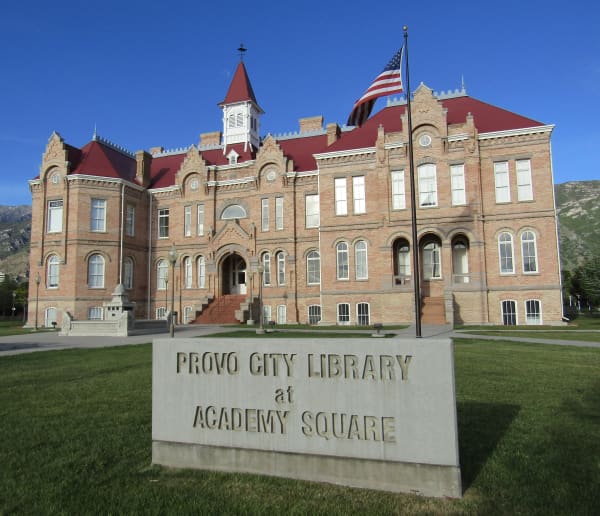
From Provo, closer to home. The Provo City Library at 550 N. University Ave. occupies the old Brigham Young Academy building. Susa Young Gates founded the academy's music department after enrolling in 1878, before that building existed; our Brigham Young Academy history explains where the school met in those years. If the genealogy side of Gates's career interests you, our Family History Library visitor guide covers planning a research trip to Salt Lake City.
Reading the sources yourself
The best primary sources are online and free. The Utah State Archives has digitized the 1870 act, the 1895 convention records and the 1919 ratification papers, including Martha Hughes Cannon's 1896 election financial disclosure. Utah Women's History, the Better Days site, has biographies and a year-by-year timeline. The Utah Historical Society's History To Go site has the Utah History Encyclopedia entries quoted above, and the National Park Service has articles on Utah and on suffrage across the West.
A few cautions from comparing them:
- "First to vote." Accurate when stated as the first woman to vote under an equal suffrage law. Not proven beyond the Deseret News's "we believe."
- Niece or grandniece. Seraph Young was a grandniece of Brigham Young in the Better Days biography; some short summaries say niece.
- 1869 or 1870. Utah's act is 1870. The 1869 law was Wyoming's.
- When the vote came back. The constitution was written and ratified in 1895, but it took effect with statehood on Jan. 4, 1896, so sources may say either year.
- 1919 dates. The Legislature voted Sept. 29-30; the governor signed in early October.
For the wider story of how Utah got to statehood, see our guide to Utah's road from territory to state, and for the town that grew up around all of it, start with our short history of Provo. The Utah War guide covers the federal-territorial conflict of a generation earlier, and our famous people from Utah Valley collects other figures from the region.
Related Guides
- A Short History of Provo: From Fishing Camp to College Town
- Brigham Young Academy: The Building That Became the Library
- The Utah War of 1857-58: Johnston's Army, the Move South and Camp Floyd
- From Territory to State: How Utah Became the 45th State in 1896
- The Family History Library in Salt Lake City: How to Plan a Visit
- FrontRunner from Provo: What to Know Before You Ride
- Provo's Historic Districts
Sources: Utah Division of State History ("Women's Suffrage: 1870-1896" on I Love History; Utah History Encyclopedia entries on woman suffrage by Jean Bickmore White and on Martha Hughes Cannon by John Sillito and Constance Lieber, and "Brief History of Utah," on History To Go); Utah State Archives (1870 act record, "150 Years of Utah Suffrage," Constitutional Convention records); National Park Service ("Women's Suffrage in Utah," "Utah and the 19th Amendment," the US suffrage timeline and the 19th Amendment by state page); Architect of the Capitol; Utah State Capitol (tours, House Chamber murals, Emmeline B. Wells bust); Utah Women's History / Better Days (biographies of Seraph Young and Emmeline B. Wells, the ratification article, the "A Path Forward" article and the "Thinking Women" timeline); the Church Historian's Press; the Encyclopedia of Mormonism (BYU); Visit Utah; KSL; KPCW. All checked Nov. 14, 2026.
Frequently Asked Questions
When did women get the right to vote in Utah?
Who was the first woman to vote in Utah?
Didn't Wyoming give women the vote first?
Why did Utah women lose the vote in 1887?
How did Utah women get the vote back?
Who was Martha Hughes Cannon?
Where is the Martha Hughes Cannon statue?
When did Utah ratify the 19th Amendment?
Sources
The facts in this guide were checked against these sources. Hours, fees and rules change, so confirm anything time-sensitive with the source before you go. How we make Provo.com.
- Women's Suffrage: 1870-1896, Utah Division of State History (I Love History). Checked November 14, 2026.
- Women's Suffrage in Utah (Utah History Encyclopedia, Jean Bickmore White), Utah Historical Society, History To Go. Checked November 14, 2026.
- Martha Hughes Cannon (Utah History Encyclopedia), Utah Historical Society, History To Go. Checked November 14, 2026.
- Brief History of Utah: Statehood, Utah Historical Society, History To Go. Checked November 14, 2026.
- 150 Years of Utah Suffrage: Stories of Utah Women, Utah State Archives. Checked November 14, 2026.
- Constitutional Convention (1895) Records and Dockets, Utah State Archives. Checked November 14, 2026.
- 1870 Acts and Bills: Act conferring upon women the elective franchise, Utah State Archives (FromThePage). Checked November 14, 2026.
- Women's Suffrage in Utah, National Park Service. Checked November 14, 2026.
- US Women's Suffrage Timeline 1648 to 2016, National Park Service. Checked November 14, 2026.
- 19th Amendment by State, National Park Service. Checked November 14, 2026.
- Utah and the 19th Amendment, National Park Service. Checked November 14, 2026.
- Martha Hughes Cannon Statue, Architect of the Capitol. Checked November 14, 2026.
- Utah State Capitol: Tours, Utah State Capitol. Checked November 14, 2026.
- House Chamber Murals, Utah State Capitol. Checked November 14, 2026.
- Emmeline B. Wells, Utah State Capitol. Checked November 14, 2026.
- Seraph Young Ford, Utah Women's History / Better Days. Checked November 14, 2026.
- How Utah Women Gained the Right to Vote in 1870 (Part 1), Utah Women's History / Better Days. Checked November 14, 2026.
- Meet the Women Who Led Utah in Ratifying the 19th Amendment, Utah Women's History / Better Days. Checked November 14, 2026.
- Thinking Women: A Timeline of Suffrage in Utah, Utah Women's History / Better Days. Checked November 14, 2026.
- Emmeline B. Wells, Utah Women's History / Better Days. Checked November 14, 2026.
- A Path Forward, Utah Women's History / Better Days. Checked November 14, 2026.
- The First Fifty Years of Relief Society, Document 3.17, Church Historian's Press. Checked November 14, 2026.
- Gates, Susa Young, Encyclopedia of Mormonism (BYU). Checked November 14, 2026.
- Utah Women's History and Suffrage Sites, Visit Utah. Checked November 14, 2026.
- The 1st woman in US history to cast a ballot was from Utah, KSL. Checked November 14, 2026.
- Statue of first woman state senator elected in Utah unveiled at U.S. Capitol, KPCW. Checked November 14, 2026.