Utah asked to join the Union for the first time in 1849, two years after the first Latter-day Saint wagon companies reached the Salt Lake Valley. It got in on Jan. 4, 1896. In between came seven constitutions or conventions, a territory government run by presidential appointees, a federal army, a string of federal laws aimed at plural marriage, the seizure of church property, the loss and recovery of women's right to vote, and the rebuilding of the territory's whole political system from the ground up. When the news finally arrived, Provo was a county seat of about 6,000 people with an academy of about 400 students and a woolen mill employing 150, by historian Richard D. Poll's count.
This guide follows that road year by year, using the Utah Historical Society, the Utah State Archives, the Utah Legislature's transcript of the 1895 convention, the Church of Jesus Christ of Latter-day Saints' own history pages and the American Presidency Project. Where the sources disagree, or where the history is still argued about, we say who says what.
| Milestone | Date | Source |
|---|---|---|
| State of Deseret constitution drafted | March 1849 (records disputed) | Utah Historical Society |
| Utah Territory created | Sept. 9, 1850 | Utah Historical Society |
| Statehood attempts | Seven, 1849 to 1895 | Utah State Archives |
| Edmunds-Tucker Act | 1887 | Utah Historical Society |
| Woodruff Manifesto | Sept. 24, 1890 | Church of Jesus Christ |
| Enabling Act signed | July 16, 1894 | Proclamation 382 |
| Constitutional convention | March 4 to May 8, 1895 | Utah Historical Society |
| Constitution ratified | Nov. 5, 1895 | Utah Historical Society |
| Statehood proclaimed | Jan. 4, 1896 | Proclamation 382 |
| State officers inaugurated | Jan. 6, 1896 | Thrive125, Utah Historical Society |
1849: the State of Deseret
The Salt Lake Valley was Mexican territory when the first pioneer companies arrived in July 1847. Linda Thatcher's "Struggle for Statehood Chronology," published by the Utah Historical Society on its History To Go site, notes that the Treaty of Guadalupe Hidalgo transferred it to the United States on Feb. 2, 1848, and church leaders began planning for statehood.
The result was the State of Deseret, a name taken from the Book of Mormon, where it means "honeybee." According to Thatcher, a constitutional convention opened in Salt Lake City on March 8, 1849, and drafted a constitution on March 10. Brigham Young was elected governor on March 12, with Willard Richards as secretary, Newell K. Whitney as treasurer and Heber C. Kimball as chief justice. Almon W. Babbitt was sent to Congress as the would-be state's representative.
Poll, writing the "Deseret" entry for the Utah History Encyclopedia, adds a complication: the convention was "reportedly" held in March, but its records, he writes, were created in July 1849 by a council of church leaders, who saw that there was no time to go through the normal sequence of statehood steps. John M. Bernhisel left Great Salt Lake City on May 3, 1849, carrying petitions with several thousand signatures that asked Congress for a Territory of Deseret.
The state Deseret's founders imagined was enormous. Poll says it covered the Great Basin, the Colorado River drainage and a corridor to the Pacific near San Diego. Thatcher says it reached east to the Continental Divide.
Deseret also did real governing. Its General Assembly first met in January 1850 and, in Poll's account, organized county governments and incorporated Great Salt Lake City, Ogden, Provo and Manti. It created a militia, levied property and liquor taxes, regulated water and timber, and incorporated the church, the Perpetual Emigrating Fund Company and the University of Deseret. Provo's own charter dates to this period; our short history of Provo covers the town's founding years and the conflict with the Timpanogos that came with them.
1850: a territory instead of a state
Congress said no. Sen. Stephen A. Douglas presented the Deseret papers on Dec. 27, 1849, Thatcher writes, and the House refused to seat Babbitt. Two objections stood out: the region did not have the 60,000 eligible voters Congress expected for statehood, and the proposed state was far too big.
As part of the Compromise of 1850, the Senate passed a bill creating Utah Territory on Sept. 7, 1850, and the House passed it on Sept. 9. President Millard Fillmore signed it the same day, and the Senate confirmed his appointments on Sept. 30, with Brigham Young as governor. The Utah State Archives, in its 2021 "Utah's Road to Statehood: 125 Years" post, sums up the first rejection the same way: too large, and short of population.
Deseret did not disappear all at once. The General Assembly dissolved the state on April 4, 1851, on Young's recommendation, and the new territorial legislature re-enacted Deseret's laws on Oct. 4, 1851, according to Poll. He also describes a "shadow government" that held annual Deseret General Assembly sessions from January 1862 to January 1870. Poll closes his entry by noting that Utah's beehive symbol still commemorates the idea.
A territory was a lesser status than a state. The president appointed the governor, the secretary and the federal judges, and Congress could override the territorial legislature. That structure is the background to nearly everything that follows.
The middle attempts: 1856, 1862, 1867 and 1872
Thatcher's chronology walks through each later try.
- 1856. Under President Franklin Pierce, the fifth territorial legislature, meeting in Fillmore, authorized a constitutional convention on Dec. 10, 1855. The 1856 effort went nowhere. The following year President James Buchanan replaced Young as governor and sent an army to Utah, the episode covered in our guide to the Utah War and Camp Floyd.
- 1862. In December 1861 the legislature called another convention. Gov. John W. Dawson vetoed the bill and left Utah on Dec. 31. Voters elected delegates anyway on Jan. 6, 1862, and 67 delegates met beginning Jan. 20 and finished a constitution for Deseret by Jan. 23. Bernhisel, by then Utah's delegate in Congress, presented it to the House on June 9. It failed. That same year Congress passed the Morrill Anti-bigamy Act, which Thatcher says banned polygamy in the territories and disincorporated the church but was rarely enforced.
- 1867. In January the legislature asked Congress both to repeal the Morrill Act and to admit Utah. Neither happened.
- 1872. A convention opened Feb. 19 in Salt Lake City's City Hall and adopted a constitution by March 2. Voters ratified it on March 18 by 25,160 to 365, Thatcher writes, but Congress referred it to committee on April 2, and the committee reported it unfavorably.
Two other events of these years changed the territory's politics. The transcontinental railroad was completed at Promontory on May 10, 1869, ending Utah's isolation and, in Thatcher's words, increasing tensions between Latter-day Saints and "gentiles," the local term for non-members. In February 1870, non-members and dissident Latter-day Saints organized the Liberal Party. Until the national parties arrived two decades later, Utah politics was essentially a contest between the Liberal Party and the church-aligned People's Party, divided along religious lines.
The railroad era also reshaped Utah County. The Pony Express and overland telegraph had already crossed the west side of the county; our guide to the Pony Express in Utah covers those sites.
Why Congress kept saying no
The Utah State Archives is direct about it. Later rejections cited population requirements, its 2021 post says, but the real concerns were the church's bloc voting and polygamy. Thatcher dates the public acknowledgment of plural marriage by church authorities to 1852 and calls polygamy the main obstacle to statehood for the next 38 years.
The Utah Historical Society's statehood overview adds a demographic point: non-members made up 10 percent or less of Utah's population and were concentrated in Salt Lake City and other urban areas and in mining and railroad towns. To many in Congress, admitting Utah meant handing a state government to a single church. Historian Stanford J. Layton, writing in the Historical Society's History Blazer in 1995, says the federal effort to change that has been called "the Americanization of Utah for Statehood."
The federal laws: Morrill, Poland, Edmunds and Edmunds-Tucker
Congress spent three decades passing laws aimed at plural marriage and at the church's political power. The summaries below draw on Thatcher's chronology and the Church of Jesus Christ's own history topic on antipolygamy legislation.
- Morrill Act, 1862. The church history topic says it made bigamy punishable by a fine and five years in prison. Enforcement was weak during the Civil War.
- Poland Act, 1874. Passed by both houses on June 23, 1874. Thatcher says it shifted civil and criminal jurisdiction to federally appointed district courts and limited the church-controlled probate courts. The church page says it gave federal judges jurisdiction over antipolygamy prosecutions and a hand in selecting jurors.
- Reynolds v. United States, 1879. On Jan. 6, 1879, the U.S. Supreme Court unanimously upheld George Reynolds's conviction and the federal ban. The church history page says the First Presidency helped bring the case and that the court held the First Amendment protected religious belief but not religious practice.
- Edmunds Act, 1882. Signed by President Chester A. Arthur in March 1882. Thatcher says it made "unlawful cohabitation" easier to prove, barred polygamists and cohabitants from voting, holding office and serving on juries, and created a five-member Utah Commission to oversee elections. The church page says cohabitation was punishable by a fine or six months in prison.
- Edmunds-Tucker Act, 1887. The Senate passed it in January 1886, the House stalled it until February 1887, and President Cleveland let it become law without his signature. Thatcher and the church history page agree that it took church property valued above $50,000 and ended woman suffrage in the territory.
The Historical Society's statehood overview says arrests for polygamy greatly increased after 1883. Church members called the enforcement period "the raid," and the church history page says that between 1885 and 1889 most apostles, stake presidents and other leaders were in hiding or in prison, while many families moved to Canada or Mexico. On May 2, 1885, a mass meeting in the Salt Lake Tabernacle adopted a "Declaration of Grievances and Protest," which a delegation presented to Cleveland on May 13, Thatcher writes.
Utah kept applying throughout. A convention met April 10 to 27, 1882, and wrote a constitution under the name Utah rather than Deseret; voters ratified it May 22, and Congress did nothing beyond referring bills to committee. Another met June 30 to July 7, 1887, and this time the draft called polygamy incompatible with republican government. Voters ratified it Aug. 1, and Congress held hearings in 1888 but did not admit the territory.
1890: the Manifesto
On Sept. 24, 1890, church President Wilford Woodruff wrote the statement now known as the Manifesto. Thatcher says it was released to the Associated Press on Sept. 25. The text, published today as Official Declaration 1 in the church's Doctrine and Covenants, says: "We are not teaching polygamy or plural marriage, nor permitting any person to enter into its practice." Woodruff declared his "intention to submit to those laws" and advised members "to refrain from contracting any marriage forbidden by the law of the land." The church accepted the declaration as authoritative and binding at its general conference on Oct. 6, 1890.
How to read the Manifesto is still discussed. The church's history topic says the end of plural marriage was "a process rather than a single event," and the Utah State Archives notes that some members continued the practice in secret. Thatcher calls the Manifesto a major doctrinal shift that cleared the way toward statehood. All three agree it was the turning point.
1891 to 1894: new parties and amnesty
Layton's History Blazer article argues that after the Manifesto, "the march to statehood stalled," and not over polygamy or theocracy but over party politics. Utah's two territorial parties tracked religion, and neither national party wanted to admit a state whose votes were unpredictable or locked to the other side.
The fix was to dissolve the local parties. On May 29, 1891, the People's Party voted to disband and urged members to join the national parties, Thatcher writes. Democrats and Republicans organized that July. The Liberal Party held on longer and disbanded on Dec. 18, 1893. Layton writes that church leaders sought to "assign" members to both national parties to balance Utah politics, and he credits the eventual statehood to that rebalancing. He also notes the long-run result: a two-party commitment in Utah and a tendency to vote with national trends.
Amnesty followed. Layton says President Benjamin Harrison offered an amnesty in 1893, and that the Utah Commission ruled that year that "amnestied polygamists be allowed to vote." In September 1894 Cleveland pardoned and restored voting rights to Utahns who had been disqualified for practicing polygamy.
The Enabling Act of 1894
Congress passed the Utah Enabling Act in July 1894. Layton gives July 10 as the date the Senate passed it, and Cleveland's later proclamation says the act was "approved on the 16th day of July, 1894." It invited Utah to elect delegates to a convention at the seat of territorial government "on the first Monday in March, 1895," to write a constitution and submit it to voters "on the Tuesday next after the first Monday of November, 1895."
The act came with conditions. The Utah State Archives says it required the constitution to include a clause banning polygamy. The finished document's Article III reads: "Polygamy or plural marriage are forever prohibited." The Archives notes that this provision could be changed only with the consent of the United States as well as the state.
The act also set representation. The opening-day transcript of the convention, published by the Utah Legislature, reproduces the act's apportionment, which gave Utah County twelve delegates. Layton writes that a statehood celebration followed the signing at Saltair Resort.
The 1895 constitutional convention
Voters, only men at that point, elected delegates on Nov. 6, 1894. Layton counts 107 delegates: 59 Republicans and 48 Democrats, 28 of them non-members of the church, including one Methodist Episcopal minister. His occupational tally includes 28 farmers and ranchers, 15 lawyers, 13 merchants, eight mining businessmen and six educators. The Utah State Archives' 2021 "Finish Line" post gives a slightly different count, 109 seats with 79 filled by Latter-day Saints. The Archives' own convention records page uses 107, the number in the Enabling Act.
The convention opened at noon on Monday, March 4, 1895, in the new Salt Lake City and County Building, where James N. Kimball of Weber County was elected temporary president, the transcript shows. John Henry Smith of Salt Lake City, one of four church General Authorities elected as delegates, presided as permanent president, according to Layton and the transcript's list of officers. The delegates finished on May 6 and signed the document on May 8, Thatcher writes.
The Archives' "Finish Line" post lists the three most debated subjects as prohibition, women's suffrage and polygamy. Polygamy was settled by the Enabling Act. Prohibition was left to a future legislature.
Suffrage was harder. Utah women had voted under territorial law starting in 1870 and lost the vote under the Edmunds-Tucker Act in 1887. According to the Utah Women's History site (utahwomenshistory.org), every delegate had pledged support for equal suffrage, but B. H. Roberts of Davis County argued that including it could sink the constitution with voters or Congress and proposed a separate vote after statehood. Orson F. Whitney and Franklin S. Richards argued the other side. Delegates voted 75 to 14 for suffrage on April 5, with 12 absent, and suffrage passed its final vote on April 18. The finished Article IV says the rights of Utah citizens "to vote and hold office shall not be denied on account of sex."
Utah voters ratified the constitution on Nov. 5, 1895, and elected the first state officers and legislators at the same election. Layton says the voters chose a Republican governor, a Republican congressman and a Republican legislature by narrow margins.
Jan. 4, 1896: Statehood Day
Cleveland signed the proclamation on Saturday, Jan. 4, 1896. The American Presidency Project at UC Santa Barbara lists it as Proclamation 382, countersigned by Secretary of State Richard Olney, and its closing passage declares that the creation of the state and its admission into the Union "on an equal footing with the original States is now accomplished." Utah was the 45th state.
The Utah State Archives says a telegraph station worker fired two shots into the air as a prearranged signal, and the news spread quickly. Emmeline B. Wells, the suffrage leader and editor whose diaries the Church Historian's Press has published, wrote that the morning was "bright and clear and very beautiful," that she knew the proclamation was signed when the guns fired a salute, and that the city was "streaming with flags and banners." The Archives post describes a 21-gun salute, dances, sleigh processions and parades, and says Gov. Heber M. Wells later asked residents to set candles in their windows to "symbolize Utah's emergence from the darkness of being a territory into the light of Statehood."
The formal ceremony waited until Monday, Jan. 6. Acting territorial Gov. Charles C. Richards closed schools and businesses so residents could celebrate "in a manner becoming a free, intelligent and patriotic people," according to Thrive125, the state's history project for the 125th anniversary. State officials were inaugurated in the Salt Lake Tabernacle under a flag sewn from 1,296 yards of bunting that covered the domed ceiling, and an electric light lit Utah's new 45th star. Wells, 36, received the pen Cleveland had used and, in his address, congratulated women "on their entrance into the full enjoyment of civil and political rights." Woodruff wrote in his journal that "We have Never seen such a Day as this."
Thrive125 lists celebrations around the state: a sunrise service in Manti, a parade in Brigham City with 45 women representing the states, a Nephi parade with 27 women representing the counties, and a youth-organized parade in Park City. It also records accidental gunfire injuries in some towns and a fire that destroyed Fillmore's Liberty Hall after a ball.
Provo and Utah County at statehood
Poll's essay "A State Is Born," republished by the Utah Historical Society, gives a snapshot of the new state. The 1895 territorial census counted 247,324 people, more than five existing states. About eight in 10 residents were American-born and nearly nine in 10 were Latter-day Saints. Salt Lake City had about 50,000 people.
Provo, in Poll's description, was a quiet county seat of about 6,000. Brigham Young Academy, the school whose original downtown building now houses the city library, had about 400 students; our guide to Brigham Young Academy tells that building's story. Provo had a steam-powered street railway about six miles long, and the Provo Woolen Mills, with 150 employees, was the largest surviving example of pioneer industry.
Utah County sent twelve delegates to the 1895 convention under the Enabling Act's apportionment. Of the sources we checked today, only the Legislature's transcript ties a delegate to the county by name: a committee list for March 5, 1895, includes "Corfman, Utah." A full roster by county is in the convention's roll call book, held in Utah State Archives series 3212, and we have not confirmed the other eleven names. Provo-area newspapers from the period, including the Provo Daily Enquirer, are in the University of Utah's Utah Digital Newspapers collection for anyone who wants to read the local coverage from January 1896.
Statehood also brought federal money. Utah State Parks says the Fairfield District School at Camp Floyd was "constructed in 1898 with federal funds received when Utah became a state in 1896"; our Cedar Fort and Fairfield guide covers visiting it.
How historians frame it
The sources we used agree on the sequence and differ on emphasis. The Utah State Archives frames the long delay mainly around polygamy and bloc voting. Thatcher's chronology follows the federal legislation and the church's response. Layton stresses party politics and argues that the years after 1890 were about building a two-party system that national Republicans and Democrats could accept. Poll calls Jan. 4, 1896, "more than the birthday of a state," describing it as "the wedding of Utah and the nation," and points to the prayers that opened and closed the inauguration as a sign of a new policy of peaceful coexistence between faiths.
The church's own history pages present the end of plural marriage as a process directed by revelation, while the federal laws are presented in state histories as part of a campaign to bring Utah's institutions in line with national norms. Readers looking for book-length treatments will find two cited repeatedly by the Archives and the Historical Society: Edward Leo Lyman's "Political Deliverance" (1986) and "Finally Statehood! Utah's Struggles" (2019).
Where to see statehood history from Provo
The three buildings below are in Salt Lake City, north of Provo on I-15. Hours below are as posted by each institution when we checked on Nov. 14, 2026.
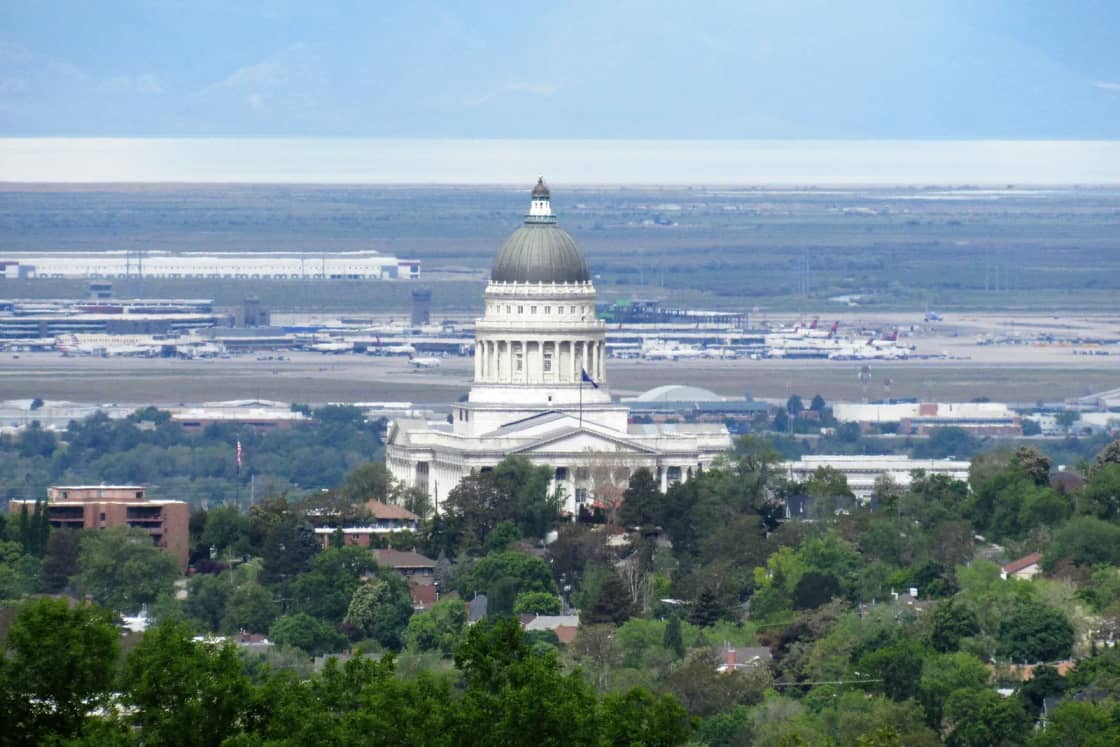
Utah State Capitol, 350 N. State St. It is the seat of the state government the 1895 constitution created. The Capitol's site lists building hours of 7 a.m. to 8 p.m. Monday through Thursday and 7 a.m. to 6 p.m. Friday through Sunday and holidays. Guided tours begin on the hour from 10 a.m. to 3 p.m., Monday through Friday except state holidays, start at the Visitor Center just inside the east entrance, and last about 40 to 45 minutes. Groups need a reservation, and self-guided visits are allowed any time the building is open. The Capitol says no guided tours run Nov. 25-27, 2026, or from Dec. 7, 2026, through Jan. 1, 2027. Visitor Services: 801-538-1800.
Utah State Archives, 346 S. Rio Grande St. The convention's papers are series 3212, which includes the Enabling Act, a roll call, transcripts, petitions and committee recommendations, and series 12795, the convention dockets. Much of series 3212 is digitized in the Archives' online Digital Archives, so you can read it from Provo. The building lists hours of 8 a.m. to 5 p.m., but the Archives says all in-person research is by appointment only and its facilities are not open to the public without one. Call 801-531-3848.
Pioneer Memorial Museum, 300 N. Main St. Run by the Daughters of Utah Pioneers. Its website lists hours of 9 a.m. to 4:30 p.m. Monday through Friday and free admission. Its displays focus on the period from the first settlers' arrival through 1869, so it covers the Deseret and early territorial years rather than 1896 itself.
Online, from home. The Utah Legislature publishes a day-by-day transcript of the 1895 convention on le.utah.gov. The Church History Department publishes the Manifesto as Official Declaration 1, and the Church Historian's Press has posted Emmeline B. Wells's diaries, including her January 1896 entries.
Closer to home, Provo's downtown still holds buildings that stood when statehood came. Our Center Street walking tour and the Tabernacle Block walking history are good ways to see the 1890s city on foot.
Related Guides
- A Short History of Provo: From Fishing Camp to College Town
- The Utah War of 1857-58: Johnston's Army, the Move South and Camp Floyd
- The Pony Express in Utah: Stations, Trail Sites and What You Can Still See
- Brigham Young Academy: The Building That Became the Library
- The Provo Woolen Mills
- The Tabernacle Block: A Walking History of Provo's Most-Used City Block
Frequently Asked Questions
When did Utah become a state?
How many times did Utah apply for statehood?
What was the State of Deseret?
Why did it take so long for Utah to become a state?
What did the Enabling Act require?
Did Utah's 1895 constitution give women the vote?
Who was Utah's first state governor?
Where can I see Utah statehood documents near Provo?
Sources
The facts in this guide were checked against these sources. Hours, fees and rules change, so confirm anything time-sensitive with the source before you go. How we make Provo.com.
- Struggle for Statehood Chronology (Linda Thatcher), Utah Historical Society, History To Go. Checked November 14, 2026.
- Utah Historical Society, History To Go: Statehood, Utah Historical Society, History To Go. Checked November 14, 2026.
- Deseret (Richard D. Poll, Utah History Encyclopedia), Utah Historical Society, History To Go. Checked November 14, 2026.
- Party Politics and Utah Statehood (Stanford J. Layton), Utah Historical Society, History To Go. Checked November 14, 2026.
- The Hatchet is Buried, The Constitutional Convention is Called (Stanford J. Layton), Utah Historical Society, History To Go. Checked November 14, 2026.
- A State Is Born (Richard D. Poll), Utah Historical Society, History To Go. Checked November 14, 2026.
- Utah's Road to Statehood: 125 Years, Utah State Archives. Checked November 14, 2026.
- Utah's Road to Statehood: The Finish Line, Utah State Archives. Checked November 14, 2026.
- Constitutional Convention (1895) Records and Dockets, Utah State Archives. Checked November 14, 2026.
- Utah State Archives: Contact Us, Utah State Archives. Checked November 14, 2026.
- Constitutional Convention, Day 1 (March 4, 1895), Utah State Legislature. Checked November 14, 2026.
- Constitutional Convention, Day 2 (March 5, 1895), Utah State Legislature. Checked November 14, 2026.
- January 6, 1896, State of Utah, Thrive125. Checked November 14, 2026.
- Utah State Capitol: Tours, Utah State Capitol. Checked November 14, 2026.
- Utah State Capitol: Visit, Utah State Capitol. Checked November 14, 2026.
- Camp Floyd State Park Museum History, Utah State Parks. Checked November 14, 2026.
- Proclamation 382: Admitting Utah to the Union, The American Presidency Project, UC Santa Barbara. Checked November 14, 2026.
- Emmeline B. Wells diaries, January 1896, Church Historian's Press. Checked November 14, 2026.
- Suffrage in Utah's Constitutional Convention, Utah Women's History. Checked November 14, 2026.
- Official Declaration 1, The Church of Jesus Christ of Latter-day Saints. Checked November 14, 2026.
- Antipolygamy Legislation, The Church of Jesus Christ of Latter-day Saints. Checked November 14, 2026.
- The Church of Jesus Christ of Latter-day Saints: Manifesto, The Church of Jesus Christ of Latter-day Saints. Checked November 14, 2026.
- The Pioneer Memorial Museum, International Society Daughters of Utah Pioneers. Checked November 14, 2026.