
Axe throwing arrived in Utah Valley the way it arrived everywhere else — as a novelty that sounded faintly alarming — and then it did something novelties usually do not. It stayed, it filled up, and it became a normal Friday night option here alongside bowling and escape rooms.
The venue on University Avenue in downtown Provo now carries a review count in the thousands at a rating just under five stars, which for a category this niche is a genuinely striking number. It suggests something beyond curiosity traffic: people are going back.
This guide covers what a session actually involves, the two venues in the county, the rage-room cousins that share the same crowd, and the practical details — ages, footwear, group size, booking — that determine whether the evening works.
Heber Hatchets — 261 N University Avenue, Provo
The Provo venue, and the default recommendation for anyone in the Provo–Orem corridor.
It sits upstairs on the downtown University Avenue strip, above a restaurant, which is the detail that shapes the whole experience: you can order food from downstairs and have it brought up while you throw. Reviewers name the burgers specifically, and the sweet potato fries turn up more than once. That single logistical fact — food during, not before — is why groups pick it over driving north.
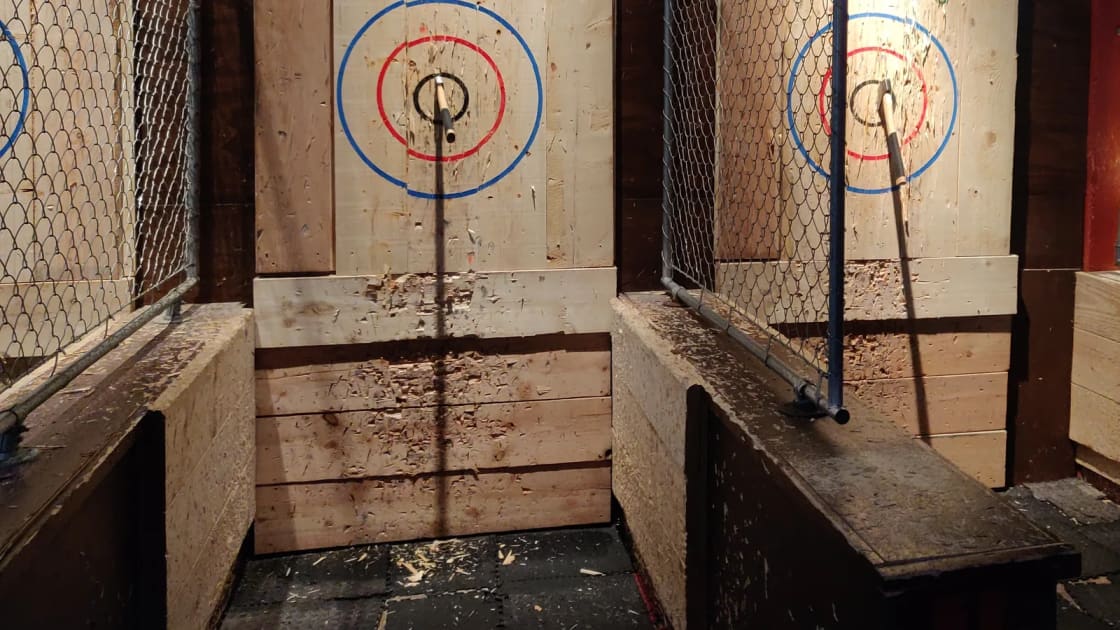
The format is straightforward. You arrive, sign a waiver, and a coach walks your group through the throw. Lanes are caged and you throw one at a time. Roughly fifteen minutes into your block, staff typically offer to swap in hatchets and throwing stars, which is the point at which most groups stop being nervous and start competing. The walls carry marked target games, so an hour has structure rather than being sixty minutes of the same throw.
The stated minimum age is around six with supervision, which is younger than most people expect and makes this a viable family activity rather than an adults-only one. Reviews from parents with elementary-age children are common and positive.
The recurring criticism, stated fairly: target board condition. More than one reviewer describes boards with chunks of plank missing and the venue looking worn in that specific respect. Boards take a beating by design and get replaced on a cycle; if you happen to book at the end of one, the throw is less satisfying because the axe does not bite cleanly. It is the single most repeated complaint and worth knowing.
Closed Sundays. Runs to around nine on weeknights and ten on Friday and Saturday.
Axe N Smash — 76 N 100 East, American Fork
The north-county option, about twenty-five minutes from Provo, and a bigger operation than its location suggests — it carries thousands of reviews at a rating just under five.
The distinguishing feature is that it does two things under one roof: axe throwing lanes and a smash room. Groups routinely book both, and the sequencing is part of the appeal — break things for half an hour, then throw axes for half an hour, then go home. The smash room draws even stronger reviews than the lanes.
Practical details that come up repeatedly and favorably: waivers and booking can be completed ahead of time online, which reviewers explicitly credit for making arrival painless; you choose your own music; and parents can watch the smash room by camera while teenagers are inside. Staff, and the owner in particular, are named constantly in reviews — this is a small operation where the person running it is on the floor.
It handles groups well, including birthday parties in the twelve-to-fifteen range, which is worth knowing because axe lanes are usually a poor fit for large parties. The combination of two activities is what makes it work: half the group throws while half smashes, then they swap.
Closed Sundays, opens midday most days and later on Monday. It slots naturally into a north-valley evening with things to do in American Fork.
The rage rooms, which are the same night out
Three venues in the county sell the adjacent experience, and they draw the same bookings — birthdays, bachelorette parties, double dates, work groups looking for something that produces a story.
Red Giant Experiences — 1658 S State Street, Orem. Run by the same operators as the escape rooms next door. There is a standard rage room, an XL rage room sized for larger groups, and a splatter room where the medium is paint rather than destruction: lights down, your own playlist, and you throw paint at walls and each other. Reviewers describe it as the most memorable group activity they have done locally, which is high praise in a county with this much competition. Closed Sundays; runs very late on Friday and Saturday.
Smash It Rage Rooms — 170 S State Street, Orem. The pricing model here is the interesting part: you can bring your own items to destroy, priced by weight, or choose from the venue's inventory. Sledgehammers, bats and crowbars are provided; there is a glass-throwing area that tracks throw speed, and a paint room. Critically, it posts Sunday afternoon hours, which almost nothing in this category does. Reviewers do flag that floors in some rooms feel soft underfoot.
Axe N Smash in American Fork, covered above.
If your group's actual requirement is catharsis rather than marksmanship, the smash rooms are the better product, and they take larger groups more comfortably.
What a session is actually like
The mental image most first-timers have is wrong in a useful direction — it is less dangerous and more technical than they expect.
You throw inside a cage. Every commercial lane is enclosed. Only one person throws at a time, and nobody walks forward to retrieve until the coach clears the lane. That rule is the entire safety model and it is enforced.
The technique is coached and it is not obvious. Most people's instinct is to throw hard. Hard is wrong. The axe has to complete a specific number of rotations over the distance to the board, which means the variables that matter are your release point and your distance from the line, not your arm strength. This is why the smallest person in your group frequently outperforms the largest, and why it is a genuinely level activity.
Overhand and underhand both work. Coaches usually start groups overhand — both hands, straight over the head, release at eye level. Some people find underhand far easier immediately. Ask to try both.
Sticking is the reward and it is binary. The axe either bites the wood or it clatters to the floor. There is no partial credit, which makes the feedback loop immediate and weirdly addictive. First sticks usually happen within ten throws.
Your shoulder will notice. An hour is the right length. Two hours is how people end up sore for two days.
Group sizing and booking
Axe lanes are sold as time blocks per lane, not per throw, which drives the arithmetic.
Two to four people per lane is ideal. With four, everyone throws often enough to improve. With eight on one lane, most of the hour is spent watching.
Larger groups need multiple lanes, and this is where booking ahead stops being optional. A party of twelve is three lanes, and three simultaneous lanes on a Friday evening will not be available on a walk-in basis.
Weekday afternoons are the walk-in window. Both venues open around midday most days, and the early afternoon is genuinely quiet.
Corporate and church groups are common here and both venues are set up for them. Axe N Smash's combination format handles a party of fifteen better than a pure axe venue can.
What to wear and bring
Closed-toe shoes. This is the one hard rule and it is enforced. Sandals will get you turned away.
Something you can swing in. The overhead throw is a full extension. Anything restrictive across the shoulders is the wrong choice, and anything short at the waist becomes a nuisance.
Hair tied back, for the obvious reason.
Nothing else. You are not gripping the blade, the axes are supplied, and there is no equipment to buy. For smash rooms, add clothes you do not care about — the paint at Red Giant reportedly washes out, but nobody should test that theory in something they like.
Competitive throwing, if you get hooked
A surprising number of people who go once for a birthday come back on purpose, and there is a structured path if that happens to you.
Axe throwing has real governing bodies and standardized rules — target dimensions, throwing distance, scoring rings, and the small "killshot" targets in the upper corners that are worth more and can only be called in specific rounds. Venues in this category typically run on one of those rulebooks, which is why the scoring on the wall looks more formal than a novelty activity requires.
What that means practically for a Utah Valley thrower: the games marked on the wall at both local venues are not invented house rules, they are standard formats, and the technique a coach teaches you in your first ten minutes is the same technique a competitive thrower uses. League play, where it runs, is usually a weekly evening block over several weeks with a fixed roster. Availability changes, so ask at the desk rather than assuming — a venue with lanes full of birthday parties on weekends often has quiet Tuesday capacity it would rather fill with a league.
The equipment question comes up fast. Unlike bowling, you do not need to buy anything: house hatchets are standardized and most venues would rather you use theirs. What improves is your consistency in distance and release, and that only comes from repetition.
How this became a Provo activity
It is worth a moment on why a category that sounds like a bar activity took hold in a county with very few bars.
The commercial axe throwing model spread out of Canada in the 2010s and reached most American metros attached to taprooms — the standard version elsewhere is axes and beer. Utah Valley imported the activity and left that half behind, and the result is a version optimized for something else entirely: groups, families and dates.
That turns out to suit the format better than the original did. Axe throwing is short, it is coached, it is genuinely level between people of different sizes and athletic backgrounds, and it produces a photograph. Those are exactly the properties that make an activity work for a valley whose social life runs on group outings, roommate nights, church activities and first dates — the same demand structure that produced an unusual density of escape rooms and kept the nickel arcades alive here long after they closed elsewhere.
The evidence is in the numbers. A niche activity in a city of Provo's size should not carry thousands of reviews at near-five stars. It does, and the reason is that it is not serving curiosity traffic — it is serving the standing weekly demand for something to do with eight people that costs less than dinner.
Where it fits in a Provo evening
The Provo venue's location does most of the work here. It is on the downtown University Avenue strip, within a short walk of two escape room companies and a block or two from a good share of the city's restaurants. A common local template is dinner downtown, an hour of axe throwing, then dessert — and because the venue serves food from the restaurant below, you can compress that to two stops instead of three.
For couples, it earns its place on the standard rotation for the same reason bowling and mini golf do: it removes the pressure to fill silence, and it puts both people on equal footing at something neither has practiced. It has the additional advantage of being slightly unexpected, which matters in a valley where the date idea list gets worked hard. Our date night activities roundup covers what pairs with it.
For groups — roommates, teams, work departments — it is one of the better options in the county precisely because it is short. An hour of axe throwing is a complete activity. Nobody has to commit to an evening.
If you are nervous about it
A genuine share of first-timers arrive quietly convinced this is a bad idea, and it is worth addressing directly, because the concern is nearly always misplaced.
You will not be handed an axe and left alone. Every session starts with a briefing and a demonstration, and a coach stays with the lane. Nobody throws until they have been watched throwing.
The axes are smaller than you are picturing. These are hatchets, not felling axes — light enough that the throw is about timing rather than force, which is precisely why children and grandparents both manage it.
Bouncebacks look worse than they are. An axe that fails to stick drops in front of the target or skitters along the floor of the cage. That is what the cage is for, and it is why the retrieval rule exists. It is the normal outcome of a bad throw, not an emergency.
Nobody is watching your technique. The single most common first-visit report is surprise at how quickly the nerves go — usually at the first stick, which for most people arrives within ten throws.
If someone in your group genuinely does not want to throw, both venues are comfortable with spectators, and at the Provo location there is food arriving from downstairs to occupy them.
The honest verdict
In Provo: Heber Hatchets, with a booking, on a night when you also want dinner. Accept that board condition varies.
North county, or if you want two activities: Axe N Smash in American Fork, which handles groups better and pairs throwing with a smash room.
If the point is destruction, not accuracy: Red Giant Experiences or Smash It in Orem, and Smash It if it has to be Sunday.
Ages: genuinely family-viable from around six, which is the single most surprising thing about the category here.
Sunday: closed, like nearly everything else. Plan around it — the indoor activities guide has the short list of what stays open.
Hours, age policies and pricing all change; call before you drive, especially around holidays when both venues run reduced schedules.
What You Are Actually Signing at the Door
Every venue on this page will hand you a waiver before you touch an axe, and almost nobody reads it. It is worth two minutes of your attention, because Utah's law on preinjury releases is more favorable to the venue than most people assume — and it has one large exception that matters enormously if you brought a child.
The framework comes from Pearce v. Utah Athletic Foundation, 2008 UT 13, 179 P.3d 760, in which the Utah Supreme Court upheld a release signed by a customer injured on a public bobsled ride. The starting position it confirmed is that preinjury releases are enforceable unless the person challenging one establishes an exception. Utah's public policy, the court had already said in Berry v. Greater Park City Co., does not stop parties bargaining away tort claims based on ordinary negligence.
The court then identified three ways a release can fail: it offends public policy; it covers an activity falling within the public interest exception; or it is unclear or ambiguous. Pearce closed the middle door for anything resembling an axe-throwing lane. The court drew a bright line: recreational activities do not constitute a public interest, so a preinjury release for a recreational activity cannot be invalidated on that ground. Contrast the businesses that traditionally do sit in the public-interest category — utilities, common carriers, innkeepers. A venue that exists to entertain you is not one of them.
The third door stays open, and it is the one worth checking. A release must be communicated in a clear and unequivocal manner, expressing an agreement not to hold the released party liable for negligence. Perfection is not required — the court quoted approvingly the observation that only on a draftsman's Olympus could one combine the elegance of a trust indenture with the brevity of a stop sign — but a document that never plainly says what it is giving up is vulnerable in a way a well-drafted one is not.
Two limits are worth carrying out of the venue with you.
First, a release does not cover gross negligence. Utah distinguishes ordinary negligence, which can be waived, from gross negligence, which cannot, and whether conduct crosses that line is a question for the trier of fact rather than something the paperwork settles in advance. A signature at the door is not a blank check for a venue that ignores its own safety procedures.
Second — and this is the one that changes behavior — a parent cannot sign away a minor child's claim. In Hawkins v. Peart, 2001 UT 94, the Utah Supreme Court held that a preinjury release signed by a parent is not enforceable against the minor child, and it has reaffirmed that position since. Utah law provides checks on a parent's authority to compromise a child's existing cause of action, and a form at a reception desk is not one of the recognized routes around them. So the signature you give on behalf of a fourteen-year-old does not do what the venue's form implies it does. That is not a reason to be cavalier about it — it is a reason to ask about supervision ratios and lane design rather than assuming the paperwork has settled the question of who is responsible.
Utah has also legislated specific carve-outs where a legislative statement of public policy exists, the clearest being skiing, where the Supreme Court held in Rothstein v. Snowbird Corp. that a resort cannot enforce a release against a skier injured by the resort's own negligence. Our skiing guide covers that ground. No equivalent statute exists for axe throwing, which is precisely why the Pearce framework, rather than a bespoke rule, is the one that applies here.
Related Guides
- Jack and Jill Lanes, Lehi: The 1957 Bowling Alley Named After Two Daughters
- Bowling in Provo & Orem: Every Lane in Utah Valley, Ranked by What You Actually Want
- The Grid: Inside Pleasant Grove's Three-Story Indoor Kart Track
- Camping Near Provo: Best Campgrounds & Tips (2026)
- Bachelorette and Bachelor Party Ideas in Utah Valley
Frequently Asked Questions
Where can you go axe throwing in Provo?
How old do you have to be to throw axes in Utah Valley?
Do you need a reservation for axe throwing in Provo?
What should I wear to go axe throwing?
Is axe throwing safe?
Are Utah Valley axe throwing venues open on Sunday?
How long does an axe throwing session last?
Is axe throwing a good date in Provo?