
More on Lehi: every guide we have published there, in one place.
Ask around Provo for the dinosaur museum and you will get one answer: Thanksgiving Point. That answer is right, and it is also incomplete in a way that costs people either money or a good hour.
Utah Valley has two dinosaur museums. One is a large ticketed hall in Lehi built around mounted skeletons and hands-on stations, aimed squarely at families. The other is a free, compact research collection on the BYU campus in Provo with a window looking into an actual fossil laboratory. They are not competing for the same visit. Choosing between them on the assumption that the bigger one is simply the better one is how people end up paying for an afternoon when what they wanted was forty-five minutes.
Here is what each place is, what it costs in time as well as money, and how to tell which one your particular kid is asking for.
Two museums, two entirely different propositions
The distinction is not size, though the size gap is real. It is purpose.
The Mountain America Museum of Ancient Life exists to give visitors an experience of deep time. Its exhibits are arranged chronologically, its skeletons are mounted in dynamic poses, and roughly a third of the floor is given over to things you are meant to touch. It is a destination in the tourism sense — you drive there, you park, you spend most of an afternoon, you buy tickets.
The BYU Museum of Paleontology exists because a university department needed somewhere to prepare, store and study fossils, and then decided to let the public watch. The display space grew out of the collection rather than the other way around. That origin shows in everything about it: the building is unassuming, the labels assume you are curious rather than five, and the most compelling thing in the room is a window into a workshop.
One is a day out. The other is a stop. Both are worth doing, and doing them on the same day is a mistake for reasons covered further down.
The Museum of Ancient Life, in Lehi
The museum sits at 2929 Thanksgiving Way in Lehi, on the Thanksgiving Point campus just off I-15 at the Highland/Alpine exit. From central Provo it is a straightforward run north — around 25 minutes without traffic, longer in the afternoon when the Point of the Mountain does what it does.
The museum describes 60 complete dinosaur skeletons and more than 50 hands-on exhibits, and characterizes its collection as one of the world's largest displays of mounted dinosaurs. It opened in 2000, the product of a collaboration between Thanksgiving Point and a group of Utah paleontologists who wanted a world-class dinosaur museum in the state that supplies so many of the world's dinosaurs.
A note on the numbers, because they matter for anyone comparing museums online. You will find higher figures quoted on tourism listings and directory sites — 120 skeletons, 63 interactive exhibits. Those numbers appear to have been accurate at some point and then simply never got updated. Where a listing site and the operator disagree, use the operator's count. This is a general rule for planning anything in Utah Valley, and it applies to hours and prices at least as much as it applies to skeleton counts.
What "mounted dinosaurs" means, and why it is the whole point
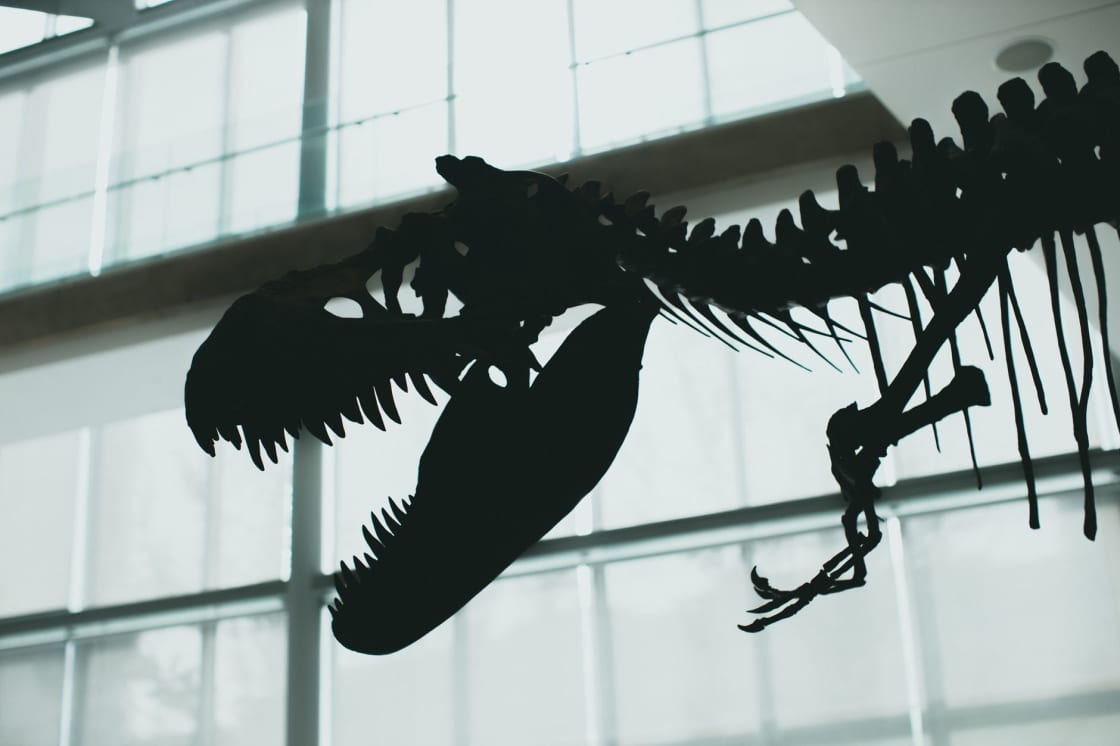
A mounted skeleton is a fossil assembled into a standing, articulated pose on an armature. It is expensive, slow, and expert work, and it is the difference between looking at a bone in a case and standing underneath an animal.
The entrance sets the terms. A life-sized Quetzalcoatlus — a pterosaur with a wingspan comparable to a small aircraft — hangs overhead, and the room is arranged so that you register the scale before you register anything else. Sauropod ribcages arch above the walkway. You pass under animals rather than beside them.
This is what a small child comes for, and it is worth being unsentimental about that. The interpretive panels are good. The chronological walk from the Precambrian forward is well constructed. But the thing that produces the reaction, the thing your kid will describe at dinner, is the moment of standing beneath a skeleton and understanding its size with their body rather than from a number on a sign.
The hands-on half
Two exhibits do most of the work here.
The Erosion Table is a water-and-sand table where children build landscapes and then watch running water take them apart. It is a geology lesson disguised as the best possible version of playing in a sandbox, and it is the single hardest exhibit in the building to extract a child from.
The Quarry Dig lets visitors excavate fossils from a matrix, which is the closest most people get to the actual first step of paleontology. Both of these are wet, sandy activities. Dress accordingly, and put a change of clothes in the car for anyone under six.
The museum also runs a paleontology lab program and periodic feeding demonstrations, and its exhibit lineup rotates — recent additions have included a sauropod-focused STEM exhibit built around comparing your own height and reach to the animals. Because these change, check what is running before you go if a specific exhibit is the reason for the trip.
Tickets, timing, and the pass arithmetic
The museum states that all admission is time-ticketed with limited availability and asks that tickets be purchased in advance. This is worth taking seriously. A Saturday in winter, a school break, or a bad air day will fill the slots, because an indoor destination in Utah County absorbs the entire valley's cabin fever at once.
On price, this guide is going to be deliberately unhelpful, and for a reason. Admission prices at Thanksgiving Point change, and the campus sells several kinds of multi-venue pass whose value depends entirely on how many of the seven venues you intend to use and over how many days. Published prices in circulation online are frequently years out of date — there are figures still being quoted in blog posts from the early 2020s. Any number this page printed would be a number somebody relied on and got wrong. Check the current admission page directly.
What is worth saying structurally: if you are visiting more than one Thanksgiving Point venue, the pass options usually change the calculation, and the campus has periodically run summer promotions that extend a single-day price across consecutive days. Look before you buy the single ticket.
The BYU Museum of Paleontology, in Provo
Now the other one, which almost nobody outside Provo knows exists.
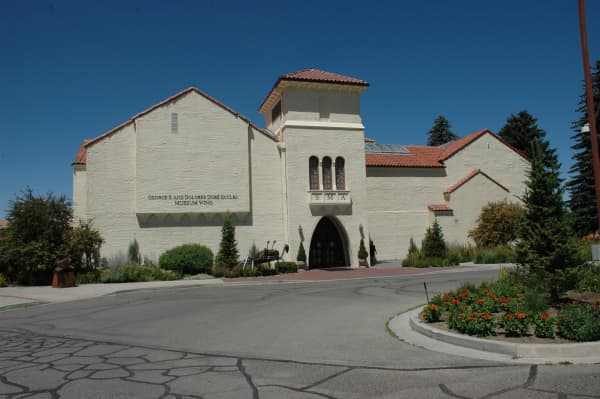
The BYU Museum of Paleontology sits at 1683 North Canyon Road, in a plain tin-and-steel building across from LaVell Edwards Stadium at the corner of University Parkway and Canyon Road. Admission is free to all guests, donations welcome. It is open 9 a.m. to 5 p.m., Monday through Friday, and closed on university holidays.
Two things about those hours. First, it is closed weekends — both days — which catches out families who assume a museum works like a museum. Second, a university calendar closes for things a commercial calendar does not, so a random Thursday in late April or during a semester break can find the door locked. Confirm before making a special trip.
Parking is in front of the building, in a lot shared with the football stadium. On an ordinary weekday this is the easiest parking of any attraction in Provo. On a home game day it is not parking at all.
The window into the fossil lab
The best thing in the building is not a skeleton. It is a pane of glass.
A display window looks directly into a working fossil preparation laboratory, where scientists and students remove rock from real specimens with pneumatic tools and dental picks. You are watching research happen — not a re-creation of research, and not a demonstration staged on a schedule.
Which also means it is not guaranteed. What sits on the bench depends on what the museum is currently working through, and whether anyone is at the bench depends on the academic calendar and the hour. Weekday mornings during term are the best odds. If the lab is quiet when you visit, the specimens are still there and still visible; you simply lose the part where somebody is holding the tool.
For a child who has already absorbed every dinosaur fact available and started asking how anybody knows any of it, this window answers the question better than any exhibit in the state.
Why Provo has a world-class fossil collection at all
The short version is one man and a lot of Utah rock.
The museum opened in 1976 as the BYU Earth Sciences Museum, built to prepare and display fossils collected by its first curator, James A. Jensen, and his field teams. Jensen was a prolific and somewhat legendary collector, and the material he and his crews brought back from quarries across Utah and Colorado outgrew its storage repeatedly — for years a substantial part of the collection was kept under LaVell Edwards Stadium.
A 2009 expansion added several thousand square feet during homecoming week, and the museum was renamed the Museum of Paleontology to reflect what it had become. The full collection now lives at the museum. Rod Scheetz, the current curator, was drawn into the field as a boy after finding baby dinosaur fossils and showing them to Jensen — which is a pleasingly circular way for a collection to acquire its keeper.
The museum marked its 50th anniversary in 2026 and reports roughly 25,000 visitors a year, a number that says something about how many people drive past the building without registering it.
Which museum for which child
A rough guide that holds up more often than not.
Under six: Lehi. The scale and the sand tables are the entire proposition at that age, and the BYU museum's quiet, label-heavy presentation will not hold them for fifteen minutes.
Six to ten: Lehi for a first visit, BYU as the follow-up once they have opinions. This is the age at which the fossil lab window stops being a boring adult thing and starts being the coolest thing they have seen.
Eleven and up, interested: BYU first, honestly. A kid who already knows what a therizinosaur is will get more out of a real collection and a working lab than out of an interactive station designed for someone half their age.
Visiting adults with no children: BYU, free, forty minutes, and you will have the room to yourself at 11 a.m. on a Thursday.
A birthday, a group, a day that needs filling: Lehi, and budget the whole afternoon.
Doing both in one day, and why not to
You can. It is about 25 minutes between them, both are open weekday mornings, and on paper a Lehi morning and a Provo afternoon looks efficient.
In practice it does not work well, for a reason that has nothing to do with logistics. The Museum of Ancient Life is loud, bright, physical and exhausting, and it is very good at using up a child's entire supply of attention. Arriving at a quiet research collection afterward, with a tired kid who has already seen sixty mounted skeletons, produces a room full of unremarkable bones.
Reverse the order and it works better — BYU first while everyone is fresh and the lab is staffed, Lehi after lunch — but the stronger recommendation is to keep them separate. They reward different moods.
Getting there and when to go
To Lehi: I-15 north from Provo, exit at Highland/Alpine (exit 284), and follow signs onto the Thanksgiving Point campus. Parking is free and plentiful. Weekday mornings are quietest; Saturdays and school holidays are busiest; the afternoon southbound return coincides with the worst of the Point of the Mountain traffic, so leaving by three or after six is the difference between twenty-five minutes and fifty.
To BYU: Canyon Road at University Parkway, north Provo. Park in the lot in front of the museum. Avoid home football Saturdays entirely — though the museum is closed Saturday anyway, so this mostly matters for the surrounding streets.
Winter is the high season for both, for the obvious reason. If you want the Museum of Ancient Life at its calmest, a weekday morning in late September or early October is close to ideal: school is in session, summer tourism has ended, and the holiday crush has not begun.
What else is on the Thanksgiving Point campus
The Museum of Ancient Life is one of several venues on the same site, which is what makes the pass arithmetic worth doing. The campus also holds Ashton Gardens, the Butterfly Biosphere, Farm Country, the Museum of Natural Curiosity, and a glass art institute, plus seasonal programming including a large corn maze and pumpkin festival in autumn.
There is a nice piece of local history buried in the ownership: the property was bought in 1995 by Alan and Karen Ashton, and Alan Ashton co-founded WordPerfect — the Orem software company that, for a stretch in the late 1980s, made Utah Valley a genuine center of the global software industry. The land was a dairy operation with several hundred cows when they bought it. The dinosaur museum, in a real sense, is what a Provo-area word processor turned into.
For the broader campus, see our Thanksgiving Point guide, and for the rest of Lehi, things to do in Lehi.
If you want more dinosaurs than Utah Valley holds
Utah is one of the best places on earth to be interested in this, and the valley is only the start of it.
The Natural History Museum of Utah in Salt Lake City, about 50 minutes north, holds a major paleontology collection with a spectacular gallery of Utah specimens and is open weekends — which makes it the answer to the Sunday problem.
Dinosaur National Monument, on the Utah–Colorado border near Vernal, is the real thing: a quarry wall with roughly 1,500 fossil bones still embedded in the rock, enclosed in a building so you can stand in front of them in situ. It is a long drive — around three and a half hours from Provo — and it is worth it. The Utah Field House of Natural History in Vernal pairs with it.
The Cleveland-Lloyd Dinosaur Quarry near Price, roughly two hours from Provo, has produced more Jurassic dinosaur bones than any other single site in the world, most of them Allosaurus, and the USU Eastern Prehistoric Museum in Price displays much of what came out of it.
Closer to home, the Hutchings Museum in Lehi holds fossils among its wider cabinet of curiosities, and is a good small-museum companion to a Thanksgiving Point trip.
The short version
If someone in your house has just discovered dinosaurs and you want the afternoon that produces the memory, go to Lehi, buy the timed ticket in advance, bring spare clothes, and give it three hours.
If you have forty-five minutes, no budget, and a weekday, go to Canyon Road in Provo, stand at the lab window, and watch somebody take 150 million years of rock off a bone with a needle. It is free, and it is the more remarkable of the two things.
Related Guides
- Thanksgiving Point's Freedom Celebration: The North Valley's Free Fourth of July Fireworks in Lehi
- Scavenger Hunts in Provo: Routes That Actually Work, and How to Build Your Own
- Lehi Roller Mills: The Footloose Landmark That Quietly Changed Its Name
- Shopping in Provo & Utah Valley: Malls, Downtown, Outlets & Where Locals Actually Go (2026)
- Jack and Jill Lanes, Lehi: The 1957 Bowling Alley Named After Two Daughters
- Mini Golf in Utah Valley: Where to Putt, and Why Provo Doesn't Have a Course
- Cheap Date Ideas in Provo: What $0, $10 and $25 Actually Buy (2026)
- Kids' Birthday Party Places in Utah Valley (2026)
- Haunted Places in Utah Valley: The Stories, and the History Underneath Them
- Vernal and Dinosaur National Monument from Provo: The Wall of Bones, and the Side of the Park With No Dinosaurs
- Nine Mile Canyon, Helper and Price From Provo
Frequently Asked Questions
Where is the dinosaur museum near Provo?
Is the BYU Museum of Paleontology free?
How big is the Museum of Ancient Life?
How long does the Museum of Ancient Life take?
Can you see dinosaur bones being cleaned in Provo?
Which dinosaur museum is better for young kids?
Do you need to buy Museum of Ancient Life tickets in advance?
Is the Museum of Ancient Life open on Sunday?
Sources
The facts in this guide were checked against these sources. Hours, fees and rules change, so confirm anything time-sensitive with the source before you go. How we make Provo.com.
- Mountain America Museum of Ancient Life, Thanksgiving Point. Checked October 12, 2026.