New this season in American Fork
Opening, closing or changing
- Domo — Sale to Progress Software for $400 million.
Coming up
- Fork Fest 2027 — See the organizer for daily times
- Steel Days 2027 — American Fork — Dates not yet confirmed
Everything dated across the valley sits on the events calendar, and openings and closings are tracked at openings and closings. Neither is a scrape: an entry appears on the tracker only when this site has already published the reporting behind it.

More on American Fork: every guide we have published there, in one place.
American Fork gets described as a gateway city so often that it is easy to miss the part where it is a good place to spend a day on its own. Yes, the canyon behind it is one of the most-visited stretches of mountain in Utah. But the city at the mouth of that canyon has a park system far bigger than its population would suggest, a summer festival whose name commemorates an industry that left the valley a quarter-century ago, and a Main Street that has quietly got a lot more interesting.
It also spent eight years called something else entirely.
Here is what is worth your time in American Fork, in and out of the canyon.
Steel Days: the week the whole city turns out
If you are picking one week to see American Fork at full volume, it is Steel Days in July. It runs about eight days and packs in something over thirty events. In June, Fork Fest fills Art Dye Park with a day of Utah bands on three stages.
The current form dates to 1945, and the naming decision is the interesting part. Then-mayor O. De Vere Wootton took the view that the celebration's existing name — Poultry Day — no longer described the city's economy. The newly built Columbia Steel mill had brought a wave of newcomers who were reshaping American Fork's housing, traffic and commerce, and the mill had become the largest employer in Utah Valley. A public call for a new name produced "Steel Day," and it stuck.
The mill is not in American Fork. It sat about six miles southeast, on the eastern shore of Utah Lake in what is now Vineyard — the plant that became US Steel and then Geneva Steel, and which closed in November 2001. American Fork's summer festival has now been named after a shuttered mill in another city for longer than most of the people attending have been alive. That is the fact worth carrying out of this section: the celebration is a piece of standing industrial memory, and the city has declined every opportunity to rename it.
The four names before it
Steel Days is the fourth name for the same civic habit, and the lineage goes back much further than 1945:
- Timber Day — an all-day picnic with music, games, horseshoes, foot races and ball games, held in a stand of trees known as The Timbers. It ran from around 1865 to roughly 1904.
- Liberty Day — no fixed date, alternating between July 4 and July 24 to cover both the nation's birthday and Utah's pioneer anniversary. The picnic moved to Central Park, now Robinson Park.
- Poultry Day — the interwar version, named for what the local economy did.
- Steel Day, from 1945, first held on Labor Day. By 1946 it was a full day of events, and the American Fork Chamber of Commerce was founded that same year partly to run it. Bands came in from Tooele, Salt Lake City, Nephi, Payson, Lehi, Pleasant Grove and Provo.
And it is not unbroken
This is worth stating plainly, because Utah Valley cities compete on festival longevity and the claims get repeated uncritically.
In 1963 the city scaled the celebration down and renamed it Community Day — a pet and hobby show and a short evening program with fireworks. Then, by Steel Days' own published history, there was no celebration at all in 1964 or 1965, apparently because no civic club wanted to take over running it. A new committee formed in 1966, moved the event to July, and brought the Steel Days name back.
So American Fork's celebration is older than Pleasant Grove's Strawberry Days one city south by any reasonable measure, and it is not continuous. That gap is precisely why Pleasant Grove's claim is phrased around continuity rather than age, and why the two cities' competing superlatives can both be defensible at once. We go through that in detail on the Pleasant Grove page.
What the week looks like now
The American Fork Chamber of Commerce has managed Steel Days in partnership with the city since 2018, and it has grown fast: kickball and golf tournaments added in 2018, kids splash night and a pickleball tournament in 2019, and a new home for the carnival at Mary and Art Dye Park. Recent years have also stretched the schedule to cover two Saturdays.
The reliable fixtures: a grand parade down Main Street on the final Saturday morning, the "City of Fun" carnival — which made its Steel Days debut in 1968 — a car show and cruise at Rotary Park, an art show reception at Robinson Park, a garden tour, an art show at the library, a quilt show at the senior center, pickleball and cornhole tournaments at Art Dye, a drone show, and a Saturday-night concert closing with fireworks from Art Dye Park.
Two details worth knowing before you go. Discounted carnival ride tickets are sold in advance, cheaper for city residents and cheaper still in the earliest window — buying at the gate is the expensive way to do it, and the advance tickets are non-refundable. And in 2020, unable to hold a normal parade, the city took the 75th anniversary parade to the people instead, running a 23-mile route through American Fork's streets — a first in the city's history.
Dates land in mid-to-late July and the lineup shifts every year, so treat any list, including this one, as a starting point. Check the current program before you build a day around it.
Mary and Art Dye Park
American Fork maintains 27 parks, which is a lot for a city this size, and the big one on the north end is the anchor.
Its full name is Mary and Art Dye Park, which matters more than it sounds: the city and the Steel Days organizers both use the full name, while most directories, review sites and mapping apps shorten it to "Art Dye Park." Both will get you to 1000 N 550 E, but if you are searching a city calendar or a reservation system, try the longer form before concluding an event does not exist.
From the entrance it reads as a modest neighborhood park. It is not. Behind the front edge sit softball diamonds, soccer fields, playgrounds, tennis and newer pickleball courts, a hiking trail, and a large amount of open ground — which is why it can absorb a carnival and a fireworks show without feeling crowded.
The part regulars rate highest is the disc golf course threaded through the trees on the east side, which has a real following among Utah players and is one of the better free afternoons in the north valley. Our Utah Valley disc golf guide covers how it fits against the rest of the county's courses.
Main Street, Robinson Park and the small museum
American Fork's historic Main Street has been filling in steadily with local businesses, and it is worth a slow walk rather than a drive-through. The old city hall is listed on the National Register of Historic Places, and William S. Robinson Park at 100 East Main Street — the Central Park of the Liberty Day picnics — is still where the car show and the art show reception land during Steel Days.
Half a block off Main, the American Fork DUP Museum at 50 S 100 E is the kind of small, volunteer-run pioneer collection that keeps limited hours and is easy to miss entirely. Confirm it is open before making a trip for it, but if you are already downtown it is ten worthwhile minutes.
For breakfast on the same street, The Kolache Place at 11 W Main Street is the American Fork branch of the Provo bakery that traded as Hruska's Kolaches until its 2026 rebrand — Czech-Texan filled pastries, savory and sweet. The operating rule is the same at every branch: it opens early and closes around 1 p.m. or when it sells out, whichever comes first. Treat the posted closing time as a ceiling, not a plan. Our profile of the business and its name change has the full story.
The city that used to be Lake City
American Fork was settled in 1850, and the name it carries now is not the name it was given.
At a conference held here on 18 September 1852 it was resolved to lay out a city on American Fork Creek and call it Lake City. That is the name it was incorporated under by legislative act on 4 June 1853, and it kept it until 1860, when the charter was amended and the name changed back — partly because residents wanted it and partly, per the Utah State Historical Society's account, to stop the mail getting confused with Salt Lake City. For a period it was also known as McArthursville, most likely after Duncan McArthur, who farmed between here and Pleasant Grove and whose name survives on the McArthur irrigation ditch.
The early figures are still legible around town. Arza Adams built the first gristmill. Matthew Caldwell, a Mormon Battalion veteran who arrived in autumn 1850 with a herd of cattle, is believed to have put up the first house, cutting the logs near Fort Provo. Leonard E. Harrington served twenty-nine years as the city's mayor, bishop and postmaster — three roles that in 1860s Utah were less separate than they now sound. Chipman Mercantile, one of the anchor businesses, closed in 1979, seven years after its centennial.
There is a neat symmetry with the neighbors: American Fork spent eight years as Lake City, and Pleasant Grove spent its first years as Battle Creek before renaming itself after a stand of cottonwoods. Two adjacent Utah County cities, neither using the name it started with.
Two park names that will send you to the wrong city
American Fork shares park names with Provo, and satnav does not care which one you meant.
The Steel Days car show is at Rotary Park — American Fork's Rotary Park. Provo also has a Rotary Park, at 1460 N 1500 W, and it is a well-known pickleball venue on the other side of the valley. Type the park name alone and you have a coin flip and a twenty-five-minute drive riding on it.
The same trap is waiting one city south: the Battle Creek Falls trailhead is at Pleasant Grove's Kiwanis Park, and Provo has a Kiwanis Park too — the finish line of the Freedom Run every July. Search the city, not just the park. It is a small thing that costs people an hour of a Saturday every summer.
Trails, and the flat one that runs the whole valley
The trail that matters most here is not in the canyon at all. The Murdock Canal Trail — a wide, paved, almost entirely flat path built on the lid of an enclosed irrigation canal — passes through American Fork on its run between Orem and Lehi, touching Lindon, Pleasant Grove, Cedar Hills and Highland along the way.
It is free, has no fee station or permit, and no parking charge, which makes it a straight contrast with the canyon a few miles east where a vehicle fee applies. For anyone who wants distance without elevation — a long ride, a run, a pushchair-friendly walk — it is the best surface in the north valley, and it is under-used relative to how good it is.
Within the city, the paved path along the river ties schools, parks and neighborhoods together and is more useful for getting places than for a day out. For elevation, the canyon and the trailheads above Highland and Pleasant Grove are the answer, and our best hikes guide sorts them by effort.
What the review sites get wrong about this city
American Fork sits in the middle of a cluster of cities whose boundaries the aggregators handle badly, and it cuts both ways.
Filed here but not here. Kitchen Eighty-Eight turns up near the top of most American Fork restaurant searches and is in Pleasant Grove. The Little India on Alpine Highway is in Highland — Alpine Highway runs through Highland rather than Alpine, which is one of the most reliable mix-ups in the county. American Fork has its own Little India, and it is a different branch.
Here but filed elsewhere. The reverse happens too, and it is why our American Fork restaurant guide gives street addresses rather than city labels. When a listing names a city but no address, treat the city as a guess.
The rule that survives all of it: verify the street address before you drive, particularly anywhere along State Street, Alpine Highway or the Highland–American Fork–Pleasant Grove seam.
A civic institution worth knowing about
The Utah State Developmental Center occupies a large campus on the city's east side and has been part of American Fork for well over a century — a state facility serving people with intellectual disabilities. It is not a visitor attraction and should not be treated as one, but it is one of the city's largest employers and a fixture of local life, and Steel Days has traditionally held its kids parade on the campus grounds. If you are wondering what the big institutional campus east of Main Street is, that is it.
American Fork Canyon
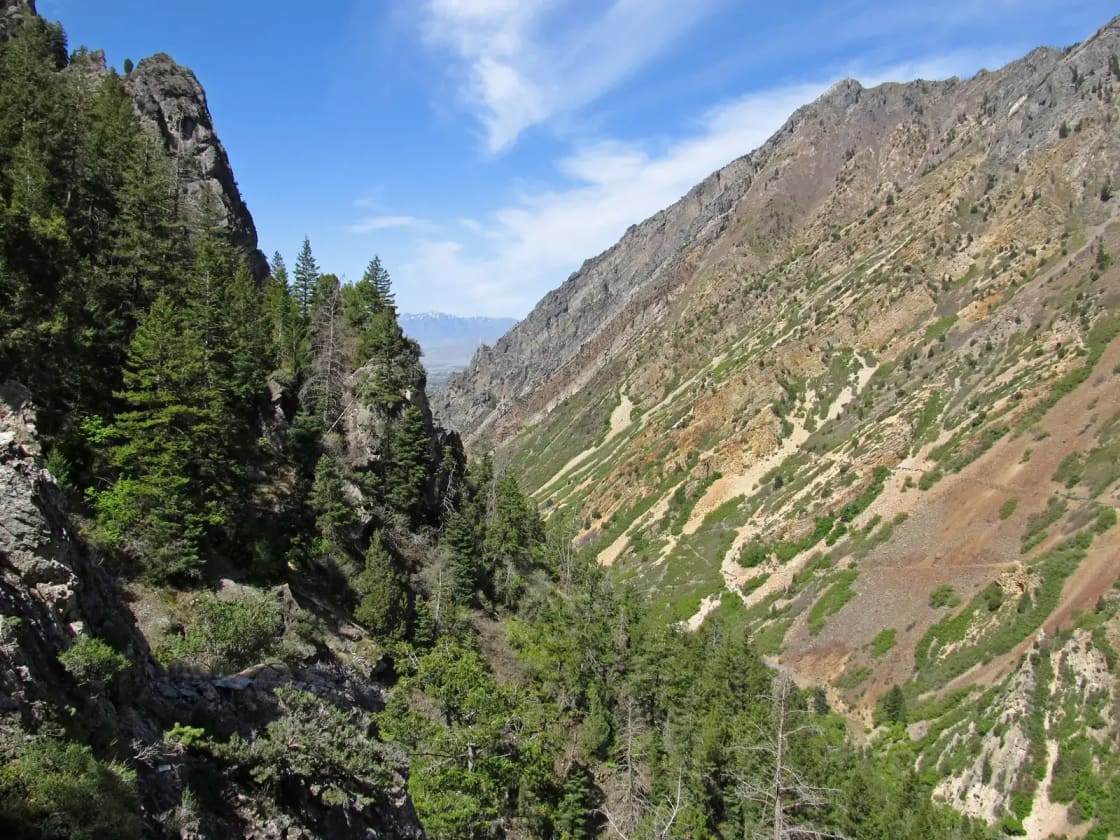
The canyon is the region's headline attraction and deserves more room than a section here can give it, so we have written it up in full: see our complete guide to American Fork Canyon for Timpanogos Cave National Monument, Tibble Fork and Silver Lake Flat reservoirs, the hiking and fishing, and the fee situation.
The short version for planning: it is a paid-entry recreation area, Timpanogos Cave tours are ticketed and reserved separately and sell out, and the Alpine Loop — the scenic road continuing over the top toward Sundance and Provo Canyon — is closed by snow through winter and into spring. In autumn the loop is one of the best leaf drives in the state, and the traffic reflects that.
Water, greens and the west side
Utah Lake forms the city's southwestern edge, and the American Fork Boat Harbor — developed in the late 1960s, which is when boat racing joined the Steel Days program — is the practical access point for fishing and paddling. Our Utah Lake guide covers conditions, launches and what the lake is like, which is not what its reputation suggests.
Fox Hollow Golf Club is the north valley's workhorse course: 18 holes, opened in 1971, with a lit driving range. It also hosts a night glow golf tournament during Steel Days, which is exactly as silly and as fun as it sounds. See the Utah Valley golf guide for how it compares.
The American Fork Fitness Center carries a large share of the city's indoor recreation, and its pool is heavily used in summer — Steel Days week includes a discount swim day and a teen pool party there. The American Fork Library runs the other half of the family programming.
The Mount Timpanogos Utah Temple stands at the north end of the city with the mountain directly behind it, and it is one of the most photographed buildings in the county. The grounds are open to everyone; our temple visitor guide explains what that means in practice for non-members.
Eating here
American Fork's restaurant scene has more depth than its reputation. Màstra is the standout kitchen and it is a destination; Little India handles the curries — and note there is a second Little India on Alpine Highway, which despite the name is in Highland, not Alpine. Aubergine Kitchen has a branch at 232 NW State Street, the plant-forward option, and The Kolache Place covers early breakfast on Main.
Full coverage, including which places are in American Fork and which ones the review sites have misfiled here, is in our American Fork restaurant guide.
If you only have three hours
Three hours in American Fork is a decision about the canyon, and it is worth making before you set off rather than at the mouth of it.
If the canyon is open and you want the canyon: drive up American Fork Canyon as far as Tibble Fork Reservoir, walk the shoreline, and come back down. That is comfortably three hours and it is the best three hours the city has. One hard constraint: weekend mornings at Tibble Fork fill early, and arriving after mid-morning on a July Saturday frequently means being turned around. Timpanogos Cave does not fit in three hours — the tickets are timed, the trail up is the hard part, and the whole thing wants half a day.
If you want the city instead: Mary and Art Dye Park is the anchor, with the disc golf course on the same ground — eighteen holes, free. Add Robinson Park and Main Street, and on a summer Monday evening finish at the American Fork Amphitheater, where the concerts are free.
Before you type a park name into satnav, read the warning two sections up. American Fork's Rotary Park and Provo's Rotary Park are a coin flip and a twenty-five-minute drive apart, and the same trap is waiting on Kiwanis Park. Search the city, not just the park.
American Fork with kids
The city's advantage with children is that its two best options are free and about four minutes apart.
Mary and Art Dye Park is the big one — the ground Steel Days is built on, and a genuine destination park the rest of the year. Robinson Park is the other, smaller and closer to Main Street. For older children, Art Dye Disc Golf Park is eighteen holes at no cost, which is an unusually good deal for an afternoon, and Axe N Smash on North 100 East works for teenagers who have aged out of playgrounds.
In summer the city runs two separate recreation buildings and the distinction matters: the Fitness Center on Center Street is the year-round indoor facility, with an indoor pool, racquetball courts, a fitness floor and child watch, while American Fork Aquatics on Main Street is an outdoor summer operation. Turning up at the wrong one in February is a common enough mistake to be worth naming. The rec centers guide compares both against the rest of the valley.
Up the canyon, be realistic about ages. Timpanogos Cave is a strenuous climb before the tour starts and is not for under-eights; Tibble Fork is the canyon outing that suits small children, because the reward is at the car park rather than a mile and a half above it.
American Fork on a Sunday
American Fork's Sunday is easier than Lehi's, because the city's draws are not concentrated in one place that closes.
The canyon does not observe Sundays. American Fork Canyon, Tibble Fork, Silver Lake Flat and, in season, the Alpine Loop are all open — and a Sunday is one of the better days to go, because the weekday commuter traffic that clogs the valley floor is absent. Timpanogos Cave runs on its own ticketed schedule rather than a weekly one, so check the booking rather than assuming either way. The city parks are open air and open all week.
Food is where the planning is needed. A share of the city's independents close on Sunday — the restaurants guide gives the current picture and names which — and it makes the point that matters more than any single closure: when a listing names a city but no address, treat the city as a guess. That guide gives street addresses rather than city labels for exactly this reason, because the Highland–American Fork–Pleasant Grove seam defeats the aggregators in both directions.
American Fork in winter
Winter splits the city in two, and the split runs at the canyon gate.
The upper canyon closes. SR-92 over the Alpine Loop is a UDOT seasonal road, shut from roughly November until late May or June and not maintained while closed. The target in a normal year is Memorial Day weekend, but the target is not a promise — in 2024 crews needed extra time and the road opened on the evening of 30 May. Check UDOT's seasonal roads page the morning you go; it lists SR-92 American Fork Canyon by name.
The lower canyon does not. The road below the closure point stays open through winter and the corridor becomes a snowshoeing and backcountry access route, which is the part most people do not know is available to them. It is also the way into the groomed snowmobile system that runs toward Tibble Fork. The closure point moves with the snow line rather than sitting at a fixed milepost, so last week's report is not this week's.
In town, winter is what the Fitness Center on Center Street is for — it is the year-round building, with the indoor pool, while the Main Street aquatics operation is a summer one. The rec centers guide sets it against the valley's others. The Murdock Canal Trail passes through the city flat and paved, and it clears early enough to stay walkable through much of the season.
Twenty-six places in American Fork, in one list
Everything below is a place you can go, inside American Fork or in the canyon the city owns the mouth of. Three deliberate absences are worth stating, because search results will tell you otherwise. Battle Creek Falls is in Pleasant Grove, not American Fork, however often the two get filed together. Oteo left the city in 2026 and now operates in Pleasant Grove, and Kitchen Eighty-Eight was never here — both are covered where they belong. The library, the Fitness Center, the boat harbor and the Mount Timpanogos Utah Temple are all in American Fork and all worth your time too.
Hours and prices are left out on purpose: both move, and a list carrying them is wrong within a season while still looking authoritative.
Make a day of it
Steel Days week in July. Parade Saturday morning, carnival in the afternoon, concert and fireworks at Art Dye that night. Buy carnival tickets in advance.
A canyon day. Timpanogos Cave tickets booked well ahead, then Tibble Fork, then back down for an early dinner on Main Street. The canyon fee and the cave ticket are separate purchases.
A no-plan Saturday. Disc golf at Mary and Art Dye Park, kolaches on Main first, the DUP museum if it is open, and the boat harbor in the late afternoon.
Winter. The canyon road closes and the city gets quiet. This is when the library, the fitness center pool and the indoor half of the north valley earn their keep — and Thanksgiving Point in neighboring Lehi is minutes away.
Thinking about living here?
If a visit has you weighing up the move, our complete guide to living in American Fork covers the housing market, the schools — including the Aspen Peaks School District that American Fork joins when the Alpine district splits in 2027 — the historic downtown and the commute.
Related Guides
- American Fork Amphitheater: Free Monday Concerts, Weddings, and Two Different Addresses
- Where to Stay in Spanish Fork: The Honest Answer About Lodging
- Things to Do in Vineyard, Utah: A Local's Guide (2026)
Frequently Asked Questions
What is American Fork, Utah known for?
Why is it called Steel Days if there is no steel mill in American Fork?
When is Steel Days in American Fork?
Is Steel Days the oldest festival in Utah Valley?
Is it Art Dye Park or Mary and Art Dye Park?
What is there to do in American Fork with kids?
How far is American Fork from Provo?
Do you have to pay to enter American Fork Canyon?