A little more than two hours down I-15 from Provo, right where I-70 splits off to the east, a square stone fort sits a couple of miles off the interstate. Cove Fort was built in 1867, in about seven months, to protect a telegraph line and give travelers and mail riders a safe place to stop. It still stands, it is free, and missionaries walk visitors through it every day it is open.
For Utah Valley families, it is one of the easiest history stops in the state to fit into a drive you are already making. Anyone headed to St. George, Cedar City, Zion or the I-70 parks passes within a few minutes of it. This guide covers what the fort is, what the tour shows, the hours and holiday closures listed by the site's operator, how to get there from Provo and what to check before you go.
A note on sourcing: every hour, fee and fact below comes from pages read on Nov. 25, 2026, mostly from The Church of Jesus Christ of Latter-day Saints, which owns and runs the site, along with Visit Utah and Utah State Parks. Where sources disagree, and on a few dates they do, this guide says so.
Quick facts
| Question | Answer | Source |
|---|---|---|
| What it is | An 1867 volcanic rock fort and way station, now a Church historic site | Church of Jesus Christ location page |
| Where | Near the I-15 and I-70 junction, about 30 miles south of Fillmore | Church visitor page |
| Mailing address | HC-74 Box 6500, Beaver, Utah 84713 | Church location page; Visit Utah |
| Cost | Free; missionary-led tours at no charge | Church visitor page; Visit Utah |
| Hours | Mon. to Sat. 11 a.m. to 5 p.m.; Sun. noon to 5 p.m. | Church location page |
| Closed | Thanksgiving, Christmas, New Year's Day | Church location page |
| Phone | 435-819-0647 (call ahead to confirm hours) | Church location page |
| Time needed | About 1 to 1.5 hours | Church visitor page |
| Season | Open year-round | Church visitor page |
| Amenities | Shaded picnic tables, lawn, public restrooms | Church visitor page |
| Accessibility | Most of the fort is accessible; some doorways too narrow for most wheelchairs | Church visitor page |
| Groups | Reservation request form on the Church's location page | Church location page |
Who this stop is for
Cove Fort works best for:
- Families driving I-15 to southern Utah who need a break that is not a gas station. The tour is free, the picnic area is shaded, and there are restrooms.
- Anyone interested in pioneer or territorial history. The Church's 1992 dedication account quotes Gordon B. Hinckley calling it "the only one of the pioneer Church forts which still stands in its entirety." A 2022 Church News article describes it more cautiously as "believed to be one of few, if not the only," pioneer forts still standing in Utah.
- Youth groups, ward activities and Scout-age kids. The Church accepts group reservation requests through a form on its location page, and the outbuildings (blacksmith shop, barn, corral) give kids something concrete to look at.
- Descendants of the families tied to the fort. Church News reported in 2022 that some of the missionaries serving there were descendants of the men who helped build it.
It is a weaker fit for:
- Visitors hoping for a self-guided museum with long exhibit panels. The experience is built around guided tours led by missionaries, and the guides are serving full-time Church missions. Expect a faith perspective alongside the history.
- People who need full wheelchair access to every room. The Church says some historic doorways are too narrow for most wheelchairs.
- A Thanksgiving, Christmas or New Year's Day stop. It is closed those days.
A short history
Why a fort at Cove Creek
By 1867, the main road between Salt Lake City and the settlements of southern Utah ran through a long, empty stretch between Fillmore and Beaver. Intermountain Histories, a project that draws on Church History Library records and a 1966 BYU master's thesis on the fort, describes about 30 miles of uninhabited desert in each direction from Cove Creek. A telegraph line had come through, and mail carriers and travelers needed a place to rest and to water and feed their animals.
It was also wartime. The Black Hawk War, which the Church dates from 1865 to 1868, was a series of conflicts between Latter-day Saint settlers and Ute, Paiute and Navajo bands across central and southern Utah. The Church's location page says the fort was built for protection against possible raids connected to that war, and that it was never attacked. The same page says the Hinckley family who ran the fort kept good relations with the local Pahvant Ute and Navajo peoples, and Intermountain Histories notes that the Pahvant leader Chief Kanosh was a guest at the fort.
The Hinckley call
On April 12, 1867, Brigham Young wrote to Ira N. Hinckley, then living in Coalville, asking him to build a fort at Cove Creek and manage the Church's ranch there. A 1995 Ensign article on the site says Hinckley left Coalville on April 17, five days later. Church News puts Coalville about 200 miles north of the fort.
Ira, his brother Arza and local workmen did the building. Intermountain Histories says about 40 men worked on it; Church News describes help from craftsmen in nearby settlements. According to the Ensign, construction ran from April to November 1867. Hinckley, his wives Adelaide C. Noble and Angeline W. Noble, and 10 children moved in and began running it late that year, Church News reports. Ira's son Arza later wrote that the fort "lives in my memory, not as a fort, but as a home."
One builder whose descendants still talk about the fort is Edward Milo Webb Jr., who Church News says was about 19 or 20 in 1867 and likely worked in the fort's quarry. He later studied at Brigham Young Academy in Provo, the school that became BYU, before founding Snowflake Academy in northern Arizona.
How it was built
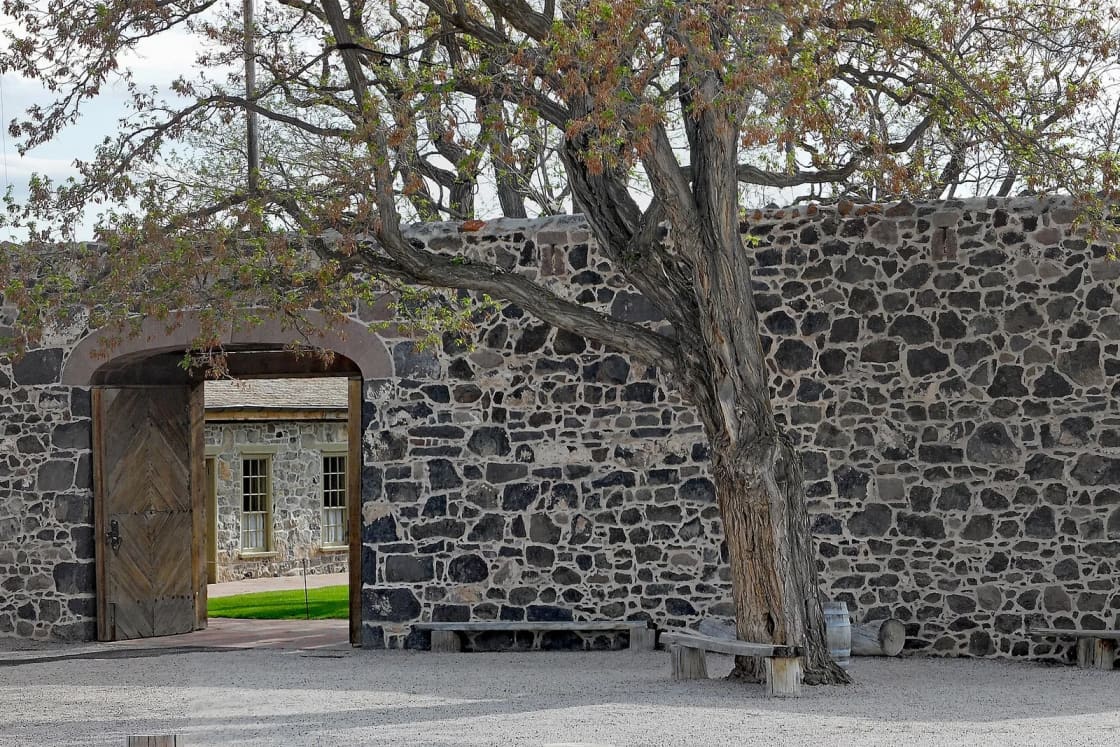
Most pioneer forts in Utah were wood or adobe and are gone. Cove Fort was built of dark volcanic rock, with Visit Utah adding limestone to the description, and the stone is the reason it survived. The measurements given in Church sources and Intermountain Histories:
| Feature | Measurement |
|---|---|
| Fort footprint | 100 feet by 100 feet, around a central courtyard |
| Wall height | 18 feet |
| Wall thickness | About 4 feet at the base, 2 feet at the top |
| Rooms | 12: six on the north wall, six on the south |
| Barn | 60 by 60 feet, center section 30 feet high |
| Corral | 150 by 200 feet |
| Original blacksmith shop | 18 by 12 feet, with a sod roof |
The 1995 Ensign article explains how the rooms were used. Of the six on the north side, three were the Hinckley family's home and three were overnight rooms for travelers. The six on the south side held business, domestic and social uses: the kitchen, the dining area and the telegraph office among them. Intermountain Histories notes the walls had gun ports, and the Church's 1992 report says the small rooms are furnished in the style of 1867 to 1877.
The way station years
From 1867 into the early 1880s, the fort was a working way station. The Church's location page lists travelers, mail riders and the telegraph line among those it served. Visit Utah says the Gilmer and Salisbury stagecoach line stopped there twice a day at its peak and that up to 75 people could eat there at once. The 1995 Ensign tells of a single 1870 stop when the Hinckleys fed 75 people from Brigham Young's party of 10 covered wagons. Young, the Church says, stopped regularly on his yearly trips to the southern settlements.
The family also ran a ranch, farm and blacksmith shop so the fort could feed itself and keep travelers' horses and wagons moving. The Church's visitor page notes that the ranch handled livestock tithed to the Church.
The railroad ended that role. Church News says traffic dropped sharply after the railroad arrived in 1882, and that the Hinckley family stopped working the ranch in 1890. Visit Utah adds that the fort was never fully settled as a town because the water supply was not enough.
Private ownership and the return
What happened next is told slightly differently by different Church sources, so here it is with attribution:
- The 1995 Ensign says the Church leased the fort out by 1890 and sold it to the Otto Kesler family after the turn of the century.
- Visit Utah says the Church leased it in 1890 and sold it to the William H. Kesler family in 1911; Intermountain Histories gives 1919 for the transfer to William Henry Kesler.
- On the return, the July 1992 Ensign says the Historic Cove Fort Acquisition and Restoration Foundation, directed by descendants of Ira N. Hinckley, donated the property to the Church in 1988. Visit Utah also says 1988. The 1995 Ensign and Intermountain Histories say 1989.
Either way, descendants of Ira and Arza Hinckley bought the fort back from the Kesler family in the late 1980s and gave it to the Church, which restored it.
Two dedications
Church sources record two dedication dates, both by Gordon B. Hinckley, Ira's grandson and at the time First Counselor in the First Presidency:
- May 9, 1992: The July 1992 Ensign reports that he dedicated Cove Fort as a historic site while restoration supervised by the Church Historical Department was nearing completion. "What has been done is a great and significant thing from the point of view of the Church, the state, and the nation," he said, according to the Ensign.
- May 21, 1994: The 1995 Ensign, Church News and Visit Utah date the dedication of the Historic Cove Fort Complex, with the restored outbuildings and the relocated Hinckley log home, to this day.
The 1995 Ensign counted 137,500 visitors in 1994. Visit Utah's current page says the site receives more than 70,000 visitors a year.
What the tour shows
The Church's what-to-expect page describes the visit in three parts:
- The Ira N. Hinckley log home. The family's house from Coalville was taken apart, moved to Cove Fort and rebuilt in the 1990s, according to Church News. Visits often begin here, and a short film inside covers the building of the fort and the family's service. Visit Utah says the film plays in the Hinckley cabin or the theater.
- The fort. Across the street from the log home. Inside the walls are the 12 rooms, including re-creations of the telegraph office and a large kitchen, and guest rooms set up the way travelers would have found them.
- The grounds and outbuildings. A garden, blacksmith shop, corral, barn and bunkhouse show the daily work of the ranch. The 1995 Ensign says the blacksmith shop was rebuilt in 1993 on its original site, 35 yards west of the fort's rear gate. Church News also lists an icehouse and hay derrick.
Missionary couples staff the site and lead the tours. The 1995 Ensign described volunteers plowing potatoes and blacksmiths at work; whether a demonstration is running on the day you go is a question for the phone number above.
The Church News piece also notes that virtual tours can be scheduled, which can help a classroom or a family member who cannot make the drive.
Hours, closures and cost
The Church of Jesus Christ of Latter-day Saints' location page for Cove Fort, checked Nov. 25, 2026, lists:
| Day | Visitor center hours |
|---|---|
| Monday through Saturday | 11 a.m. to 5 p.m. |
| Sunday | Noon to 5 p.m. |
| Thanksgiving, Christmas, New Year's Day | Closed |
The page asks visitors to call ahead to confirm, at 435-819-0647. Visit Utah lists the same hours and closures. Older hours you may see online, including the "10 a.m. to dusk" in the 1992 Ensign and seasonal hours in older articles, are out of date.
For this week: Thanksgiving is Thursday, Nov. 26, 2026, and the site is closed that day. If your family is driving south for the holiday on Wednesday or coming home on Friday or Saturday, the regular hours apply, but call to be sure.
There is no admission fee. The Church says tours are free, and Visit Utah says there is no fee to visit.
Getting there from Provo
Cove Fort is a straight shot down I-15. Our Utah state parks within two hours of Provo guide puts the Territorial Statehouse in Fillmore at about 101 miles and 1 hour 46 minutes from Provo, and the Church places Cove Fort about 30 miles south of Fillmore. Plan on a bit more than two hours each way in good conditions, and check a map app for your start point.
The route:
- Take I-15 south from Provo through Nephi, Scipio and Fillmore.
- Leave I-15 at Exit 135 for Cove Fort.
- Follow State Route 161, the old highway, a short distance to the fort. SR-161 loops about three miles between I-15 Exit 135 and I-70 near its western end, so you can also reach the fort from I-70 if you are coming back from Richfield or Capitol Reef. Watch the signs at the interchange, since roadside guides disagree on the I-70 exit number.
Visit Utah describes the location as the I-15 and I-70 intersection in Beaver County, known locally as "Ramblers." Church sources describe it as halfway between Fillmore and Beaver.
If you are coming from the Provo area for Cove Fort alone, it makes for a long but easy day. Most Utah Valley visitors will fit it into a bigger trip instead.
Pairing it with other stops
The fort sits at a crossroads, which makes it easy to combine:
- Territorial Statehouse State Park Museum, Fillmore. Utah's oldest existing government building, built as the territorial capitol; only the south wing was finished, in time for the December 1855 legislative session. Utah State Parks lists hours of 9 a.m. to 5 p.m., Monday through Saturday, closed Thanksgiving, Christmas and New Year's Day, phone 435-743-5316. Our state parks guide lists fees of $3 per person or $10 per family. The two make a natural territorial-history pair about 30 miles apart.
- Beaver. Visit Utah points to the Creamery in Beaver for cheese and ice cream, the Mineral Mountains west of town for hiking and rockhounding, and the ghost town of Frisco in the West Desert. Visit Utah also notes that Eagle Point ski resort near Beaver will not operate for the 2026-27 winter season because of 2026 wildfire damage.
- Southern Utah. Continue south to Cedar City, St. George or the Kolob Canyons section of Zion. See things to do in Cedar City and Iron County, our St. George historic sites guide, which covers Brigham Young's winter home, and Kolob Canyons.
- East on I-70. I-70 leaves I-15 right at the fort, heading toward Richfield, Capitol Reef and central Utah.
Visit Utah says the nearest lodging is in Beaver, Fillmore or Richfield. There is no lodging at the fort.
For more ideas on stops within a day of Utah Valley, see day trips from Provo and 100 things to do in Utah from Provo.
Winter driving and conditions
Winter storms can slow I-15 between Fillmore and Beaver, a long stretch with few towns. Before you leave:
- Check UDOT Traffic, which shows road weather, cameras, incidents, restrictions and plow locations along I-15.
- Read our Utah winter driving and traction law guide if snow is in the forecast.
- For the Utah County part of the drive, our I-15 through Utah County guide covers exits and express lanes.
The fort is open year-round, but the outdoor parts of the tour (courtyard, barn, corral, garden) are exposed to wind and cold in winter and sun in summer. Dress for the weather and bring water in the warm months; shade at the site is the picnic area and the buildings themselves.
What to bring and what to expect
- Time. Allow an hour to an hour and a half for the full tour, per the Church.
- Lunch. There are shaded picnic tables and a lawn. Food is not sold on the Church's list of amenities, so pack it or plan to eat in Fillmore or Beaver.
- Comfortable shoes. The tour moves between the log home, the fort across the street and the outbuildings.
- Patience with old doorways. Some are narrow and low.
- Questions. The missionary guides lead the tour and can answer questions about the families who lived there.
- A group plan. For a ward, school or youth group, use the group reservation form on the Church's location page rather than arriving unannounced.
Who should skip it
Skip Cove Fort, or save it for another trip, if:
- You are driving on Thanksgiving, Christmas or New Year's Day, when it is closed.
- You need to reach the site after 5 p.m. The posted hours end then every day.
- You want an interactive, hands-on museum with screens and displays. The experience here is a guided walk through restored rooms and outbuildings.
- You are not comfortable with a tour presented by Church missionaries. The history is told from the perspective of the Church that built and restored the fort.
What to check before you go
- Call 435-819-0647 to confirm the day's hours, as the Church asks.
- Check the calendar. Closed Thanksgiving (Thursday, Nov. 26, 2026), Christmas and New Year's Day.
- Check I-15 conditions on UDOT Traffic, especially between Fillmore and Beaver in winter.
- Book group visits through the form on the Church's Cove Fort location page.
- Ask about accessibility if anyone in your group uses a wheelchair, since some doorways are narrow.
- Plan food. Bring a picnic or plan a meal in Fillmore or Beaver.
The bottom line
Cove Fort is a free, one-hour stop on a road most Utah Valley families drive every year. It is a rare surviving pioneer fort with thick stone walls, a working-ranch setting and a clear story: a family called away from Coalville in 1867 to run a way station in the desert, and their descendants who bought it back more than a century later. If you are already driving to southern Utah, it is one of the easier history lessons you can fit into the trip.
For more on the history that shaped Utah Valley itself, see our Provo Tabernacle block walking history and the Pioneer Day explainer.
Frequently Asked Questions
Where is Cove Fort?
How much does it cost to visit Cove Fort?
What are Cove Fort's hours?
Is Cove Fort open on Thanksgiving?
How long does a visit to Cove Fort take?
Who built Cove Fort, and why?
Is Cove Fort wheelchair accessible?
Can you picnic at Cove Fort?
Sources
The facts in this guide were checked against these sources. Hours, fees and rules change, so confirm anything time-sensitive with the source before you go. How we make Provo.com.
- Visit Utah (Utah Office of Tourism): Cove Fort, Visit Utah (Utah Office of Tourism). Checked November 25, 2026.
- Territorial Statehouse State Park Museum, Utah State Parks. Checked November 25, 2026.
- Utah Department of Transportation: UDOT Traffic, Utah Department of Transportation. Checked November 25, 2026.
- Intermountain Histories: Cove Fort, Intermountain Histories. Checked November 25, 2026.
- Cove Fort (location, hours and history), The Church of Jesus Christ of Latter-day Saints. Checked November 25, 2026.
- What to Expect When You Visit the Cove Fort Historic Site, The Church of Jesus Christ of Latter-day Saints. Checked November 25, 2026.
- President Hinckley Dedicates Cove Fort (Ensign, July 1992), The Church of Jesus Christ of Latter-day Saints. Checked November 25, 2026.
- Cove Fort Today (Ensign, June 1995), The Church of Jesus Christ of Latter-day Saints. Checked November 25, 2026.
- Story of Cove Fort Illustrates the Quiet Faith of Early Saints, Church News. Checked November 25, 2026.