
Utah Valley is better set up for skating than most people assume and worse set up than it should be, and both halves of that come down to the same thing: the parks are outdoor concrete in a place with real winters.
For seven or eight months a year the county has a decent spread of public parks within twenty minutes of each other. For the rest of it, everything is under snow.
Here is what exists, what each one is like, and how to make the season work.
Fort Utah Park is closed — and that changes this whole page
Provo's public skate park is shut. On 8 September 2026 the city closed both the skate park and Fort Utah Park's main parking lot to begin the Fort Utah Improvements Project, the rebuild that turns the 1999 skate bowl into the Fort Utah All-Wheels Park.
This is not a seasonal closure or a resurfacing. The old park is being demolished and replaced, and the skate facility is moving to the northern end of the site. There is nothing to skate there, and — this is the part people miss — nowhere to park either.
Provo City hopes to finish the roughly $5 million project by summer 2027. Municipal park schedules move, so treat them as an expectation rather than a date to book against, and check Provo Parks and Recreation before you drive out.
Until it reopens, Provo's other public skate park is the free outdoor skatepark at the Provo Recreation Center on 500 North. Everything below about where else to go matters more than it did a month ago.
A note on the address, because this one has always been annoying and the directory sites have not caught up with the closure either. Fort Utah Park is listed as 200 North 2050 West Geneva Road, as 300 North Geneva Road, and as 313 North Geneva Road. These are all the same place, and all three now point at a construction site.
What is being built
The replacement is broader than a new bowl. Per Provo City's project description, the All-Wheels Park comprises:
- A rebuilt skate park meeting current design standards, relocated to the northern portion of the park for better visibility and function.
- The existing modular pump track expanded into a larger asphalt pump track, with mini ramps and progressive jump lines aimed at a wider range of ages and abilities.
- A new playground placed near the skate park.
- New restrooms and pavilions, replacing worn-out facilities.
- The 88-stall parking lot enlarged to roughly 230 stalls, plus more than 100 new shade trees — aimed at the overflow parking that has spilled onto Geneva Road side streets during youth-sports season.
- More bicycle parking, strengthening the connection to the Provo River Trail.
The pump track is the significant part for families. A street plaza serves competent skateboarders; a pump track serves balance bikes, scooters and eight-year-olds, and Fort Utah's existing pump track was a small modular one. If the build lands as described, Fort Utah stops being a skate park with a park around it and becomes the county's first real all-wheels destination.
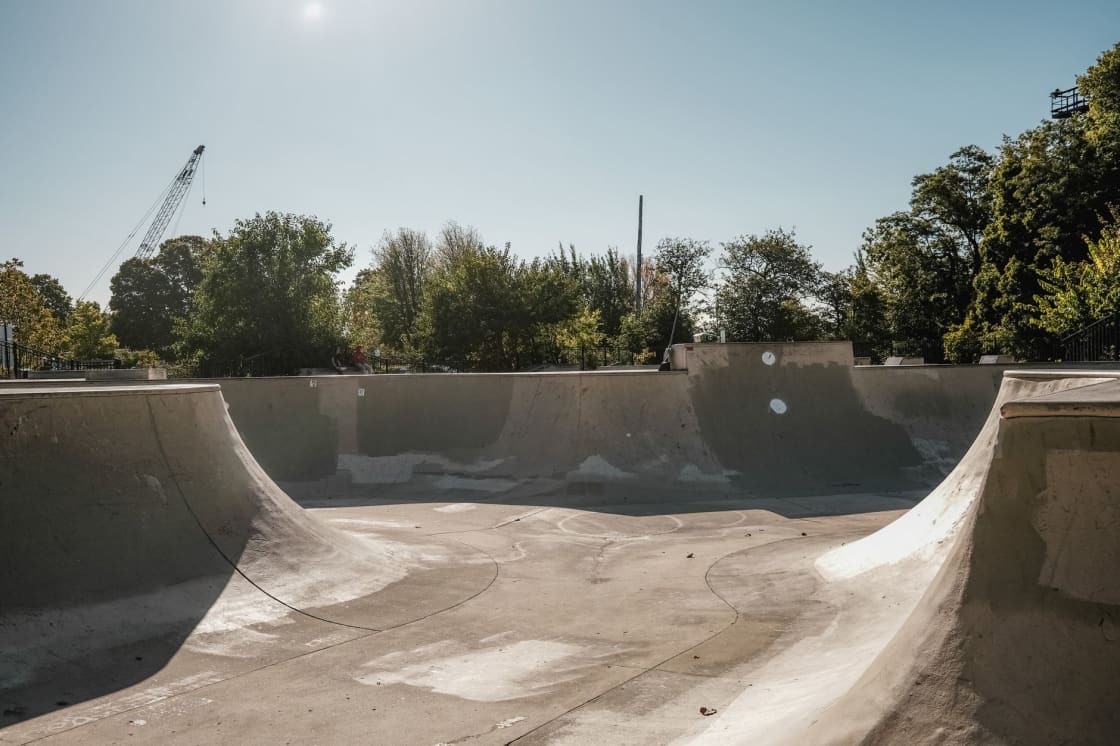
The old park, for the record, was concrete mixing transition and street — bowled terrain alongside rails, ledges and flat — which made it smoother and more predictable than the prefabricated metal ramps some smaller Utah towns installed. Poured concrete is the thing to hope they repeat.
The rules, which are worth reading rather than skimming
Two things matter.
First, gear: a helmet, knee pads, elbow pads and wrist guards, and the judgment to know your ability and skate accordingly.
Second, and this is the part that matters legally and practically, a free public skate park is generally an unsupervised, skate-at-your-own-risk facility. There is no attendant. Nobody checks pads. Nobody breaks up a queue dispute.
That has a real consequence for parents. Dropping a ten-year-old at Fort Utah is dropping them somewhere unstaffed, with older and faster users, and no one whose job it is to notice if something goes wrong. Plenty of families do it and it is fine. It is simply worth deciding deliberately rather than assuming a city facility comes with supervision.
On pads: wrist guards are the ones people skip and the ones that matter most for beginners. Wrist fractures are the characteristic first-year skateboarding injury, they happen at low speed, and they happen on the fall everybody does in week one. Helmet and wrist guards is the minimum that changes outcomes.
The rest of Fort Utah Park
The skate park is one amenity inside a larger city park, which is why the rebuild is worth more than a new bowl would be on its own.
The parking is the thing to plan around right now. The 88-stall lot is part of the construction zone. If you are coming for anything at Fort Utah Park before the project finishes, check Provo Parks and Recreation for current parking.
That has a knock-on effect people will hit without being warned: the Provo River Parkway Trail is still there, but the Fort Utah trailhead parking is not. This has been a standard flat, stroller-friendly place to start a river ride. Until the lot reopens, start instead at Utah Lake State Park (entry fee), Paul Ream Wilderness Park, or the canyon-mouth lots further east. See our guide to the Provo River Parkway for the full trailhead list.
The replica fort, the volleyball court and the baseball fields are not themselves the subject of the closure, but access to all of them runs through a park under construction. Expect noise, fencing and a changed layout.
For the trail itself, see our guide to the Provo River Parkway.
Orem's park, and why it skates differently
Orem Skate Park sits on 1200 West and is the other significant park in the immediate Provo–Orem area.
Skaters describe it in a specific and useful way: wide open, with endless lines, where the transitions connect so that you can keep moving rather than stopping and resetting between features. One reviewer's framing is that if you like to skate creatively, Orem is the one to go to.
That is a real distinction rather than marketing. A park built as a set of discrete obstacles rewards trick repetition; a park where the transitions flow into each other rewards linking things together. Which you prefer depends entirely on how you skate, and it is the single best reason to try both Provo and Orem rather than defaulting to whichever is closer.
The wider county
Within a reasonable drive there are more options than most Provo residents realize.
Provo Recreation Center has a free outdoor skatepark beside the rec center on 500 North.
Springville (200 South 700 East), Spanish Fork (491 South 600 East) and Payson (655 South Main) have parks in the south end of the valley.
American Fork has one at Greenwood Park (500 South 200 East) toward the north end.
Quality varies substantially and so does construction. Reviews across the county's smaller parks split hard between "smooth platforms and good ramps" and "prefab, not worth driving fifteen minutes for," which is the usual signature of a mix of poured-concrete and modular installations.
The practical rule skaters here follow: do not drive more than about fifteen minutes on somebody else's recommendation without checking a photo first. A park's construction type tells you more than its rating.
Outside the county, for scale: West Valley City says its 31,000-square-foot park is the largest in the state, which is worth a trip once if you are serious.
Snow, sun and the actual season
This is the constraint that shapes everything.
Concrete plus a Utah winter equals a closed park. Not officially closed — the gates do not lock — but a bowl holds snow and meltwater, and a wet transition is both unskateable and a good way to get hurt. Reviewers mention specifically that the good bowls in the region "get super snowy."
The season runs roughly April through October, with the shoulders determined by whatever the weather is doing.
Midsummer brings the other problem. Concrete in direct Utah sun gets very hot, and the middle of the day in July is unpleasant and dehydrating. Morning and evening sessions are the answer,.
The best skating weather of the year is September and early October — dry, cool, low sun, and the parks empty out once school is back.
What Utah Valley is missing
Two gaps, stated plainly.
There is no dedicated public indoor park in the county. This is the big one. A region with five months of unusable outdoor concrete and a large young population is an obvious market for indoor space, and it does not exist here at public scale. Local skaters go north, improvise, or stop for the winter. If anything on this page is a real hole in the valley's recreation provision, it is this.
Lighting is limited. In the shoulder seasons, the practical closing time at an unlit park is sunset regardless of what the sign says. Whether the rebuilt All-Wheels Park is lit is one of the useful things to watch for in the 2027 opening.
How to skate Utah Valley during the closure
Roughly two seasons without Provo's park is a long time for a twelve-year-old. The practical answer is that Utah County is dense enough that the closure is an inconvenience rather than a drought — but it changes which park is the default.
The Provo Recreation Center's skatepark and Orem's 1200 West park become the defaults. Orem is the closest substantial option outside Provo, it is wide open, and its transitions link into long continuous lines. It was already worth the drive when Fort Utah was open. It is now simply where Provo skates, which means expect it busier than it used to be, particularly on weekday afternoons after school.
Springville, Spanish Fork and Payson spread the load to the south, and American Fork serves the north end of the county. Any of them is a shorter trip than most Provo families assume.
For younger children on scooters and balance bikes, the loss is sharper, because the thing Fort Utah offered them was flat, safe, traffic-free concrete rather than the bowl. Substitute the paved trail network rather than another skate park: the Provo River Parkway and the valley's other paved trails do that job better anyway, and the pump track arriving in 2027 is precisely the facility aimed at this group.
Do not wait it out. The temptation with a stated reopening is to treat the closure as a pause. Two full summers is most of a skating childhood, and the parks twenty minutes away are good.
Skating with children
A reasonable progression for a family, given what the valley offers.
Start on flat ground, not at a park. A quiet parking lot or a smooth stretch of the Provo River Parkway builds the balance and the pushing-off that a park will otherwise punish.
First park visit: a weekday morning. The park is close to empty, the light is good, and a nervous beginner is not negotiating traffic with somebody dropping into the bowl.
Pads from day one, so it never becomes a negotiation.
Teach the etiquette early, because it is the actual barrier to entry. Skate parks run on informal turn-taking — you watch the flow, you take your line when it is clear, you do not sit on the coping or stand in a landing zone, and if you drop in on somebody you apologize. Children who learn that get welcomed. Children who do not get frozen out, and it reads to a parent as unfriendliness when it is really a safety norm.
Gear, briefly
A complete skateboard from a real skate shop beats a big-box board by a wide margin, largely on bearings, trucks and wheels rather than the deck. The price gap is smaller than people expect and the difference in how it rolls is not.
Pads sized to the person. Adult pads on a child slide and protect nothing.
A helmet that fits. Certified, snug, level on the head.
Scooters are ubiquitous at Utah Valley parks and are the most common entry point for younger children here. Nobody minds.
Local skate shops are the better source than a general sporting goods store, both for the equipment and because the staff will tell you which parks suit a beginner this month.
Reading a skate park before you drop in
If you are new to this, five minutes of watching tells you almost everything, and it is what experienced skaters do automatically on arriving somewhere unfamiliar.
Watch the traffic pattern. Every park develops one — a dominant direction people flow, a spot where lines converge, a feature everyone queues for. It is never posted and it is always there.
Find the quiet corner. Almost every park has an underused section of flat or a small bank that nobody is using. That is where a beginner belongs for the first several visits, and nobody resents someone practicing there.
Watch the surface. Cracks, pooled water, gravel washed in from the edges, and a rough patch on an otherwise smooth run are all things regulars steer around without thinking and a newcomer catches a wheel on.
Note the age mix. A park full of ten-year-olds on scooters at 4 p.m. is a different place from the same park at 8 p.m. with adults skating the bowl. Neither is unwelcoming, but they suit different visits.
Look at who is filming. Somebody setting up a camera at a feature is going to run that feature repeatedly, and giving them a clear run for a few minutes is the normal courtesy.
Where else people skate
Not everything happens at a park, and Utah Valley's flat, wide, grid-planned streets are good for the other kind of skating.
The Provo River Parkway is smooth, long, mostly flat, and shared with cyclists and walkers. For cruising, for building basic confidence, and for children learning to push, it is better than any park in the county. Yield to pedestrians and keep speed sensible on the blind bends.
Campus at BYU and UVU is heavily skated for transport, though both institutions have their own rules about where boards may be ridden and those are worth knowing before you learn them the hard way from a security officer.
Downtown Provo's grid, wide sidewalks and generally smooth pavement make it a reasonable place to get around on a board, and a meaningful number of students commute this way.
Street skating on private property is the perennial friction point everywhere and Provo is no different. The parks exist partly so that it has somewhere else to go.
Lessons and the local scene
There is no shortage of people in Utah Valley who can teach this, and the routes in are informal.
Skate shops are the front door. Staff at a real shop know who teaches, which parks are in good condition this month, and when the informal sessions happen. That knowledge is not published anywhere and it is freely given to anyone who walks in and asks.
Instructors advertise through national matching services and locally, and a single lesson at the start is worth more than a season of self-teaching for most adults — largely because a beginner's instinct in a fall is exactly wrong and someone has to correct it early.
The scene itself is more welcoming here than its reputation suggests. Skate parks look intimidating from the parking lot and are mostly populated by people who remember being bad at it. The norms described earlier are safety conventions rather than social gatekeeping, and somebody who observes them is treated fine regardless of ability.
For adults returning to it after twenty years away, the honest advice from everyone who has done it: your balance comes back quickly, your bravery does not, and your bones are meaningfully less forgiving. Pads are not optional at forty in the way they felt optional at fourteen.
The short version
Provo: Fort Utah is closed. Its skate park and main parking lot shut on 8 September 2026 for the All-Wheels Park rebuild — new skate park, asphalt pump track, jump lines, 230 parking stalls. Provo City hopes to finish by summer 2027. Until then, Provo's open public skate park is the free outdoor skatepark at the Provo Recreation Center.
Orem: the 1200 West park, wide open and built for linking lines together. With Fort Utah shut, this is one of the county's default parks rather than an alternative to one.
Elsewhere: the Provo Recreation Center, Springville, Spanish Fork, Payson, American Fork — check a photo before driving.
Season: April to October, with September the best of it. Mornings and evenings in midsummer.
Winter: there is no indoor answer in this county, and that is the gap.
For the rest of the valley's outdoor options, see things to do in Provo and our guide to family activities in Utah Valley.
"Unsupervised, skate at your own risk" is a statute, not a disclaimer
The "skate at your own risk" idea is not just a city hedging. It is a fairly accurate summary of Utah law, and the law is more categorical than any sign.
Utah Code § 57-14-201 provides that an owner of land owes no duty of care to keep the land safe for a person entering for a recreational purpose, and no duty to warn of a dangerous condition, use, structure or activity on it. Utah Code § 57-14-101 states that the chapter limits the liability of public and private landowners alike, and Utah Code § 57-14-102 defines "owner" to include the possessor of any interest in the land, whether public or private. A city is an owner within the meaning of the chapter.
The activities are listed by name. The recreational-purpose definition in Utah Code § 57-14-102 expressly includes skateboarding, roller skating, in-line skating and bike riding, along with walking, running and jogging. There is no interpretive work to do here: skating a public concrete park is the statutory example.
The section that closes the urban-park argument
For years the obvious counter-argument was that a recreational-use statute was meant for wild land, not for a poured concrete bowl inside city limits. Utah Code § 57-14-401 removes it. A person may not make a claim against or recover from an owner of any land — including land in developed or improved, urban or semi-rural areas opened to the general public without charge, such as a lake, pond, park, trail, waterway, or other recreation site — for personal injury or property damage caused directly or indirectly by participating in an activity with a recreational purpose on the land.
"Developed," "improved," "urban," "park," "without charge." Every element describes Fort Utah.
The three things that would change the answer
A gate fee. Utah Code § 57-14-202 keeps the protection only where use is permitted without charge, or for a nominal fee of no more than one dollar a year, and Utah Code § 57-14-204 removes it where the owner charges a person to enter or use the land. Utah Valley's public parks are free, which is precisely why they are unsupervised. A supervised, ticketed indoor facility — the thing this county does not have — would be operating under an entirely different duty of care, and that is part of why it costs more to run than a slab of concrete.
Willful or malicious conduct. The same section preserves liability for a willful or malicious failure to guard or warn against a dangerous condition and for deliberate injury. Immunity from ordinary negligence is not blanket immunity, and a known, concealed, serious defect that nobody addresses is a different case from a park that is simply hard.
A child and an artificial condition. Utah Code § 57-14-301 governs trespassers and carries a narrow exception for serious physical injury or death to a child — sixteen or younger, per Utah Code § 57-14-102 — caused by an artificial condition the owner knew about, knew posed an unreasonable risk to children, and knew children were likely to encounter. It applies where somebody is on the land without permission, which a posted, open-hours public park mostly forecloses. It is worth knowing anyway, because it is the only place in the chapter where a young age changes the analysis.
Where a claim does clear all of that, Utah Code § 57-14-501 caps noneconomic damages against a landowner at four hundred and fifty thousand dollars for actions arising on or after 14 May 2019, excluding punitive damages and wrongful death.
And the reciprocal, which is the useful part for anyone skating: Utah Code § 57-14-205 and the second subsection of Utah Code § 57-14-401 both provide that none of this relieves you of the duty of care you would otherwise owe. Drop in on someone and the statute protects the city, not you.
Related Guides
- Horseback Riding in Utah Valley: Where to Ride, What It's Actually Like, and Who Takes Beginners
- Shooting Ranges in Utah Valley: Where the Public Can Actually Shoot, and What to Bring
- RV Parks & Hookups Around Provo: How Camping With a Rig Actually Works Here
- Disc Golf in Utah Valley: Every Course, Ranked Honestly
- Best Photography Spots in Provo & Utah Valley (2026)
- Soldier Hollow: The Olympic Venue You Can Actually Use
- Stargazing & Dark Sky Spots Near Provo (2026)
- ATV & UTV Rentals Near Provo: Nobody Rents From Provo, and Other Things Worth Knowing First
- The Provo River Delta's Last Construction Summer: What's Finishing, What's Detoured
- Provo River Delta keeps getting better: new fishing platforms, boat ramps, and fresh trout
Frequently Asked Questions
Where is the skate park in Provo?
What are the hours of the Provo skate park?
Do you have to wear a helmet at the Provo skate park?
Is the Provo skate park good for beginners?
Are there other skate parks near Provo?
Can you ride BMX or scooters at Utah Valley skate parks?
Is there an indoor skate park in Utah Valley?
Is Provo building a new skate park?
Sources
The facts in this guide were checked against these sources. Hours, fees and rules change, so confirm anything time-sensitive with the source before you go. How we make Provo.com.
- Parks Projects, Provo City. Checked October 12, 2026.
- Amenities (Provo Recreation Center), Provo City. Checked October 12, 2026.
- What To Do in Provo: The Great Outdoors, Provo City Library. Checked October 12, 2026.
- What To Do in Provo Summer, Provo City Library. Checked October 12, 2026.
- West Valley City: Skate Park, West Valley City. Checked October 12, 2026.
- Utah Code 57-14-102, -201, -301, -401, -501, Utah Legislature. Checked October 12, 2026.
- Provo City breaks ground on new Fort Utah Park on west side, KUTV. Checked October 12, 2026.
- Skate park set to open in Provo, The Daily Universe (BYU). Checked October 12, 2026.