
Pottery has become one of the more reliable social activities in Utah Valley, which is a slightly odd sentence to write about an ancient craft. The drop-in wheel session has settled into the same cultural slot as the escape room and the axe-throwing place: a two-hour thing you book for a date, a birthday or a group, and it happens to also be a genuine art form you might get hooked on.
Utah County now supports both ends of that — the casual one-evening version and the sustained instruction version — and the studios that do one do not always do the other well. This is what exists and which door matches what you want.
Prices, class schedules and studio hours in this category change frequently and several studios here are small independent businesses. Everything below should be confirmed directly before you book.
Decide this first
Three different things get called "a pottery class" and they are not interchangeable.
A wheel experience is a single session, usually around two hours, where you make one or two pieces with an instructor beside you. A multi-week course teaches you to throw, over four weeks or longer, with clay and firing included. Open studio or membership is wheel time for people who already know what they are doing and need equipment.
Most disappointment in this category comes from booking the first while wanting the third.
Throw Art Studio, Provo
Throw Art Studio sits at 308 East 300 South in Provo and is the best known of the valley's dedicated pottery studios, with a large and consistently positive review base.
Its core offering is an intro-level wheel session in which you are guided through making a piece, priced per wheel with up to two people sharing, plus a separate charge for the clay itself in graduated weights. Beyond that it runs four-week beginner courses that bundle four two-hour classes with clay, glaze and firing, and — importantly — studio access to practice outside class hours.
Why the practice access matters
That last detail is the thing to look for. Throwing is a physical skill built by repetition, and four supervised sessions without practice in between produces four evenings of fun and very little retained ability.
A course that includes open practice hours is a fundamentally different product from one that does not, and it is worth paying more for. If you are choosing between programs and one includes studio time, that is usually the better course regardless of the headline price.
The Kreative Kiln, Provo
The Kreative Kiln operates on North University Parkway in Provo with a format built around a complete single visit: you throw a piece, paint it yourself using mixable colors, and leave it to be fired.
The painting step is what distinguishes it. At most studios glaze selection is limited and the technical results are somewhat out of your hands; a paint-your-own model gives more visible authorship of the finished object, which for children and for one-off group visits is often the more satisfying experience.
SCERA Art Studios, Orem
SCERA runs the most established class program in the valley, on a school-year calendar rather than a drop-in basis, and it is the option most people overlook because they think of SCERA as a theater.
Its adult wheel pottery classes run across the week — several weekday evenings, a Wednesday afternoon and two Friday morning slots — for ages 18 and up, with a curriculum described as adapting to both beginners and people with experience. Teen wheel pottery for ages 12 to 17 runs weekday late afternoons, and there is a monthly hand-building program for ages 6 to 11.
Why SCERA is the value option
Community arts centers price differently from private studios because they are not built to make a margin on a date night. For someone who wants to learn rather than to have a nice evening, a year-long class at a community center is usually the most instruction per dollar available.
SCERA also runs homeschool sections, which is a meaningful gap-filler in a county with a substantial homeschooling population and limited daytime arts provision for it.
Villa Ceramics and the smaller studios
Villa Ceramics offers structured courses including a Level 1 covering wedging, centering, throwing basic forms and an introduction to glazing — the standard beginner sequence taught properly rather than compressed into one evening.
Utah County also carries several smaller operations, including the Utah Center for the Ceramic Arts and Tiny Art Exchange in Provo, and White Stone Pottery, a long-running one-person studio in Alpine teaching adults on electric wheels in monthly enrollments. Small studios come and go and their published details go stale quickly, so call before driving.
What a first session is like
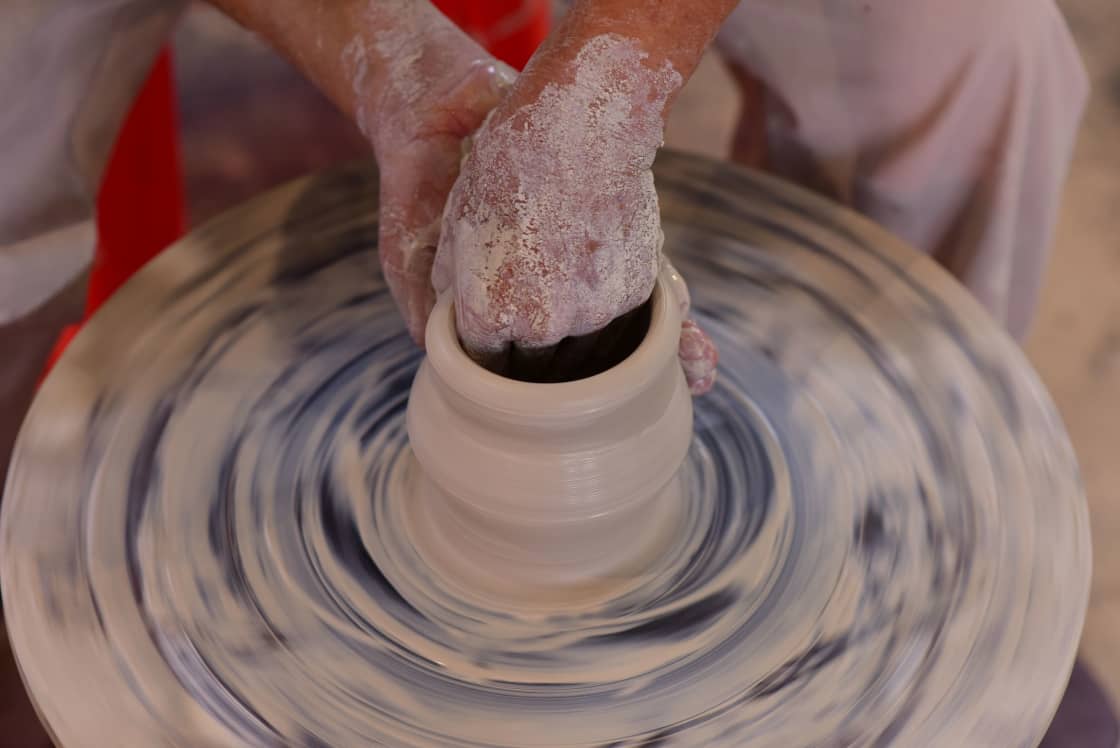
You will be given an apron. You will be shown how to wedge clay to get the air out, how to center it on the wheel — which is most of the difficulty — and how to open and pull a wall.
Expect to fail several times. Centering is a knack that arrives suddenly rather than gradually, and almost nobody gets it in the first twenty minutes. Studios that run intro sessions well plan for this and will step in to rescue a piece so that you leave with something. Wear clothes you do not care about; clay slip gets everywhere and does not always wash out.
Air dry versus fired
Some studios offer a choice: air-dry clay you take home the same day, or standard clay they keep, glaze and fire for collection later.
Air dry is instant and free of extra fees, and it is the right answer for young children and for anyone who wants the object tonight. It is also water-soluble, not food-safe and fragile. Fired work costs more and takes a couple of weeks, and it is an actual ceramic object you can use. Know which one you are buying.
Understanding the fees
Pottery pricing looks confusing because it is usually unbundled. A typical structure separates the wheel time, the clay by weight, and a glaze-and-fire fee.
That means a quoted price of thirty dollars is rarely the total. Ask what the finished-piece cost is, not the session cost, and ask whether a second piece costs extra. None of this is a hidden charge — it reflects genuine material and kiln costs — but it does surprise people expecting a single flat price.
Firing outside work
This is where beginners hit a wall. Studios generally will not fire pieces made elsewhere, and the reason is technical rather than territorial: an unknown clay body can bloat or explode at temperature, damaging the kiln, the shelves and everyone else's work in the load.
If you have bought a wheel for the garage and are looking for firing services, expect to be turned down repeatedly. The realistic paths are a studio membership that includes firing, a community arts program, or eventually your own kiln.
Studio memberships and open wheel time
Recurring wheel time for competent throwers is the scarcest resource in Utah Valley ceramics. Some courses include practice hours; some studios sell memberships.
If this is what you need, phone rather than browse. Membership arrangements are frequently informal, capped by the number of wheels, and not always advertised on a website. A studio with no membership page may still have space for a regular who asks.
The university route
Both BYU and UVU teach ceramics within their art programs, which is the serious end of the spectrum and generally requires enrollment.
For non-students, community education is the bridge. Our guide to community education in Utah Valley sets out how the school district, UVU continuing education and BYU evening classes work, and ceramics appears in that ecosystem periodically. It is worth checking each term rather than assuming a class runs continuously.
Seasonality
Class programs at the community centers run on a school-year calendar, typically opening in September and running to spring, with summer handled separately through camps rather than continuing classes.
Private studios run year-round but their bookings swing hard. December is the busiest month by a wide margin — gift certificates, work parties and holiday group bookings — and February carries a smaller peak around Valentine's. If you want a Saturday evening slot in those windows, book weeks out. Midweek in the late summer is when studios are quietest and instructors have the most time for you, which makes it quietly the best time to start.
Booking for a group
Almost every studio here handles groups — birthdays, ward activities, work outings, youth groups — and group bookings usually need to be arranged directly rather than through an online calendar.
Two practical notes. Wheel count is the binding constraint, not floor space, so a large group may be split across sessions or paired two to a wheel. And hand building scales far better than wheel throwing for big groups, so if you have twenty people and two hours, a hand-building session will produce a better evening than fighting over six wheels.
Doing it with children
Under about eight, hand building is the right choice. Small hands lack the strength to center clay and the frustration arrives fast.
SCERA's ages 6 to 11 program is built on exactly this principle — hand building with a monthly theme rather than wheel work. From twelve upward the wheel becomes realistic, and teen-specific classes exist precisely because that age group learns it quickly and gets bored in a mixed adult beginner room.
What it costs to keep going
If pottery sticks, the cost curve is real. Between class fees, clay, glaze and firing, a regular habit runs to a meaningful monthly figure before you own any equipment at all.
The cheaper long-term routes are a community center class you repeat term after term, or a studio membership if you can find one. Buying a wheel is the expensive-looking option that is sometimes cheapest over years — but only if you have solved firing, which brings you back to the kiln problem.
Why this took off here
The drop-in pottery studio is a national trend, but it landed unusually well in Utah Valley for reasons specific to the place.
This is a county with an enormous population of young adults, a strong culture of organized group activity, and a persistent demand for social options that do not involve alcohol. A two-hour pottery session is almost perfectly engineered for that market: it is structured, it is shared, it produces a keepsake, and it works equally as a date, a family night or a ward activity.
The result is that Utah County has more dedicated wheel studios per head than you would predict from its size, and that they survive on group bookings as much as on individual enthusiasts.
The learning curve, honestly
Everyone is told that centering is hard. What they are not told is the shape of the difficulty.
The first session is usually enjoyable because expectations are low and an instructor rescues everything. The second and third are frequently discouraging, because you are now trying to do it yourself and the clay is not cooperating. Somewhere around the fourth or fifth attempt it clicks, often abruptly.
That curve is the argument for a multi-week course over a string of one-off sessions. People who quit almost always quit in the discouraging middle, and a course carries you through it.
Glazing is a separate craft
New potters concentrate entirely on the throwing and then discover that glazing determines what the finished object looks like — and that glaze behaves very differently raw than fired.
The blue you brush on is often gray in the pot. Thickness changes color. Two glazes overlapping do something neither does alone. Studios keep fired sample tiles for exactly this reason; ask to see them before choosing, because the pot in your head and the pot in the kiln are otherwise unrelated.
What to wear and expect to lose
Clay slip dries to a fine dust that works into fabric and does not reliably wash out, particularly from anything textured or dark.
Wear old clothes, short sleeves or sleeves you can push well past the elbow, and remove rings before you start — clay in a ring setting is hard to get out. Long hair should be tied back. Nothing here is fussy studio etiquette; it is all things people learn the expensive way once.
Paint-your-own pottery is a different thing entirely
Worth separating, because the categories blur in search results. Paint-your-own studios sell you a pre-made bisque piece — a mug, a figurine, a plate — which you decorate and they fire. There is no clay work and no wheel.
It is an excellent activity with young children, it requires no skill, and it is not pottery in the sense this guide otherwise means. If what you want is a calm hour decorating something with a five-year-old, that is the format to look for. If you want to make the object as well as decorate it, you want a wheel or hand-building studio.
Buying local ceramics instead
Not everyone who likes pottery wants to make it. Utah Valley's makers sell through the seasonal markets, the holiday craft circuit and occasional studio sales, and several teaching potters sell their own work directly.
The farmers markets in particular carry ceramics alongside produce through the summer season — our guide to Utah Valley farmers markets sets out which days run where. Buying a mug from the person who threw it is, for most people, the cheaper route to owning good pottery than four weeks of classes.
A note on gift certificates
Every studio here sells them and they are among the better gifts available locally, for a specific reason: they commit the recipient to an experience without committing them to a schedule.
The caveat is expiry. Small studios change hands, move and occasionally close, and a certificate bought eighteen months ahead of use carries real risk. Buy them to be used within a season rather than banked.
Choosing, in one paragraph
For a date or a one-off group evening, book a wheel experience in Provo. For a child under twelve, book hand building at SCERA. For a teenager, SCERA's teen wheel class. For an adult who wants to learn, take a multi-week course with practice access, or SCERA's year-long adult class. And if you already throw and just need a wheel, start phoning studios about memberships, because that is the one thing this valley does not advertise well.
One more reason people start
Ceramics has an unusually strong reputation as a wind-down activity, and the studios here lean into it. The wheel demands enough attention that you cannot think about anything else, the material forgives being started over, and two hours pass without a screen in them.
That is a real part of why the format has spread, and it is worth knowing if you are choosing between this and a louder group activity. Nobody comes out of a pottery session more wound up than they went in.
Related Guides
Frequently Asked Questions
Can I try pottery once without signing up for a course?
How much does a beginner pottery class cost?
What is the difference between wheel throwing and hand building?
Are there classes for children?
Can I fire my own pieces somewhere?
Is there open studio time for people who already know how to throw?
How long until I get my finished piece back?
Where can I learn seriously rather than casually?
Sources
The facts in this guide were checked against these sources. Hours, fees and rules change, so confirm anything time-sensitive with the source before you go. How we make Provo.com.
- Throw Art Studio. Checked October 12, 2026.
- Tiny Wheel Pottery, SCERA Center for the Arts. Checked October 12, 2026.
- SCERA Center for the Arts: Art Classes, SCERA Center for the Arts. Checked October 12, 2026.