
Dinosaur National Monument covers more than 200,000 acres across two states. Almost all of the photographs you have seen come from a single building on the Utah side, and a meaningful number of visitors drive to the wrong state to find it.
That is the first thing to get right about this trip. The second is that it is three hours from Provo, which changes what kind of day you are planning.
The mistake that costs people an afternoon
There is a town in Colorado called Dinosaur. The monument's headquarters is near it. The Canyon Visitor Center is there.
There are no dinosaur bones on display on the Colorado side.
This is not a trick and it is not badly signed by the Park Service — it is a consequence of how the monument grew. The original monument was established in 1915 as an 80-acre protection around the Carnegie fossil quarry near Jensen, Utah. In 1938 it was expanded by a factor of thousands to protect the canyons of the Green and Yampa rivers, and that expansion is what carried the boundary into Colorado.
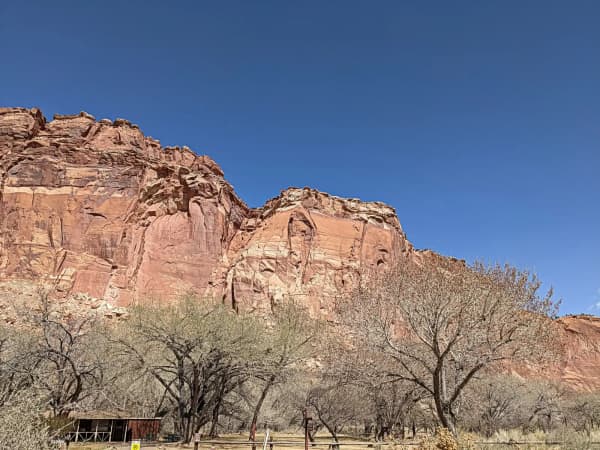
So the monument now protects two different things: a fossil bed, and a spectacular river canyon system. They are about a two-hour drive apart within the same park.
If your children have been promised dinosaurs, you want the Utah side, near Jensen. Search for the Quarry Visitor Center specifically rather than for the monument, and check the destination before you commit to the drive. Navigation apps asked for "Dinosaur National Monument" have a well-documented habit of choosing the headquarters.
The drive from Provo
Roughly 175 miles, about three hours, via US-40 east.
The route leaves Utah Valley through Heber, climbs Daniels Summit, drops through Duchesne and runs east across the Uinta Basin to Vernal, then continues to Jensen. It is a good drive — scenic in stretches — and it is not a fast one.
Practical notes:
Daniels Summit is a real mountain pass. In winter it demands respect and occasionally closes. Check UDOT conditions between November and April.
Fuel in Heber, Duchesne or Roosevelt. The gaps between services in the Basin are longer than Wasatch Front drivers expect.
Cell coverage is patchy across the Basin and inside the monument. Download offline maps before you leave. This is a genuine recommendation, not boilerplate — the monument's interior roads have effectively none.
Three hours each way plus a proper visit is a twelve-hour day. It is done regularly and it is a lot with young children. An overnight in Vernal turns a forced march into a comfortable weekend, and Vernal has the lodging to support it.
Our day trips from Provo guide sets this against the shorter options.
The Wall of Bones
The Quarry Exhibit Hall is the reason to make the drive, and it delivers.
In 1909, paleontologist Earl Douglass, working for the Carnegie Museum, found a line of articulated Apatosaurus tail vertebrae eroding out of a sandstone ridge. What followed was one of the most productive dinosaur excavations ever undertaken — tons of bone shipped east to Pittsburgh and other institutions over the next decade and a half.
Douglass's own idea was that some of the quarry should be left in place and roofed over so the public could see bones in context rather than only mounted in museums. That idea became the building.
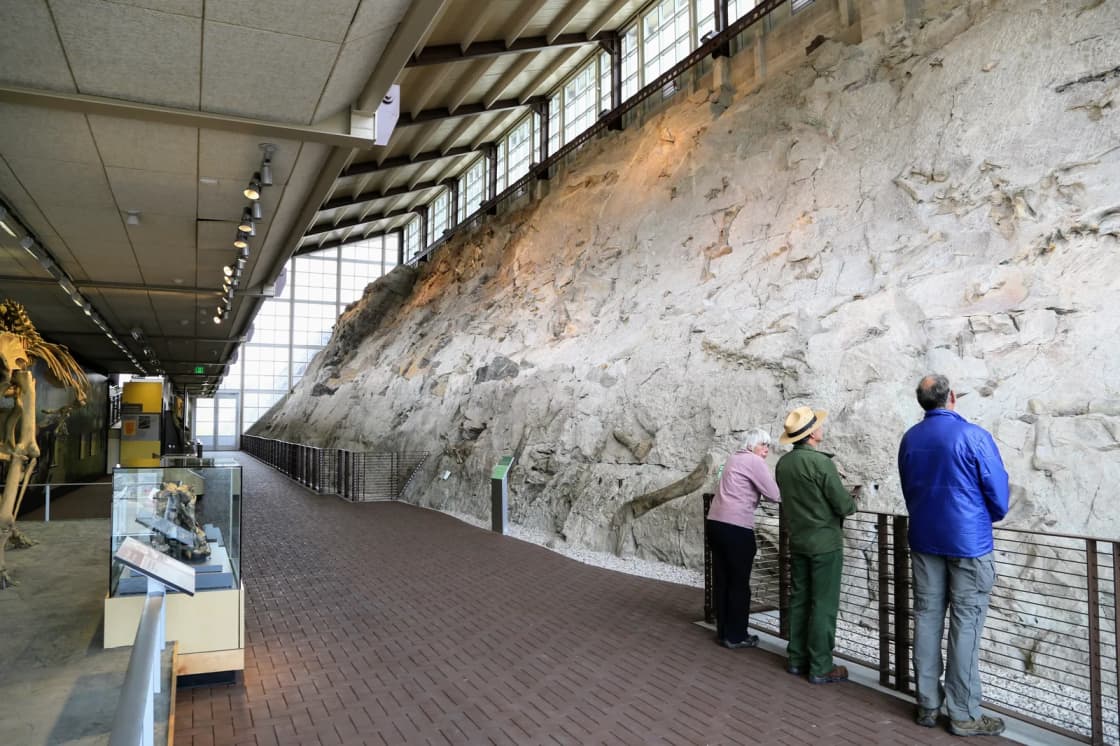
What you see today is a rock face roughly 200 feet long and two stories high, carrying approximately 1,500 dinosaur bones still embedded in the stone. Not casts. Not a reconstruction. The actual deposit, partially excavated in relief so the bones stand proud of the surrounding rock.
Allosaurus, Stegosaurus, Camarasaurus, Diplodocus, Apatosaurus — the roll call of the Late Jurassic, jumbled together as a river sandbar collected carcasses roughly 149 million years ago.
The current building opened in 2011, replacing the 1958 original, which had been built on expansive clays that slowly tore it apart.
Ask a ranger where the touchable section is. There is one designated place on the wall where you may put your hand on genuine fossil bone. For most children it is the moment the trip becomes real.
Getting up to the hall, which changes seasonally
This detail is worth confirming rather than assuming, because the arrangement varies and the monument has run construction projects in recent years.
The long-standing pattern: in the busy summer season you park at the Quarry Visitor Center at the bottom and take a shuttle up to the Exhibit Hall. In the off season you drive your own vehicle up the hill. Operating hours are also longer in summer than the rest of the year.
Check the National Park Service's current conditions page for the monument before you go. A three-hour drive is the wrong distance at which to discover a closure.
What else is on the Utah side
The quarry is an hour of the day. The rest of the Utah side is worth the remainder.
Cub Creek Road runs east from the quarry area past several of the monument's best short stops — including Fremont culture petroglyph panels carved into the rock roughly a thousand years ago. The lizard panel is the well-known one. These are fragile and irreplaceable: photograph them, never touch them, and do not add anything to them.
The Josie Bassett Morris cabin sits at the end of that road. Josie Morris homesteaded here alone for around fifty years, running livestock in box canyons she used as natural corrals. The cabin and the walk up the canyon behind it are a quiet, human-scale counterpoint to the deep time on the other side of the day.
The Green River runs through the monument and is a serious rafting destination in its own right — Split Mountain and the canyons above it. That is a trip rather than a stop.
Short trails including the Fossil Discovery Trail connect parts of the area on foot when open, and there are further fossil exposures visible along it.
Vernal, and why the museum earns its slot
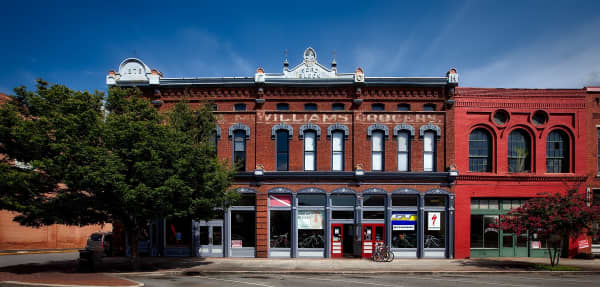
Vernal is a town of around 10,000 in the Uinta Basin, historically built on ranching and later on oil and gas, and it leans into the dinosaur identity without embarrassment. There is a pink Diplodocus on Main Street.
The Utah Field House of Natural History State Park Museum at 496 E. Main Street is the anchor, and it is the right complement to the quarry rather than a duplicate of it.
The quarry shows you bones in rock. The Field House shows you what those bones were: mounted skeletons, a descent through geologic time as you walk down through the exhibits, a window into a working paleontology lab where preparators clean specimens, and an outdoor dinosaur garden of life-size models set among planting meant to suggest the period.
It also functions as a free visitor center for the whole Vernal area, which is useful on a first trip — current conditions, road status, what is open.
Do the museum first if you can. Walking into the quarry already knowing what a Camarasaurus looked like makes the wall legible rather than a jumble.
Our guide to dinosaur museums in Utah Valley covers the much closer options, including the collections at BYU — worth knowing about if the drive is not going to happen this year.
Where the fossils came from, briefly
The reason eastern Utah is full of dinosaurs is the Morrison Formation, a layer of Late Jurassic river and floodplain sediments that stretches across a huge swath of the American West and is arguably the most productive dinosaur-bearing rock unit in the world.
The quarry deposit is a sandbar. A river carried carcasses downstream, an obstruction collected them in one bend, and sediment buried the accumulation fast enough to prevent complete destruction. That is why the bones are jumbled and disarticulated rather than laid out as complete animals — you are looking at a log jam of bodies, not a graveyard.
Roughly 149 million years later, uplift and erosion tilted the layer and exposed its edge, which is how Earl Douglass came to find a tail sticking out of a hillside.
What it costs
Dinosaur National Monument charges a per-vehicle entrance fee valid for seven days, with lower rates for motorcycles and for individuals arriving on foot or by bicycle. The National Park Service publishes current amounts on the monument's fees page.
Two things worth knowing before you pay it:
The America the Beautiful annual pass covers it. If you already hold one — or if you are likely to visit two or three national parks in a year, which from Utah Valley is close to inevitable — the annual pass pays for itself quickly. Utah's five national parks are all reachable from here, and our guides to Moab, Zion and St. George and Capitol Reef cover the rest of that math.
The Utah Field House is a state park, not a national one, so it charges separately and a federal pass does not apply. A Utah State Parks pass does. These are two different systems and holding one does not help with the other — the same structural point that catches people at Antelope Island.
Fee-free days exist on both systems at various points in the year, which is worth checking if your dates are flexible and you do not mind company.
The rest of Dinosaurland
The Vernal area markets itself as Dinosaurland, and the monument is not the whole of it. Three additional stops are worth knowing about, because they change the trip from one building into a genuine weekend.
Red Fleet State Park, about 12 miles north of Vernal, holds a dinosaur trackway — actual footprints pressed into a sloping sandstone surface at the edge of a reservoir, left by animals walking across a shoreline in the Early Jurassic. Reaching them requires a hike of roughly a mile and a half each way over slickrock, and depending on the reservoir level part of the track surface may be under water. The trade for the effort is that you are looking at behavior rather than anatomy: not what the animal was, but where it went. Red Fleet is also a swimming and boating reservoir, with striking red rock formations, which makes it a reasonable second day for a family that has had enough of museums.
McConkie Ranch, in Dry Fork Canyon northwest of Vernal, holds one of the more remarkable concentrations of Fremont rock art anywhere. The panels sit on private land, access has traditionally been by donation, and the figures — tall, broad-shouldered anthropomorphs with elaborate headdresses and jewelry, some of them larger than life — are unlike the imagery most visitors associate with petroglyphs. Because access depends on a private landowner, confirm that it is open before driving out. The same rules apply as at the monument: no touching, no chalk, no additions.
The Uinta Basin itself is worth understanding rather than just driving through. It is an oil and gas region, and the pump jacks and truck traffic are the working economy rather than scenery. It is also the home of the Ute Indian Tribe of the Uintah and Ouray Reservation, one of the largest reservations in the United States by land area, with its headquarters at Fort Duchesne on the road you take to get here. That history connects directly to Utah Valley's own — our guide to the Timpanogos and the Utes covers the nineteenth-century removals that ended with Ute peoples relocated to this basin, which is a considerably more uncomfortable and more important story than the dinosaurs.
Flaming Gorge, if you have a third day
About 45 minutes north of Vernal, US-191 climbs out of the Basin and arrives at Flaming Gorge Reservoir — a 91-mile impoundment of the Green River behind a dam completed in 1964, straddling the Utah–Wyoming line.
The drive up is the sell even if you do not stop. Sheep Creek Canyon and the Red Canyon Overlook deliver a view down onto water an improbable shade of blue-green from cliffs several hundred feet above it, and the highway itself passes through a road cut that steps back through hundreds of millions of years of exposed rock with interpretive signs naming each layer as you drive.
Flaming Gorge is a serious fishing destination — the tailwater below the dam holds trophy trout and the reservoir itself holds lake trout that reach large sizes — and a boating and houseboating one in summer.
For a Provo family this is realistically a separate trip rather than an add-on to a dinosaur day. But if you have already driven three hours to Vernal, the marginal cost of the extra hour to see the gorge is the best value available in the region.
Is it worth three hours each way?
Worth answering directly, because this is the longest single-destination day trip this site recommends and it is not right for everyone.
It is worth it if somebody in the household is interested in dinosaurs, or if you want the specific experience of touching a fossil in the rock it was buried in. Nothing closer to Provo offers that. The BYU collections are excellent and Thanksgiving Point's Museum of Ancient Life is a very good museum, but both show you assembled animals in a building. The quarry shows you the deposit.
It is not worth it if the goal is simply a good family day out — Utah Valley has better returns per hour of driving in almost every direction. And it is not worth it as a single day with children under about five, who will spend ten of the twelve hours in a car seat for one hour of payoff they may not remember.
The overnight changes the calculation completely. Vernal has ordinary chain lodging at rates well below the Wasatch Front, and splitting the drive turns the trip from an endurance event into a genuine weekend with three or four real stops in it.
The other honest point: this is a trip that rewards a small amount of preparation more than most. A child who has spent twenty minutes the night before learning to recognize an Allosaurus femur will find the wall legible. A child who arrives cold sees a lumpy cliff. The Park Service's own site has enough material to do that, and it converts the single most expensive part of the day — the drive — into anticipation rather than dead time.
A realistic plan
As an overnight, which is the version worth recommending:
- Day one: Leave Provo mid-morning, stop in Heber for food, arrive Vernal early afternoon. Utah Field House for two hours. Dinner in Vernal, stay the night.
- Day two: Early start to the quarry before the heat and the crowds. Exhibit Hall, then Cub Creek Road for the petroglyphs and the Josie Morris cabin. Lunch from a cooler. Leave by mid-afternoon, home for dinner.
As a single day, if that is what is available: leave at 6:00 a.m., quarry by 9:30, Cub Creek until early afternoon, Field House on the way out if it is still open, home around 8:00 p.m. It works. Nobody will be pleasant by the end.
Carry more water than you think, sun protection, and food — options inside the monument are essentially nonexistent and the Basin sun is unforgiving on exposed rock.
Frequently Asked Questions
How far is Dinosaur National Monument from Provo?
Why are there no dinosaur bones on the Colorado side?
What is the Quarry Exhibit Hall?
Can you touch the fossils?
How do you get up to the Quarry Exhibit Hall?
Is the Utah Field House museum worth it as well?
Are there dinosaur tracks or petroglyphs to see?
What is the best time of year to visit?
Sources
The facts in this guide were checked against these sources. Hours, fees and rules change, so confirm anything time-sensitive with the source before you go. How we make Provo.com.
- Quarry Exhibit Hall, National Park Service, Dinosaur National Monument. Checked October 12, 2026.
- National Park Service, Dinosaur National Monument: Directions, National Park Service, Dinosaur National Monument. Checked October 12, 2026.
- National Park Service, Dinosaur National Monument: Earl Douglass, National Park Service, Dinosaur National Monument. Checked October 12, 2026.
- "Dinosaur Rush" Created Excitement in Uinta Basin, Utah Division of State History (History to Go). Checked October 12, 2026.
- Utah Field House of Natural History State Park Museum, Utah State Parks. Checked October 12, 2026.