
Ask a Utah Valley resident to rank the state's five national parks by distance from Provo and almost everyone gets it wrong. Zion has the fame, Moab has the reputation as "our" desert weekend — but the closest of the five by road miles is the one in the middle that most locals have driven past pieces of without ever properly visiting. Capitol Reef's visitor center sits about 180 road miles from Provo, a drive of about three and a half hours, and it is the only park of the five where the main road through the headline scenery is entirely free.
It is also, in 2026, the last major Utah park with none of the access machinery that now shapes trips to the others: no shuttle like Zion, no permit lottery guarding its best-known hike, no timed-entry history like Arches. You drive in, in your own car, any day of the year. That combination — closest, freest, least regulated — is why this page exists. Our ranking of all five parks by drive and season compares them.
The drive: US-89 through the towns, not the freeway
The route is half the trip. From Provo you take I-15 only as far as the US-89 split near Spanish Fork, then run south down the Sanpete Valley through a string of pioneer towns — Fairview, Mt. Pleasant, Ephraim, Manti with its hilltop 1888 temple visible for miles, Gunnison — before climbing through Salina country and dropping via UT-24 through Loa, Bicknell, and Torrey to the park's west entrance. It is two-lane nearly the whole way, through working farm country, and it is a pleasant drive in a way the I-15 slog to Zion is not. The Sanpete towns along US-89 are covered in things to do in Sanpete County.
Two practical notes. First, services thin out fast after Salina — Loa, Bicknell, and Torrey have gas, but this is a fill-up-when-you-can corridor, and much of it goes quiet on Sundays, a fact Utah Valley residents will find familiar rather than surprising. Second, the alternative route — US-6 through Spanish Fork Canyon to Price, then south through Hanksville to enter the park from the east — is longer but sets up the Goblin Valley loop described below, and doing the trip as a circle is better than doing either road twice.
Torrey, the little town eight minutes from the entrance, is the base: a handful of lodges and restaurants, a market, and formal certification as a dark-sky community, which tells you what the town thinks its asset is. They are right, and we'll get to it. Torrey's scale is worth understanding before you go — a few hundred residents, a dining scene you can count on your fingers that runs seasonal hours and thins dramatically in winter, and no chain anything. That is a feature for atmosphere and a planning fact for dinner: eat early, or confirm what's open, especially outside the May-to-October core.
The crowd math deserves its own sentence, because it is the quiet reason to choose this park. Capitol Reef drew roughly 1.5 million visits in a recent year — against several times that at Zion — and spreads them along a corridor with no choke point, no gateway strip, and no queue to be in. On an identical July Saturday, the difference is not subtle: you will wait for nothing here except pie.
The fee structure, which is almost a joke
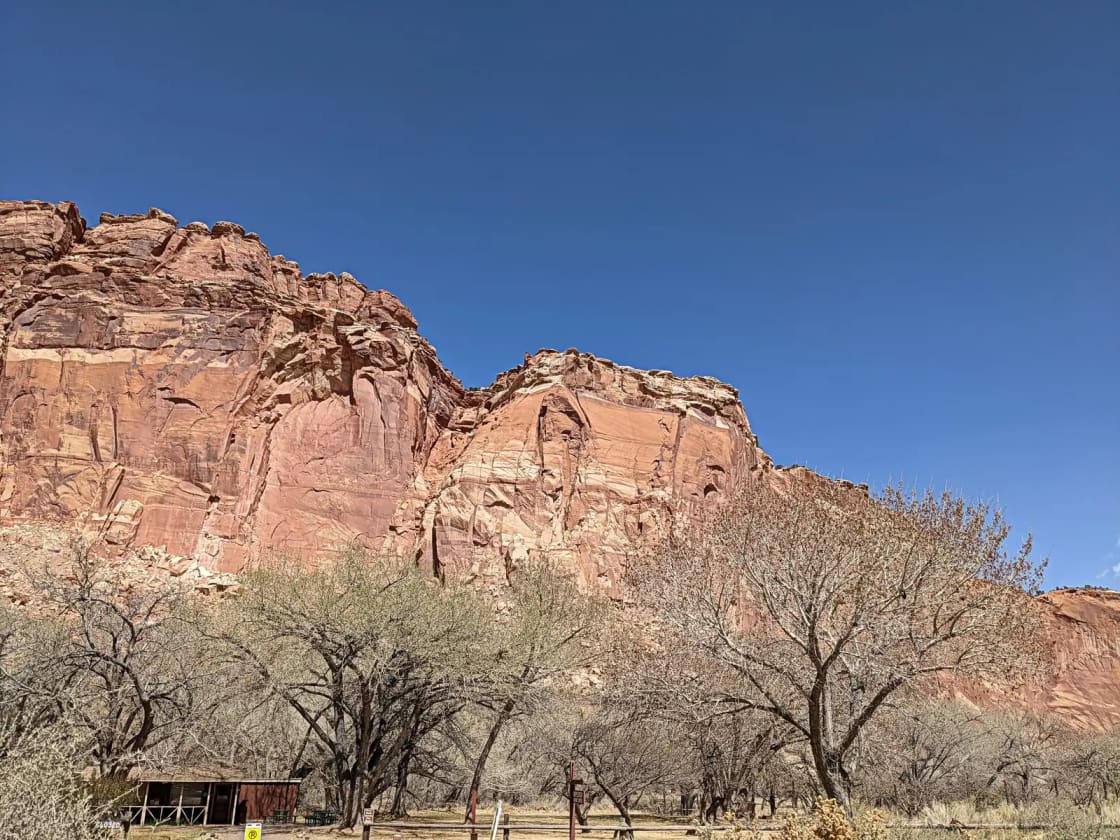
Here is the fact that reorganizes the whole visit: UT-24 through the park is free. The highway runs directly past the visitor center, through the Fruita historic district, past the Fremont petroglyph panels and the Hickman Bridge trailhead, with the Castle and Capitol Dome towering over the road — and none of it has an entrance station. The park lists a standard pass of $10 to $20 (with a $35 park annual pass), and the fee is collected for the Scenic Drive, the 7.9-mile paved road that runs south from the visitor center past the campground toward Grand Wash and Capitol Gorge. The America the Beautiful pass covers it, and the fee is collected at a self-pay station, not a gate with a line.
Compare that with the rest of the state's Mighty 5 machinery and it stops being trivia and becomes strategy: Capitol Reef is the park you can decide to visit on Friday night and execute on Saturday morning with zero administrative planning. Nothing to win, nothing to reserve, nothing to time.
Fruita: orchards, petroglyphs, and pie in the right order
The center of the park is not a rock formation. It is a preserved settlement in the green canyon bottom of the Fremont River, where Mormon pioneer families planted fruit trees in the 1880s and kept a tiny community going until the Park Service bought out the last resident, Dewey Gifford, in 1969. The orchards never left. The Park Service tends them still — apples, apricots, peaches, pears, cherries, plums — and when a crop comes ripe, orchards are posted open for U-pick: sampling fruit while you stand among the trees is free, and you pay a small per-pound fee on the honor system for what you carry out.
The honest caveat is that harvests answer to the spring frost, not the calendar. An early bloom followed by freezing nights in 2025 destroyed most of that year's crop and closed U-pick for the season — so check the park's current fruit status before you build the trip around picking. The orchards are worth walking even in a lean year; the cottonwood shade and the cliffs behind the fruit trees are the park's most photographed contradiction.
A mile down the Scenic Drive, the Gifford Homestead — the 1908 farmhouse — sells small deep-dish fruit pies, cinnamon rolls, ice cream, and local jams from its kitchen, traditionally opening each year on March 14, Pi Day, and running to late fall. The pies sell out, often by early afternoon on busy days. Buy first, hike after. This is the most important logistical instruction on this page.
Back on the free highway, the Fremont petroglyph boardwalk displays panels of horned anthropomorphic figures and bighorn sheep pecked into the varnished cliff face by the Fremont culture roughly a thousand years ago — a fifteen-minute stop that gives the whole landscape a longer memory. Binoculars help; the best figures sit high on the wall.
What to do: a first-timer's day
The park is built around the Waterpocket Fold, a nearly 100-mile wrinkle in the earth's crust — a single-sided buckle of rock layers that runs south almost to Lake Powell. The developed corridor where UT-24 and the Scenic Drive cross it holds nearly everything a first visit needs: Our Lake Powell guide covers the lake itself.
Hickman Bridge is the signature short hike: 1.8 miles round trip from the highway to a 133-foot natural bridge, with Fremont granary ruins visible along the way. Go early in summer; the trail is exposed.
The Scenic Drive plus Grand Wash is the paid $20, and worth it: eight paved miles under monumental cliffs, then the spur into Grand Wash, where you can walk the flat canyon floor between walls that close to a couple hundred feet tall. From the same wash, Cassidy Arch climbs steeply — 3.4 miles round trip — to one of the few arches anywhere you can walk on top of, carrying the name of Butch Cassidy, whose gang used this remote country to vanish between robberies.
Capitol Gorge, at the Scenic Drive's end, adds the Pioneer Register — names of 19th-century travelers inscribed on the canyon wall — via an easy walk. Sunset Point and Goosenecks Overlook, on a short spur near the west entrance, are the five-minute stops that outperform their effort, especially at the hour the name suggests.
If you have the vehicle for it, the Cathedral Valley loop in the park's remote north — 58 miles of dirt requiring high clearance, with monoliths named Temple of the Sun and Temple of the Moon standing alone on the desert floor — is the expansion pack. Check conditions at the visitor center first; the roads go impassable when wet, and the loop typically involves fording the Fremont River.
The dark sky, which is the second trip hiding inside the first
Capitol Reef is a certified International Dark Sky Park with Gold-tier skies — the top of the scale — and the practical difference from anywhere near home is total. Utah Valley's best stargazing involves driving away from a metro area of hundreds of thousands; Capitol Reef involves standing in one of the darkest developed places in the lower 48, with Torrey's handful of streetlights the only competition on the horizon.
On a moonless night the Milky Way core is bright enough to cast the faintest of shadows, and the park leans into it with ranger astronomy programs in season and an annual fall dark-sky festival with nearby Torrey. The play from Provo: pick a new-moon weekend, book the Fruita campground months ahead or a Torrey room less ahead, do the canyon by day and the sky by night. An August or September trip catches Perseid tails, warm evenings, and — in a good year — ripe fruit in the same 24 hours.
The Goblin Valley loop, and other add-ons
Capitol Reef anchors the best two-park loop in the state that involves no second national park. Goblin Valley State Park sits about an hour east via UT-24 through Hanksville: a shallow valley floored with thousands of mushroom-shaped sandstone hoodoos that children — and adults who have stopped pretending — can wander among freely, plus its own certified dark sky. Run the loop as Provo → US-89 → Capitol Reef → Hanksville → Goblin Valley → north on UT-24/US-6 through Price → home, or in reverse, and neither road repeats.
Closer add-ons: Scenic Byway 12, rated among the great drives in America, begins at Torrey and climbs over Boulder Mountain toward Escalante — even its first 30 miles, driven as an out-and-back viewpoint run, justify the detour. And the aspen high country of Fishlake National Forest flanks the approach on UT-24; Fish Lake itself, home of the Pando aspen clone — by some measures the most massive single organism on earth — is 40 minutes off the route and turns entirely gold in late September. Fish Lake itself, home of the Pando aspen clone, has its own guide. The slot canyons at the end of that road are in our Escalante guide.
When to go, and the one-day verdict
Spring and fall are the honest best: blossom season in the orchards runs April-ish, harvest rolls from summer cherries and apricots into fall apples, and October pairs gold cottonwoods with Gold-tier stars. Summer is peak family season and runs hot but functional with early starts — and monsoon-season awareness in the slot-like washes, where flash floods are a real hazard born miles away. Winter stays open in every particular, because nothing about this park's access ever changes.
Can you day-trip it from Provo? Genuinely yes — it is the only one of the Mighty 5 where the arithmetic works: about three and a half hours each way, no shuttle queue, pie at ten, two hikes, petroglyphs, overlook at golden hour, home by ten. But the sky is half the park, and the sky requires staying. Make it an overnight once and the day-trip version will feel like leaving a movie at intermission.
The return leg, which is the hard part
Everything written above is about getting there. The part of this trip that most often goes wrong is the four hours back, and it goes wrong for two reasons that compound each other.
The first is the corridor itself. Taking US-89 through the central Utah towns rather than the freeway is the right call in daylight and a different proposition at night. This is a two-lane highway through agricultural valleys with high ground on both sides, which is to say it is exactly the geometry that puts deer on the asphalt during the autumn and winter migration months. Utah's collision data concentrates in those months and in the hours around dawn and dusk; a UDOT study of a comparable state highway found roughly four in five animal-related crashes happened outside full daylight.
The second is you. A Capitol Reef day trip is a long day — the national park is far enough from Utah Valley that the driving alone eats seven or eight hours round trip, and the good version of the day involves walking around in high-desert sun before you start the return. Fatigue and a dark two-lane road through deer country is a worse combination than either separately, and it is the one variable on this trip you can control.
There is a third consideration that is easy to miss and worth stating plainly. UDOT has described parts of the US-89 corridor in southern Utah as a concern specifically because of the distance to medical facilities — the point being that the consequences of a collision out there are shaped by how far you are from help, not only by the collision. The same logic applies through the central-Utah stretch. Sevier and Sanpete counties have hospitals; the miles between them are long.
So the honest planning advice for this trip is the least exciting sentence in this article: leave Capitol Reef earlier than feels necessary. Turning for home mid-afternoon rather than at golden hour buys you the descent through the towns in daylight, which is when they are worth seeing anyway. If the dark-sky program is the reason you came — and it is a good reason — then the trip is an overnight, not a day trip, and the money spent on a room in Torrey buys back the entire risk profile of the drive.
If you do end up driving it late, the standard set applies: high beams wherever there is no oncoming traffic, eyes on the verges rather than the lane, and a hard straight-line stop rather than a swerve if something steps out. Utah's Roadkill Reporter app, run by the Division of Wildlife Resources with UDOT, is worth having on your phone before you go; reporting a carcass gets it cleared before it becomes the next driver's problem.
There is one more reason the remote stretches deserve more caution than the raw crash counts suggest: those counts are known to be low. UDOT's working assumption is that roughly half of all wildlife-vehicle collisions in Utah are never reported to authorities, and under-reporting is worst exactly where traffic is thin and the nearest agency office is an hour away. A quiet-looking segment of the map is not necessarily a safe one; it may simply be a segment where nobody filed the paperwork.
Related Guides
- Dispersed Camping Near Provo: The Rules, The Roads & What Most Guides Get Wrong (2026)
- The USYS Boys National Championships Arrive at Epic Sports Park July 13–23
- The Heber Creeper: A Complete Guide to the Heber Valley Railroad
- Park City from Provo: The Year-Round Day Trip Guide
- Bear Lake from Provo: Turquoise Water, Raspberry Shakes, Real Distance
- The Complete Guide to Epic Sports Park: Provo's 100-Acre Tournament Machine
- Heber Valley & Midway from Provo: The Day Trip Through the Canyon
- Camping Near Provo: Best Campgrounds & Tips (2026)
- Best Day Trips from Provo, Utah (2026)
- Logan and Cache Valley from Provo: The Other College Valley
- Rockhounding from Utah Valley: Topaz, Geodes, Trilobites and the 25-Pound Rule
- Goblin Valley and the San Rafael Swell from Provo
Frequently Asked Questions
How far is Capitol Reef from Provo?
Does Capitol Reef require a reservation or a shuttle?
What is Fruita, and can you really pick fruit in a national park?
Is the pie at the Gifford House worth the hype?
What are the must-do hikes for a first visit?
Is Capitol Reef good for stargazing?
When is the best time to go?
Can you do Capitol Reef and Goblin Valley in one trip?
Sources
The facts in this guide were checked against these sources. Hours, fees and rules change, so confirm anything time-sensitive with the source before you go. How we make Provo.com.
- Capitol Reef National Park (NPS): Fees & Passes, Capitol Reef National Park (NPS). Checked October 12, 2026.