Upcoming dates

More on Payson: every guide we have published there, in one place.
There is a field in Payson where, every July, men in kilts pick up a pole the size of a small telephone pole, run a few steps, and throw it end over end.
That sentence is the entire pitch for the Payson Scottish Festival & Highland Games, and it undersells it slightly. The festival has been running for more than four decades, it takes over Memorial Park in the south end of Utah Valley for a Friday evening and a full Saturday, and — the part that makes it genuinely unusual — it costs nothing to walk into.
Organizers describe it as one of only two free-admission Scottish festivals in the western United States. Most Highland games in North America charge at the gate, and many charge properly. Payson does not.
The basics
Where: Memorial Park, 250 South Main Street, Payson. About thirty minutes south of Provo on I-15. It is a real neighborhood park with big mature trees around the perimeter, which is the single most important thing to know about the site in July.
When: Mid-July. A short Friday session in the late afternoon and evening, then Saturday from morning through late afternoon. The exact weekend moves slightly year to year — the dates box at the top of this page carries the next festival's dates, and says plainly when they are estimated rather than confirmed.
Cost: Free admission. Free street parking. Bring cash and cards for food, merchandise and the clan tents.
Which day: Saturday, if you are choosing. Friday is the opening — a Strongman competition and the beginning of the atmosphere — but Saturday carries the opening ceremonies, the full heavy-athletics program, the dancing and the bulk of the vendors.
What actually happens
The heavy events
The Highland Games proper are a throwing competition, and the events are old enough that most of them are just a job someone used to have, turned into a sport.
The caber toss is the one people come for and the one most people misunderstand. The caber is a tapered wooden pole. The athlete lifts it vertically, cradles it against the shoulder, runs a few paces and flips it end over end. It is not scored on distance. It is scored on direction — a perfect throw lands the caber pointing directly away from the thrower, described as a twelve o'clock. Watching a competitor place three throws at eleven, one and twelve is much more interesting once you know that is what they are trying to do.
The hammer throw is a metal head on a shaft, spun around the head with the feet planted — no turning, unlike the Olympic version — and released for distance.
The stone put is the direct ancestor of the shot put, thrown from a standing position or with a short run, using a stone rather than a machined ball.
The weight throws cover distance and height. The weight-over-bar event, in which a heavy weight is thrown single-handed over a raised crossbar, is the second-best spectator event after the caber for the simple reason that the bar keeps going up until everyone fails.
The sheaf toss uses a pitchfork to pitch a burlap bundle over a bar. It looks agricultural because it is.
Payson adds its own Payson Stones challenge and runs a caber championship, and the Strongman competition on Friday evening is a separate discipline that opens the weekend.
Pipes and drums
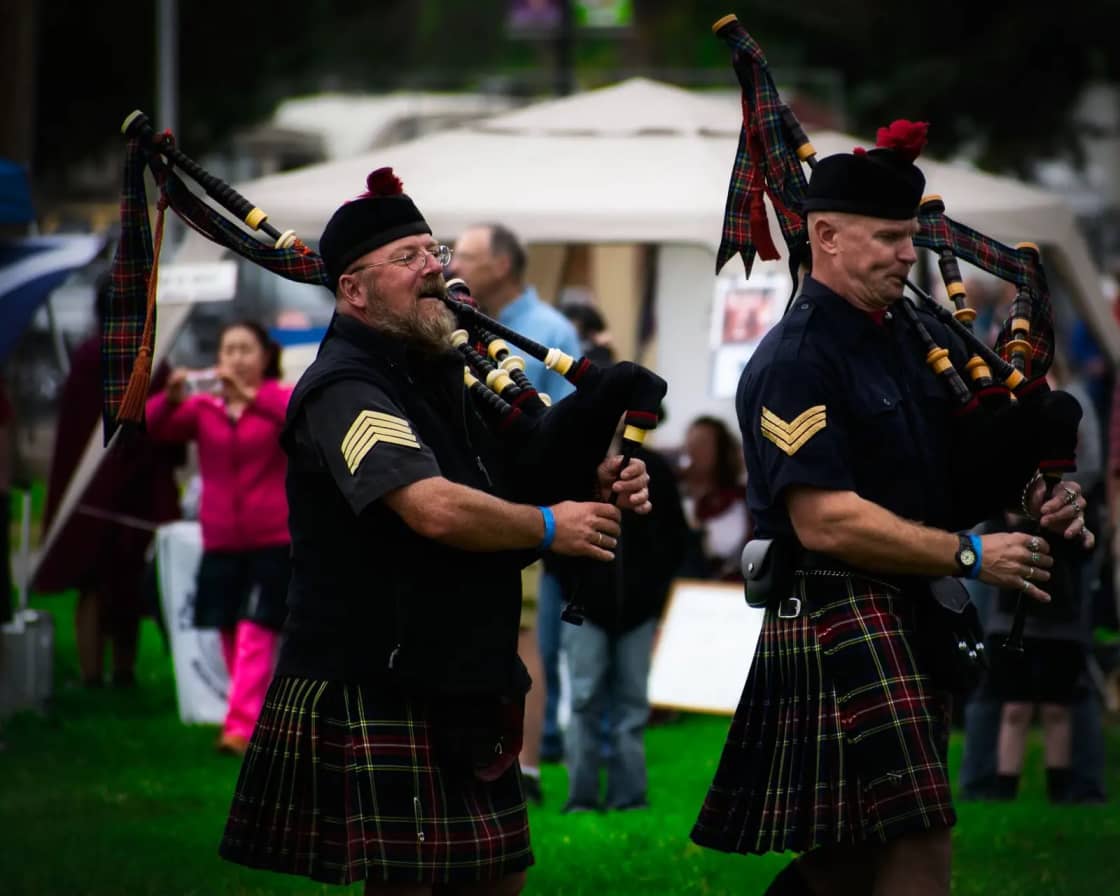
Pipe bands play through the day and are the reason the festival is audible from several streets away. If you have only ever heard bagpipes through a speaker, hearing a full band outdoors at close range is a different physical experience — the drone sits somewhere in your chest.
Highland dancing
Competitive Highland dance runs alongside the athletics: the fling, the sword dance, the sailors' hornpipe. It is judged, technical and performed largely by young people who have trained hard, and it is a good counterweight to watching grown men throw logs.
Clan tents
Rows of booths representing Scottish family names, staffed by people who know the history of those names and want to talk about it. You do not need to be Scottish, or to be sure you are Scottish, to walk up to one. The whole point of a clan tent is to answer that question for people who have wondered. Utah's genealogical culture makes this section busier here than it would be at a comparable festival elsewhere, which is one of the small ways the event is specifically local.
Kids' Highland Games
Scaled equipment, scaled distances, same events. Children compete, get taken seriously, and generally have the best day of anyone present.
Reading a pipe band
The bands are the most visible thing at the festival and the least explained, so a short orientation.
A pipe band is two instrument groups working as one: pipers playing Great Highland bagpipes, and a drum corps split between snares, tenors and a single bass. The bass drum sets the pulse, the tenor drummers play flourishes and visual work with the sticks, and the snare line carries the intricate part. When a band is good, the snare line is the reason.
Everything is in one key, roughly. The Highland pipe has nine notes and no volume control, which is why bagpipe music is built out of ornamentation — grace notes, doublings, throws, birls — rather than dynamics. What sounds like decoration is actually how the instrument articulates at all. Once you know that, a tune stops sounding like a continuous drone with a melody on top and starts sounding like phrasing.
The drones are tuned before every set and it takes a while. The stretch of noise before a band plays properly is not the performance going wrong; it is three drones per piper being brought into agreement.
Massed bands — several bands playing together — usually bookend the day, and it is the loudest and best thing that happens. If you are choosing one moment to be near the field for, that is it.
A first-timer's Saturday
The day has a shape. Roughly, and allowing for the schedule to move year to year:
Morning. Opening ceremonies with the clans, the heavy events beginning, the field at its least crowded and the temperature at its most reasonable. This is the best hour of the day and the one most people miss.
Late morning. Heavy athletics running in flights, dancing underway on its own platform, clan tents fully staffed and not yet tired of talking. Good window for the surname conversation.
Midday. Hottest, busiest, and the point at which the shaded perimeter earns its keep. Eat now, because the food queues get worse later.
Afternoon. The caber events, which are what most of the crowd came for, and the kids' games. Attention concentrates on the field.
Late afternoon. Results, massed bands, and the pack-up. The crowd thins quickly once the last competition is called.
If you have two hours rather than a day, take late morning. If you have one hour, take whatever hour the massed bands are playing.
What to eat
Vendor row is the usual mix of festival food and Scottish specialties, and the balance shifts year to year with who books.
Reliably present: meat pies and bridies — a bridie is essentially a pastry filled with seasoned meat and onion, and it travels well around a festival field. Sausage rolls. Shortbread, sold by people who take shortbread seriously. Scotch eggs turn up most years.
Haggis appears some years and not others, and when it does it is usually sold as a small tasting portion rather than a plate. It is worth trying once. The description everyone gives — oats, offal, onion, pepper, cooked in a casing — makes it sound worse than it eats; the flavor is closer to a coarse, peppery stuffing than to anything alarming.
Also there: the standard American outdoor-event lineup, because a two-day festival cannot feed a crowd on bridies alone.
If nobody in your group will eat any of that, Payson's own restaurants are a few minutes from Memorial Park, and the south-county food guide covers the wider area.
Getting there, parking and access
From Provo: south on I-15 to Payson, then to Main Street. Around half an hour without traffic.
Parking is free street parking in the blocks around Memorial Park, and it behaves the way free street parking always behaves: excellent at nine in the morning, poor by eleven. There is no paid lot to fall back on, so arriving early is the whole strategy.
Access: Memorial Park is a municipal park — grass, paths and mature trees. It is flatter and easier underfoot than a fairground, which makes this one of the more stroller- and wheelchair-manageable summer events in the valley, with the caveat that grass after a crowd is still grass.
Restrooms are park facilities plus portable units. Plan accordingly on the Saturday.
How to do it well
Arrive early on Saturday. Street parking near the park is free and finite, and the gap between arriving at nine and arriving at eleven is the difference between parking beside the park and parking several blocks from it.
Bring a camp chair. There is limited fixed seating around the athletic field. Almost everyone who looks comfortable brought their own chair.
Claim shade, not a front-row spot. Memorial Park's trees are the amenity. The throwing field is large and visible from the shaded perimeter, and mid-July in Payson makes an unshaded folding chair a poor long-term investment.
Water, hat, sunscreen. The south end of the valley runs hot and dry, and the elevation means the sun is harsher than the temperature suggests.
Ask the athletes questions between flights. Highland-games competitors are, as a group, strikingly willing to explain what they are doing. There is a lot of standing around between throws and most of them would rather talk to you than not.
Ear protection for very small children if you plan to be close to the massed pipe bands.
Who is actually competing
The athletes are not a touring professional circus. Highland games in North America run on a class system, and most of the field at a festival this size is amateur.
Competitors are typically grouped by experience and by category — an amateur field with its own tiers, a masters division for older athletes, and women's classes that run the same events with implements scaled to the class. Weights and caber lengths differ by class, which is why two throwers can post very different distances and both be doing well.
What that means for a spectator is that you are usually watching people who have day jobs, who drive to a handful of games a season, and who train in a field somewhere with equipment they bought or made. They are strong, they are serious about technique, and they are not being paid. It is closer in spirit to a regional track meet than to a professional exhibition, and it is a much better watch for it.
The other thing worth knowing: the heavy events run in flights all day rather than as discrete scheduled spectacles. There is no single moment when "the games" happen. Throwers rotate through events across the afternoon, so arriving at any point puts you in the middle of something.
Why Utah Valley, of all places
The reasonable question is what a Highland games is doing in a small city in Utah County.
The straightforward answer is migration. A substantial share of nineteenth-century emigration to Utah came out of Britain — Scotland very much included — and those family lines are still here and still traced. Utah's unusually strong genealogical culture keeps that ancestry live in a way it is not in most American communities: people here are far more likely than average to know which specific Scottish parish a great-great-grandparent left.
A festival like Payson's sits directly on top of that. It is not a themed event borrowed from somewhere else. It is a diaspora community doing what diaspora communities do, in a park, for free, for forty-odd years.
There is a second one, too. The Highland Fling runs in the city of Highland at the north end of the valley a few weeks later — smaller, similar spirit. Two Scottish festivals in one Utah county is a genuinely strange statistic, and it is not an accident.
Making a day of it in Payson
Payson is worth more than the drive-in-and-drive-out treatment. Things to do in Payson covers the town, and the Payson city guide covers what it is like beyond the events calendar. If you like the town, Golden Onion Days over Labor Day weekend is its other big annual gathering and has an entirely different character — small-town parade and fireworks rather than international heritage.
For the rest of the valley's summer, the events calendar carries what is running week to week.
The honest take
This is a small festival, and that is the recommendation rather than the caveat.
Free admission changes the whole texture of an event. Nobody is trying to extract a day's worth of value from a ticket they already bought, so people wander in, watch a caber flight, eat something, listen to a band and leave when they are done. The athletes are close enough to talk to. The clan tents will spend twenty minutes on your surname. The children compete on the same field the adults do.
If you have driven past Payson for years without stopping, this is the weekend that makes the case for the town.
The restroom math behind a free festival in a neighborhood park
Nothing tells you more about how seriously an outdoor festival has been planned than its restrooms, and in Utah that is not left to the organizer's judgment. There is a table in state rule with numbers in it, and it explains a great deal about how a park-based festival is laid out.
The rule is Utah Admin. Code R392-400, Temporary Mass Gathering Sanitation, which applies where an event reasonably anticipates 1,000 or more people for two or more hours a day at a site being used for a purpose different from its designed use — a neighborhood park hosting Highland games being a clean example.
Table 1, and what it actually requires
R392-400-15(3) provides that the number of toilets shall be provided in accordance with Table 1, which is indexed on two axes: peak crowd and average time at the gathering, from one hour to ten.
The numbers are steeper than intuition suggests, because they scale on dwell time as hard as on headcount. A peak crowd of 2,000 staying an average of four hours requires 12 toilets. The same 2,000 people staying eight hours requires 20. A peak crowd of 5,000 at four hours requires 25; at eight hours, 50. At 10,000 and six hours the figure is 75.
R392-400-15(6) handles longer events: for a gathering running more than ten hours, the requirement is the ten-hour figure plus the figure for the additional hours or portion of them.
The uplift that catches organizers out is R392-400-15(4): if alcoholic beverages are consumed at the gathering, the operator shall increase the number of required toilets by 40 percent. Not a recommendation, and not tied to whether the event sells the alcohol — the trigger is consumption.
Placement, accessibility and servicing
The rule does not stop at counting. R392-400-15(7) requires portable toilets to be located a minimum of 100 feet from any food service operation and not more than 300 feet from the grandstand, spectators or other activity areas, with the local health officer able to grant exemptions where site conditions limit placement. Those two distances together are why the toilet bank at a well-run festival is always slightly further from the food than feels convenient and always closer to the crowd than feels tidy.
R392-400-15(5) requires five percent, with a minimum of one, of the required toilets to be accessible and identified by the International Symbol of Accessibility in compliance with 36 C.F.R. Part 1191.
R392-400-15(8)(a) requires working hand wash stations at a minimum rate of one per ten portable toilets or portion thereof, with soap, water and single use towels at each under (8)(b). Where soap and water are impractical the health officer may allow sanitizing gel under (8)(c) — but (8)(d) bars gel from replacing soap and water at stations used by food service workers. R392-400-15(9) adds one covered trash container per ten toilets, and R392-400-9(2)(b) separately requires a waste container next to the hand wash stations.
Three servicing rules complete it. R392-400-15(11) requires each unit to be secured against vandalism and adverse weather by tie-downs, anchors or similar means. R392-400-15(13)(a) requires wastewater to be removed at least once every 24 hours or more often as necessary, with the health officer able to change that frequency for weather, season or the nature of the event. R392-400-15(15) requires each unit to be serviced and then removed within 48 hours of the gathering ending.
Why this is worth knowing as an attendee
The layout is not arbitrary and you can read it. The 100-foot food setback and the 300-foot crowd limit mean the units will be at the edge of the activity rather than the middle of it. Looking outward from where the crowd is thickest is the fastest way to find them.
Hand wash stations track toilet count, so find the bank and you have found them. One per ten units is the floor, and they will be beside the toilets rather than elsewhere.
Accessible units exist by rule, in small numbers. Five percent of a modest bank is one or two, which is why arriving with a specific need is worth planning around rather than assuming. For the wider accessibility picture, see our wheelchair-accessible Utah Valley guide.
Grounds layout, festival dates and hours change year to year; confirm them with the organizers rather than relying on a guide.
Related Guides
- Payson Golden Onion Days
- Things to Do in Payson
- Living in Payson
- Utah County Fair & Rodeo
- Provo Freedom Festival
- Family Activities in Utah Valley
- The Orem Asian Festival: University Place's Free Spring Celebration of Asian Cultures — When It Happens, What to Expect at The Orchard, and Where to Find More
- Christmas in Provo: Holiday Events & Lights Guide (2026)
- Pioneer Day, Explained: Why Utah Shuts Down on July 24
- Utah Valley Events: Your Guide to August and Labor Day 2026
Published August 2026. The festival's dates move within mid-July from year to year and the program is set annually — this page describes the event's structure rather than printing a schedule that expires. Confirm the current year's dates and program with the official festival site before traveling.
Frequently Asked Questions
When is the Payson Scottish Festival?
Is the Payson Scottish Festival free?
Where is it held?
What are the Highland Games heavy events?
Can children take part?
What is a clan tent, and can I visit one if I am not Scottish?
What is there to eat?
Is there another Scottish event in Utah Valley?