Upcoming dates

Most people in Utah Valley have a vague awareness that there is a county fair and a much clearer awareness that they have never been to it. The Fourth of July is enormous here, Pioneer Day is enormous here, and by the end of July a lot of households are simply out of festival energy.
That is the fair's problem, and it is also the reason it is worth going. The Utah County Fair & Rodeo runs four days at the Spanish Fork Fairgrounds in the stretch from late July into the first days of August, and it is the county's last big communal thing before school starts. It is smaller than the events that precede it. It is also the only one where somebody's fourteen-year-old is showing a steer they raised.
The basics
Where: Spanish Fork Fairgrounds, 475 South Main Street, Spanish Fork. Not Provo. This is the single most common planning mistake — the county fairgrounds sit in the south end of the valley, about twenty minutes down I-15 from Provo, and people who leave home assuming a fifteen-minute drive arrive late for the thing they came to see.
When: Four days, Wednesday through Saturday, in the window that closes out July and opens August. The precise dates shift year to year. The dates box at the top of this page carries the next fair's dates, and says plainly when Utah County has not confirmed them yet; treat any date you remember from a previous year as a guess.
The daily rhythm: The fair opens progressively later in the week and runs later each day — a short Wednesday afternoon and evening, a longer Thursday, a Friday that starts around midday, and a full Saturday that opens in the morning. That escalation is deliberate and it is useful. It means Wednesday is quiet, Saturday is not, and the middle two days are the compromise most people should take.
Cost: General admission is modest. Carnival rides are a separate purchase, sold per ride or as a wristband. The rodeo is its own ticket. Because all three of those numbers are reset every year, we do not print them — the fair's official site publishes the current schedule of prices, and that is the only version worth trusting.
What actually happens there
The livestock side — the real fair
Strip away the midway and a county fair is an agricultural competition, and Utah County's still is. 4-H and FFA members show cattle, sheep, swine, goats, poultry and rabbits, and the judging is the structural backbone the rest of the event hangs off.
If you have never watched a market-animal show, it is more interesting than it sounds. Teenagers who have spent months on a single animal walk it in front of a judge who explains, out loud, what he is seeing and why one animal places above another. It is one of the few public events anywhere where you can watch expertise being taught in real time to people who are visibly nervous.
The barns are also, practically speaking, the best value in the fair: free to walk through, shaded, full of animals a small child can get close to, and staffed by exhibitors who will almost always answer a question about what they are holding.
The rodeo
The rodeo is the ticketed headline and it draws the biggest crowd of the week. Standard rough-stock and timed events. If you are coming specifically for the rodeo, buy ahead and arrive early — seating fills, and the parking situation at the fairgrounds is at its worst on rodeo nights.
The demolition derby
Enormously popular, extremely loud, and the event most likely to convert a skeptic. Cars are wrecked deliberately in a dirt arena until one still moves. Bring hearing protection for children and expect dust.
The midway and the food
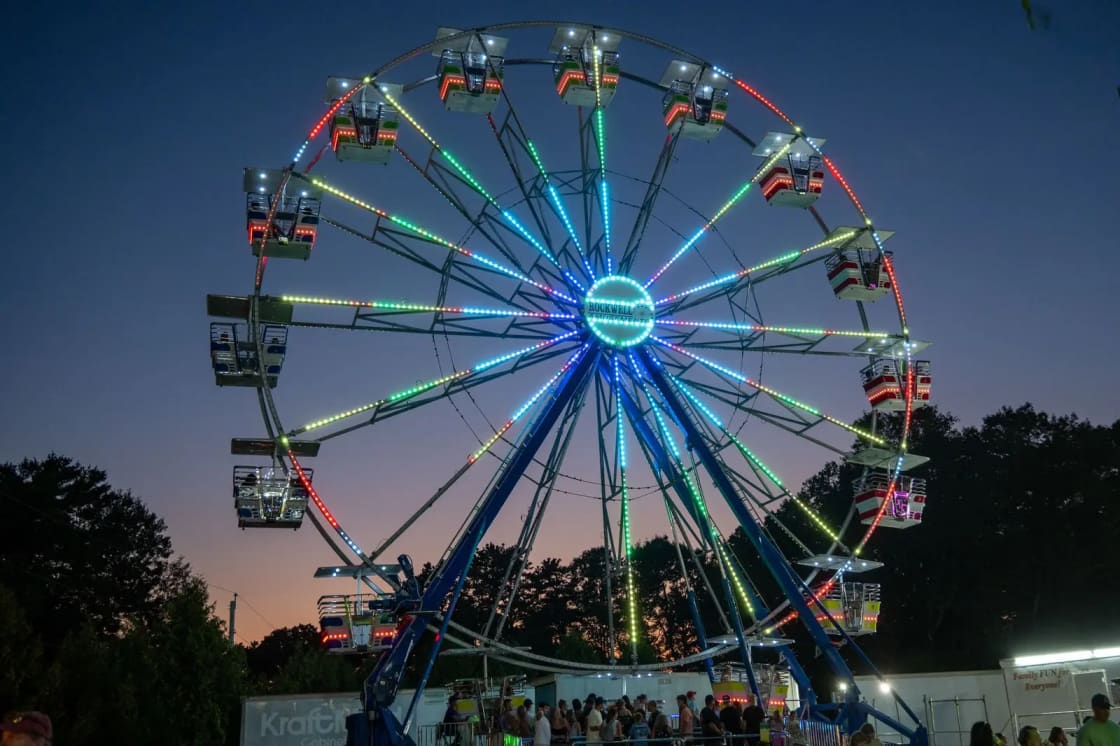
Carnival rides, games, and the food that only tastes correct at a fairground: scones with honey butter, funnel cake, corn dogs, shaved ice, roasted corn. Nothing here is a secret and nothing here is cheap. It is the part of the fair that is identical to every other fair in the country, which is exactly why people come.
Exhibits, concerts and vendors
Open-class exhibit halls display the quilts, preserves, produce, photography and art that county residents entered — see below on how to enter your own. There is live entertainment across the run, vendor booths, and the community-organization tables that are a decent way to find out what actually exists in the south end of the county.
If you have never been to a rodeo
A large share of the people who move to Utah Valley have never sat through a rodeo, and the ticketed rodeo is the fair's headline. Ninety minutes of unexplained events is a long time. Here is what you are looking at.
Rough stock — the events where a rider tries to stay on an animal that does not want them there. Bareback riding and saddle bronc riding are both eight seconds on a bucking horse, the difference being the equipment and the style: bareback is a rigging handle and a violent ride, saddle bronc is a rein and a specialized saddle, and it is the more technical of the two. Bull riding closes most programs because nothing follows it well.
The scoring is the part nobody explains. In rough stock, the animal is scored as well as the rider — up to 50 points each, out of 100. A rider who makes a clean eight seconds on a horse that did not buck hard cannot post a high score. That is why the crowd reacts to the draw, and why a bucked-off rider sometimes gets more sympathy than derision.
Timed events — the clock decides. Tie-down roping and team roping are working-ranch tasks done at speed. Steer wrestling involves a rider leaving a moving horse to put a steer on the ground, and is over faster than it takes to describe. Barrel racing is a sprint around a cloverleaf of three barrels, usually the fastest and most immediately legible event on the card, and the one first-timers most reliably enjoy.
The rest of the card. Expect mutton bustin' — small children on sheep, helmeted, in the single most photographed event of any county rodeo — plus a specialty act and the rodeo clown, who is doing crowd work and bullfighter safety work at the same time.
Practical notes: it is dusty, it is loud, and it runs on a schedule that is firmer than most fair events. Arrive with time to park. Bring hearing protection for very young children. And do not expect to follow the announcer's terminology on your first visit — nobody does.
Getting there and parking
From Provo and Orem: south on I-15, exit at Spanish Fork, then to Main Street. Call it twenty to thirty minutes from central Provo depending on the hour, and add to that on a Friday or Saturday evening.
From the south end of the county — Payson, Salem, Santaquin — it is a short drive, and this is genuinely a south-county event in a way the rest of the valley sometimes forgets.
Parking fills from the fairgrounds outward. On rodeo and derby nights the near lots go first and the overflow is street parking in the surrounding blocks. Nobody has ever regretted arriving thirty minutes early and nobody has ever enjoyed circling.
Transit is not a realistic option for the fairgrounds in the evening. Plan on driving, and plan on a designated driver arrangement if that is relevant to your evening.
Accessibility: fairgrounds are gravel, dirt and grass. A wheelchair or a stroller works, but it works better with wide tires than with small hard casters, and the ground gets churned up as the week goes on.
Why a county fair still exists
County fairs began as agricultural extension events — a place to judge stock, compare crops, and spread whatever the state agricultural college had learned that year. Nearly every county in the American West has one, and a great many of them are quietly dying as the farming population that justified them shrinks.
Utah County's has a specific reason to persist. The county still has real agriculture in its south end, the 4-H and FFA programs still enroll substantial numbers of young people, and the fair is the terminal event those programs point at all year. The livestock auction at the end of a market-animal season is not decoration; it is the point of the project for the young person who raised the animal.
That is the frame worth carrying in. The midway is the part that pays for the event. The barns are the part that justifies it.
How to do it well
Pick your day around the event, not the crowd. If the derby is the point, you are going on derby night whatever the crowds do. Only if you are going for the fair generally does the Thursday-or-Friday advice apply.
Go later than feels natural. Late-July afternoons in Spanish Fork are hot in a way that ends visits early. The fair's best hours are the last three — the temperature drops, the lights come on, and the midway looks the way it is supposed to look.
Bring cash. Some vendors and booths take cards and some do not, and the ones that do move slower. Cash is the difference between a five-minute queue and a fifteen-minute one.
Bring water and something warm. Both. The swing between a Utah Valley afternoon and a Utah Valley evening at this time of year catches people out every single year.
Park once. Fairgrounds parking fills from the inside out. Arrive, park, and accept the walk rather than circling for something closer.
Entering the fair yourself
This is the section most guides skip, and it is the one that changes the fair from something you attend to something you are part of.
Open-class competition is open to county residents, not to farmers. The categories run well beyond livestock: baking, canning and preserves, quilting and needlework, horticulture and cut flowers, floral arrangement, photography, fine art, crafts. If you grow tomatoes or make jam or take photographs, there is a class for it.
The deadline is the trap. Entries are registered in advance and physically delivered during a short intake window in the days before the fair opens — not on opening day. Every year people discover the open class exists while walking through it, at which point they are a year early for next time.
Where to look: the county's official fair site publishes the exhibitor handbook and class list ahead of the season, including the entry fees, the intake times and the rules about what disqualifies an entry. Read the handbook rather than assuming; the rules on things like jar type for preserves and mounting for photography are specific.
Youth entries run through 4-H and FFA, which have their own timelines and their own leaders — if you have a child who wants to show an animal, that conversation starts many months before the fair, not in July.
What it costs a family, realistically
The gate is the cheap part. The shape of a family day, in rough proportions rather than dollar figures that expire:
- Admission is the smallest line. For a family it is usually less than the cost of one meal out.
- Rides are the largest line by a wide margin, and the wristband-versus-single-tickets decision is the one that determines your total. A wristband makes sense if children are going to ride repeatedly for hours; single tickets make sense for two or three rides on the way past. Decide before you get to the booth.
- Food at fair prices runs roughly double what the same food costs anywhere else, which is the standing bargain at every fair in the country.
- The rodeo is a separate ticket per person and is the second-largest line if you go.
The genuinely free version exists and is not a bad day: walk the livestock barns and the exhibit halls, watch a judging class, look at the entries, leave. That is two hours, costs the admission and nothing else, and is the part of the fair with the most actually happening in it.
Where it sits in the county's calendar
The fair is the last stop in a very crowded run. Spanish Fork's Fiesta Days wraps up just before it in the same city, and Springville's World Folkfest lands nearby in the same window. Two weeks earlier the valley is finishing Pioneer Day; a few weeks earlier than that, the Freedom Festival has consumed Provo entirely.
That density is why the fair gets overlooked, and it is also an argument for going. By the first week of August the crowds that filled every other event have gone home, and what is left is the version of a Utah County summer that most closely resembles what a Utah County summer used to be.
If you are making a day of it in the south end of the valley, things to do in Spanish Fork and the Spanish Fork restaurant guide cover what else is within a few minutes of the fairgrounds, and Payson's Golden Onion Days is the next south-county event on the calendar after this one.
The honest take
If you want spectacle, the Fourth of July in Provo is a bigger event by an order of magnitude and you should go to that instead.
The county fair is a different proposition. It is a small, unfashionable, agriculturally rooted event that has kept running because the people who make it happen have not stopped. Go for the barns, stay for the derby, and if you have children, understand that the thing they will remember is not the rides — it is the fourteen-year-old in the show ring with a steer twice their weight, being taken completely seriously by a room full of adults.
The permit behind a county fair, and who can shut it
A county fair looks like a self-organizing thing: livestock arrives, the rodeo runs, the food row opens. There is a permit underneath it, held by a named person, and a health officer with the authority to close any part of it on the day. Knowing that structure explains several things visitors notice and few people can account for.
The governing instrument is Utah Admin. Code R392-400, Temporary Mass Gathering Sanitation, authorized under Utah Code §§ 26B-7-402 and 26B-1-202.
The permit, and the one question that decides whether it is needed
R392-400-4(1) is flat: a person may not operate a temporary mass gathering without a valid written permit issued by the local health officer. No threshold language, no discretion — if the event is a temporary mass gathering, the permit is mandatory.
Whether a fair is one turns on R392-400-2(2), the permanent-facilities exclusion, applied to purpose-built fairgrounds. A fairground with permanent structures designed for exactly this assembly is doing what it was built to do, which is the situation the exclusion contemplates — unless the designed occupancy levels are exceeded. So the answer for any particular fairground in any particular year is a question of fact about that site and that crowd, and it is the health department's to answer rather than a guide's. What matters for a visitor is that the question is live, and that a bigger year can change it.
Emergency medical care, which the rule specifies in unusual detail
Livestock, a rodeo and midsummer heat make a fair a place where people get hurt, and R392-400-11 is written accordingly. Where the rule applies, the operator must ensure the gathering has at least one first aid station, and that the station affords privacy to a person receiving care, is of sufficient size for the number of caregivers and the predicted number of sick or injured people, is strategically located, is easily accessible by emergency vehicles, and is clearly marked and identifiable.
Two requirements in that section are the ones worth knowing about. Under R392-400-11(1)(g) the operator must give the emergency medical provider a map of the site showing first aid stations, emergency vehicle ingress and egress routes, landing zones where applicable, and rendezvous locations. And under R392-400-11(2)(c) the local health officer or the emergency medical provider may require the operator to provide dedicated stand-by ambulances and personnel at the gathering.
An ambulance parked at a rodeo is not a courtesy. It is frequently a permit condition, and it is one of the visible signs that the health department has looked at the event and made a judgment about it.
Inspection, closure and what a penalty actually costs
R392-400-7(1) allows the local health officer to inspect before, during and after a gathering. R392-400-7(2) requires the operator to give the health officer access to each area the officer deems necessary, with the number of access credentials requested — a nicely practical clause, since a ticketed event with a wristband system could otherwise fence out its own regulator. R392-400-7(3) requires the operator to communicate those access privileges to staff, which is why a gate volunteer who has never met an inspector is supposed to already know what to do.
The closure power sits at R392-400-8. The health officer may issue a notice of violation to the owner or operator, and under R392-400-8(3) may issue and post a notice of closure of the gathering or any affected part on determining that conditions constitute a serious or imminent health hazard. A closed area may not be used again until the conditions are abated and the health officer gives written approval. R392-400-8(5) makes it improper for an unauthorized person to deface or remove a posted closure notice.
Penalties follow at R392-400-16. A violation may be penalized under Utah Code § 26B-1-224; each day a violation continues is a separate violation; and the violator is additionally liable for any expense the local health department incurs removing or abating a nuisance, source of filth, health hazard or sanitation violation.
For the food side of the same event, which runs on its own permits, see food permits and inspections in Utah County. Fair dates, hours and gate prices shift year to year; confirm them against the current listing rather than any general guide.
Related Guides
- Provo Freedom Festival: The Complete Guide
- Payson Golden Onion Days
- Pioneer Day in Utah, Explained
- Things to Do in Spanish Fork
- Best Restaurants in Spanish Fork
- Family Activities in Utah Valley
- Fiesta Days: Spanish Fork's Rodeo Week and the Valley's Biggest 24th of July
- Christmas in Provo: Holiday Events & Lights Guide (2026)
- Payson Scottish Festival & Highland Games: The Complete Guide
- Stadium of Fire: How Provo's Fourth of July Actually Works
- Utah Valley Events: Your Guide to August and Labor Day 2026
- Wasatch County Fair Days: the Heber derby, the PRCA rodeo and how to get tickets
Published August 2026. Dates, admission and ticket prices for the fair are reset annually — this page deliberately describes the fair's shape and timing rather than printing figures that expire. Confirm the current year's dates, hours and prices with the official Utah County Fair site before you travel.
Frequently Asked Questions
When is the Utah County Fair?
Where is the Utah County Fair held?
How much does the Utah County Fair cost?
Which day of the fair is best?
Is the Utah County Fair the same as the Utah State Fair?
Can I enter something in the fair?
Is the fair good for young children?
What else is happening in Utah County that week?