
Almost every "accessible things to do" guide has the same flaw: it lists places with a ramp. A ramp at the door tells you nothing about whether the bathroom is usable, whether the accessible parking is a quarter mile away, whether the path from the lot crosses gravel, or whether the one accessible table is next to the kitchen.
This is an attempt at the other kind of guide — the one that tells you how the pieces of Utah Valley connect for someone using a wheelchair, where the good infrastructure is, and where the limits are. Some of what follows is unflattering about places we otherwise recommend. That is the point.
A caveat we would rather lead with than bury: accessibility details change, and no third-party page should be your final check. Venues renovate, lifts break, and a route that worked in June can be under construction in August. Everything here is orientation. The phone call is the verification.
The geography is on your side
Start with the good news, because it is structural and it does not change.
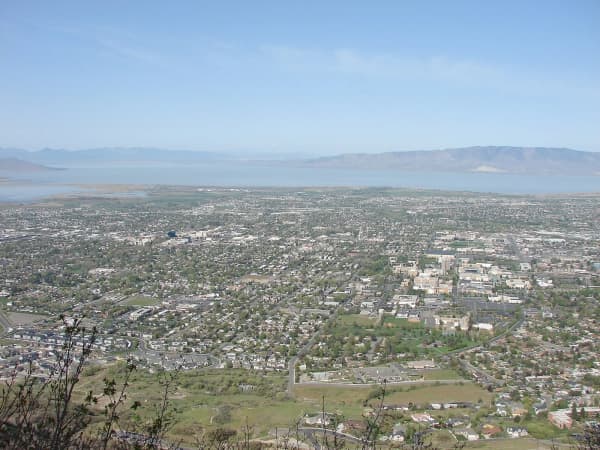
Provo and Orem sit on a flat valley floor with a wide, regular street grid. Blocks are long, streets are broad, and the older parts of the city were laid out with room that most American downtowns of the same age do not have. For a manual chair user, flat and wide is worth more than almost any individual accessible feature.
The valley's difficulty is entirely vertical and entirely on the east side. Everything from about the BYU campus upward climbs the bench, and the grades on the upper neighborhoods — Oak Hills, Wasatch, Indian Hills, Rock Canyon — are serious. If you are choosing where in Provo to spend time, west and central are flat, east and north are not, and that single fact organizes more of the practical experience than any accessibility rating.
The newer west-side neighborhoods add a second advantage: recent single-family construction is far more likely to have a no-step entry, a wider door and a single-level layout than housing built in the 1950s on the east bench.
Transit, in order of usefulness
UTA On Demand
The most interesting recent development for accessible travel in Provo is a service most people have not heard of.
UTA On Demand is curb-to-curb microtransit — you hail a shared van from an app and it collects you near your location. It runs a zone covering roughly 8.6 square miles of west Provo and Orem, home to about 24,000 people, and the fare is $2.50 with a transfer to bus or FrontRunner included within two hours. UTA described the launch fleet for this zone as 100% ADA-accessible.
The operationally important detail: turn on wheelchair accessibility in your app profile. Once that setting is on, every trip you book is dispatched with an accessible vehicle. It is a profile setting rather than a per-trip request, which is a better design than it sounds — but it means a rider who has not found the setting can be matched to a vehicle that does not work for them.
Two limits. The zone does not cover central or east Provo, and the service does not run on Sunday. A second, much larger zone opened across north Utah County in August 2026.
FrontRunner and UVX
FrontRunner is the accessible spine for travel out of the county, with Provo Central and Orem Central both served. UVX, the bus rapid transit line running the Provo–Orem corridor past both campuses, uses stations rather than curbside stops, which generally means level boarding and a more predictable experience than a conventional bus.
The recurring constraint on both is Sunday. FrontRunner does not operate on Sundays, and neither does On Demand. Anyone planning a Sunday that depends on transit needs a different plan — a car, a paid rideshare with an accessible vehicle booked ahead, or a change of day.
Paratransit
UTA operates paratransit as a complement to fixed-route service, with its own eligibility process. It is worth applying before you need it rather than during a crisis, because eligibility determination takes time. UTA's customer service line handles the process, and eligibility for paratransit is separate from the reduced-fare program, which is a common point of confusion.
Driving and parking
Utah issues disabled parking placards through the Division of Motor Vehicles, on an application with a section certified by a licensed medical provider. Both temporary and permanent placards exist; permanent placards attach to the person, not the car, so they travel with you.
Downtown Provo parking is a mix of street parking and lots, and the accessible spaces are generally where you would hope. The harder problem downtown is not the space but the curb-to-door path on the older blocks, where a historic building can have a step at the threshold that a modern lot cannot fix.
The outdoors, assessed
This is where Utah Valley over-performs, and where the misleading listings do the most damage.
The Provo River Parkway
The Provo River Parkway is the single best accessible outdoor asset in the county and it is not close. It is paved, it runs a long continuous distance from the canyon down through the city toward Utah Lake, and it connects a large number of destinations along the way.
Treat it as a network rather than one trail. Different sections have different grades, surfaces and crossings, and "paved" does not mean "flat" over that distance — the upper canyon sections carry real gradient. The practical approach is to pick a section, check it, and build a routine around the part that works, rather than assuming the whole length is uniform.
Bridal Veil Falls
Bridal Veil Falls is the accessible waterfall, with the caveat that what is accessible is the approach. The parkway is paved past it and there is parking nearby, which puts a dramatic view within reach in a way almost no other Utah waterfall manages. Beyond the paved viewing area the ground is rock and uneven, and that part is not accessible. Set the expectation as a paved viewpoint and it is excellent; set it as an accessible hike and it disappoints.
Utah Lake and the west side
Utah Lake State Park and the west-side parkway trails offer flat, open, paved-or-graded routes with big views and, crucially, easy parking. The Provo Bay wetlands are a birding area where much of the value is available from a vehicle or a short flat approach.
What is not accessible, plainly
The canyon hikes are not. Y Mountain is not. Rock Canyon's trail beyond the paved beginning is not. Most of the Wasatch trail network is rock, root and grade, and no amount of careful wording changes that. Saying so is more useful than a hedged listing that wastes somebody's Saturday.
Venues and buildings
The pattern here is consistent and predictable once you see it: age of building predicts accessibility more reliably than type of business.
Recently built public facilities are the strongest. The Provo Recreation Center is the clearest example — modern, purpose-built, with accessible parking, entry and facilities designed rather than retrofitted. Newer municipal buildings, libraries and schools generally follow the same pattern.
University campuses are well-resourced and well-mapped. Both BYU and UVU maintain accessibility infrastructure, accessible parking and offices that handle access questions, including for visitors rather than only students. Campus buildings vary in age, so the offices are the right first contact rather than a campus map.
Chain retail and newer restaurants are usually fine, because they were built under current code in purpose-built shells with their own parking.
Historic downtown storefronts are the weak category. A narrow nineteenth- or early twentieth-century building on Center Street may have a compliant front door and an interior that cannot accommodate a chair — a step down to a back room, a bathroom up a half flight, tables packed to the walls. This is not indifference so much as physics inside a listed shell, and it is why calling ahead beats any directory.
Performance venues vary widely. Larger and newer rooms handle accessible seating well and can usually tell you exactly where the positions are. Smaller and older rooms may have one location, may not have a companion seat beside it, and may need advance notice.
Winter is the real variable
Nothing on this page matters as much between December and March as who clears the snow, and how fast.
A cleared sidewalk is an accessible route. An uncleared one is a wall. Utah Valley's snow is frequent rather than catastrophic — a valley-floor winter is mostly a series of modest storms rather than a few enormous ones — which sounds better than it is, because it means the clearing question comes up repeatedly rather than once.
Responsibility is split in a way that produces uneven results. Streets are the city's; the sidewalk in front of a property is generally the property owner's responsibility, and compliance varies house by house on the same block. The practical consequence is that a route can be perfectly clear for four blocks and impassable for one, and the impassable block is not predictable from one week to the next.
Three things help. Prefer routes with institutional frontage — schools, churches, municipal buildings and larger businesses clear reliably and early, because they have to. Check whether a trail is on the plowed list before planning a winter outing; some paved trail sections get cleared and some do not. And build in more time than the distance suggests, because refreeze overnight turns cleared surfaces into ice in a valley that runs cold and dry.
Winter also changes the transit calculation in your favor. A $2.50 accessible van from a heated house to a covered station is a much better February proposition than a mile of uncertain sidewalk.
Events, festivals and outdoor seating
Utah Valley runs a heavy calendar of outdoor events, and the accessibility experience at them is more variable than at fixed venues, for a straightforward reason: the infrastructure is temporary.
The things that go wrong are consistent. Grass and gravel are the default surface at park events and neither is good. Accessible parking gets consumed by event volume long before the event fills. Temporary accessible toilets are provided in small numbers and placed at the edge. And sightlines at a standing crowd event are a genuine problem that no ramp addresses.
What works, in rough order of reliability: arrive at the beginning rather than the middle, contact the organizer in advance because most local events are run by people who will make an accommodation if asked and cannot if not, and favor ticketed seated events over free standing ones where the choice exists. Larger, longer-running festivals tend to handle this better than small ones, because they have had the complaints and fixed the obvious failures.
For dining, the useful question to ask on the phone is not "are you accessible" — almost everyone says yes — but three specific ones: is there a step at the entrance, is the accessible restroom on the same floor, and can you seat a chair without moving furniture. Those three answers predict the visit.
Planning a visit from out of town
For visitors, a few decisions front-load most of the difficulty.
Where to stay. Newer hotels along the University Parkway corridor and near the freeway are far more likely to have accessible rooms than anything characterful downtown, and they have their own flat parking. Confirm roll-in shower versus tub bench directly with the property rather than through a booking platform, because platform filters are unreliable on this specific point.
Which airport. Provo Municipal is small, which for many travelers is an accessibility advantage — short distances, simple layout, no inter-terminal transfer. Salt Lake City offers far more routes and full accessibility infrastructure but is an hour away and much larger to cross. The right answer depends on whether route choice or airport simplicity matters more to you.
What to do. A realistic accessible day here looks like: a paved section of the Provo River Parkway in the morning, lunch somewhere purpose-built with its own lot, an afternoon at a modern indoor venue or a campus museum, and the canyon viewed from Bridal Veil Falls rather than hiked. That is a good day, and it is honest about what the terrain allows.
Healthcare and services
Utah Valley Hospital in Provo is the region's major facility and the anchor of the local healthcare system, which matters both practically and for anyone weighing a move. Notably, the hospital sits among the destinations served by the UTA On Demand west-side zone, even though it is just outside the zone proper.
For equipment, advocacy and help navigating benefits, Utah's independent living center network serves Utah County and is the usual first call — these are the organizations that deal with the practical questions no city page can answer well.
Living here: the honest balance
In favor: a flat valley floor, a wide grid, the longest good paved trail in the region, two universities with real accessibility resources, a major hospital, newer west-side housing with single-level layouts, and a $2.50 accessible curb-to-curb transit option that did not exist two years ago.
Against: winter, which turns an accessible route into an inaccessible one for months and depends on how quickly a given street or trail gets cleared. Distance, because the valley assumes a car. Older housing stock with steps. A historic downtown that is charming and difficult in the same breath. And Sunday, which quietly removes both FrontRunner and On Demand from the map.
None of that adds up to a simple verdict. It adds up to a place where the infrastructure is better than most people expect and the coverage of it is much worse than it should be — which is the gap this page is trying to close.
Buying the ticket: the federal rules on how accessible seating must be sold
Most accessibility guidance about venues is about the building. There is a separate federal rule about the transaction — how accessible seating must be sold, described and priced — and it is both more useful and far less known. It lives at 28 C.F.R. § 36.302(f), added to the Title III regulation in the 2010 revisions, and it is a policy rule rather than a design standard.
§ 36.302(f)(1)(i) defines "accessible seating" for this purpose as wheelchair spaces and companion seats complying with Sections 221 and 802 of the 2010 Standards, plus any other seats required to be offered for sale under the multiple-ticket provision.
Equal opportunity to buy, spelled out in five parts
§ 36.302(f)(1)(ii) requires a public accommodation selling tickets to modify its policies, practices or procedures so that people with disabilities have an equal opportunity to purchase accessible seating:
- (A) during the same hours;
- (B) during the same stages of ticket sales — including, expressly, pre-sales, promotions, lotteries, wait-lists and general sales;
- (C) through the same methods of distribution;
- (D) in the same types and numbers of ticketing sales outlets, including telephone service, in-person sales at the facility, and third-party ticketing services; and
- (E) under the same terms and conditions as other tickets for the same event.
Subsection (B) is the one that overturns a widespread practice. A venue that runs a members' presale for general seating but requires accessible-seating buyers to call during business hours after the general on-sale is not offering the same stages of ticket sales.
What a venue must tell you if you ask
§ 36.302(f)(2) attaches three duties upon inquiry. The venue must (i) inform you — or your companion, or a third party buying on your behalf — of the locations of all unsold or otherwise available accessible seating for the event; (ii) identify and describe the features of that seating in enough detail to let you assess independently whether a location meets your needs; and (iii) provide materials such as seating maps, plans, brochures and pricing charts identifying accessible seating with the same text or visual representations as other seats, where such materials are given to the general public.
The phrase "assess independently" is the operative one. A description that amounts to "it's accessible" does not satisfy a provision written in those terms, and asking about specific features — sightline over standing spectators, distance to the nearest accessible restroom, which entrance is step-free — is asking for what the rule already requires.
Price, which is the provision most often breached quietly
§ 36.302(f)(3) provides that the price of accessible seating shall not be set higher than the price for other tickets in the same seating section for the same event, and that tickets for accessible seating must be made available at all price levels for every event.
There is a remedy built in for older buildings. If accessible seating cannot be provided at a particular price level because barrier removal is not readily achievable, the venue must work out the percentage of accessible tickets that should have been available at that level — determined by the ratio of tickets at that level to total tickets in the assembly area — and offer that number for purchase at that price level in a nearby or similar accessible location.
In practice this means a venue with accessible positions only in its most expensive tier still owes cheaper accessible tickets, priced at the cheaper level, somewhere comparable.
Proof of disability, and what may be asked
§ 36.302(f)(8) is flat: a public accommodation may not require proof of disability, including for example a doctor's note, before selling accessible seating.
What it may do is bounded and specific. For single-event tickets, under (f)(8)(i), it is permissible to ask whether the purchaser has a mobility disability or a disability requiring the accessible features provided, or is buying for someone who does. For series-of-events tickets, under (f)(8)(ii), the venue may ask the purchaser to attest in writing to the same thing. And under (f)(8)(iii) a venue may investigate potential misuse where there is good cause to believe seating was purchased fraudulently.
So a question is lawful; a demand for documentation is not.
Three things worth doing with this
Buy at the same moment everyone else does. The rule entitles you to the same sales stages, and the practical loss from waiting is the same as it is for anyone else — supply.
Ask for the features, not the label. § 36.302(f)(2)(ii) exists precisely so you can decide for yourself rather than be told a seat is suitable.
Push back on a price gap, politely and specifically. § 36.302(f)(3) is the citation, and "same price as other seats in this section, and available at all price levels" is the sentence that resolves it.
For the building side of the same subject — how many spaces a venue must have and where they go — see our Peaks Ice Arena guide and the SCERA Shell guide.
Related Guides
- UTA On Demand in Utah County
- Provo River Parkway Trail: The Complete Guide
- Bridal Veil Falls
- The Provo Rec Center Guide
- Getting Around Provo: FrontRunner, UTA & Commuting Guide
- Assisted Living & Senior Care in Utah Valley
- Retiring in Utah Valley
- Parking in Downtown Provo Without Getting a Ticket
- The Provo DMV Guide
- Urgent Care or the ER? Where to Go in Provo & Orem
Frequently Asked Questions
Is UTA transit in Utah Valley wheelchair accessible?
How do I get a disabled parking placard in Utah?
Are there wheelchair accessible trails near Provo?
Is Bridal Veil Falls accessible?
Which Provo venues handle accessibility well?
Is Provo a good place to live if you use a wheelchair?
What accessible transport is there to Salt Lake City?
Who can help with accessibility questions locally?
Sources
The facts in this guide were checked against these sources. Hours, fees and rules change, so confirm anything time-sensitive with the source before you go. How we make Provo.com.
- Public Transit | Provo, UT, Provo City. Checked October 12, 2026.
- 28 CFR 36.302 Modifications in policies, practices, or procedures, eCFR / U.S. Department of Justice. Checked October 12, 2026.