
Every food scene has a restaurant that other restaurants are measured against, and in Utah Valley the Indian one has been settled for thirty-three years.
Bombay House opened on 5 February 1993. It was the first Indian restaurant in the state of Utah. Every Indian restaurant that has opened in Utah since — and there are now a lot — opened into a market that Bombay House had already spent years teaching what a tandoor was.
It is also, for a place that popular, surprisingly good at frustrating first-time visitors. You cannot book a table. You cannot get lunch. And the gluten marking on the menu works backwards from every other restaurant you have been to.
This page is the whole picture: where it came from, what to order, and the specific rules that catch people out.
The founder is a more specific story than the usual one
The origin story of most immigrant-founded restaurants is a family recipe and a leap of faith. This one has a hospitality degree in it.
Daniel Shanthakumar was raised in Chennai, in a household that sat across two worlds — the traditions of southern India and the Western faith his family had embraced. He came to the United States and earned a degree in hotel and restaurant management from Brigham Young University–Hawaii, then came to Utah specifically intending to introduce the state to the food he grew up with.
That detail reframes the whole enterprise. Bombay House was not somebody's kitchen scaled up and hoped for. It was a trained hospitality professional making a deliberate market bet on a state that, in 1992, had no Indian restaurant at all — in a college town whose population turns over every few years and whose dominant culture at the time had very little exposure to the cuisine.
The bet took. On 5 February 1993 the doors opened, and the restaurant has run continuously since.
What being first actually meant in 1993
It is easy to read "Utah's first Indian restaurant" as a trivia line. It was a much harder commercial proposition than it sounds.
In 1993, Provo was a college town of roughly 90,000 people whose restaurant scene ran on pizza, burgers, Mexican and family chains. There was no Indian restaurant in the state to compare against, which meant there was no established audience, no supply chain built for the ingredients, and no local frame of reference for what the food should cost or taste like. A customer walking in had, in most cases, never eaten it.
That last part cuts both ways, and it is the thing that made Provo a more plausible place to try than it looks from outside. Utah Valley has an unusually high concentration of people who have spent extended time living abroad — a consequence of missionary service — and a steady flow of international students through two universities. A restaurant serving an unfamiliar cuisine in Provo is not only selling to people who have never tried it. It is also selling to a meaningful population who ate it daily for two years somewhere else and have not found it since.
Bombay House opened into that gap. Everything that followed in the valley — the competing kitchens, the lunch buffets, the north-valley expansion — happened on ground it cleared.
What it is like inside
The room has changed less than the valley around it, and that is generally considered part of the appeal rather than a criticism — although a minority of reviewers do say the space could use a refresh.
Warm, low lighting. Wooden fittings and booth seating. Murals of scenes from Indian life and legend around the walls. Indian music underneath the conversation rather than over it. The smell of the tandoor, which in a small room is most of the experience before the food arrives.
The thing regulars mention first is not a dish. It is the bread arriving hot enough that you tear it and it warms your hands.
The three rules that catch people out
1. There is no lunch, and there has not been for years
Bombay House opens at 4 p.m. It serves dinner only, Monday through Saturday, and is closed Sunday.
This is the single most persistent piece of stale information about the restaurant. Bombay House ran a lunch service, including a buffet, for long enough that it lodged in local memory, and search results, travel guides and word of mouth have not fully caught up. People still turn up at noon.
If you want an Indian lunch buffet in the area, India Palace in Provo and Haveli in Orem both run one, and both are good in their own right rather than consolation prizes.
2. You cannot reserve a table
Walk-in only. The restaurant runs an in-house waitlist at the door, and it is not on the OpenTable booking network.
For a restaurant with this reputation, that is genuinely counterintuitive. It is the obvious choice for an anniversary, a graduation dinner, a visiting-parents meal — exactly the occasions where people expect to book weeks ahead — and there is no mechanism to do it.
The practical consequences:
- Weekend evenings run long waits. Arriving at 7 p.m. on a Friday and expecting to be seated promptly is optimistic.
- The move is to arrive early. Turning up close to opening at 4 p.m. is the reliable strategy, particularly for a group.
- Large groups have no guarantee at all. Staff are widely reported to handle big orders well once you are seated. Getting seated is the problem.
- BYU event weeks compound everything. Education Week in August, graduation, and home football weekends all put pressure on the same small dining room.
3. The gluten marking is inverted
This one is worth reading twice.
Items that contain gluten are marked with a G. The unmarked items are gluten-free.
Nearly every restaurant does the opposite — marking the safe items so a diner can scan for the symbol. A person with coeliac disease or a serious gluten intolerance who reads this menu the way they read every other menu will select exactly the wrong dishes.
To be fair to the restaurant, the convention is stated on the menu. But it runs against a very strong habit, and the failure mode is not a mild one. Confirm with your server rather than relying on the marking, and say the word "coeliac" if that is what you are dealing with — kitchens treat that differently from a preference.
What to order
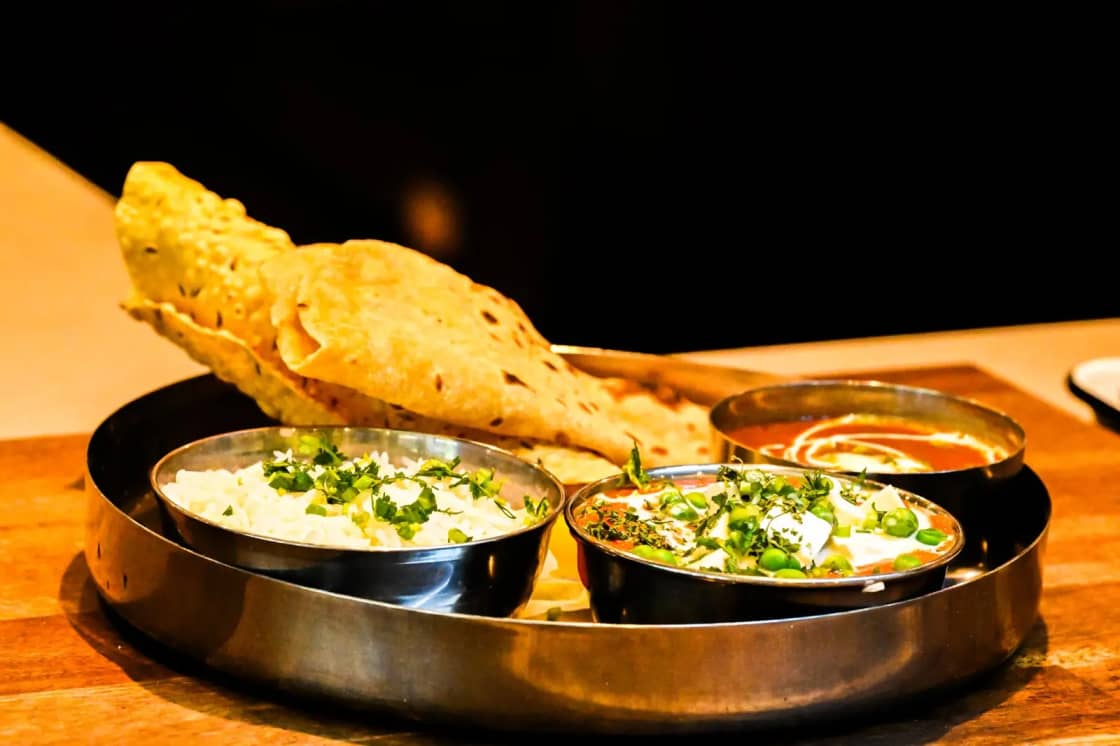
Chicken tikka masala is the most-ordered dish and it earns the position. If you have never eaten Indian food before — which, in a town with this much religious-mission-driven international exposure and this much first-time-visitor traffic, is a real category of diner — this is the correct starting point.
Beyond it, the dishes long-time regulars name:
- Vindaloo, for anyone who actually wants heat rather than the idea of heat
- Lamb korma, at the opposite end
- Biryani, which is the dish that most rewards a kitchen that has been doing this for thirty years
- Coconut chicken and paneer masala, both frequently named
- Tandoori shrimp and lamb saag from the tandoor and the greens side
Start with the appetiser platter if there are a few of you — vegetable samosa, onion bhaji, chicken pakora, vegetable pakora, served with mint and tamarind chutneys. It is the most efficient way to work out what the kitchen does well before committing.
The vegetarian menu is extensive and taken seriously. Dal, chana masala, paneer dishes and vegetable curries are not a small section bolted on for completeness — Indian cooking is structurally vegetarian-friendly and this kitchen treats that side properly. It is one of the genuinely strong options in the valley for vegetarian and vegan diners.
Desserts are worth ordering rather than skipping: mango ice cream, cardamom rice pudding, and dry milk pastries all come up repeatedly.
Spice, and the honest version of ordering it
Bombay House will adjust heat levels, and this is where it is worth being direct about a Utah Valley phenomenon.
A restaurant serving a customer base that includes a large share of people new to the cuisine will calibrate its default toward the middle. That is not a criticism of the kitchen — it is a rational response to who walks in. But it does mean that if you have eaten a lot of Indian food and you order at the default level, you may find it milder than you expected.
Ask for it the way you actually want it, and be specific rather than saying "spicy," which means different things to different people. If you want it genuinely hot, the vindaloo ordered up is the honest test.
What to drink
The drinks list is not an afterthought and it is where a first-timer can improve the meal cheaply.
Mango lassi is the standard order and the correct one if the heat gets away from you — yoghurt does more against capsaicin than water, which spreads it around. Masala chai at the end of the meal. Imported beer has historically been listed alongside the food, though what is actually pourable in a given Utah restaurant depends on its license, and licensing here is more complicated than in most states. Sources on this restaurant's alcohol service are not consistent with each other, so if a drink pairing matters to your evening, ask when you call rather than trusting any listing — including this page.
The wait, and how to actually beat it
Because there is no booking mechanism, managing the wait is the whole game. In rough order of effectiveness:
Arrive at opening. Four o'clock is early for dinner by most people's standards, which is exactly why it works. A table at 4:15 on a Friday is realistic; a table at 7:15 is not.
Go on a weeknight. Monday through Wednesday are materially easier than Thursday through Saturday.
Avoid the campus calendar. Education Week in August, graduation weekends, and home football Saturdays all push traffic onto University Avenue. A restaurant with no reservation book absorbs that pressure entirely through queue length.
Put your name in and walk. The in-house waitlist means you are standing there anyway. The University Avenue corridor has enough around it that a twenty-minute wait can be spent somewhere other than a foyer.
Consider takeaway. The restaurant does order-ahead and delivery. Curries travel well — better than most restaurant food — and this is the pragmatic answer for a weeknight when the dining room is full.
Catering, which is the underrated part
Bombay House does catering, and it comes up repeatedly in the context of weddings.
That is worth knowing in a valley where wedding catering is a large and fairly conventional market. Indian food solves several problems at a reception that standard catering does not: it holds temperature well over a long service, it scales without degrading, and the vegetarian half of the menu is genuinely equal to the rest rather than a single sad tray at the end of the line. For anyone planning a reception with a mixed-diet guest list, it is a stronger option than its profile suggests.
If you are working through the wider question, the Utah Valley wedding vendor side of this site covers the rest of the field.
Where it sits
463 N University Avenue, north of downtown and on the approach to campus.
That places it on University Avenue, the street Provo's entire address grid counts outward from, and roughly midway between the downtown restaurant cluster and the BYU area. It is an easy stop on a campus visit and a short drive from downtown. Parking is on-site and less of an ordeal than the downtown blocks.
The restaurant also operates beyond Provo, so if you are searching online, make sure you are looking at the Provo location's hours and not another one's.
One thing this site cannot resolve for you
The closing time is genuinely contested between sources.
Bombay House's own Provo location page has listed 4 p.m. to 10 p.m., Monday through Saturday. Yelp and several aggregators list 4 p.m. to 9 p.m.
Those cannot both be current, and there is no way to determine from the outside which one somebody forgot to update. This is the same pattern that runs through a lot of restaurant information in this valley: an official page is not automatically a current page. A restaurant's own website is often the least frequently updated thing it owns, because nobody is looking at it internally.
If you are aiming for a late table, call. The number is on their site, and a thirty-second call beats a wasted drive.
Why it still matters
There is a version of this restaurant's story where being first is the whole story — a historical footnote that outlived its relevance once better-funded competition arrived.
That is not what happened. Bombay House is still, thirty-three years on, the restaurant that comes up first when anyone in Utah Valley is asked about Indian food, and it holds that position against a field that now includes serious competition across Provo, Orem and the north valley. Being first opened the market. Staying good is why it still owns it.
If you are working through the best restaurants in Provo generally, this is one of the handful of places on that list that has been on it for three decades.
The short version
Utah's first Indian restaurant, opened February 1993 by a Chennai-raised BYU–Hawaii hospitality graduate, still the one everyone names.
Dinner only from 4 p.m. No lunch, whatever an old search result says. Walk-in only with a waitlist at the door, so arrive early or arrive on a weeknight. Closed Sunday.
Order the tikka masala if it is your first time and the vindaloo if it is not. Take the bread seriously.
And if you eat gluten-free: on this menu, the G marks the dishes you cannot have.
Why the building shapes the visit, and what the law actually requires of it
A restaurant that opened in the early 1990s is operating in a building that predates most current accessibility standards, and that is not an accusation. It is a description of how the law is structured, and it explains why accessibility varies so widely between one Provo restaurant and the next.
Title III of the Americans with Disabilities Act covers places of public accommodation, and restaurants sit squarely inside it. The Department of Justice rules are at 28 C.F.R. Part 36. For a building already standing, the standard is readily achievable barrier removal: an operator must remove architectural barriers where doing so is "easily accomplishable and able to be carried out without much difficulty or expense" (§ 36.304(a)). That is a deliberately softer test than the one a new build faces.
The regulation gives examples of what usually falls inside it — installing ramps, cutting curbs, repositioning shelves, rearranging tables and chairs, widening doorways, fitting offset hinges (§ 36.304(b)) — and it also draws limits. Rearranging movable furniture is not readily achievable to the extent it would cost significant serving space. The duty does not extend to areas used only by employees. And where removal genuinely is not achievable, the obligation shifts rather than disappears: the business must make its goods and services available through readily achievable alternative methods instead (§ 36.305).
New construction and alterations are held to a much higher bar, the 2010 ADA Standards for Accessible Design. There is a safe harbor for elements that already complied with the earlier 1991 Standards, but elements that never complied have been subject since March 2012 to being brought toward the 2010 Standards to the extent readily achievable (§ 36.304(d)(2)). The upshot is that a remodel is usually the moment the standard tightens on a space like this one.
The practical takeaway for a diner is simply that older independent restaurants in this valley differ enormously from each other on entry width, restroom configuration, and interior circulation, and that the variation is lawful rather than negligent. If any of that matters for your table, the reliable move is a phone call describing your specific need rather than a search for an accessibility symbol on a listing — because the symbol, where it appears at all, is usually reporting the parking lot and nothing else.
Delivery: Curry Travels, Naan Does Not
Indian food is among the best cuisines to have delivered, and Bombay House's menu is largely made of the dishes that prove it.
Curries are, in transport terms, close to ideal. They are sauces. They hold heat for a long time, nothing about them depends on a texture that a container will ruin, and many of them are genuinely better after twenty minutes of sitting, which is not a claim you can make about much else on this site. Rice is indestructible. Dal, korma, tikka masala, vindaloo and anything braised all arrive as themselves.
Naan is the exception and it is a significant one. It comes out of a tandoor blistered and hot and it is at its best for a handful of minutes. Sealed in a bag against steam, it goes soft and then leathery. Ask for it packed separately from the hot dishes if you can, and give it a minute in a hot dry pan or oven at home — that recovers most of what the drive takes.
Anything fried — pakora, samosa — follows the same rule as fried food everywhere and arrives softened.
Two practical notes. Order rice generously, since it costs little, travels perfectly and stretches a curry. And confirm your heat level rather than assuming, because spice numbering is not standardized between kitchens and the app gives you a dropdown rather than a conversation.
Our food delivery guide covers the local platforms and the cost stack behind an order.
Related Guides
- Black Sheep Cafe: The Provo Restaurant Built on a Navajo Nation Childhood
- Strap Tank: The Brewery Named After a Motorcycle
- Tommy's Burgers: The Provo Chili Burger Institution That Became a Truck
- Brick Oven: Seventy Years on One Provo Corner
- Provo's Best Kept Secret Restaurants (2026)
- The BYU Creamery: History, Flavors, and Which Location to Actually Go To
- The Provo & Orem restaurant directory — where this place sits among everything else we cover, with the address and the city
Frequently Asked Questions
When did Bombay House open?
Can you book a table at Bombay House?
Does Bombay House serve lunch?
What time does Bombay House close?
How does Bombay House mark gluten on its menu?
Who founded Bombay House?
What should I order at Bombay House?
Is Bombay House good for large groups?