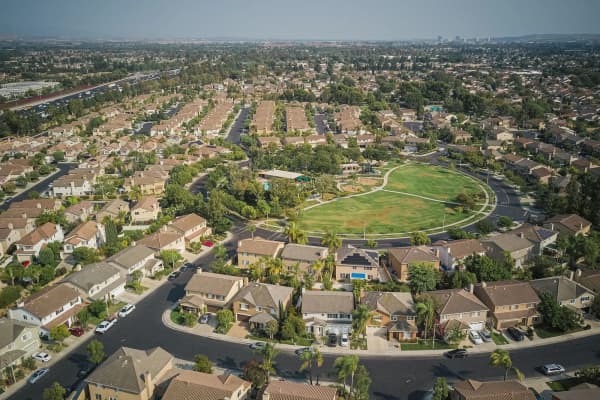

A vacant lot in Utah County is buildable when four things line up: the parcel legally exists as a lot, it has legal access, it has water you have the right to use, and it has a way to dispose of sewage that the health department will approve. Miss one and you can own land you are not allowed to build a house on. This guide takes the four in the order they tend to kill deals, with the offices and documents that answer each one.
It is general information, not legal or financial advice. For a specific parcel, the written word of the county or city, the Division of Water Rights and a title company outranks anything here.
First question: city or county?
Utah County Community Development serves only unincorporated Utah County. Its home page says so plainly, and it means the rules below about zone clearances, building permits and the county Land Use Ordinance apply only outside city limits.
Most buildable lots in the valley are inside a city: Lehi, Saratoga Springs, Eagle Mountain, Spanish Fork, Santaquin and the rest each have their own zoning, subdivision and permit offices. The health department and water rules apply in both places, but the planning answer comes from whichever government has the parcel. The county's interactive zone map shows unincorporated zoning and parcel information, and it is a quick way to see which side of a city line a parcel sits on.
1. Does the lot legally exist?
A parcel of land and a buildable lot are not the same thing. A seller can deed you a piece of a larger tract without anyone's approval. Whether the county or city will issue a building permit on that piece is a separate question.
Utah County's planning page defines a subdivision as "any land that is divided into two or more lots for the purpose of sale, lease, or development," with requirements in Section 14.12 of the Land Use Ordinance. A lot created by deed outside that process may be treated as an illegal division.
The tool for checking: a zone clearance request. According to Utah County's Planning and Zoning page, the request can answer questions about a parcel's:
- Legal status
- Rebuild letter (for a parcel that once had a structure)
- Ability to construct a dwelling
- Allowed uses
- Subdividing
You submit the request and pay the fee, and the county typically issues a written statement within 10 business days saying the request is approved, conditionally approved or not approved. Make your offer contingent on a favorable answer. Inside a city, ask the planning department for its equivalent; in Provo, our zoning guide explains the city's zone verification letter.
2. Can you get to it, legally?
A dirt track to the property is not access. Legal access means a recorded right to cross the land between your lot and a public road: frontage on that road, a dedicated private road, or a recorded easement. Without it, you may not get a building permit, a lender may refuse the loan, and a title insurer may except access from coverage.
What to check:
- The plat or survey. Does the lot touch a public road? Our guide to looking up property records in Utah County shows where plats and recorded easements live.
- The title commitment. Ask the title company to confirm access and to list any easement that provides it. A commitment that excepts access is telling you something.
- The road itself. A private road needs a recorded maintenance agreement, or you may be the one plowing it.
- Fire access. The county building permit application asks for the distance to the nearest fire hydrant, and the Community Development office includes a Fire Marshal division that handles wildland urban interface codes. A long private drive on a foothill lot can trigger requirements of its own; our guide to wildfire defensible space covers what those codes aim at.
3. Water: the right, the share and the pipe
Water is where Utah land deals differ most from the rest of the country.
Land does not automatically come with water you can use. The Utah Division of Water Rights' FAQ puts it directly: "You must own a water right to divert and use water in the State of Utah." Water rights are real property, bought and sold much like land.
Rights and shares are different things. Under Utah Code 73-1-11, a water right that is appurtenant to land passes to the buyer unless the seller reserves it in the deed, conveys part of it, or conveys it separately beforehand. But the same section says the right to use water evidenced by shares of stock in an irrigation or canal company "is not a water right appurtenant to land." Shares transfer separately, as securities, under 73-1-10. A listing that says "comes with water" may mean a recorded right, company shares, a city connection or nothing at all.
What to ask for:
- The water right numbers, if any, and the Division of Water Rights record for each. The division notes that county recorders are the office of record for title, but its own records show a right's status.
- The share certificates and the company name, if irrigation shares are included, and confirmation from the company that the shares can be transferred to you and used on this parcel.
- A water rights addendum to the deed. Utah Code 57-3-109 lets a deed carry a legislatively approved addendum that identifies the water rights transferred, or states that none are; the county recorder forwards it to the State Engineer.
Nonuse matters. The division's FAQ says water rights not exercised for seven years are subject to forfeiture, though only a district court can declare one forfeited. A right that has sat unused on a vacant lot for a decade deserves a closer look from a water attorney or engineer.
Can you drill a well?
Not freely. The division's FAQ says a well cannot be drilled without permission from the State Engineer, and in an area closed to new appropriation, "you will need to acquire all or part of an existing water right."
Utah County sits in areas the division lists as closed. Its policy pages for Area 55, Northern Utah Valley and Provo River, Area 54, Cedar Valley, and Area 51, Utah and Indianola Valleys each state: "All supplies of water are fully appropriated." All three list Governor's Proclamation 2022-01, issued November 3, 2022, which suspended new appropriations in the Great Salt Lake Basin with narrow exceptions. The Area 55 page notes that change applications based on irrigation company shares or Central Utah Water Conservancy District exchange contracts have been approved to authorize development. Area 54's page says change applications representing a new groundwater withdrawal from Area 54 East filed after September 30, 2010 will not be approved, which matters on the Eagle Mountain and Cedar Valley side.
In practice, a well on a Utah County lot usually means buying an existing right and filing a change application to move it to your parcel, with no guarantee of approval. Price that before you price the land.
Or connect to a system
If the parcel is in a city or a water district's service area, the question becomes whether the system will serve it and what the connection and impact fees are. Our guide to impact fees in Utah Valley explains those charges. For outdoor watering, many cities run a separate secondary system tied to shares; our secondary water guide explains how cities treat shares dedicated to a development.
4. Sewer or septic
Utah's onsite wastewater rule, R317-4, starts with a preference: R317-4-3 requires connection to a public sewer "except when such sewer is not available or practicable for use." If there is no sewer, you need a septic system the health department will approve, and the land must pass a feasibility review first.
Feasibility. Under R317-4-4, the regulatory authority determines feasibility for any proposed lot. At least one soil exploration pit is required, and the authority may also require a percolation test. The maximum groundwater table has to sit far enough below the system, which can mean monitoring an observation well for about a year. Conventional systems need at least 48 inches of suitable soil below the dispersal system, and systems are not allowed on slopes steeper than 35%.
Lot size. The rule's Table 1.1 sets minimum lot sizes by soil type and water source:
| Soil type | With public water | With a private well |
|---|---|---|
| 1 | 12,000 sq ft | 1.00 acre |
| 2 | 15,000 sq ft | 1.25 acres |
| 3 | 18,000 sq ft | 1.50 acres |
| 4 and 5 | 20,000 sq ft | 1.75 acres |
Soil type 5 also requires an advanced treatment system. The county zone may demand more land than the table.
Setbacks. Table 2 of the same rule keeps an absorption field 100 feet from a private well and from streams and canals, and 5 feet from property lines. Every property on septic also needs a designated replacement area. On a narrow lot with a canal along one side, those distances can leave no legal place for a drain field.
Who permits it. In Utah County, the Utah County Health Department takes new onsite wastewater applications and subdivision feasibility applications. Its 2026 fee schedule lists:
- Wastewater system permit and plan review: $1,800, including the current state fee
- Groundwater monitoring: $750 plus $25 per test hole
- Drinking water sample for onsite wastewater systems and private wells: $205 plus lab fees
Those are the department's charges only. The soil evaluation, engineered design and installation are paid to private firms.
The sequence on paper. Utah County's zoning compliance and building permit applications both carry a health department sign-off block for wastewater and potable water that must be completed before you submit. The building permit application lists the questions that trigger health department review, including whether work is within 5 feet of a septic tank or drain field. In other words, no health department approval, no county permit.
5. The tax surprise: greenbelt rollback
A lot of rural land in Utah County is assessed under the Farmland Assessment Act, often called greenbelt. Under 59-2-503, land generally needs at least five contiguous acres actively devoted to agriculture for two years to qualify.
When the land stops qualifying, Utah Code 59-2-506 imposes a rollback tax: the difference between the tax paid at agricultural value and the tax that would have been paid at market value, for a period reaching back as far as five years. The rollback is a lien on the land that relates back to the start of that period, and it is due within 60 days of the assessor's notice.
Building a house on part of a greenbelt parcel, or buying a small piece split off from it, can trigger the rollback. The purchase contract should say who pays it. Our guide to property tax in Utah County explains how assessment works more broadly.
6. Everything else a land buyer should look at
- Flood zones and runoff. A lot near a creek or on an alluvial fan may carry a FEMA flood designation; see our guide to flood insurance and FEMA maps in Utah County.
- Slope and geology. The 35% septic limit is one signal. Steep foothill lots may need geotechnical reports before a permit.
- Utilities. Ask the power provider how far the nearest line is and what extension costs.
- CC&Rs. A lot in a platted subdivision may carry recorded covenants on house size, materials or animals.
- Taxes and assessments. Check for special district assessments on the tax notice.
A due-diligence order that saves money
- Map check (free). City or county? Zone? Near a canal, creek or steep slope?
- Title commitment. Legal description, access, easements, liens and any water rights of record.
- Zone clearance or city equivalent. Is this a legal lot, and can a house go here?
- Water. Rights and shares verified with the Division of Water Rights and the canal company, or a written will-serve answer from the water system.
- Sewer or septic feasibility. Sewer availability, or soil pits and a feasibility application with the health department.
- Greenbelt status. Ask the assessor whether a rollback will follow the sale.
Write each one into the purchase contract as a condition with its own deadline, and give yourself enough time; groundwater monitoring alone can take months. The state's standard REPC was written mostly with houses in mind, but its due diligence and water service sections still apply to land; our guide to REPC deadlines explains how those clocks work. Once the land checks out, our guide to building a home in Utah Valley picks up the sequence from lot to keys.
Related Guides
- Secondary Water and Water Shares
- Building a Home in Utah Valley
- Buying a Cabin or Second Home Near Provo
- Looking Up Property Records in Utah County
- Impact Fees in Utah Valley
Frequently Asked Questions
Does vacant land in Utah come with water?
Can I drill a well on land I buy in Utah County?
How do I find out if a lot in unincorporated Utah County is buildable?
What does a septic permit cost in Utah County?
How big does a lot need to be for a septic system in Utah?
What is a greenbelt rollback tax?
Do I need legal access to build on a lot?
Can I buy a piece of a larger parcel and build on it?
Sources
The facts in this guide were checked against these sources. Hours, fees and rules change, so confirm anything time-sensitive with the source before you go. How we make Provo.com.
- Utah County Community Development home page, Utah County. Checked October 20, 2026.
- Planning & Zoning (zone clearance, subdivisions), Utah County Community Development. Checked October 20, 2026.
- Zoning Compliance Permit Application 2026, Utah County Community Development. Checked October 20, 2026.
- Building Permit Application 2026, Utah County Community Development. Checked October 20, 2026.
- Frequently Asked Questions, Utah Division of Water Rights. Checked October 20, 2026.
- Area 55 policy, Northern Utah Valley and Provo River, Utah Division of Water Rights. Checked October 20, 2026.
- Area 54 policy, Cedar Valley, Utah Division of Water Rights. Checked October 20, 2026.
- Area 51 policy, Utah and Indianola Valleys, Utah Division of Water Rights. Checked October 20, 2026.
- Fee Schedule 2026, Utah County Health Department. Checked October 20, 2026.
- Annual Permits & Certifications (Onsite Wastewater), Utah County Health Department. Checked October 20, 2026.
- Real Estate Purchase Contract and state-approved addenda (effective Dec. 4, 2024), Utah Division of Real Estate. Checked October 20, 2026.
- Utah Code 73-1-11, Appurtenant water rights pass to grantee, Utah State Legislature. Checked October 20, 2026.
- Utah Code 73-1-10, Conveyance of water rights, Utah State Legislature. Checked October 20, 2026.
- Utah Code 57-3-109, Water rights addenda, Utah State Legislature. Checked October 20, 2026.
- Utah Code 73-3-1, Appropriation, Utah State Legislature. Checked October 20, 2026.
- Utah Code 59-2-503, Qualifications for agricultural use assessment, Utah State Legislature. Checked October 20, 2026.
- Utah Code 59-2-506, Rollback tax, Utah State Legislature. Checked October 20, 2026.
- Utah Admin. Code R317-4-3, General Standards, Legal Information Institute (Utah Administrative Code). Checked October 20, 2026.
- Utah Admin. Code R317-4-4, Feasibility Determination, Legal Information Institute (Utah Administrative Code). Checked October 20, 2026.
- Utah Admin. Code R317-4-13, Tables, Legal Information Institute (Utah Administrative Code). Checked October 20, 2026.