
Most cities the size of Provo do not have anything like the UVX, and most people who live here do not fully realize what they have.
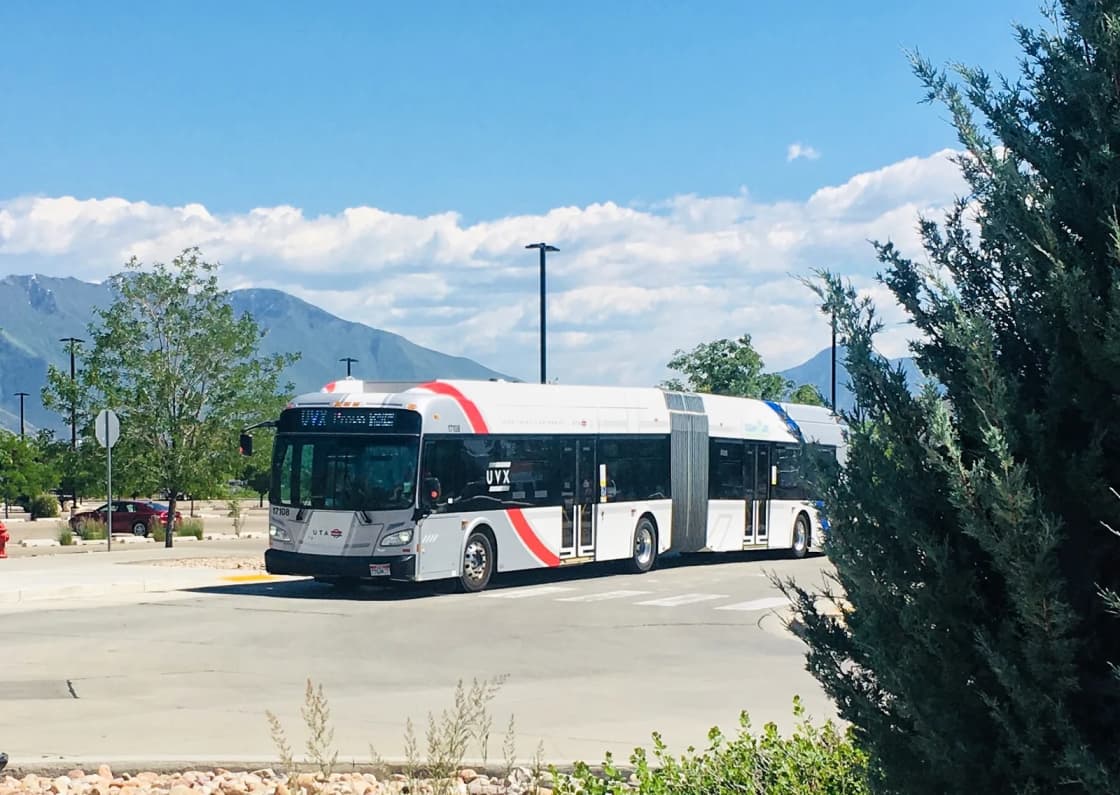
It is a bus rapid transit line — a real one, with articulated buses, dedicated lanes on parts of the route, raised platforms and off-board layout rather than a pole in the dirt. It runs the length of the Provo-Orem corridor, links both FrontRunner stations, stops at both universities, and comes often enough that checking a timetable feels like an unnecessary ritual.
And for a very large share of the people it serves, it costs nothing to ride.
That last part has an asterisk that has caught out thousands of people since 2024, and we will get to it, because it is the single most important thing to understand about this line before you plan around it.
What the UVX actually is
UTA runs it as route 830X. It opened in a soft launch in August 2018 and formally the following January, and it covers roughly eleven miles between Orem Central Station at the north end and Provo Central Station and the East Bay area at the south.
The route follows University Parkway and University Avenue, which is the correct way to think about it: it is a line drawn down the busiest corridor in Utah County, and it stops at nearly everything on that corridor that generates trips.
Running from north to south, it serves Orem Central Station, Utah Valley University, the University Place area, the stretch of University Parkway that carries most of Orem's retail, then over the Provo line to BYU campus and the stadium area, down through downtown Provo and past the library, and finally to Provo Central Station and the East Bay business park.
The stop count is published differently in different places — UTA, the city and Wikipedia have each given a slightly different number depending on whether terminal bays and shuttle extensions are counted. That inconsistency does not matter to a rider. What matters is that the places you are likely to be going are on it.
The vehicles are the tell
BRT is a term that gets applied loosely, and plenty of places use it for a normal bus with a new paint job. Provo's version is closer to the real thing.
The buses are articulated — the bendy kind, with the accordion joint in the middle — and they were specified for this corridor rather than borrowed from a general fleet. They have interior ski racks, which is a detail that tells you a great deal about what UTA expected people to do with them in a valley where the canyons start ten minutes from campus.
Parts of the route have dedicated lanes. Stations have platforms rather than curbside signs. The overall effect is that the UVX behaves less like a bus and more like a light rail line that happens to have tires.
The fare situation, which is where everyone gets confused
For roughly six years from opening, the UVX was free to everyone. No fare, no tapping, no thinking about it. That was a deliberate promotion, and it worked — the line's ridership was strong from the start and the zero fare was a large part of why.
That ended on August 18, 2024. Since then, the UVX has charged a regular UTA fare.
Here is the part that matters:
Students at BYU and UVU still ride free. A current student ID from either institution functions as a full UTA pass — not just on UVX, but on regular buses, on TRAX in Salt Lake County, and on FrontRunner. This is one of the better deals attached to being a student in this valley and a lot of students never use it.
Everyone else pays. A regular one-way fare covers local buses, UVX, TRAX and a couple of other services for a two-hour window, which functions as a built-in transfer. FrontRunner is a premium service and costs more on top.
The practical consequence shows up constantly: a student and a visiting parent board together, the student taps through out of habit, and the parent discovers at the reader that this is not a free bus. If you are hosting anyone this year, tell them before the bus arrives, not at it.
How to pay without thinking about it
- Cash to the operator. Exact fare only. Drivers do not make change. This is the worst option and it exists mainly for people with no alternative.
- Contactless card or the Transit app. Tap and go. This is what most non-student riders should default to.
- FAREPAY card. A reloadable card that applies a daily and weekly cap, so a day with a lot of trips stops charging you past a threshold rather than accumulating indefinitely.
- Day pass. Unlimited rides that day across bus, UVX and TRAX. If you expect more than two trips, this is usually the cheaper answer.
Fares change. We are deliberately not printing a table of numbers here that will be wrong in a year — check UTA's fares page for the current figure before you plan a budget around it.
The Sunday problem
The UVX does not run on Sunday. Neither does FrontRunner.
This is not a reduced schedule or a longer wait. It is no service. And it is the single most common way visitors and new residents get stranded, because a plan that worked perfectly on Saturday simply does not exist the following morning.
It compounds with something else about this valley: a great deal of what you might be traveling toward on a Sunday is also closed. We have written about that at length in our guide to restaurants open on Sunday in Provo, which covers both halves of the problem — the places that are shut and the transit that is not running to them.
If you need to move on a Sunday without a car, your realistic options are rideshare, a friend with a car, or walking. Downtown Provo is compact enough that walking is a genuine answer for a lot of trips, which is not true of most of Orem.
Who this line is actually good for
Students, obviously
If you attend BYU or UVU, the UVX makes a car optional rather than necessary for the ordinary week. Campus to downtown, campus to campus, campus to a grocery run at the north end of the corridor — all of it works, all of it is free with your ID, and none of it requires you to find parking.
Our BYU student guide and UVU student guide both cover the wider picture of getting around as a student here, including the parts the bus does not solve.
People who work the corridor
If your home and your job are both within a few blocks of University Parkway or University Avenue, the UVX is faster than driving more often than you would expect, once you count the walk from wherever you parked. The corridor's traffic is the reason the dedicated lanes exist.
Anyone connecting to FrontRunner
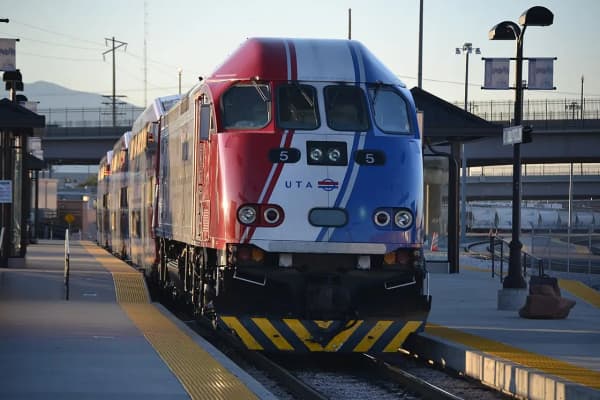
This is the underrated one. Both ends of the UVX are FrontRunner stations, which means the bus is the local distributor for a regional rail line. Get off the train at Provo Central or Orem Central, walk to the platform, and the UVX will put you within a short walk of most of the corridor. We cover the rail half of that trip in our guide to FrontRunner from Provo.
People who do not want to own a second car
Households here often run one car fewer than they otherwise would because of this line. Whether that works depends entirely on where you live relative to the corridor — a detail we get into in living in Provo without a car and, from the other direction, in car ownership in Utah Valley.
Who it is not good for
Being honest about this is more useful than selling it.
If you live east or west of the corridor, the UVX is a bus you have to get to first. Provo's east bench and the neighborhoods out toward the lake are both a real walk or a connecting bus away, and a connection doubles the number of things that can go wrong.
If your schedule is unusual, the ends of the service day matter. Late-night frequency drops to roughly half-hourly, and there is a last bus. Missing it in Orem at midnight is a genuinely bad evening.
If you are carrying anything substantial, an articulated bus at a campus peak hour is a difficult place to be with luggage or a large grocery run. The line handles bikes and skis well and handles suitcases poorly.
If it is Sunday, see above.
Practical things worth knowing
Watch for construction changes at the south end. UDOT work on the University Avenue overpass near Provo Central Station has produced routing and stop changes on this corridor, and UTA has been publishing the arrangement as it evolves. A moved stop is invisible on a schedule, so check alerts before relying on a specific south-end stop.
Use the app, not a memorized time. Because the frequency is high, the useful question is never "when is the bus" but "where is the bus." Real-time tracking answers that; a printed timetable does not.
Frequency claims vary by source, and the official ones are not always current. Provo City's transportation page advertises a tighter all-day headway than UTA's own current schedule supports. This is a general pattern worth internalizing about local information: the official host is not always the most current page. Trust the operator's live data.
The stations are not all equal. Some are proper platforms with shelter and displays; some are more modest. If you are meeting someone, name the station precisely, because the corridor has stops in both directions within sight of each other.
Your student ID is a full UTA pass, not a UVX pass. Students routinely use it for the bus and never realize it also covers the train to Salt Lake City. That is a materially different life.
What was here before, and why that matters
It is worth understanding what the UVX replaced, because it explains the design.
Before 2018, the Provo-Orem corridor was served by conventional bus routes running along the same streets at conventional frequencies. They worked, in the sense that a bus arrived eventually. They did not shape behavior, because a service you have to plan around is a service most people drive instead of.
The change that mattered was not the route. It was the frequency. Transit planners have a rough threshold — somewhere around every ten to fifteen minutes — past which riders stop consulting a timetable and simply turn up. Below that threshold you have a service people schedule around. Above it, you have something closer to a utility.
The UVX was built to sit on the right side of that line, and the physical infrastructure follows from it: dedicated lanes so buses are not stuck in the traffic they are meant to compete with, platforms so boarding is fast, and articulated vehicles so a crowded bus does not have to leave people behind.
This is also why the fare change in 2024 mattered more than a fare change usually does. A free, frequent service is a genuinely different product from a paid, frequent one — not because of the money, but because tapping is a decision and turning up is not.
The canyon connection
One detail on the UVX says a great deal about where it is.
The buses were specified with interior ski racks. Not bike racks on the front, which every UTA bus has — racks inside the vehicle, for skis and boards.
That is not a feature you add to a campus shuttle. It is a feature you add when you know a meaningful share of your riders are moving toward mountains, and in this valley the canyons genuinely do start about ten minutes from campus.
The UVX itself does not go up a canyon. What it does is connect to the rest of the system, and UTA has run seasonal service toward Sundance. For anyone here without a car who wants to get outdoors, the practical chain is UVX to a connection, and the practical limitation is that the chain is thin and seasonal. Getting to a trailhead without a car remains the hardest ordinary thing to do in Utah Valley.
Game days and event days
Two situations change the character of this line.
BYU home football games. The stadium is on the route. On a game Saturday the UVX becomes a stadium shuttle in effect if not in name, and it is a genuinely good way to avoid the parking problem entirely — a subject we treat separately in our guide to BYU football parking. Expect crowded buses in the hour before kickoff and immediately after the final whistle, and expect the ordinary corridor trip you were trying to make to be slower than usual.
Downtown events. Summer concert nights, the farmers market, festival weekends. Downtown Provo's parking is capped by a two-hour on-street limit that we cover in detail in our guide to downtown Provo parking, and on event days the bus is frequently the better answer for exactly that reason.
Accessibility
All UTA buses are wheelchair accessible, and UVX stations are built as platforms rather than curbside stops, which makes level boarding considerably more straightforward than on a conventional route. Alternate-format schedules are available on request, and UTA provides telephone communication for deaf and hard-of-hearing riders through the 711 relay service.
If you are planning around a specific mobility need, the station-by-station picture is worth checking directly with UTA rather than assumed from the line's general specification — platform conditions vary along the corridor, and the ongoing construction at the south end has moved stops.
How it fits the rest of the valley
The UVX is the strongest single piece of transit in Utah County, and the honest framing is that it is one excellent line rather than a network. It solves the corridor. It does not solve the valley.
North-south along University Parkway and University Avenue, service is genuinely good. Anywhere else, you are on regular UTA bus routes with lower frequency, or you are driving. FrontRunner extends the picture northward to Salt Lake County six days a week, and UTA has been planning an extension of that line further south toward Springville, Spanish Fork and Payson — which would change the shape of this map, though not soon.
For now, the useful mental model is a spine with ribs. The spine is very good. Plan around the spine.
If you are working out whether you can live here without a car at all, start with the corridor question: how far are you from the UVX, and is that distance one you will actually walk in February? Everything else follows from the answer.
Related Guides
- Things to Do in Provo Without a Car: The UVX and FrontRunner List
- Buses From Provo to Vegas, St. George & Beyond: The Intercity Guide
- Cracked Windshields in Provo: The Utah Rule Everyone Quotes Wrong
- The Provo DMV, Decoded: Two Agencies, Two Buildings
- PVU or SLC: Which Airport Should You Fly From?
- Scooters & Bike Share in Provo: What's Actually on the Street (2026)
- Car Washes & Detailing in Utah Valley: Where to Go and What to Know
- The Provo Newcomer's Guide — UVX in context with the other getting-around decisions
- Why Provo Addresses Are Coordinates — reading stops off the grid
Frequently Asked Questions
Is the UVX free?
How often does the UVX run?
Does the UVX run on Sunday?
Where does the UVX actually go?
How long does the whole line take end to end?
Do I need exact change?
Can I take a bike or skis on the UVX?
Is there construction affecting UVX stops right now?