
Utah does something most states do not, and almost nobody in Provo finds out until after they have waited three weeks for a license-office appointment: the state licenses private schools to give the official road test.
That single fact reorganizes the whole errand. The Driver License Division still issues the license, but the test that gates it can be taken at a strip-mall driving school on a Tuesday afternoon, usually within days rather than weeks, for a fee. Whether that trade is worth it depends on how much your time is worth and how badly a sixteen-year-old wants to drive to school in September.
The two things a driving school actually sells
Driver education and road testing are separate products, and separating them is the first step in not overpaying.
Driver education is the state-required course for teen licensing: a classroom or online component covering law and theory, plus behind-the-wheel instruction with a certified instructor, plus observation hours. It is required for a license before 18.
Road testing is the exam itself. Certified third-party testers administer the same official state exam a Driver License Division examiner would. Critically, most schools will test a candidate who trained somewhere else — in fact, state rules generally prevent a school from testing a student it trained, which is why the two products are usually bought from two different businesses.
Adults relicensing, out-of-state transfers and nervous first-timers often want only the second thing, or only a couple of hours of the first. Say so when you call.
The Provo and Utah County options
A-1 Driving School is the long-standing Utah County name, with a Provo office at 286 South 600 East, Suite B, and an American Fork office at 59 East Main Street. It offers both driver education and state road testing, and its testing service is explicitly limited to candidates who did not train with A-1. Reviews are genuinely mixed and split sharply by instructor.
Independent Driving School, at 560 South State Street in Orem, serves Provo, Orem and the south-county towns with a home-study course, a drive-only option for people who have finished the classroom portion, and certified road testing.
Alta Driving School, at 1160 South State Street, Suite 100 in Orem, draws consistent praise for calm testing and for instructors who work in more than one language.
Utah Driving School in American Fork, at 122 North Center Street, Suite B, and Dave's Driving School, also American Fork at 105 South 700 East, both run north-county operations with strong review profiles and instructors who will meet students away from the office.
3 Brothers Testing School in Pleasant Grove is a testing-focused operation rather than a full driver-ed school, which is a useful thing to know if the test is all you need.
Provo High School is a certified state testing facility
This is the option families overlook because it is not a business.
Provo High School teaches driver education and is a certified state testing facility authorized to administer the Utah state road exam. Students who complete the course sign up for the test with a Provo High instructor, and once they pass, they take that result to the Driver License Division for the license itself with youthful-driver restrictions attached.
Registration goes through the school's driver education coordinator, requires a copy of the student's learner permit submitted with the form, and the fee and forms go to the business office. Fee waivers are available — to Provo High students specifically. Provo High students also get priority registration, with students who live inside Provo High boundaries but attend elsewhere placed on a waiting list and contacted if a spot opens.
Students have a year to finish the course, and the learner permit must stay current throughout.
The written test is a separate errand
Worth stating because it trips people up: driving schools do not administer the written knowledge test. That is a Driver License Division function, done at a DLD office. Some private-school materials say this in the fine print and students still turn up at a testing school expecting to do both in one visit.
The written test can generally be taken once a candidate is eligible for a learner permit, and the permit is what unlocks the practice hours. Sequence it first, not last. Our Provo DMV guide covers which of Utah's two agencies handles which piece and where each one is.
The teen sequence, in the order it actually happens
Written knowledge test at a DLD office, then the learner permit at 15. Then driver education — classroom plus behind-the-wheel. Then the supervised practice hours, which include a required portion logged after dark, and which have to be recorded rather than estimated.
Then the required learner-permit holding period, which is the step that cannot be shortened by paying anyone. Then the road test, at a DLD office or a certified third-party school. Then the license at 16, carrying youthful-driver restrictions on passengers and late-night driving for an initial period.
Families who work backward from a sixteenth birthday and start the month before are the ones who end up frustrated. The holding period alone means the permit has to come first by a wide margin.
What "two hours" means in practice
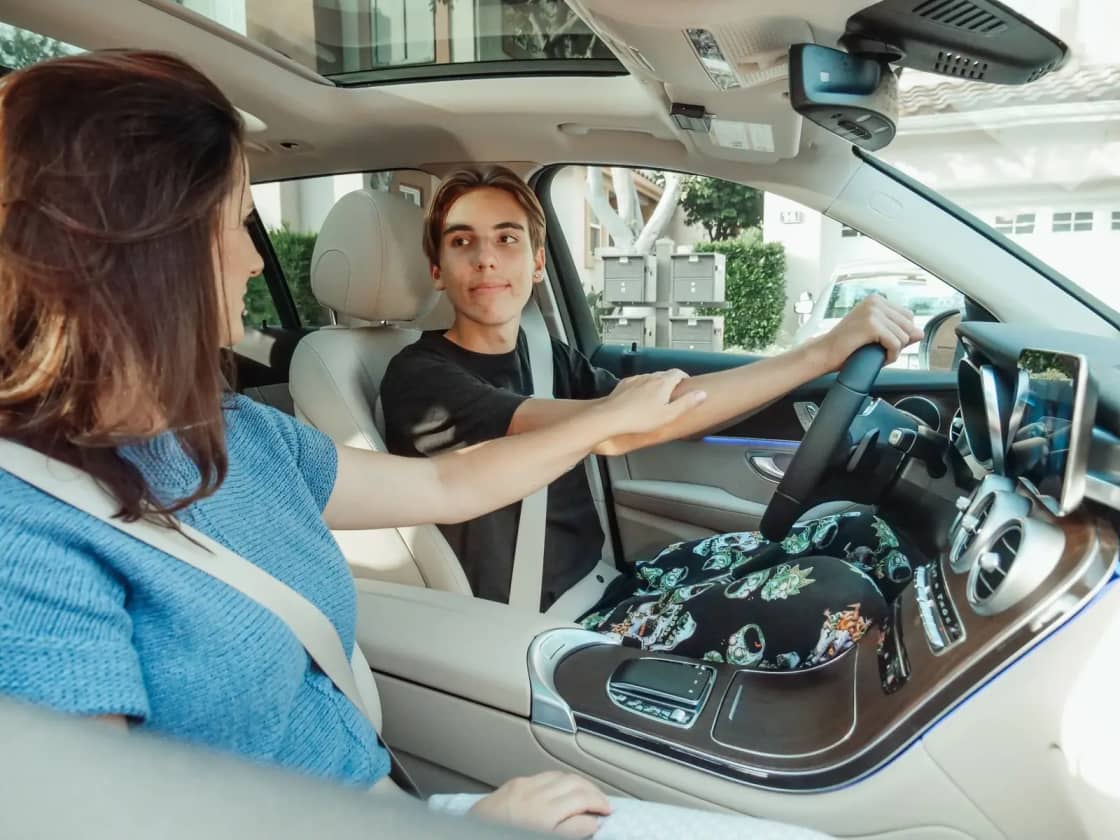
Behind-the-wheel instruction is sold in blocks, usually two hours, and this is where the money goes. A package might include three drives; a nervous student might need six.
Two things to ask before booking. First, whether the two hours are two hours — several review threads across local schools describe blocks that run closer to an hour and three quarters, which matters when you are buying three of them. Second, whether the block is one-on-one or shared with an observing student, because an observation seat is a legitimate part of driver education but it is not the same product as solo wheel time.
Neither of those makes a school bad. Both change what you are actually paying per hour of driving.
The instructor matters more than the school
Read the reviews for names, not for businesses.
This is the clearest pattern across every Utah County driving school with a meaningful review count: the same shop collects five-star reviews naming one instructor and one-star reviews naming another, often in the same month. Students describe instructors who used the emergency brake before the car left the parking lot, and other instructors at the same address who took a terrified beginner from zero to comfortable on the road in a single session.
Ask who you will be assigned to. Ask whether you can request someone. Ask what the school does if the fit is wrong after one drive. A school that answers those three questions comfortably is worth paying more for.
Adults who never learned
There is a real population here of adults without a license — people who grew up in cities with transit, people who arrived from countries where driving was not a default, people who simply did not get around to it at 16.
None of the teen-specific requirements apply once you are 18. What remains is the written knowledge test, the eyesight screening, and the road test. A learner permit is still the legal way to practice.
Several Utah County schools teach adult beginners as a normal part of the business and are matter-of-fact about it. If the anxiety is the actual obstacle rather than the skill, say that on the phone — the instructors who are good at it will tell you so, and the ones who are not will also tell you, in their tone.
Out-of-country licenses and the surrender rule
The largest time saving in the entire Utah licensing system goes to people transferring a valid license from another country: surrender the foreign license and you generally skip both the learner-permit waiting period and the Traffic Safety and Trends exam.
The word doing the work is surrender. You hand the license over and do not get it back. For someone who travels home regularly and drives while there, that is a real cost, and it is worth deciding deliberately rather than discovering it at the counter.
Our guide for international students in Provo covers this alongside the Social Security and residency steps it depends on.
Testing in your own car
Most third-party testers will let you test in your own vehicle if it is registered, insured and mechanically sound. Expect the tester to check lights, brakes, horn, seat belts, mirrors and the windshield before the test starts, and expect a refusal for a dash warning light or a crack in the driver's sight line.
Testing in the school's car costs more but removes a category of risk, and some candidates find the instructor's vehicle easier because it has the passenger-side mirror and controls the tester expects. Several north-county schools test in a Tesla, which students find novel and which changes almost nothing about the exam.
What the road test actually looks like
Around twenty minutes of ordinary driving. Lane changes, a left turn across traffic, speed control, following distance, mirror and shoulder checks, backing, and parking. Nothing exotic.
The failures that recur in Utah County are not dramatic: rolling a stop rather than stopping, drifting wide on a right turn, missing a shoulder check on a lane change, and speed — both over and, surprisingly often, well under. Testers also fail candidates for pulling out with insufficient gap, which is the single most-cited item in local reviews.
Third-party testers vary in strictness and some are noticeably tougher than the state office. That is not a reason to avoid them; a tester who fails you for a wide right turn has told you something true.
Winter changes the training, not the test
The road test does not have a snow module, but learning to drive here without ever practicing on snow is a gap the license will not catch.
Utah Valley gets inversion fog, black ice on shaded canyon-mouth roads, and the specific problem of a benchland grid where every east-west street is a hill. A student who does all their behind-the-wheel hours in July has not driven the city they actually live in.
If the timing works, get at least a couple of supervised hours in January. Our winter tires and canyon driving guide covers what the vehicle needs for the same conditions.
Scheduling reality, and when to book
Demand is seasonal and predictable. Spring, right before summer, is the heaviest stretch, followed by August as families realize school is starting. December and January are the quietest.
Book the road test before you finish the drives, not after. Third-party availability is generally days rather than weeks, but it is not instant in May, and a test slot can always be moved.
And confirm by phone. The most common complaint across every Utah County driving school's review page is communication — unreturned calls, unconfirmed appointments, an instructor who did not appear. A confirmation text the day before costs nothing and prevents the most annoying failure mode in the whole process.
The paperwork the school does not handle
A driving school can teach you and can test you. It cannot license you, and the handoff between those two things is where families lose a week.
What the school gives you is a completion certificate for driver education and, separately, a passed road-test result. Both are documents. Both have to travel to a Driver License Division office along with everything else the DLD wants — proof of identity, proof of Social Security number, two proofs of Utah residency, and the learner permit itself. The school does not transmit anything on your behalf in a way that removes the office visit.
The practical consequence is that a teenager who passes a road test on Thursday is not licensed on Thursday. They are licensed whenever the next DLD appointment is, which in a busy month is not the following morning. Book that appointment at the same time you book the road test, not after you pass it. A DLD appointment can be moved; a slot that was never reserved cannot.
Keep the paper. Every local school will tell you the same thing eventually, usually after someone has called asking for a reprint: originals go in a folder, not a glove box, and not a backpack belonging to a sixteen-year-old.
Insurance, and the conversation nobody enjoys
Adding a new driver to a policy is the largest single cost of teen licensing in Utah Valley, and it dwarfs anything a driving school charges. It is worth pricing before the license exists rather than after.
Two things are worth knowing. Most insurers apply a driver-education discount, and some apply a further good-student discount, which means the course can partially pay for itself through the premium rather than through the DMV. Ask your carrier what documentation they want — usually the completion certificate — and whether the discount applies from the license date or the policy renewal.
The other is that a permit holder is generally covered under a parent's policy while supervised, but the coverage question changes the moment the license is issued. Confirm rather than assume, and confirm before the road test, because the gap between passing and being properly insured is exactly the window in which new drivers do the most damage.
Utah's minimum liability limits are low relative to what a serious collision costs, which is a separate argument covered in car ownership in Utah Valley.
What this actually costs, in structure
Expect three separate line items: the classroom or online course, the behind-the-wheel drives, and the road test. Buying all three from one school looks tidy and usually is not possible, because the school that trained you generally cannot test you.
The public-school route is the cheapest by a wide margin for eligible students, with waivers available on top of that. The private route buys speed and scheduling flexibility. For an adult who needs one test and no instruction, the third-party testing fee alone is the entire cost, and it is modest against the alternative of taking a morning off work for a state appointment three weeks out.
Ask each provider for the total, itemized, before you pay for the first thing. The headline course price is almost never the number you end up spending.
Related Guides
- Cracked Windshields in Provo: The Utah Rule Everyone Quotes Wrong
- Charter Schools in Utah Valley: How the Lottery Works and What You Give Up
- Buying a Used Car in Utah Valley: Titles, KSL, and the As-Is Rule
- Scooters & Bike Share in Provo: What's Actually on the Street (2026)
- Towed in Provo: The Sign at the Entrance Decides Whether They Were Allowed To
- Car Insurance in Utah: The Minimums Changed, and What Actually Drives Your Rate Here
- Car Washes & Detailing in Utah Valley: Where to Go and What to Know
- FrontRunner from Provo: What to Know Before You Ride
- Buses From Provo to Vegas, St. George & Beyond: The Intercity Guide
- Finding a Trustworthy Mechanic in Utah Valley
Frequently Asked Questions
Can a driving school in Utah give the official road test?
How much does driver education cost in Provo?
How old do you have to be to get a driver license in Utah?
Does Provo High School teach driver education?
Do adults need driving school in Utah?
What is the Traffic Safety and Trends exam?
Can I use my own car for the Utah road test?
How do I choose a driving instructor?