
More on The North Bench: every guide we have published there, in one place.
Three cities, one guide, and the reason is that nobody shops for them separately.
Highland, Alpine and Cedar Hills sit on the same bench at the north-east corner of Utah Valley, several hundred feet above the valley floor, pressed up against the mountain front. They have traditionally shared a high school. They share overlapping public safety arrangements. On 1 July 2027 they all join the same new school district. And the buyer who is seriously considering one of them is almost always considering all three, because what they want — space, quiet, mountain access, and a commute that still works — is a bench product rather than a city product.
Writing three separate guides would mean writing the same context three times and then never getting to the comparison, which is the part that decides anything.
This is the area-by-area companion to our individual guides to living in Highland, living in Alpine and living in Cedar Hills.
The one thing to know before you compare anything
None of these three cities has official neighborhoods.
Provo does. Provo City runs a Neighborhood District Program, in which neighborhoods are grouped into districts with volunteer boards, and our Provo neighborhoods guide is built on that structure because the structure exists.
Highland, Alpine and Cedar Hills have nothing equivalent. What gets called a neighborhood here is one of three things: a subdivision name that appears on a plat and in listings, a road reference that locals use as shorthand, or a general piece of geography like "up by the canyon" or "the canal side."
All three are useful for orienting yourself. None of them has civic standing, a fixed edge, or any relationship to what governs a property. HOA status, zoning, water shares, animal rights and school assignment are all parcel-level facts, and none of them can be read off an area name.
So this guide describes areas as what they are — patterns in how the bench was built — and tells you where the real boundaries are instead.
The bench, in one paragraph
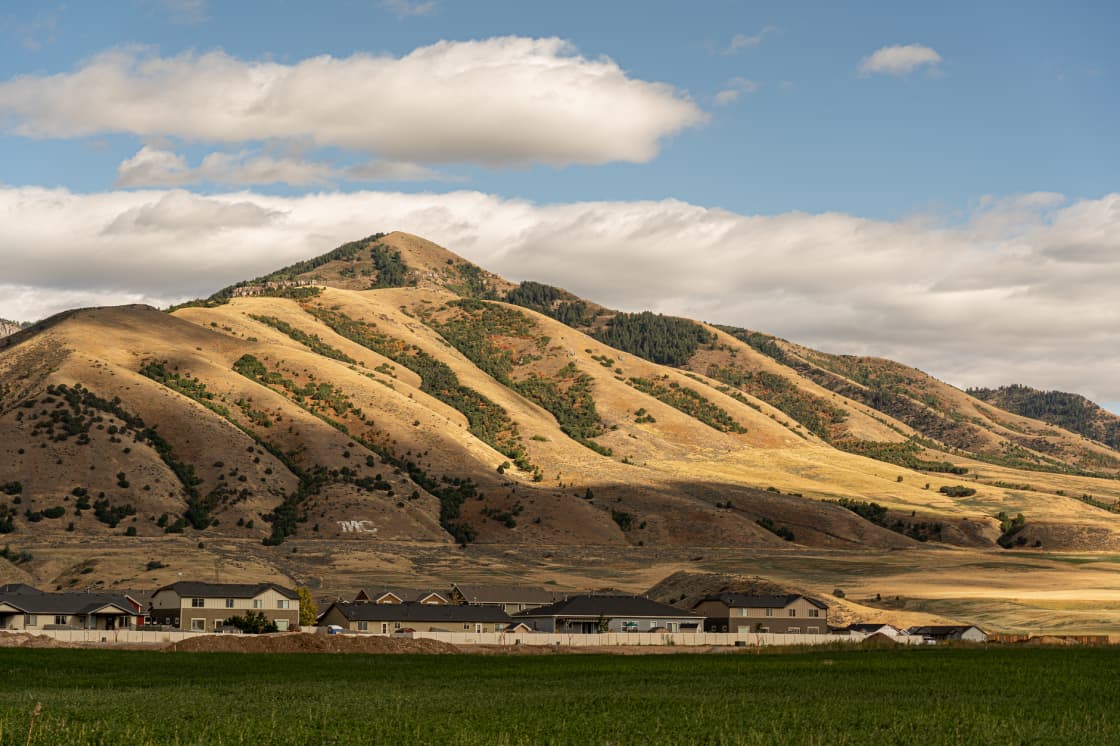
Picture the north-east corner of the valley. The mountain front runs behind it, the mouth of American Fork Canyon cuts into it, and a shelf of higher ground sits between the mountains and the valley floor. That shelf is the bench. American Fork sits below it on the flat. Lehi is west across the valley. The three cities on the shelf, arranged roughly from highest and deepest in the corner to lowest and most compact, are Alpine, Highland and Cedar Hills.
Almost every difference between them falls out of that arrangement.
The areas
Alpine: the top of the valley
Alpine is the oldest of the three by a long way — settled in 1850 and incorporated in January 1855 — and almost nothing about its current housing stock suggests it. The historic core is small and the great majority of the city is modern, large-lot residential built as the bench filled in over the last several decades. Our short history of Alpine covers how the town got here.
It sits highest and furthest into the mountain corner, with the Lone Peak Wilderness rising directly behind it and trailheads inside the city limits. That is the actual product. People move to Alpine for immediate mountain access and for the sense of being set apart from the valley, and they accept a longer drive to everything in exchange.
The trade-offs are real and they are all versions of the same trade-off. Shopping and services are a drive. The commute starts further back. Winter arrives earlier, lands harder and leaves later than anywhere else on the bench. Alpine is where the winter question stops being a detail and becomes a lifestyle fact.
Reads as: the most set-back, the most mountain, the least convenient, the highest.
Highland: the broad middle
Highland is the largest of the three in land area and the one with the most useful position. It spreads across the middle of the bench with substantial frontage on the Timpanogos Highway corridor, which is what makes it the easiest of the three to get in and out of.
Its defining characteristic is that it kept its space. Highland is a large-lot city by design and by long-standing preference, and that preference has been the central subject of local argument for years — growth, water and density are the things Highland residents disagree about, in the way that every city has one argument it keeps having.
Highland Glen Park is the city's central gathering spot. The paved Murdock Canal Trail runs through the area and is used, not just present. American Fork Canyon is minutes east for hiking, Timpanogos Cave and the Alpine Loop.
Practically, Highland is where a buyer lands who wants Alpine's lot sizes without Alpine's set-back, or who wants the bench without committing to the deepest corner of it.
Reads as: the most road access, the largest lots at scale, the middle of everything on the bench.
Cedar Hills: young, compact, and the entry point
Cedar Hills is young by Utah standards and it shows in the built form. Founded in 1974, incorporated as a town on 2 November 1977, and a city only since 22 July 1999, it is the most compact of the three and the most consistently subdivided.
That compactness is the whole story. Cedar Hills has less land, smaller lots on average, and a denser pattern than its two neighbors, and that is precisely why it functions as the entry point to the bench. Buyers who want Lone Peak High School and mountain proximity but find Alpine and Highland out of reach very often land here. It is the same bench, the same school, the same district transition and the same mountain — at a different density.
The density trade-off is worth naming rather than pretending it does not exist, because it is the thing people notice after they move rather than before. If your mental image of the bench is a two-acre lot with horses on it, Cedar Hills is not that, and the guide that tells you otherwise is selling something.
Cedar Hills also has its own service arrangement: the city says fire and emergency medical services come through its contract with the American Fork Fire Department, while its neighbors Alpine and Highland are served by Lone Peak Public Safety. Check with the city for current police and animal control arrangements.
Reads as: the newest, the densest, the most reachable, the same school.
The canyon end
Cutting across all three is the canyon end of the bench — the properties closest to the mouth of American Fork Canyon and the mountain front behind it.
This is not a neighborhood and it is not one city's territory. It is a condition. Properties near the canyon end get the best access to the trail system and the Alpine Loop, the most direct mountain views, the most snow, the steepest approaches and the most wind coming out of the canyon. Wildfire exposure is a genuine consideration at the mountain interface, as it is anywhere on the Wasatch Front foothills.
If the canyon is why you are moving here, this is where you want to be, and you should look at the driveway grade and the approach road in February rather than in July.
What differs between these three
Strip out the marketing and the differences reduce to four things:
Elevation and set-back. Alpine highest and furthest in, Highland the middle, Cedar Hills lowest and closest to the valley floor. This drives snow, commute and the feeling of the place more than anything else.
Lot size. Alpine and Highland are large-lot cities. Cedar Hills is not, and does not claim to be.
Age of stock. Alpine has the oldest founding and a modern housing stock. Cedar Hills has the youngest founding and the most uniform stock. Highland sits between, with the widest spread of build eras.
Access. Highland has the most frontage on the corridor and is easiest to get in and out of. Alpine is the furthest back from everything. Cedar Hills is compact and quick to cross.
Everything else — school, district, mountain, public safety, the general shape of the community — the three of them substantially share. That is why they belong in one guide.
The commute case, which is the underrated part
The story people tell about the bench is that it is remote. The story that is true is more interesting.
The Timpanogos Highway corridor connects the bench west toward Lehi and the Silicon Slopes employment center. For a worker whose job is in the tech corridor, the drive from the bench is comparable to crossing Lehi itself at peak hour — which is to say that living in Lehi does not buy you as much commute advantage over the bench as the map suggests it should.
That reframes the decision. If the bench and Lehi are close on commute, then the comparison is between what each place gives you for the money, and the bench's answer is lot size, quiet, mountain access and a settled community, against Lehi's answer of newer inventory, far more shopping and services, and a much larger supply of houses.
Neither is the right answer for everyone. But the bench is a real option for tech-corridor workers rather than a sacrifice, and a lot of buyers write it off on geography without ever timing the drive.
Time it yourself. At the hour you would leave. In February as well as August.
What the bench costs you is services. Shopping, restaurants and daily errands are thinner up here and mostly mean a drive down to American Fork or west to Lehi. That is the honest trade and it does not go away.
Schools: the part that is settled and the part that is not
Settled: on 1 July 2027, all three cities join the new Aspen Peaks School District, along with American Fork, Lehi and the Utah County portion of Draper. Alpine School District dissolves on 30 June 2027 following the 2024 ballot measure. The map is drawn and the date is fixed. Our guide to the Alpine School District split covers the full reorganization.
Not settled, and frequently misunderstood: which high school a specific address is assigned to. All three cities have traditionally fed Lone Peak High School, and that pattern is strong enough that listings simply say "Lone Peak schools." It remains an address-level fact drawn by the district, and boundaries here have been redrawn before.
The critical thing to understand is that these are two different questions with two different sources, and the district reorganization does not answer the second one. Lone Peak and American Fork High both land inside Aspen Peaks, so the split does not cut between them and gives nobody a structural reason to move the line. We wrote a whole guide on that confusion: two high schools, one district.
Verify the parcel. It takes minutes and it is the single highest-value check a buyer on this bench can make.
Winter, properly
Every guide to these cities mentions winter. Most of them mention it the way a brochure mentions it.
Here is the practical version. You are several hundred feet above the valley floor against a mountain front. Snow that falls as rain in Provo falls as snow here. Storms that dust the valley accumulate on the bench. Mornings are colder, melt is later, and the streets hold snow after the valley floor has cleared. Alpine, highest and deepest into the corner, gets the most of all of it.
What that means when you are buying:
- Look at the driveway grade, and look at it knowing it will be icy.
- Look at how the approach road climbs, not just the property.
- Ask what the city's plow priority is for that street.
- Budget for a real snowblower, not a shovel.
- Think about tires before you need them, not during the first storm.
None of this is a reason not to live here. Plenty of people move to the bench specifically because they want winter to be a real season. It is a reason not to be surprised by it, and our guide to winter driving in Utah Valley canyons is worth a read if the canyon is part of your routine.
Renting on the bench
Rental supply here is thin and that is a structural feature rather than a temporary condition.
These are large-lot, owner-occupied cities that were built as ownership products. There is not much purpose-built multifamily inventory, and what rental stock exists is mostly individual houses, basement apartments and accessory units rather than complexes. Cedar Hills, being denser, has somewhat more than the other two, but the difference is one of degree.
If you want to try the bench before committing, expect to search patiently and expect the options to be houses rather than apartments. Renters should also read our guide to Utah renters' rights, because the rules governing a basement apartment in Highland are the same rules governing a complex in Provo, and single-unit landlords are less likely to know them cold.
What the map does not tell you
A few things that shape daily life here and appear on no listing.
Services are drawn separately from city limits. Cedar Hills proves it: its fire and EMS come by contract from American Fork, while Alpine and Highland are served by Lone Peak Public Safety. Do not assume the city name tells you who responds, who bills you, or whose library card you get.
Library access is not what you expect. In more than one of these cities, library service works differently than a newcomer assumes, and it is worth checking rather than discovering. Each of our individual city guides covers the local arrangement.
Water is the argument. Growth and water are the standing local disagreements on the bench, particularly in Highland. If you go to a city council meeting, this is what it will be about.
The trail system is used. The Murdock Canal Trail is not a line on a map that nobody walks. It is a daily piece of infrastructure for a lot of residents, and proximity to it is a real amenity.
Everything closes early and Sunday is quiet. This is true across Utah Valley and it is more pronounced in smaller bench cities with fewer commercial options to begin with.
Choosing in one pass
If you want the bench and you want it compressed:
- You want the most mountain and you accept the longest drive → Alpine.
- You want large lots with the easiest access → Highland.
- You want the bench and the school at the lowest entry point, and you accept density → Cedar Hills.
- You want the canyon → the canyon end of any of the three, and go look at it in winter.
- You work in the tech corridor and assumed the bench was too far → time the drive before you rule it out.
And then, whichever one you pick: verify the school assignment for the specific parcel, check the zoning for whatever you plan to keep on the lot, and look at the driveway in February.
Water, and why it is the standing argument
Every city has one argument it keeps having. On this bench, it is water — and growth, which is the same argument wearing a different coat.
The reason is structural. These are large-lot cities in a high desert, and large lots in a high desert mean irrigated landscape. A city of half-acre and one-acre parcels with lawns and trees on them uses a great deal more water per household than a city of compact lots, and every additional subdivision adds to a demand that was already high per head.
That puts the bench in a genuine bind that has no clean answer. Restricting growth protects the water supply and the low-density character that residents moved here for, and it also restricts supply in a market where people want to live. Allowing growth adds tax base and housing and gradually erodes the thing that made the place distinctive.
You do not need a position on this to buy here. You do need to know it is live, because it shows up in ways that touch a homeowner directly: watering restrictions in dry years, secondary or pressurised irrigation systems that are their own utility with their own rules, landscape requirements in newer subdivisions, and the periodic reappearance of density proposals that fill a council chamber.
If you go to one city council meeting before buying on this bench, this is what it will be about, and it will tell you more about the place than any listing will.
What a large lot costs you
The bench sells space, and space is the thing buyers most reliably underestimate the ongoing cost of.
A large lot is a maintenance obligation measured in hours per week during the growing season and in equipment the rest of the year. Mowing, irrigating, pruning, snow clearing on a long driveway, and the fencing and outbuildings that come with an acre are all real recurring commitments. Irrigation water — often delivered through a separate secondary system rather than through the culinary supply — has its own billing, its own scheduling and its own failure modes.
None of this is an argument against it. Plenty of people on this bench wanted exactly that relationship with their property and would not trade it. The buyers who end up unhappy are almost always the ones who bought the view and inherited the acreage as a side effect.
The honest test is simple: picture the least appealing version of the task — clearing a hundred feet of driveway at six in the morning in February — and decide whether the rest of it is worth that. If it is, the bench is a very good place to live.
Related Guides
- Living in Highland
- Living in Alpine
- Living in Cedar Hills
- Two high schools, one district: Lone Peak vs American Fork High
- The Alpine School District split, explained
- Aspen Peaks School District
- American Fork neighborhoods
- Lehi neighborhoods
- The Alpine Loop scenic drive
Frequently Asked Questions
Why are Highland, Alpine and Cedar Hills covered in one guide?
What is the difference between Highland, Alpine and Cedar Hills?
Are these official neighborhoods with defined boundaries?
Do all three go to Lone Peak High School?
Does the 2027 district split change anything for these three cities?
Is the bench really a commute alternative to Lehi?
How much of a factor is winter up here?
Why doesn't this guide publish home prices?
Sources
The facts in this guide were checked against these sources. Hours, fees and rules change, so confirm anything time-sensitive with the source before you go. How we make Provo.com.
- Fire / Ambulance, City of Cedar Hills. Checked October 12, 2026.
- New Fire Station, American Fork City. Checked October 12, 2026.
- Public Safety - Lone Peak Police Department, Alpine City. Checked October 12, 2026.
- Alpine City History, Alpine City. Checked October 12, 2026.
- Cedar Hills: voters approve Alpine School District split, City of Cedar Hills. Checked October 12, 2026.
- Neighborhood District Program, Provo City. Checked October 12, 2026.