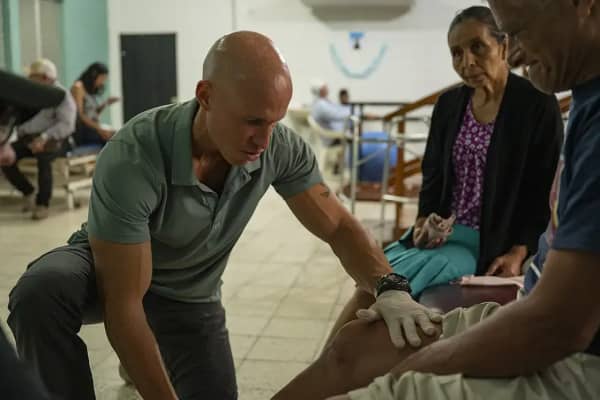

You can book a physical therapist in Utah without seeing a doctor first. That has been the plain text of state law since May 7, 2025, when Utah Code Section 58-24b-307 took effect: "A physical therapist may evaluate, initiate, and provide physical therapy treatment for a client without a referral from another health service provider." No visit cap, no time limit, no condition attached.
What can still stop you is your insurance plan, and what decides whether the therapy helps is the therapist. This guide covers both: what the law lets a PT do, how to confirm the person treating you is licensed, how insurance changes the picture, and how to compare clinics in Utah Valley without relying on anyone's star rating. It is general information, not medical advice. After a serious injury, or if you are unsure what is wrong, see a physician first; our urgent care or the ER guide covers where.
If you are still deciding between a chiropractor and a physical therapist, start with chiropractic vs. physical therapy, which compares the two professions. This page assumes you have chosen PT.
Direct access: what the law says, and what it does not
The statute. Section 58-24b-307, titled "No referral required for physical therapy," was enacted by Chapter 219 of the Legislature's 2025 General Session. It is one sentence long. It does not limit how many visits you can have or how many days you can be treated before a physician signs off.
What it does not cover: your insurance contract. A licensing statute tells a therapist what they may do. It does not tell your health plan what it must pay for. Many plans pay for physical therapy without a referral; some require a referral, a prescription or prior authorization; many cap the number of PT visits per year. Before your first visit, call the number on your card and ask:
- Is physical therapy covered without a physician referral?
- Is prior authorization required, and who requests it?
- How many visits per year are covered, and do they reset on January 1 or on a plan year?
- Is this specific clinic in network?
If the answer to the first question is no, a quick visit to your primary care doctor or an urgent care for a referral may be cheaper than paying for PT out of pocket.
Work injuries and car accidents follow their own payment rules. If you were hurt on the job, the workers' compensation process decides which provider and how many visits; see our guide to workers' compensation in Utah. Car accident coverage is discussed in our chiropractic and PT guide.
What a physical therapist may and may not do in Utah
Utah Code Section 58-24b-102 defines physical therapy. Paraphrased, it includes:
- Examining, evaluating and testing a person with a physical impairment or injury.
- Identifying or labeling the impairment, writing a treatment plan, and reassessing it.
- Treatment through therapeutic exercise, movement and mobility training, and manual therapy (soft tissue mobilization, therapeutic massage and joint mobilization).
- Fitting and training with orthotics, prosthetics, assistive and adaptive devices; prescribing durable medical equipment.
- Ordering imaging, under a separate section of the code.
- Dry needling, if the therapist has the training the Division of Professional Licensing requires by rule.
- Administering certain prescription drugs under Section 58-24b-403: topical medications for wound care and musculoskeletal treatment (including by iontophoresis or phonophoresis), and, in an institution without a respiratory therapist within 10 miles, aerosol medications, always on a written prescription from someone licensed to prescribe them.
And it excludes:
- Diagnosing a disease.
- Dispensing or prescribing drugs.
- Acupuncture.
- Surgery.
- Taking X-rays.
Put plainly: a PT can assess your knee, decide whether your problem is something therapy can address, treat it, and order imaging when the code allows. A PT cannot diagnose an illness or write you a prescription, and a good one will send you back to a physician when what they find is outside their lane.
Who is treating you: PT, PTA or aide
Section 58-24b-102 sets out three roles you may meet in a clinic:
- Licensed physical therapist (PT). Licensed to practice physical therapy. Evaluates you and sets the plan. Section 58-24b-503 requires licensed physical therapists to use the letters PT with their name or business and licensed assistants to use PTA.
- Licensed physical therapist assistant (PTA). Licensed to practice physical therapy, subject to limits in the code.
- Physical therapy aide. Trained on the job, giving routine help to a licensed PT or PTA while they practice. Aides are not licensed.
It is reasonable to ask at your first visit: who will I see at each appointment, and how often will the licensed PT reassess me?
How to check a license in two minutes
- Utah license lookup. The Division of Professional Licensing's physical therapy page links to its license verification and to a disciplinary actions and citations search. Search the therapist's name. Check that the license is active and see whether there are any public actions.
- Compact privilege. Utah has been part of the Physical Therapy Licensure Compact since 2017 (Utah Code Title 58, Chapter 24c). A therapist licensed in another compact state may practice here on a compact privilege instead of a Utah license. DOPL's page sends you to ptcompact.org to verify a privilege.
- Protected words. Under Section 58-24b-503, it is unlawful for someone who is not a licensed PT or PTA to call their services "physical therapy" or "physiotherapy," or to offer or bill for services described that way. A recovery studio offering "physio" without a licensed therapist is not just using loose language.
The kinds of PT clinics in Utah Valley
We do not rank or endorse clinics. Here are the categories you will find, with examples we could confirm from the operators' own pages.
Hospital-system outpatient therapy. Intermountain Health lists Physical Therapy and Rehabilitation, Orem Neuro (801-714-3366) and Primary Children's pediatric rehabilitation (833-577-3422) on the Orem Community Hospital campus, which Intermountain calls the region's central location for pediatric and neuro rehab. It lists Physical Therapy and Rehabilitation, Spanish Fork (385-344-5430) at Spanish Fork Hospital. Timpanogos Regional's site also mentions physical therapy. System clinics make sense when your surgeon or doctor is in the same system and you want shared records.
A university clinic. Rocky Mountain University of Health Professions runs the RMU Physical Therapy Clinic at 587 South State Street, Provo. RMU says licensed specialists treat patients with help from doctoral and pre-PT students from RMU, BYU and UVU, and lists balance and vestibular, chronic pain, neurological, orthopedic, pediatric and post-surgical therapy, plus pelvic floor therapy, electromyography, an MS program and telehealth. An RMU article describes a Community Rehabilitation Clinic opened in October 2014 for low-income, uninsured and underinsured patients, including people who have used up their insurance PT benefit. RMU's clinic site now routes to the PT clinic, so call to ask what reduced-cost care is available today and who qualifies.
Independent and specialty clinics. Utah Valley has many private PT practices, including sports, pelvic health, vestibular, pediatric and hand therapy clinics. Use the checklist below to compare them.
Sports medicine practices. If you want a physician evaluation first, or the problem is an athletic injury, see our sports medicine guide.
Choosing a clinic: questions that sort them
Bring these to a phone call or first visit:
- Who evaluates me, and who treats me? A PT should do the evaluation. Ask how much of each session is with the PT, a PTA or an aide.
- How long is a visit, and how many patients does a therapist see at once? A clinic that books one patient per therapist per hour runs very differently from one that overlaps three.
- Do you treat my problem often? A runner's knee, a post-surgical shoulder, a concussion, dizziness and pelvic floor problems are different specialties.
- What is the plan, and how will we know it is working? Expect measurable goals (range of motion, strength, a pain or function score) and a rough number of visits.
- What will I do at home? Most of the work happens between visits.
- What does it cost? Ask for the self-pay rate even if you have insurance, and whether they bill your plan directly. Ask about cancellation fees.
- Hours and location. Twice-weekly visits for six weeks is twelve trips. A clinic near work or school beats a better-rated one across the valley if the drive means you skip sessions.
- Ask about the edges of the day. If you work standard hours, ask which days the clinic opens early or stays late, and whether it opens on weekends at all.
Signs to look elsewhere: long prepaid packages before an evaluation, passive treatments only (heat, massage machines) with no exercise plan, no reassessment, or reluctance to say who is licensed.
When PT is a starting point, and when it is not
Direct access means you can start. It does not mean every problem should start with PT. Utah's definition of physical therapy excludes diagnosing disease, and the heading of Section 58-24b-403 includes referral. If a problem follows a serious injury, or comes with symptoms that worry you beyond the sore joint itself, a physician is the better first stop. Otherwise, a good therapist will tell you at the first visit whether they can help or whether you need someone else.
Related care. Massage therapists are licensed separately; our massage therapy guide explains what they must show you. For insurance basics, including Medicaid, see health insurance in Utah, explained. For the county gym and pool options that often follow a course of PT, see every gym in Utah Valley, compared and indoor pools and lap swimming.
Frequently Asked Questions
Do I need a doctor's referral for physical therapy in Utah?
Is there a visit limit or time limit on seeing a PT without a referral in Utah?
What can a physical therapist not do in Utah?
Can a physical therapist do dry needling in Utah?
How do I check that a physical therapist is licensed in Utah?
What is the difference between a PT, a PTA and a PT aide?
Is there low-cost physical therapy in Utah County?
Can a gym or spa advertise 'physio' without a licensed therapist?
Sources
The facts in this guide were checked against these sources. Hours, fees and rules change, so confirm anything time-sensitive with the source before you go. How we make Provo.com.
- Physical Therapy, Utah Division of Professional Licensing. Checked October 20, 2026.
- Utah Code 58-24b-307, No referral required for physical therapy, Utah State Legislature. Checked October 20, 2026.
- Utah Code 58-24b-102, Definitions, Utah State Legislature. Checked October 20, 2026.
- Utah Code 58-24b-403, Utah State Legislature. Checked October 20, 2026.
- Utah Code 58-24b-503, Utah State Legislature. Checked October 20, 2026.
- Utah Code Chapter 58-24c, Physical Therapy Licensure Compact, Utah State Legislature. Checked October 20, 2026.
- RMU Physical Therapy Clinic, Rocky Mountain University of Health Professions. Checked October 20, 2026.
- RMUoHP's Community Rehabilitation Clinic, Rocky Mountain University of Health Professions. Checked October 20, 2026.
- Orem Community Hospital medical services, Intermountain Health. Checked October 20, 2026.
- Spanish Fork Hospital medical services, Intermountain Health. Checked October 20, 2026.