
Ask the internet whether locksmiths are licensed in Utah and you will get a clean, confident, unanimous answer: no. The Division of Professional Licensing handles contractors and electricians and plumbers and alarm installers and dozens of other trades, and locksmithing is not on the list.
That answer is correct about the state and wrong about this city.
Provo licenses locksmiths. It has for decades, under its own ordinance, with fingerprints and a police background investigation and a bond and a serial number stamped into every key. It is one of a small number of American cities that regulates the trade at the municipal level, and almost nobody standing outside a locked front door at eleven at night knows it exists.
What the ordinance says
Chapter 6.16 of the Provo City Code is titled, simply, Locksmithing. It runs ten sections, and the published code is current through Ordinance 2026-23, passed on June 23, 2026.
Section 6.16.010 defines the trade broadly — installing, changing, removing, constructing, reconstructing, repairing, adjusting, manufacturing or duplicating locks, safe combinations and keys, along with the duplication of keys generally.
Section 6.16.020 is the operative one. No person, firm, corporation or employee of one may carry on the business of locksmithing within Provo city limits without first obtaining a license. And then a sentence with real teeth: each act of locksmithing shall be deemed a separate violation. Not each day of unlicensed operation, not each customer relationship. Each act.
Getting the license is not a formality
This is where the ordinance stops resembling a routine business registration.
Under 6.16.040 the license is personal, not corporate. A locksmith company operating in Provo does not hold one license covering its technicians; each individual employee is required to hold a separate license. The application asks for the name the work will be done under, the applicant's contact details, five character references, a photograph taken within the preceding six months, and fingerprints, filed with the Provo Police Department.
Section 6.16.070 sends every application to the Chief of Police, who must approve it after an investigation. The ordinance tells the Chief what to look for: a reputation for honesty, and a police record devoid of any crime involving the taking of property — burglary, larceny, theft or similar. Anyone convicted of a felony is denied outright.
Section 6.16.060 requires a bond in the penal sum of one thousand dollars, with two or more sureties or an equivalent acceptable to the City attorney, conditioned on the applicant's faithful observance of the law and on the protection of the property a locksmith gets access to by virtue of the job. The bond is waived only for businesses already licensed under the general business chapter whose locksmithing is limited to cutting keys.
The fee sits on the city's Consolidated Fee Schedule rather than in the ordinance text, and renewal is annual, with a written statement of anything that has changed since the original application.
Two provisions worth understanding as a customer
Most of a licensing ordinance is administrative. Two sections of this one are not, and both change what you know about your own locks.
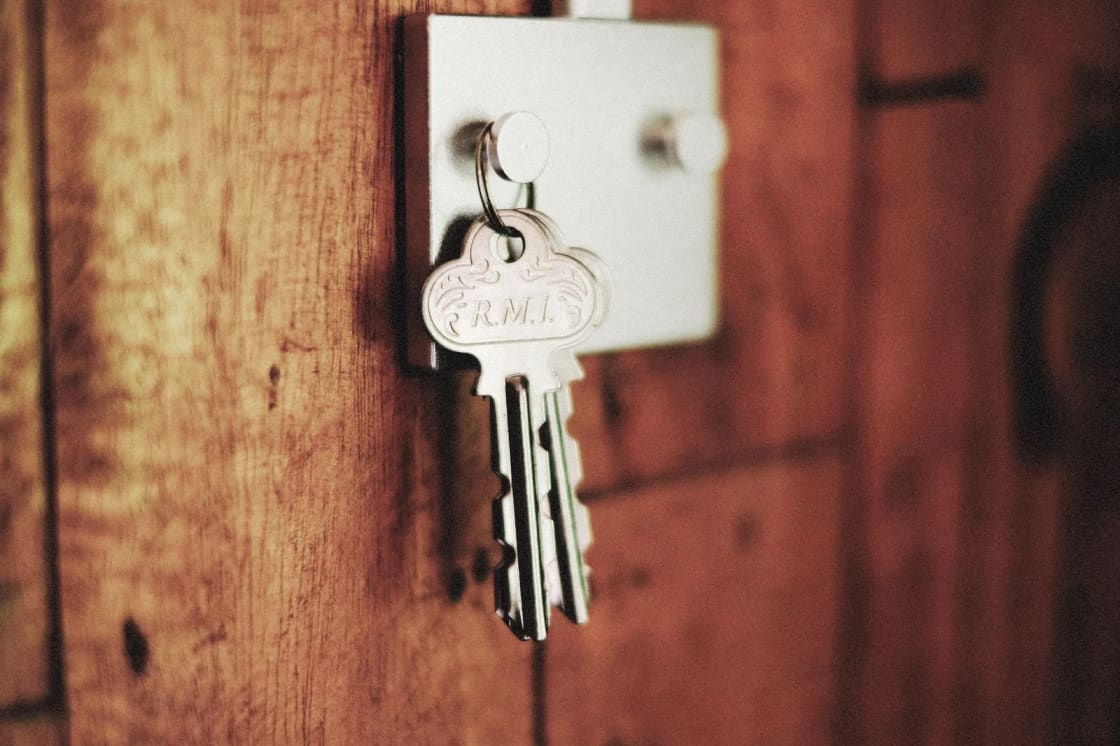
The serial number. Under 6.16.090, every licensed Provo locksmith is issued a serial number or distinctive designation, and that mark must be stamped on any key the locksmith makes, repairs, sells or gives away. Go look at the keys on your ring. If one of them was cut by a licensed locksmith in this city rather than spun off a blank at a hardware store, there is a mark on it that says who cut it. If you have ever wondered how many copies of your house key are circulating and where they came from, this is the only physical evidence trail you are going to get.
The book. Section 6.16.080 requires each licensee to keep a record — literally described as a book — open to inspection by any police officer at any time. It records the name and address of every person for whom a key is made, by name or number, and the name and address of every person for whom a locked automobile, building, structure, house, store, safe or vault is opened or a key fitted, with the date of the action. The records are retained for at least eighteen months.
The logic is obvious once you see it. If a house is burgled with no forced entry, the question of who recently had a key made or a lock opened becomes the investigation. But it does mean that a lockout in Provo is a recorded event, and it is better to learn that here than to be surprised by it.
Who is exempt
Section 6.16.030 carves out four categories, and they cover most of the situations where a reasonable person would wonder.
A state-licensed contractor or carpenter fitting a lock as part of a door or a remodeled door is exempt, provided the lock and key come from the manufacturer's stock and no adjustment or reconstruction of the lock is involved. Hanging a door with a boxed deadbolt is carpentry. Rekeying that deadbolt is locksmithing.
Store employees duplicating keys by a mechanical process are exempt. The person running the key machine at a hardware store is not required to be a licensed locksmith, which is why key cutting is available at counters all over the valley.
In-house maintenance staff are exempt where all the locksmithing is limited to property under the employer's control and is not performed for a fee or under contract. An apartment complex's own maintenance technician rekeying a unit between tenants sits here. A contractor hired to do the same rekeying does not.
And a locksmith licensed and in business outside Provo's jurisdiction is treated differently under the fourth exemption, which matters in a valley where the city line runs through the middle of everyday errands.
What this gives you at the door
Here is the practical translation.
When a locksmith arrives at a Provo address, you can ask to see a city locksmith license and a permit number, and there is a real document behind the question. Under 6.16.100, a licensee operating from a place of business must display a sign — style, size and color prescribed by the Chief of Police — reading Licensed Locksmith together with the official permit number.
That single question does more work than any amount of judging a van by its paint job. Someone who has been through fingerprinting, a police investigation and a bond has a great deal to lose by behaving badly on your porch. Someone who tells you the state does not license locksmiths, so there is nothing to show, has just answered a different question than the one you asked.
The scam this is built to stop
Locksmith fraud follows a national script, and it works because everyone who encounters it is already having a bad day.
It usually starts online. A search for an emergency locksmith surfaces a listing with a local-sounding name and a local address that turns out to be a mail drop or nothing at all. A call center takes the call, quotes a startlingly low price for the visit, and dispatches whoever is nearest. The technician who arrives is often not the person the listing implies, drives an unmarked vehicle, and cannot produce a business card that matches the name you called.
Then the price changes. The quote was for the trip; the labor is separate; this is a high-security lock and requires drilling. Drilling is the tell. A competent locksmith can open the overwhelming majority of residential locks without destroying them, and a technician who reaches for a drill within the first minute is either unskilled or is manufacturing a lock replacement to sell you. Payment is demanded in cash, on the spot, from someone who very much wants to be inside their house.
None of that is specific to Provo. What is specific to Provo is that you have a question available to you that most of the country does not.
What a straight call sounds like
Get the total, not the trip charge. Ask what the visit costs including labor, including the after-hours surcharge if it is after hours, and what would make the number go up. Get it before anyone is dispatched.
Ask for the business's legal name and confirm the technician's vehicle and paperwork carry it.
Expect to prove the property is yours. A locksmith who opens your door without asking for identification and something linking you to the address will do the same for whoever asks next.
Ask whether the lock will survive. For a standard residential deadbolt, the answer should almost always be yes.
Pay in a traceable way. A refusal to take anything but cash on a job in a fixed building is worth walking away from, and you can walk away — you are allowed to decline a price that changed after arrival and call someone else.
Renters, which in this city is most people
Get the order of operations right before you spend anything.
If you are locked out of a rented unit, your landlord or property manager is the first call, not the second. Most Provo complexes run a lockout procedure, some through an on-site office and some through an after-hours line, and many charge a modest fee for it. That fee is almost always lower than an emergency locksmith call, and more importantly, a tenant who hires a locksmith to open a door has created a question about who authorized work on the owner's hardware.
Do not change or rekey a lock in a rental without written permission. The lock belongs to the property, altering it typically breaches the lease, and if the manager has no working key the cost of restoring the original hardware lands on you at move-out. Our guide to renters' rights in Utah covers the wider set of obligations running in both directions.
There is one exception worth naming plainly. If you are dealing with a safety situation — a former partner with a key, a stalking concern, a protective order — that is not a routine maintenance request, and it is worth putting in writing to your manager as such and escalating rather than waiting in a queue.
Moving in, and the rekey nobody does
Buy a house in Utah Valley and you inherit an unknown number of keys. Previous owners, their relatives, a cleaner, a dog walker, three real estate agents, whoever borrowed one during the remodel. The seller's disclosure does not cover it and nobody can tell you the number.
Rekeying is the answer, and it is a different, cheaper job than replacing locks. A locksmith repins the existing cylinder to a new key. The hardware stays, the finish stays, the doors stay hung, and every key in circulation stops working. On a standard house it is a short visit.
Do it in the first week, before the boxes are unpacked and it slides down the list forever. And while someone competent is standing in your entryway, ask them to look at the strike plates. The most common weakness in a Utah Valley front door is not the lock at all — it is a strike plate held by three-quarter-inch screws into soft trim, which a shoulder defeats regardless of what the deadbolt cost.
Cars are a separate trade
Automotive work has drifted a long way from cutting a blank.
A key for anything built in roughly the last two decades usually contains a transponder chip that has to be programmed to the vehicle, and a proximity fob is a small computer. Some makes and models a well-equipped locksmith can handle at the roadside; others require dealer-level access, and an honest locksmith will tell you which one you have before driving out rather than after.
Two things save real money here. First, if you still have one working key, getting a spare cut and programmed is a routine appointment. Losing the last key is the expensive event, because the vehicle may need reprogramming from scratch. Second, ask the locksmith and the dealer both. The answer varies by manufacturer and neither one is reliably cheaper.
If you are locked out with the keys visible on the seat, note that many roadside assistance plans and some auto insurance policies include lockout service you are already paying for. Our car ownership guide for Utah Valley covers what those policies typically bundle.
Smart locks change the question
Keypad and app-controlled locks have spread quickly through Provo's rental stock, and they change what a locksmith is for rather than eliminating the need for one.
The mechanical part of a smart lock is still a mechanical lock, and the failure modes are mostly ordinary — a misaligned strike, a dead battery, a bolt binding against a swollen frame in August. What changes is the access question. Codes are not keys. They do not need to be collected at move-out, they can be issued and revoked individually, and on most systems they leave a log.
That is a genuine improvement over the unknown-number-of-copies problem, with one caveat: a code shared once is shared forever, and a great many households run a single code that everyone from the pet sitter to the in-laws has known for years. Rotating it costs nothing.
When it goes wrong
If the price you were quoted is not the price you were charged, or the work was not what was described, you have three places to go and they are not interchangeable.
Start with the business, in writing. Many disputes end here because the operator would rather refund than argue.
Take licensing complaints to Provo City. The license is the city's, the police investigation behind it is the city's, and the enforcement is the city's. Complaints about deceptive pricing or misrepresentation belong with the Utah Division of Consumer Protection, which handles consumer sales practices statewide.
And if you believe you were defrauded outright — a technician who took payment and left the door unopened, or who charged for hardware never installed — that is a police matter, and in this city the police are already the agency that vetted the license.
- Funeral Homes, Obituaries and Death Records in Utah County: The Practical Guide
- Finding an Electrician in Provo: The Supervision Rule Nobody Explains
- Food Help in Utah County: Where to Go, What to Bring & What Nobody Asks You
- Appliance Repair in Utah Valley: Utah Deliberately Does Not License the Person Fixing Your Dryer
- Radon in Utah Valley: One in Three Homes, and the Only Way to Know Is to Test
- Wildlife Removal in Utah Valley: You Can Kill the Raccoon. You Can't Drive It Up the Canyon.
- Hiring a Roofer in Utah Valley: The License Class Most Homeowners Check Wrong
- Tree Removal in Utah Valley: The Tree Out Front Probably Isn't Yours
- Garage Doors in Utah Valley: Two Federal Dates, One Spring, and the Test You Should Run Tonight
- Waterwise Landscaping in Utah Valley: Lawns, Localscapes & Actually Saving Water
- House Cleaning in Provo: The Turnover Calendar, the Hard Water, and the Cleaning Check If the lock is a symptom of a bigger project, hiring home pros in Utah Valley covers vetting any trade that works on your house, and the Provo business license guide explains the city licensing layer these rules sit inside.
The short answer
Utah does not license locksmiths. Provo does, and the ordinance behind that license is stricter than most people would guess: fingerprints, a police investigation, a bond, a mandatory denial for felony convictions, a serial number stamped on every key and a record of every door opened kept for eighteen months.
You do not need to know any of the section numbers. You need to know that the question "can I see your Provo locksmith license and permit number?" has a real answer, that a legitimate locksmith will give it without friction, and that the person who tells you no such thing exists has told you something useful about themselves.
Related Guides
- Getting Things Fixed in Utah Valley: Shoes, Watches, Jewelry, Sewing Machines and Small Engines
- Phone & Computer Repair in Provo: Who Fixes What, and When Not To
- Hiring Home Pros in Utah Valley
- Calling Provo Police Without Calling 911: The Non-Emergency Line, Online Reports & Records
Frequently Asked Questions
Do locksmiths need a license in Utah?
So what does Provo require?
Who approves a Provo locksmith license?
How can I tell whether the locksmith at my door is licensed here?
What is the stamped key rule?
Is there a record of my lockout?
Does the hardware store cutting my key need a locksmith license?
What if I am locked out in Orem, Springville or Spanish Fork?
Sources
The facts in this guide were checked against these sources. Hours, fees and rules change, so confirm anything time-sensitive with the source before you go. How we make Provo.com.
- Provo City Code Chapter 6.16 Locksmithing, Provo City (municipal.codes). Checked October 12, 2026.
- Provo City Code 6.16.060 Bond, Provo City (municipal.codes). Checked October 12, 2026.