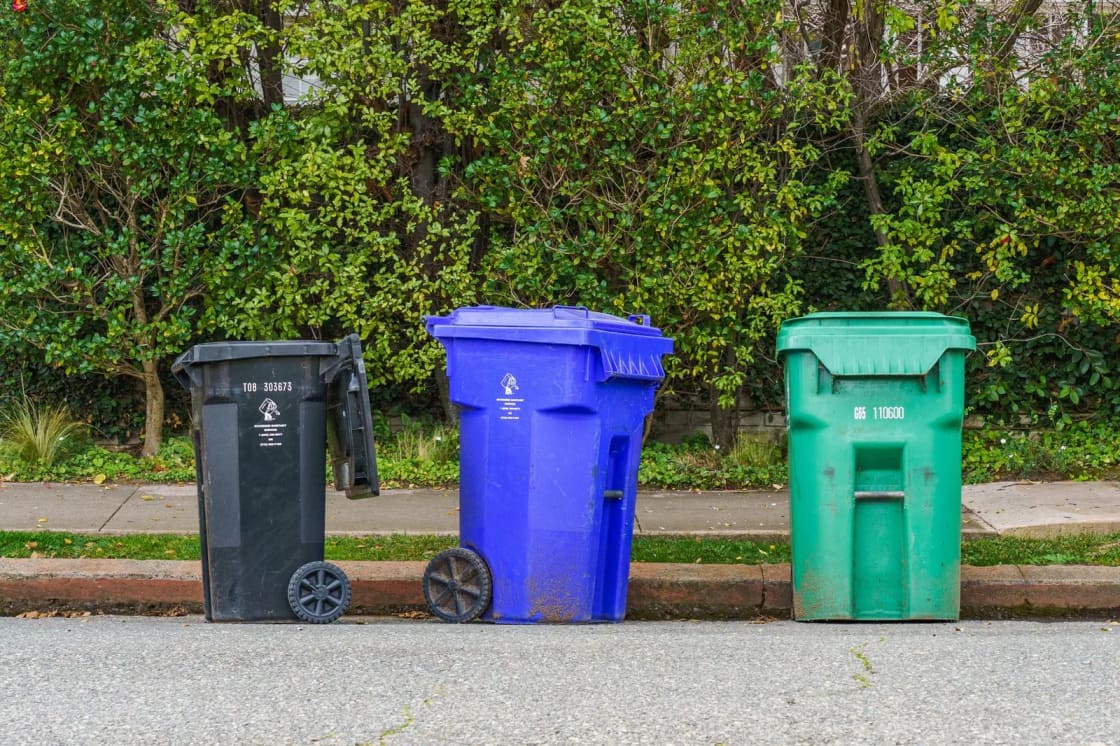

Provo runs a three-can system, and almost everything that goes wrong with it comes down to two facts nobody tells you when the cans show up: the three containers are nearly the same size, and only two of them are collected year round.
That is the practical shape of household waste here. The sorting rules matter, and we will get to the specific items that get pulled back out of the blue can. But the errors that actually cost people money and draw fines are simpler than contamination — they are a green can left at the curb in January, and a household paying for a second garbage can when recycling would have been cheaper.
The three cans, and the one that has a season
Black is garbage. Blue is household recycling. Green is yard waste. All three are roughly 95 gallons, which is why they get confused, and why the lids are the only quick way to tell them apart from a distance.
Black and blue run year round on a day assigned by address. There is no single citywide collection day — the city publishes an address lookup, and your day comes from where you live.
The green can is different, and this is the part worth writing on the lid:
The 2026 green yard-waste season ran from March 2 through November 27. During the season, green cans are emptied on the same day as garbage pickup. Outside it, the green can is not on a route at all. A green can put out in December is not late; it is out of season.
Those dates move a little each year, so treat the specific numbers above as this year's window rather than a permanent rule, and check the city's page before the shoulder months. What is durable is the shape: a spring start, a late-November end, and same-day collection with garbage while it is running.
What the blue can actually takes — and the four things it doesn't
Most of the blue-can rules are the ones you would guess. The instructive part is the exceptions, because each of them is something a reasonable person would assume is recyclable.
Shredded paper
Paper is the flagship recyclable, so this one catches nearly everyone: shredded paper is not recycled in Provo. The reason is mechanical rather than ideological — shredded paper is too small for the sorting line and falls between the rollers and belts at the plant, and putting it in a bag first reproduces exactly the problem that makes plastic bags unwelcome.
The city's instruction is to bag it and put it in the black can, with the bag closed so it does not blow out of the truck. Shred confidential documents by all means. They still go to the garbage.
Aluminum foil, trays and pie tins
Aluminum is one of the genuinely valuable materials in the stream, which makes this counterintuitive. Cans are fine. Foil, disposable roasting trays and pie tins are not, because they generally arrive with baked-on food and oil that a quick rinse does not remove, and that residue degrades the material around them in the bale.
The distinction the city is drawing is not aluminum versus not-aluminum. It is clean versus greasy.
Plastic bags
Bags of any kind jam the sorting equipment. This includes the well-intentioned move of putting recyclables into a bag before putting them in the blue can. Loose in the bin is correct.
Anything not in the can
With the exception of Christmas trees and leaf bags, everything Provo collects has to be inside a container. A neat stack beside the can is not collected. The trucks are built for 95-gallon cans set along a city street, and that constraint explains more of Provo's waste policy than any environmental target does — including the next section.
Why apartments get no city recycling
If you live in an apartment or a townhome in Provo and you have never seen a blue can, the explanation is the equipment. The city's collection trucks can only service 95-gallon cans placed along city streets. Most multi-unit buildings use a shared dumpster and a private hauler, which the city's curbside system cannot serve.
That is a structural gap rather than a policy choice, and the city's answer to it is a drop-off option rather than a route change.
There is a free residential drop-off recycling program at the compost yard — the city brands it Super Six in the Bin — open to residents only. You need identification with a Provo address, or a utility bill matching your ID. It is not available to businesses or to non-residents.
Two practical notes. First, the recycling bins that used to sit at Fort Utah Park and Kiwanis Park have been removed, after persistent illegal dumping at both. If you are working from an older list of drop-off points, those two are gone. Second, this is worth raising before you sign a lease: not every building in Provo is on city solid waste collection, and "utilities included" covers wildly different things across buildings. Our utilities setup checklist goes through what to ask.
The compost yard, and the price nobody can pin down
The city's compost yard sits at 1625 South Industrial Parkway in south Provo, where collected green waste is ground and sold back as compost.
Its hours are narrow and worth checking before you load a trailer: Fridays and Saturdays, 7:00 a.m. to 5:00 p.m., weather dependent, with extended weekday hours during the spring and fall cleanups. From March through November it handles recycling, yard waste and compost. From December through February it is open for recycling drop-off only — which is the winter workaround for apartment dwellers, and the reason the green-can season and the compost yard season are not the same thing.
Drop-off is limited to Provo residents, with a driver's license or a current Provo utility bill. Explicitly excluded: landscapers, tree services, commercial vehicles and contractors. This is a residential facility, and it checks.
On price, we are going to decline to give you a number, and the reason is that the city publishes more than one. Two live pages on Provo's own site give different resident and non-resident compost rates. Rather than pick the one that suits the sentence, here is the part both agree on:
- Residents pay roughly half what non-residents pay.
- Green-waste drop-off is free during the city cleanups and carries a small per-load fee outside them.
- Larger trailer loads cost more than a pickup bed.
Call 311 for the current figure. That ordering is durable; the specific dollar amount on any given page is not.
Where the hazardous and electronic waste goes
None of it goes curbside, and this is the category where guessing gets expensive.
Old computers and electronics, batteries, burned-out fluorescent bulbs, and leftover lawn fertilizers and pesticides all go to the South Utah Valley Solid Waste District transfer station rather than into any of your three cans.
Here the honest answer is a caution rather than an address. Published street addresses for that facility differ between sources — the city's own page and various third-party moving guides disagree not only on the road but on which city the station is in. We are not going to resolve that from a desk, and printing one of them with confidence would just add a fifth version to the pile. Pull the address from the district's own website on the day you make the trip.
The two annual cleanups are the cheapest week of the year
Provo runs spring and fall cleanups, each with dumpsters placed out for about six weeks. If you are disposing of furniture, appliances or a garage's worth of accumulated material, the cleanup windows are the difference between free and not.
Both cleanups come with a coupon for a free load to the transfer station. The fall cleanup has historically also included a coupon for leaf bags. Leaf bags and Christmas trees are, along with nothing else, the two things the city will collect that are not inside a can.
The strategic version: if it is bulky and it is not urgent, wait for a cleanup window. Doing it in an ordinary week costs money that doing it in a cleanup week does not.
The money question, answered plainly
Residential garbage collection comes with basic city services. Recycling is offered as an option when you set up service, and you can add it later by calling Customer Service at 311, or (801) 852-6000.
The city's own argument for opting in is a cost comparison rather than an environmental appeal: participating in recycling runs about $12 a month cheaper than paying for an additional black garbage can. That is the comparison that matters for a household generating more waste than one can holds. The choice is rarely "recycle or don't." It is "second blue can or second black can," and the blue one is cheaper.
For how waste fits alongside power, water, gas and internet when you are first setting up a household here, see the full utilities checklist. For the broader picture of what running a household in this city costs, we keep a running breakdown in the cost of living in Provo, and the general orientation guide is living in Provo.
Contamination, and why it matters more than effort
There is a well-meaning habit that does active harm, and it is worth naming because almost everyone does it: putting something in the blue can because you hope it is recyclable.
The industry name for this is wishcycling, and the reason it is a problem rather than a harmless optimism is that recycling is a materials business with buyers and quality standards. A contaminated bale is worth less, and a badly contaminated one is worth nothing and goes to landfill anyway — including everything correctly sorted that traveled with it.
So the rule that produces the best outcome is counterintuitive:
When in doubt, throw it out.
That is not resignation. It is the guidance that protects the material you sorted correctly.
The most common contaminants, in rough order of how much damage they do:
- Plastic bags and film, which jam the sorting machinery outright
- Food residue, especially grease and oil
- Shredded paper, for the mechanical reasons above
- Textiles and clothing, which tangle in equipment
- Hoses, cords, chains and anything that wraps — the industry calls these tanglers, and they stop the line
- Batteries, which are a genuine fire risk at sorting facilities
That last one deserves emphasis. Lithium batteries cause fires at recycling and waste facilities, and the devices they hide inside — vapes, toys, greeting cards that play music, small electronics — are exactly the items people toss without thinking. They belong at the hazardous waste facility.
Bulk waste, moving out, and the August problem
Provo has a housing turnover pattern that produces a waste problem no other city of its size has quite so acutely.
A very large share of the city's leases end in the same few weeks of summer, and the result is a predictable wave of abandoned furniture, mattresses and household goods at the curb in neighborhoods where the city does not collect items outside cans.
If you are moving:
- Furniture and mattresses do not go curbside. Leaving them there is dumping, and it is enforceable.
- Plan for the transfer station, or time your move near a cleanup window if you can.
- Donation is usually faster and cheaper than disposal for anything serviceable, and the valley has several organizations that will take furniture. Call before loading — most will not take stained upholstery or damaged mattresses.
- Check whether your building is on city collection at all. If it uses a private hauler and a shared dumpster, the rules are the hauler's, not the city's, and dumpster capacity in August is the constraint everyone discovers at once.
If you are a neighbor rather than a mover, the illegal dumping that removed the recycling bins from two city parks is the same phenomenon. Reporting it through 311 is the mechanism that exists.
If you are new to the city
A short sequence for a household setting up from scratch, in the order the steps actually need to happen.
Before you move in, ask whether the address is on city solid waste collection or on a private hauler with a shared dumpster. The answer changes everything below and it is not obvious from the outside.
When you set up city services, opt into recycling at that point. It is offered at signup and it is cheaper than the alternative of buying more garbage capacity. If you decline and change your mind, 311 adds it later.
Look up your collection day by address rather than watching the neighbors, because adjacent streets can be on different days.
Note the yard-waste season dates somewhere you will see them in November, which is when people put a full green can out and wonder why nothing happens.
Locate the compost yard and the transfer station before you need either. The compost yard has narrow hours — two days a week — and discovering that on a Wednesday with a loaded trailer is a wasted afternoon.
Find out when the spring and fall cleanups run, and hold bulky disposal for those windows if you can.
The short version
- Three cans, all about 95 gallons. Black garbage, blue recycling, green yard waste.
- The green can has a season — roughly March to late November — and is collected on your garbage day within it.
- Shredded paper, aluminum foil, disposable trays and plastic bags do not go in the blue can. Bag the shredded paper and put it in the garbage.
- Everything must be inside a can, except Christmas trees and leaf bags.
- No city recycling at most apartments, because the trucks only take 95-gallon cans on city streets. Use the free resident drop-off at the compost yard instead.
- Compost yard: Fridays and Saturdays, 7:00 a.m. to 5:00 p.m., full service March through November, recycling-only December through February.
- Electronics and hazardous waste go to the county transfer station — and get that address from the district, not from a listing.
- Wait for the spring or fall cleanup for anything bulky.
Related Guides
- What Provo Can Actually Cite You For: Weeds, Junk Vehicles and the Nuisance Code
- Dry Cleaning & Alterations in Provo: Suits, Missions & Wedding Deadlines
- Family Court in Utah County: The 30 Days, the Two 90s, and What the Forms Assume You Know
- Provo's Elevation: How High It Is and What That Actually Changes
- Calling Provo Police Without Calling 911: The Non-Emergency Line, Online Reports & Records
- Nails & Lashes in Provo: Salons, Student Rates & What to Ask
- Finding Someone in the Utah County Jail: Search, Visits, Money & Mail
- The Fault Under Utah Valley: What the Forecast Actually Says, and What It Leaves Out
- Free Things Your City Gives You in Utah Valley
- The Provo Newcomer's Guide — bin day and the rest of the week-one list, printable
- Utility Rates in Utah Valley
Frequently Asked Questions
What do the black, blue and green cans in Provo mean?
When does Provo's green yard-waste can get collected?
Does recycling in Provo cost extra, or does it save money?
Why doesn't my Provo apartment have recycling?
Can I put shredded paper in the Provo recycling bin?
Is aluminum foil recyclable in Provo?
What can I put in the green yard-waste can?
Where do I take electronics, batteries and hazardous waste in Provo?