Thanksgiving Point has spent roughly three decades turning a Lehi farm into a gardens-and-museums campus. The next building it wants to add is not a museum. It is a multistory structure meant to be seen from the inside and the outside at once — a building whose walls are the exhibit.
Plans for the King and Diane Husein Sphere of Light were introduced in mid-August by Thanksgiving Point and the Roots of Humanity Foundation, and reported by the Daily Herald on August 14. The building would sit in Ashton Gardens and be wrapped in roughly 10,000 square feet of stained glass — about 300 windows — designed and fabricated by Lehi's Holdman Studios. Thanksgiving Point CEO McKay Christensen told the Herald he believes it will become a hallmark destination for the state, and that its scale has no equivalent anywhere.
Here is what has been released, what has not, and what a claim like that should be measured against.
What has been released
The design is done. Christensen said the building design for the project is complete and that a first round of donors has come forward. The project is a partnership with the Roots of Humanity Foundation and, per the Herald, will be funded mostly or entirely by private donations. The Herald credits Tom Holdman and his team as the visionaries, and King and Diane Husein and Alan and Karen Ashton as the people making it happen.
The content of the glass is the point. Christensen described the 300 windows as depicting stories of people everywhere in the world — beliefs, cultures and faiths of every kind. Annie Underwood of Holdman Studios framed the same idea in plainer terms: the story the glass tells is that everyone is connected. The Herald's photographs from the studio show finished pieces ranging from a red dragon breathing fire at a shield-bearing man to dense figurative panels drawn from ancient stories, history and the natural world.
The building will also carry an educational program. Christensen said it will include lab spaces for children to learn storytelling, art and production design — a fit with Thanksgiving Point's stated focus on education, and with the campus that already includes the Museum of Natural Curiosity and the Butterfly Biosphere.
What has not been released
A date. The timeline, Christensen said, depends on how fast the remaining support arrives. The stated goal is to have the building finished for the 2034 Winter Olympics, when the campus expects visitors from far beyond Utah. That is a target, not a schedule; there is no groundbreaking date, no construction contractor named, and no opening season.
A budget. No cost figure has been published. For a privately funded building of this ambition, that is not unusual at the announcement stage, but it means no outsider can yet judge how far along the fundraising is.
Admission and hours. Nothing on whether the Sphere will be a ticketed attraction, part of a gardens admission, or free. Thanksgiving Point's existing venues are ticketed separately, so the question is a real one.
Site specifics. The Herald describes the location as Ashton Gardens. Where in the garden, and what it displaces, has not been shown beyond renderings.
We will update this page when any of those four change. Until then, treat "hallmark destination" as the organizers' intent, not a description of something that exists.
Why the scale claim is worth taking seriously
Christensen's remark that there is nothing else like it in the world rests on the amount of glass in one building, and on that measure it is at least plausible. Large stained-glass programs elsewhere tend to be spread across a cathedral over centuries, or concentrated in one wall of a modern building. A 300-window program in a single structure, executed by a single studio over a few years, would be unusual anywhere.
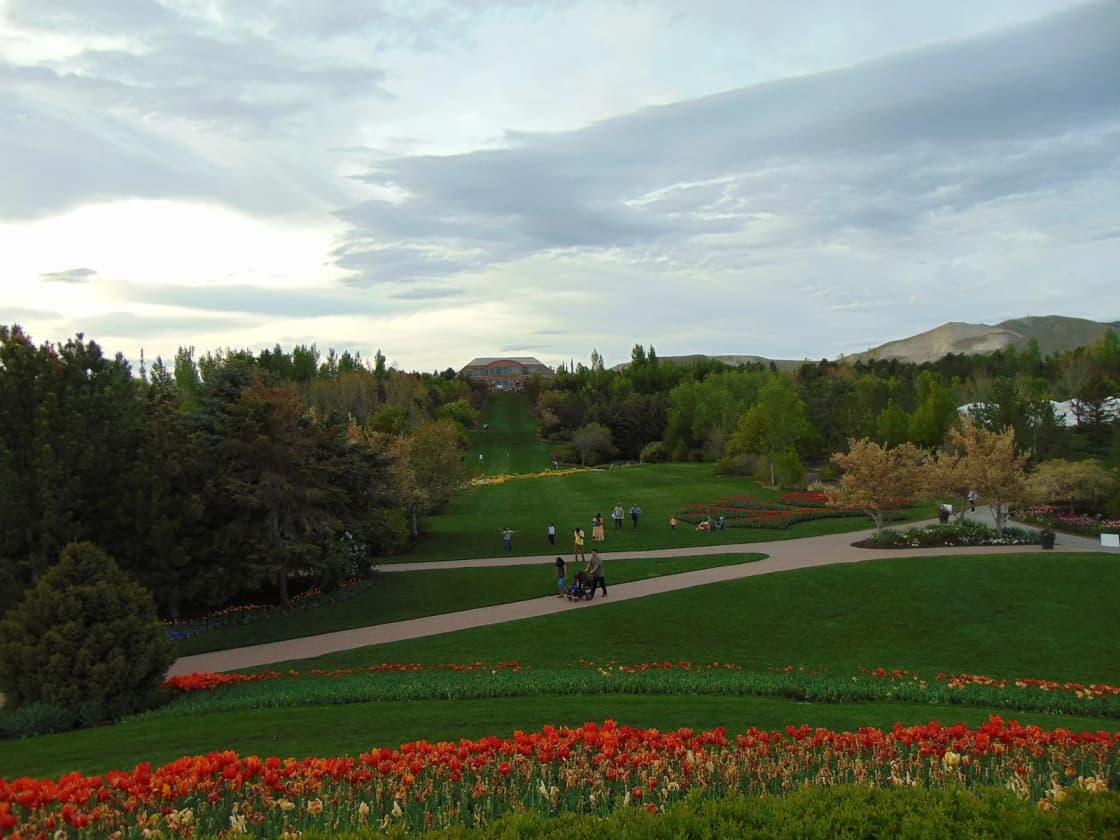
It is also on-brand for Lehi in a way that is easy to miss. Holdman Studios is a local firm with a national commission list, and Thanksgiving Point has built its identity on things that do not obviously belong on a former Lehi farm — an Italian garden, a grotto waterfall, a dinosaur museum. A glass sphere is a continuation of that habit, not a departure from it.
What to do with this now
Nothing, unless you are a donor. There is no construction to watch and nothing to visit. The near-term interest is in Holdman Studios itself, whose finished pieces for the Sphere are inside its Lehi headquarters — a working studio rather than a public gallery, so do not turn up expecting a tour.
If you are planning a Thanksgiving Point visit this fall, the campus you will see is the existing one. Our Thanksgiving Point guide covers the gardens, the museums and how to sequence them; the Lehi things-to-do roundup puts the campus alongside the rest of the city. We will add the Sphere to both the day it has a door.
Source: Daily Herald, "'A hallmark destination:' Plans released for Sphere of Light, a multistory stained glass center at Thanksgiving Point," Jacob Nielson, August 14, 2026. Quoted claims are attributed to the people who made them; no figure on this page has been independently verified beyond that report.
Related Guides
- Thanksgiving Point: The Complete Guide — the campus as it exists today
- Things to Do in Lehi — the rest of the city around it
- Museum of Natural Curiosity — the children's museum on the same campus
- Butterfly Biosphere — the other year-round indoor venue at Thanksgiving Point
- Thanksgiving Point Freedom Celebration 2026 — the campus's largest annual event
- Springville Museum of Art — Utah Valley's other major art destination
Frequently Asked Questions
What is the Sphere of Light?
When will it open?
Who is paying for it?
Who is Holdman Studios?
Will there be anything to do there besides look at glass?
Can I see any of the glass now?
Sources
The facts in this guide were checked against these sources. Hours, fees and rules change, so confirm anything time-sensitive with the source before you go. How we make Provo.com.
- 'A hallmark destination': Plans released for Sphere of Light, Daily Herald. Checked October 12, 2026.
- Largest stained glass art creation in the world planned for Lehi, KSL.com. Checked October 12, 2026.