Moab in winter is cold, bright and quiet. Arches and Canyonlands stay open from November through March, the visitor centers keep shorter hours, and the trails that are packed in April are close to empty. The catch is ice. The Park Service warns that even a little snow or ice can make trails and roads in the area impassable, and in December the sun sets around 5 p.m. For a Provo driver, the hardest part of the trip is usually not in Moab at all. It is US-6 over Soldier Summit.
| What | Winter status | Source, checked Nov. 21, 2026 |
|---|---|---|
| Arches National Park | Open 24 hours, year-round | NPS Arches |
| Arches visitor center | Daily 9 a.m. to 4 p.m., closed Dec. 25 | NPS Arches winter page |
| Arches timed entry | Not required in 2026; 2027 not announced | NPS Arches |
| Fiery Furnace ranger hikes | Spring through fall only | NPS Arches |
| Devils Garden Campground | 25 first-come sites, November to February | NPS Arches winter page |
| Island in the Sky visitor center | 9 a.m. to 4 p.m. daily in midwinter | NPS Canyonlands |
| Needles visitor center | Closed from early December to mid-February | NPS Canyonlands |
| Dead Horse Point State Park | Open 6 a.m. to 10 p.m.; $20 per vehicle | Utah State Parks |
| Drive from Provo | About 191 miles, 3 hr 50 min on dry roads | OSRM |
| Sunset in Moab, Dec. 21 | 5:01 p.m. | U.S. Naval Observatory |
What stays open
The short version: the parks, the main roads and most trails. Moab's official travel council says the nearby national parks stay open during the off-season months of November to March, when visitation is lowest, and that entry fees still apply.
Arches National Park is open 24 hours a day, every day of the year, according to the Park Service. Its winter page lists the visitor center as open seven days a week from 9 a.m. to 4 p.m., closed on Dec. 25. The park says most hiking trails remain open year-round. Ranger-led hikes and campfire talks are not offered in winter, but children can still pick up a Junior Ranger booklet at the visitor center and earn a badge.
Canyonlands National Park is also generally open year-round, 24 hours a day. Its winter page, last updated Sept. 21, 2026, lists the Island in the Sky visitor center at 8 a.m. to 4 p.m. daily from Oct. 28 through Nov. 29, then 9 a.m. to 4 p.m. from Nov. 30 through March 2. It closes at 1 p.m. on Thanksgiving Day and Christmas Eve and is closed on Christmas Day. Drinking water at Island in the Sky is available only when the visitor center is open; there is none at the campground. There is no gas, food or lodging inside the park.
The Needles district is the one that changes most. The park's winter page says the Needles Visitor Center closes from Dec. 6 through Feb. 12 and lists hours of 8 a.m. to 4 p.m. before and after that break. The same page gives a reopening date of "Thursday, February 13th, 2027," but Feb. 13, 2027 falls on a Saturday, so call the park at 435-719-2313 to confirm the exact date. The Needles campground stays open on a first-come, first-served basis, and water is available only at the visitor center.
Dead Horse Point State Park is open year-round from 6 a.m. to 10 p.m., according to Utah State Parks. The visitor center is open daily from 7 a.m. to 5 p.m. and closed on Thanksgiving, Christmas and New Year's Day. The day-use fee is $20 per regular vehicle (up to eight people), $10 per motorcycle, and $10 for a group of up to four people walking or biking in. Two winter notes from the park's page: the main overlook walkway is closed Dec. 1 to 4, 2026 for repaving, with alternate rim routes of about 200 yards that include stairs and are not mobility accessible, and the Kayenta Campground is closed from Dec. 1, 2026 through Feb. 28, 2027. Wingate Campground and the Moenkopi yurts stay open.
In town, the Moab Information Center at 25 E. Center St. lists hours of 9 a.m. to 4 p.m., seven days a week. Many retail shops and galleries stay open year-round, the travel council says, and the city's Electric Light Parade is held on the first Saturday of December, which this year is Saturday, Dec. 5.
What closes or slows down
Winter is the off-season in Moab, and the travel council says many restaurants and businesses change their hours or close for an extended break. Its December 2024 list for that season, for example, showed the Moab Museum closed Dec. 23 to Feb. 10 and Skydive Moab closed Nov. 15 to March 1, along with several restaurants taking breaks of two weeks to two months in January and February. The council's Moab in Winter page posts a current list of closures. Dates change every year, so check the specific restaurant or outfitter you are counting on before you drive four hours.
Inside the parks, these are the main things that stop or get harder:
- Ranger programs at Arches. The park says ranger-led hikes and campfire talks are not offered in winter.
- Fiery Furnace. The Arches permit page, updated Nov. 1, 2026, says ranger-guided hikes into the Fiery Furnace run "spring through fall" and require reservations. Self-guided exploration permits cost $10 per person, and the page does not describe a winter season. Our Fiery Furnace guide explains how the permits work when they are offered.
- The park road after snow. Arches says the road might close for several hours after a snowfall while crews plow, and that roads, parking lots and pullouts can stay icy, especially in shade.
- Backcountry roads. Canyonlands says paved roads may close temporarily for plowing, while unpaved backcountry roads may be impassable for much longer.
- Needles Visitor Center. Closed for roughly two months in midwinter, as above.
Timed entry: not this year, and 2027 is unsettled
Arches announced on Feb. 18, 2026 that it would not require advanced timed-entry reservations for the 2026 season, ending a requirement that had applied in recent seasons. "Visitors may enter the park at any time during operating hours," the release said. The park's trip-planning page adds that vehicles may be diverted from park entrances when areas become too congested, and that reservations are still required for Devils Garden Campground and for Fiery Furnace hikes.
Nothing in that release or on the park's pages covers 2027. When this guide was checked on Nov. 21, 2026, the park's old timed-entry reservation page returned an error and no 2027 announcement had been posted. That doesn't matter for a trip between now and Dec. 31. For a trip in January, February or March 2027, check nps.gov/arch and Recreation.gov a few days before you leave. Our guide to Arches entry reservations covers how the system worked and where any change would show up first.
You still need an entrance pass. The Arches fees page lists $30 per private vehicle, $25 per motorcycle and $15 per person on foot or bike, with youth 15 and under free. A $55 annual pass covers Arches, Canyonlands, Natural Bridges and Hovenweep. The America the Beautiful annual pass is $80 for U.S. residents. The fees page says it was last updated in April 2025, so confirm the current price before you pay.
The cold mornings
Moab is not a warm-weather escape in midwinter. The Park Service's almanac for Arches lists these monthly averages:
| Month | Avg. high / low (F) | Days below 32 F |
|---|---|---|
| November | 56 / 30 | 18 |
| December | 45 / 23 | 26 |
| January | 44 / 22 | 28 |
| February | 52 / 28 | 22 |
| March | 64 / 35 | 10 |
Canyonlands describes winters the same way: highs averaging 30 to 50 degrees and lows averaging 0 to 20. Its almanac lists an extreme low of minus 1 degree in January. Precipitation is light, about half an inch a month in the core winter months, and the parks say large snowfalls are uncommon in the desert itself, though the nearby mountains get more.
What that means on the ground: a clear morning in January will likely start below freezing, and the sun takes time to clear canyon walls and fins. Plan the first hour of the day for driving and overlooks, not for a north-facing trail. Our guide to Utah's warm places in winter compares Moab with St. George and Page using NOAA's 30-year normals; the short version is that Moab is dry and bright but only a few degrees warmer than Provo in January.
Ice on slickrock and trails
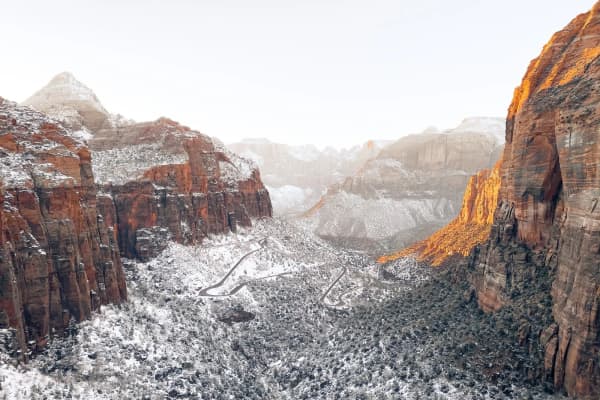
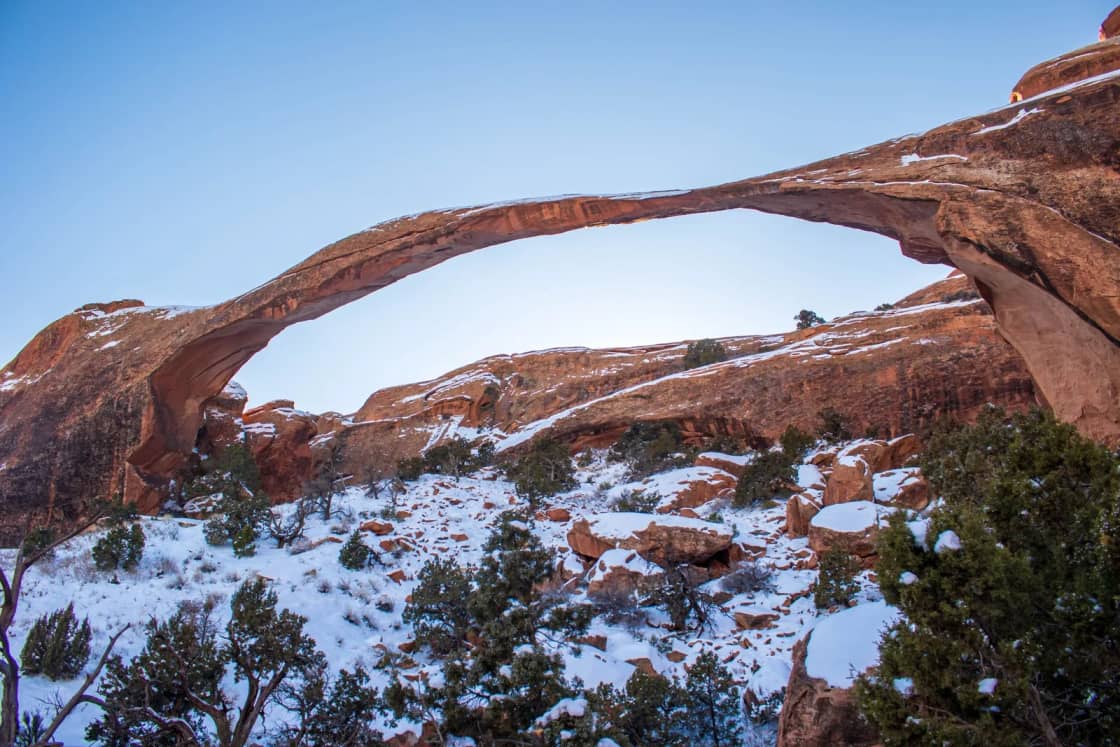
This is the part people from the Wasatch Front underestimate. Snow in Provo usually means soft snow on dirt. In Moab it often means a thin glaze on smooth sandstone, which is harder to see and harder to stand on.
The Arches winter page is direct about it. "Popular trails like Delicate Arch and Devils Garden quickly become slippery from packed snow and ice," it says, and "shady trails, like the one to Delicate Arch, can be icy through early spring." Drifting snow can also cover trail markers, making even easy trails harder to follow. Canyonlands calls snow- and ice-covered sandstone "treacherous" and notes that snow can bury the cairns that mark many routes.
Both parks recommend traction. Arches suggests traction devices and trekking poles for icy trails, and Canyonlands recommends instep crampons or other traction aids. A pair of slip-on microspikes is the practical choice for most day hikers.
Some practical habits:
- Ask first. Arches suggests checking trail photos and current road conditions at the visitor center before heading out. It takes five minutes and can save a wasted drive to a trailhead.
- Pick sunny exposures. South-facing slickrock dries faster than north-facing trail. Shade is where the ice lasts.
- Turn around early. On a slickrock route like Delicate Arch, the slope that is fine going up can be the one that is dangerous coming down once the afternoon melt refreezes.
- Use overlooks on bad days. Short walks to viewpoints and the scenic drives give you most of the scenery without the exposure. Our Delicate Arch guide covers the lower viewpoint option.
If you are bringing children, read our Moab with kids guide with winter in mind. The short, flat walks that work for small legs in spring are the same ones to favor in winter, and the long slickrock climbs are the ones to drop.
Short daylight
Winter days in Moab are short, and the parks are spread out. U.S. Naval Observatory data for Moab shows:
| Date | Sunrise | Sunset |
|---|---|---|
| Saturday, Nov. 21, 2026 | 7:07 a.m. | 5:01 p.m. |
| Monday, Dec. 21, 2026 | 7:32 a.m. | 5:01 p.m. |
| Friday, Jan. 15, 2027 | 7:34 a.m. | 5:21 p.m. |
| Monday, Feb. 15, 2027 | 7:09 a.m. | 5:56 p.m. |
Civil twilight adds about half an hour on each end. On the winter solstice, that's about nine and a half hours of sun. OSRM puts the drive from downtown Moab to the Arches area at roughly 19 miles and 35 minutes, and Island in the Sky and Dead Horse Point are farther out. Two big stops a day is realistic. Three is a stretch.
The short days also change the drive home. If you plan to leave Moab after a full day in the parks, you will be driving US-6 over Soldier Summit in the dark. In winter that's the wrong order. Better to spend the last night in Moab and drive home in daylight.
Backcountry roads: Shafer Trail and White Rim
The dirt roads that make Canyonlands famous are the most likely things to be off the table. Canyonlands says the Shafer Trail is "often impassable during winter due to snow and ice." The road conditions page, updated Nov. 19, 2026, listed the Shafer Trail as open with high-clearance 4WD recommended, and said to "expect washboarding, mud, and ruts above the switchbacks." The White Rim Road was open, but the park said travel was not advised on the west side because of muddy, slick conditions and quicksand. Mineral Bottom was open, with travel not advised for the same reasons. Day-use trips on the White Rim require a permit.
In the Needles, the Nov. 12 update listed several roads, including Salt Creek, Lavender Canyon and the Colorado River Overlook Road, as impassable after recent rains, and the route to the Confluence via Elephant Hill Road closed because of damage. The park's winter page also says that some Needles roads that need gate combinations are often impassable in winter.
These conditions change quickly. If a backcountry drive is the point of the trip, check the Canyonlands road conditions page and call the district visitor center before you leave Provo. If you're not sure your vehicle can self-rescue in mud, stay on pavement. Our Island in the Sky guide covers the paved overlooks, which work well in winter.
The drive from Provo
OSRM's routing service estimates about 191 miles and 3 hours 50 minutes from downtown Provo to downtown Moab. The route runs southeast through Spanish Fork Canyon on US-6, over Soldier Summit, through Price, and on to the US-191 junction for the run south into Moab. That is a dry-road estimate with no stops.
US-6 is the leg that needs a plan. KUER reported in November 2023 that the 128-mile stretch from Spanish Fork to I-70 had seen 2,615 crashes and 48 deaths since 2018, with hot spots in Spanish Fork Canyon and at Soldier Summit. The Utah Highway Safety Office listed driving too fast for the weather among the main contributing factors. UDOT has spent more than $148 million on widening, barriers, intersection work and curve warning signs over about two decades, and it says earlier projects have significantly reduced crashes. Its list of projects in design includes widening the highway and adding a median barrier near Soldier Summit.
Winter checklist for the drive:
- Check before you go, and again in Price. UDOT posts Road Weather Alerts and current restrictions at udottraffic.utah.gov and in its app. For roads outside the parks, the Park Service also points to UDOT's road weather forecast and 1-866-511-UTAH (8824).
- Know the traction law. UDOT or law enforcement can require traction devices on canyon and mountain routes, and UDOT says drivers may need to comply up to 24 hours before a storm. For two-wheel-drive cars, the minimum is 3PMSF-rated tires or chains on all drive tires. Our traction law guide has the full table.
- Drive it in daylight. With sunset near 5 p.m., leaving Provo by mid-morning gets you over Soldier Summit and into Moab before dark.
- Fill up. There is no gas inside Canyonlands, and the Park Service lists no services in the Needles or Island in the Sky districts.
- Carry winter gear. Warm layers, water, food and a blanket belong in the car on any winter drive through rural Utah.
Our Utah road conditions guide lists every place to check.
Where to sleep: camping and lodging
Camping is possible in winter, but it's cold, and most sites are first-come, first-served.
- Devils Garden Campground in Arches. The park's winter page says that between November and February, 25 sites are available first-come, first-served, with restrooms and drinking water. Gathering wood is prohibited; firewood is sold at the visitor center or in Moab. The park's conditions page says reservations run March through October.
- Canyonlands campgrounds. Willow Flat at Island in the Sky and the Needles campground are first-come, first-served in winter. Willow Flat has no water.
- Dead Horse Point. Wingate Campground and the Moenkopi yurts stay open while Kayenta is closed. The park lists off-peak RV sites at $50 a night and hike-in tent sites at $40, and yurts at a discounted $100 plus tax from Dec. 1 to 20 and Jan. 3 to Feb. 13 (standard rate $150 including day-use fees and taxes). The dishwashing sinks are shut off in winter because of freezing nights.
- BLM campgrounds. The BLM says Loop B at Ken's Lake Campground, south of town, is open year-round, first-come, first-served, at $20 per site per night, with vault toilets and no drinking water. Loop A is closed during the low-use season.
The travel council says many hotels offer deals in the winter months but does not list prices, so compare rates directly. Our guide to where to camp and stay in Moab compares the campgrounds, Sand Flats and town lodging.
Things that work well in winter
- The paved scenic drives. The Arches park road and the Island in the Sky road reach most of the famous views from pullouts.
- Short walks on sunny ground. Save the long slickrock hikes for a clear, dry stretch after a storm has melted off.
- Dead Horse Point at midday. The overlook is a short walk from parking, and the park is open until 10 p.m.
- Stargazing. The travel council points to clear winter skies as a reason to visit, and local stargazing tours run in winter. Dress for temperatures well below freezing.
- The La Sal Mountains. The council says the La Sals, in the Manti-La Sal National Forest, offer areas for cross-country skiing, sledding and limited snowmobiling. Check road and avalanche conditions before going up.
- Indoor climbing and classes. The council's events calendar lists a Winter Climbing Club from Nov. 23, 2026 to Jan. 13, 2027 and climber yoga at the MARC through March 29, 2027.
Who should skip it
Moab in winter is a good trip for adults who like quiet, cold mornings and are comfortable on winter roads. It's a worse fit for some people:
- Anyone counting on the Fiery Furnace or ranger programs. Those are spring-through-fall activities.
- Drivers uneasy on US-6 in snow. If the forecast calls for a storm over Soldier Summit, move the trip.
- Families with toddlers who would end up on icy slickrock. Stick to overlooks or wait for March.
- Backcountry drivers without a capable 4WD. Shafer, White Rim and the Needles back roads may be closed, muddy or iced over.
- People who want warm afternoons. For that, St. George is a better bet in December and January.
- Anyone hoping to make it a day trip. With nearly eight hours of round-trip driving and sunset near 5 p.m., a winter day trip leaves almost no time in the parks. Plan at least one night. Our Moab from Provo guide covers the planning in more detail.
How we checked this
Park hours, closures and road conditions in this guide come from the National Park Service pages for Arches and Canyonlands, read on Nov. 21, 2026. Dead Horse Point details are from Utah State Parks, Ken's Lake details from the BLM, and town information from the Moab Area Travel Council. Sunrise and sunset times are from the U.S. Naval Observatory, and drive times from the OSRM routing service. Winter hours and road status change often, so confirm with the parks before you leave Provo.
Frequently Asked Questions
Is Arches National Park open in winter?
Do I need a timed-entry reservation for Arches in winter?
How cold is Moab in winter?
Can you hike to Delicate Arch in winter?
Is the Fiery Furnace open in winter?
Can I drive the Shafer Trail in winter?
How long does it take to drive from Provo to Moab in winter?
Who should skip Moab in winter?
Sources
The facts in this guide were checked against these sources. Hours, fees and rules change, so confirm anything time-sensitive with the source before you go. How we make Provo.com.
- Visiting in Winter, Arches National Park, National Park Service. Checked November 21, 2026.
- Operating Hours and Seasons, Arches National Park, National Park Service. Checked November 21, 2026.
- Plan Your Visit, Arches National Park, National Park Service. Checked November 21, 2026.
- Arches National Park news release, Feb. 18, 2026 (timed entry), National Park Service. Checked November 21, 2026.
- Fees and Passes, Arches National Park, National Park Service. Checked November 21, 2026.
- Fiery Furnace Permits, National Park Service. Checked November 21, 2026.
- Weather, Arches National Park, National Park Service. Checked November 21, 2026.
- Current Conditions, Arches National Park, National Park Service. Checked November 21, 2026.
- Visiting in Winter, Canyonlands National Park, National Park Service. Checked November 21, 2026.
- Road Conditions, Canyonlands National Park, National Park Service. Checked November 21, 2026.
- Weather, Canyonlands National Park, National Park Service. Checked November 21, 2026.
- Dead Horse Point State Park, Utah State Parks. Checked November 21, 2026.
- Dead Horse Point State Park fees, Utah State Parks. Checked November 21, 2026.
- Ken's Lake Campground, Bureau of Land Management. Checked November 21, 2026.
- Snow Tire, Chain and Traction Device Requirements, Utah Department of Transportation. Checked November 21, 2026.
- UDOT to add new safety features along US-6, Utah Department of Transportation. Checked November 21, 2026.
- Road Weather Alert, Utah Department of Transportation. Checked November 21, 2026.
- Sun and moon rise/set data, Moab, U.S. Naval Observatory. Checked November 21, 2026.
- OSRM route, Provo to Moab, Project OSRM. Checked November 21, 2026.
- Moab in Winter, Moab Area Travel Council. Checked November 21, 2026.
- What's closed in the winter in Moab, Moab Area Travel Council. Checked November 21, 2026.
- Moab Information Center, Moab Area Travel Council. Checked November 21, 2026.
- A reminder for holiday drivers: take it easy on US-6 between Spanish Fork and I-70, KUER. Checked November 21, 2026.