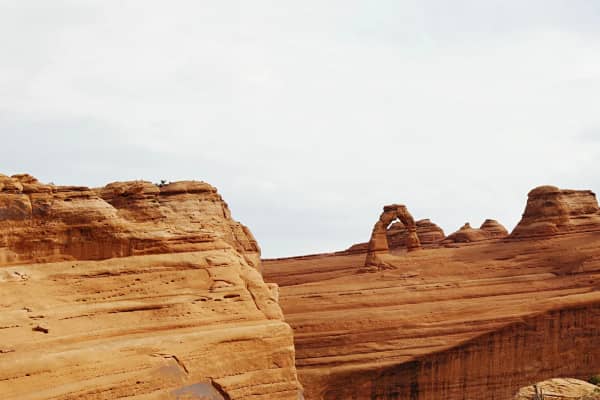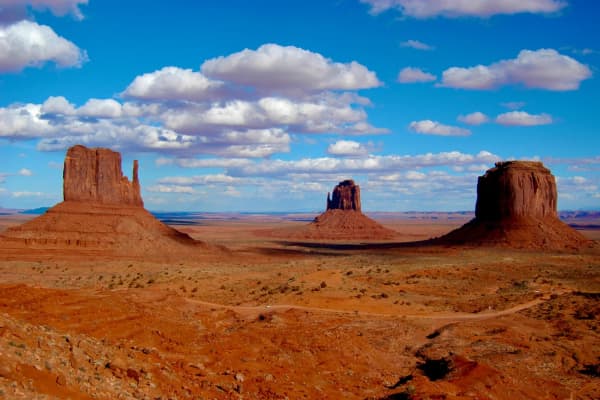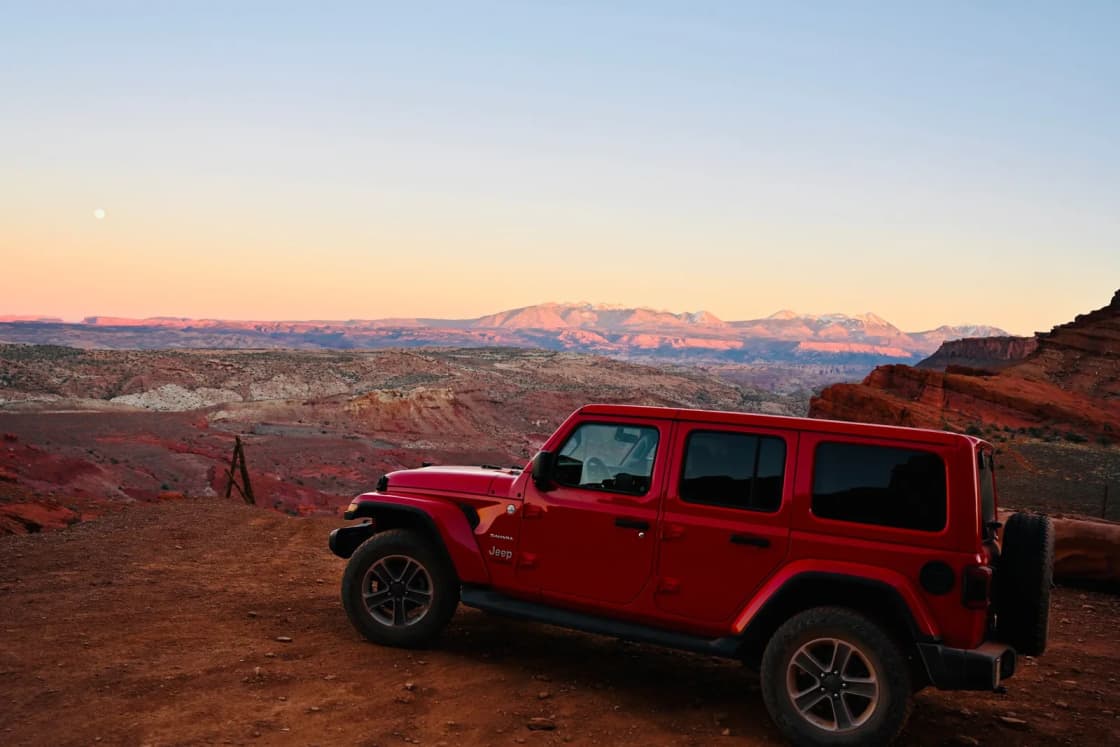
Moab has two reputations. Most Provo visitors know the one built on Arches and Canyonlands. The other belongs to the dirt and slickrock roads on the public land around town, where full-size four-wheel-drive trucks, modified Jeeps and rented side-by-sides crawl over sandstone fins and down ledges with names like Hell's Revenge and Pritchett Canyon. Once a year, for nine days around Easter, that second reputation takes over the town during the Easter Jeep Safari.
This guide is for Utah Valley drivers who want to understand how that world works before they commit a weekend and a vehicle to it: how the trails are rated, which rules apply on which kind of land, what the national parks allow, what the safari costs and when the 2027 edition falls. It sits under our broader Moab from Provo guide, which covers the drive, the parks and the season.
Every date, fee and rule below was checked against the named source on Nov. 20, 2026. Trail conditions change after every storm, and land managers revise rules, so check again before you go.
Quick facts
| Topic | What the source says | Source |
|---|---|---|
| Drive from Provo | About 190 miles, roughly 3 hours 50 minutes without stops | OSRM routing |
| 2027 Easter Jeep Safari | March 20 through March 28, 2027 | Red Rock 4-Wheelers |
| Safari registration | Opens January 2027, online only, until trails fill | Red Rock 4-Wheelers |
| Safari trail fee | $75 per vehicle per trail day | Red Rock 4-Wheelers |
| Vehicles on safari runs | Full-size street-legal 4x4s; no UTVs or ATVs | Red Rock 4-Wheelers |
| Trail rating scale | 1 (county dirt road) to 10 (buggies only) | Red Rock 4-Wheelers |
| Sand Flats entry | $10 per private vehicle for 7 days; $35 annual | BLM |
| Sand Flats 4x4 speed limit | 15 mph | Grand County |
| Canyonlands permit roads | White Rim, Elephant Hill, Lavender Canyon, Peekaboo/Horse Canyon | NPS |
| Canyonlands permit fee | $6 online; none for same-day walk-up | NPS |
| UTVs in the parks | Not allowed in Arches or on Canyonlands permit roads | NPS |
| Utah adult OHV course | Free, online, under 30 minutes, once in a lifetime | Utah Division of Outdoor Recreation |
| Non-resident OHV permit | $35 per machine, 12 months, online only | Utah Division of Outdoor Recreation |
Who this is for, and who should skip it
Moab's four-wheel-drive country suits a few kinds of Provo visitors. There are owners of stock or lightly modified trucks and SUVs who want a scenic backcountry day without breaking anything. There are owners of built rigs who know what lockers and 35-inch tires are for and want the famous ledges. There are families who would rather pay a guide or ride along on a tour. And there are people who have no interest in driving off pavement but are curious about the safari as an event.
Some people should skip the harder trails, or skip the trip during safari week altogether:
- Drivers in all-wheel-drive crossovers. Arches' own rules say AWD vehicles do not meet its definition of four-wheel drive, and the Red Rock 4-Wheelers scale requires four-wheel drive from rating 3 upward.
- Anyone in a rental with a paved-roads clause. The Canyonlands driving page warns that most rental agreements restrict vehicles to paved roads. Read your contract; a Jeep rented from a Moab outfitter that sells trail use is a different case from a sedan rented at the Salt Lake airport.
- Drivers who have never used low range. The Canyonlands permit roads require high-clearance, low-range four-wheel drive, and the NPS describes the Maze roads as not suitable for inexperienced drivers.
- Travelers who need quiet, cheap rooms. Discover Moab describes the safari as attended by thousands of visitors. If you want Arches without engine noise and full motels, pick another week.
How to get there from Provo
OpenStreetMap routing (OSRM) puts downtown Moab about 190 miles and just under four hours from Center Street and University Avenue in Provo, without stops or traffic. The usual route leaves I-15 at Spanish Fork, follows US-6 through Spanish Fork Canyon to Price and Green River, picks up I-70 east for a short stretch, and turns south on US-191 into Moab.
If you're towing a trail rig, plan for a slower trip and a few fuel stops. US-6 is a two-lane freight route for much of the way, and our road conditions guide covers where to check UDOT closures and chain rules before you leave, which matters in March, when the safari falls.
Moab is not a day trip from Utah Valley for anyone who wants to drive a trail. Most of the routes in this guide take most of a day on their own. For where to sleep, including BLM campgrounds and the Sand Flats sites, see Where to Camp and Stay in Moab.
Who manages the land, and why it matters
The roads around Moab fall under several managers, and each sets its own rules. Knowing whose land you're on tells you what you can drive there.
- BLM land. Most of the famous jeep trails, including Hell's Revenge, Fins and Things, Poison Spider Mesa and the Gemini Bridges area, sit on Bureau of Land Management land run by the Moab Field Office. Motorized travel is limited to designated routes. The BLM's 2023 Labyrinth Rims/Gemini Bridges travel plan covered about 812 miles of routes on roughly 300,000 acres in Grand County, and the agency said at the time that 96 percent of Jeep Safari routes in the field office remained available for off-highway vehicle use. The BLM's route maps and decisions are posted on its ePlanning site.
- Sand Flats Recreation Area. This area just east of town, home to Hell's Revenge, Fins and Things and the Slickrock Bike Trail, is managed by a partnership between Grand County and the BLM. It has its own fees and rules, covered below.
- Canyonlands National Park. The park allows street-legal four-wheel-drive vehicles on specific backcountry roads, several of which need a permit, and bans ATVs, UTVs and OHVs on those roads.
- Arches National Park. Arches has a handful of designated four-wheel-drive roads and bans off-highway vehicles outright.
- Private and state land. Some trails cross private parcels. The Red Rock 4-Wheelers FAQ mentions a $2 private gate fee at Pritchett Canyon as an example.
How the trails are rated
There's no single official difficulty scale for Moab's jeep trails, but the one most local drivers and guidebooks refer to is the 1-to-10 scale published by Red Rock 4-Wheelers, the club that organizes the Easter Jeep Safari. Discover Moab, the area's official tourism site, points visitors to the club's website as a reference for most of the area's four-wheel-drive trails.
Here is how the club describes the levels, condensed:
| Rating | Terrain | Equipment the club lists |
|---|---|---|
| 1 | Maintained county dirt road | High-clearance 2WD or 4WD |
| 2 | County dirt road with light maintenance | High-clearance light-duty 4WD |
| 3 | Loose rock, sand, some slickrock, steps up to 12 inches | 4WD; 33-inch tires a plus |
| 4 | Washes, gulches, rock steps up to 18 inches | 4WD and 33-inch tires |
| 5 | Steps up to 24 inches, water up to 12 inches | 4WD, 33-inch tires, a locker or limited slip |
| 6 | Steps up to 36 inches, deeper water and mud | 35-inch or larger tires, two traction devices |
| 7 | Steps over 48 inches, steep climbs and descents | Front and rear lockers, 35-inch tires, tow hooks |
| 8 | Like 7, more extreme | Same as 7 plus 37-inch tires |
| 9 | Steps over 60 inches, off-camber sections | Lockers, 37-inch tires, winch, 100-inch minimum wheelbase |
| 10 | Buggy territory | Not for street-driven 4x4s |
The club's wording at the top end is blunt. At 7 and 8, it says vehicle damage is likely and rollovers are possible. At 9, it says rollovers are very common and recommends carrying spare parts and tools. At 10, it says modified factory vehicles won't be able to complete the trail. The club also notes that weather and use constantly change the routes, and that turning back is usually an option.
Where well-known trails fall
The Red Rock 4-Wheelers trail listing gives these ratings for routes Provo visitors often ask about:
- Chicken Corners: 2. Discover Moab calls it perfect for beginners. It climbs over Hurrah Pass and ends on a bench about 400 feet above the Colorado River.
- Gemini Bridges area ("3 Icons" run): 3. Discover Moab calls Gemini Bridges a starter route but warns that a steep, exposed climb at the start and some ledges can be tricky for newer drivers.
- Fins and Things: 4. Discover Moab notes sudden, steep climbs and sandy berms and recommends taller tires for clearance.
- Elephant Hill: 5.
- Hell's Revenge: 6, with a separate safari version, "Tip Toe Trip," rated 4.
- Poison Spider Mesa, Steel Bender and Top of the World: 6.
- Golden Spike, Moab Rim, Behind the Rocks, Metal Masher and Kane Creek Canyon: 7.
- Cliffhanger: 8.
- Pritchett Canyon: 9.
Two cautions. First, the ratings describe a trail as the club runs it on a given event, and the same name can carry different ratings depending on which obstacles are included or bypassed, as the two Hell's Revenge listings show. Second, other managers describe the same terrain more starkly. The BLM's Hell's Revenge page calls it extremely difficult, says only very experienced drivers with advanced vehicles should attempt it, and says it is not suitable for ATVs.
A reasonable rule for a first Moab trip in a stock truck or SUV is to stay at 1 to 3, drive with at least one other vehicle, and save the 4s and up for a guided run or a trip with experienced friends.
The Easter Jeep Safari
What it is
According to Red Rock 4-Wheelers' history, the safari began in 1967 as a one-day event run by the Moab Chamber of Commerce: a single Saturday group ride on the Behind the Rocks Trail, with no entry fee. The Moab Rim trail was added the next year. The club took over coordination around 1982, after the BLM began requiring a permit and insurance, and has since grown it into a nine-day event. Discover Moab described the 2026 edition, the 60th, as offering expert-led group rides on nearly 40 trails in and around Moab's backcountry.
Where it sits on the calendar
The safari is tied to Easter, so its dates move each year. The 2026 event ran March 28 to April 5. Red Rock 4-Wheelers lists the 2027 Easter Jeep Safari as March 20 through March 28, 2027, which puts it a week earlier on the calendar than this year's.
For Provo visitors, that timing matters in a few ways:
- It lands in spring travel season. Late March is also when many Utah school and college spring breaks fall. With thousands of safari visitors in town, book rooms and campsites early if you're going that week for any reason.
- Check two forecasts. Conditions on Soldier Summit and US-6 can differ from those in Moab. Look at the National Weather Service forecast for both ends of the drive in the days before you leave.
- Registration comes first. The club's FAQ says registration for 2027 begins in January 2027 and runs until all trails are full. Since sign-ups close trail by trail as they fill, watch the club's home page for the opening date if you have a specific trail in mind.
Registering and costs
Red Rock 4-Wheelers handles everything through its website, rr4w.com. The steps it lists:
- Create a profile on the site and add your vehicle. A profile alone does not register you for anything.
- Register for the safari and individual trails through the Events tab once registration opens. The opening date is posted on the club's home page.
- Keep your license number, vehicle details and contact information current.
The club says people with an up-to-date profile before Dec. 1 automatically receive the printed Safari magazine, with the trail schedule, sometime in January.
The FAQ lists the fee as $75 per vehicle per trail day, and says trails usually take most of a day. The club says the money pays land access costs to the BLM, the National Park Service and the State of Utah, and that registration fees cover the trail-use permits for event trails, with Elephant Hill the exception. Cancellations received in writing before the posted deadline are refunded minus a $15 fee. After the deadline, openings are not refilled and fees are forfeited, and the club does not refund for broken vehicles or weather unless it cancels the trail itself. Refunds can take up to four weeks.
What vehicles can go
The club allows full-size, street-legal four-wheel-drive vehicles of all kinds, and you do not need a Jeep. Street-legal rock buggies are allowed. UTVs, sand buggies, crawlers and Razor-style ATVs are not. The FAQ says stock four-wheel-drive vehicles can handle many of the lower-rated trails, while the hardest terrain generally takes high-clearance, heavily modified trucks and a skilled driver. Match your vehicle to the club's rating table before you sign up for a trail.
Watching instead of driving
You don't need to register to see the safari. For 2026, Discover Moab listed a vendor expo at the Old Spanish Trail Arena (Thursday, April 2, 10 a.m. to 7 p.m., and Friday, April 3, 9 a.m. to 5 p.m.) and a Jeep expo of the brand's concept vehicles in the Walker Drug parking lot that weekend, both free. There was also a Vintage Iron car show at the arena and a children's program called Camp Moab for ages 6 to 17. Schedules for 2027 had not been posted as of Nov. 20, 2026; the club's magazine and Discover Moab's event pages are the places to look.
If you arrive without a reservation and want to ride, Discover Moab said to visit the registration desk at the Old Spanish Trail Arena between 7 and 10 a.m. during the event to check for open spots. Questions go to the club through the contact page on rr4w.com or at 435-259-ROCK.
If you're not there for the safari
The safari puts nearly 40 organized trail runs and thousands of visitors into Moab over nine days. If you want quieter roads or an easier motel booking, plan around March 20 to 28, 2027. If you do overlap, expect convoys on the popular routes and full trailheads, and give organized groups room to pass or to work through obstacles.
Sand Flats: Hell's Revenge and Fins and Things
Sand Flats Recreation Area is the closest four-wheel-drive country to downtown Moab. The BLM's Sand Flats page lists about 30 miles of jeep trails, 140 first-come, first-served campsites and six group sites, which can be reserved through Recreation.gov.
Fees. The BLM page lists a 7-day pass of $10 for a private vehicle and $5 for a bicycle or motorcycle, and a $35 annual pass that covers the cardholder and passengers in one private vehicle for day use. Camping is $20 per night per vehicle. Grand County's fee page says federal and state passes are not accepted, except that the federal Access Pass was grandfathered in. Grand County's kiosk fee schedule for 2026 is posted as an image, so confirm the current rate at the entrance station.
Rules. Grand County's rules page sets a 15 mph maximum speed on the 4x4 trails and says operating a motorized vehicle or mountain bike off designated roads and trails is a class A misdemeanor. The Fins and Things section south of the Sand Flats road is day use only, closed from a half hour before sunset until a half hour after sunrise.
Hell's Revenge. The BLM puts the route at about 6.5 miles and two to three hours. The trailhead has no toilets or drinking water and limited cell coverage, and there is trailer parking. To get there from Moab, take 300 South east, turn right on 400 East to Mill Creek Drive, follow Mill Creek Drive to Sand Flats Road, and continue about a mile. About half a mile in, the Hell's Revenge Dinosaur Tracksite preserves more than 50 footprints in the Navajo Sandstone; disturbing them is prohibited. The trail also crosses the Slickrock Bike Trail, so watch for riders, and see our Slickrock Trail guide if you're splitting the weekend between wheels and pedals.
The national parks' backcountry roads
Canyonlands
Canyonlands has some of the most famous four-wheel-drive roads in the West, and it regulates them closely.
Permits. The park requires a day-use permit for every vehicle, motorcycle and bicycle on the White Rim Road, Elephant Hill Road, Lavender Canyon Road and the Peekaboo/Horse Canyon roads. Each vehicle and each bike needs its own permit, even if the bikes arrive on a vehicle. Permits go on sale on Recreation.gov at 8 a.m. Mountain time the day before your trip, with a $6 reservation fee. The park holds 25 of the 50 daily White Rim vehicle permits, plus any unreserved Needles permits, for in-person issue at visitor centers on the day, with no fee, up to an hour before closing. The park entrance fee is separate. Overnight trips need a backcountry permit instead.
Limits. The White Rim Road allows 50 vehicles and 50 mountain bikes a day, with groups capped at three vehicles and 15 bikes. Elephant Hill allows 24 vehicles and 12 bikes a day, with groups of three vehicles and 12 bikes, and groups must start at least 30 minutes apart. Elephant Hill also bars vehicles over 21 feet long or 85 inches wide.
The roads themselves. The NPS describes the White Rim as a 100-mile loop and says driving it in one day is not advised; most visitors take two to three days. The Shafer Trail drops 1,500 feet off the Island in the Sky mesa, and the park highly recommends high-clearance four-wheel drive or AWD for it, but it needs no permit. Neither does Potash Road, roughly 35 to 40 miles from the bottom of the Shafer Trail back to Moab; allow at least three hours. In the Needles, Elephant Hill is among the most technical roads in the park, and the NPS warns of deep sand, standing water and quicksand on Salt Creek and Horse Canyon and creek crossings that wash out in monsoon season on Lavender Canyon. The Maze roads are described as extremely remote and very difficult.
Vehicles. ATVs, UTVs and OHVs are not permitted on the permit roads, and motorbikes must be equipped and licensed for interstate travel. Most backcountry roads require high-clearance, low-range four-wheel drive. The park warns that towing a disabled vehicle out of the backcountry can cost more than $2,000 and that roadside assistance and towing insurance may not apply there. There's no food, gas or lodging in the park, and cell service is limited.
For the paved side of the district, see our Island in the Sky guide.
Arches
Arches is a paved-road park for most visitors, but it does have a few designated four-wheel-drive roads: Willow Springs Road, the West Valley Jeep Road, Tower Arch Road and Cache Valley Road, along with unpaved Salt Valley and Klondike Bluffs roads.
The park's current Superintendent's Compendium, dated December 2025, requires high-clearance four-wheel drive on the West Valley Jeep Road and on Tower Arch Road from Salt Valley Road to the western Tower Arch parking lot. It defines that as a Jeep, SUV or truck with at least 15-inch rims and at least 12 inches of clearance, and says AWD vehicles do not qualify.
The compendium bans vehicles off designated roads, and bans off-highway vehicles, which it defines to include ATVs (even street-legal ones), side-by-sides, sand rails and dune buggies. All vehicles must be equipped to legally operate on interstate highways, carry valid state registration and plates, and be driven by a licensed driver. Road-registered motorcycles are allowed. All park roads can close temporarily for weather or emergencies.
Arches did not require timed-entry reservations in 2026. Whether that holds for 2027 is covered in our Arches entry reservations explainer.
Utah OHV rules for ATVs and side-by-sides
Full-size trucks and Jeeps registered as ordinary road vehicles follow normal vehicle law. ATVs, UTVs and off-highway motorcycles fall under Utah's OHV rules, which changed recently and apply on BLM land around Moab.
- Adult education course. The Utah Division of Outdoor Recreation, which now runs the state OHV program, says all OHV operators 18 and older must complete the free online Utah Adult OHV Education Course and carry a valid certificate while riding. It is designed to take under 30 minutes and is required once in a lifetime. The division's FAQ says guided tours, sanctioned OHV events and 4x4s registered as normal road vehicles are exempt, and that a temporary certificate can be printed when you finish.
- Youth course. Riders under 18 must complete the separate Youth OHV Education Course.
- Non-resident permit. Non-residents need a $35 permit for each machine they operate on public land, valid 12 months from purchase and sold online only. As of Sept. 8, 2026, out-of-state OHVs need the permit even when registered as street legal in another state, with limited exceptions.
- Rentals. The division's FAQ doesn't address rental machines specifically; it lists (801) 538-5500 for questions. Ask the rental shop what paperwork it expects from you.
Utah Valley riders who want to practice close to home can start with our Five Mile Pass OHV guide or look at ATV and UTV rentals in Utah Valley.
Costs at a glance
A Moab four-wheel-drive weekend can range from a few dollars in fees to a large repair bill. The fixed costs that the sources list:
- Sand Flats: $10 per private vehicle for seven days, $5 per bike or motorcycle, $35 annual, $20 per night to camp.
- Canyonlands day-use permit: $6 online, free same-day in person, plus the park entrance fee.
- Easter Jeep Safari: $75 per vehicle per trail day.
- Pritchett Canyon private gate: $2, per the Red Rock 4-Wheelers FAQ.
- Utah non-resident OHV permit: $35 per machine.
- Utah OHV education course: free.
The variable costs are fuel for a roughly 380-mile round trip from Provo, lodging, any guided tour or rental, and whatever the trail does to your vehicle. Guided tour and rental prices vary by operator; check them directly.
What to bring
- A full-size spare, a jack that works on your lifted or loaded vehicle, and the tools to use them.
- A tire gauge and a way to air back up if you air down for slickrock.
- Recovery points or tow hooks; on trails rated 7 and up, the club lists them as required.
- More water than you expect to drink, and food for a delay. The Hell's Revenge trailhead has no water, and Canyonlands has no services in the backcountry.
- A paper map or offline map with the designated routes. The BLM posts motorized travel maps for the Moab Field Office, and Canyonlands and Arches publish park maps.
- A way to call for help where cell service fails, such as a satellite messenger.
- A printed or downloaded permit for any Canyonlands road that requires one, and your OHV education certificate if you're riding a UTV or ATV.
Safety and conditions
The common threads in what the land managers say are simple: stay on the designated route, know your vehicle's limits, and plan for being stuck.
- Off-route driving is a crime. The BLM and Grand County both call off-trail driving at Sand Flats a class A misdemeanor; the BLM adds that it can bring fines, jail and vehicle forfeiture. Violations can be reported to the BLM at 435-259-8115.
- Ratings are a floor, not a guarantee. The club warns that weather and use change trails constantly. A step rated 24 inches last spring can be deeper after a storm.
- Water changes everything. The NPS warns of quicksand, washouts and flash flood damage on Needles roads. Wet clay roads can become impassable.
- Help is far away. The NPS warns of towing bills that can exceed $2,000 and insurance that may not apply. Travel with another vehicle on anything beyond a graded road.
- Share the trail. Hell's Revenge crosses the Slickrock Bike Trail, Gemini Bridges is shared with mountain bikers, and Canyonlands' permit roads carry cyclists too.
What to check before you go
- Red Rock 4-Wheelers (rr4w.com) for the 2027 safari registration opening date, the trail schedule and the current rating of any trail you plan to drive.
- Canyonlands' day-use permit page and Recreation.gov for permit availability, and the NPS road conditions page for closures.
- Arches' alerts and compendium for 4WD road status and the 2027 entry system.
- The BLM Moab Field Office at (435) 259-2444 or blm.gov for route designations, maps and closures.
- Grand County's Sand Flats pages for current fees and rules.
- Utah Division of Outdoor Recreation for OHV education and non-resident permit requirements.
- UDOT and the National Weather Service for the US-6 and US-191 drive and the Moab forecast.
Related on Provo.com
- Moab from Provo: Planning the Drive, Arches and Canyonlands
- Where to Camp and Stay in Moab: BLM Campgrounds, Sand Flats, Motels and Town
- Canyonlands Island in the Sky: Mesa Arch, Grand View Point and the Short Drive In
- Moab Mountain Biking: The Slickrock Trail and Where Beginners Should Start Instead
- Dead Horse Point State Park: The Overlook, the Fees and the Intrepid Bike Trails
- Moab With Kids: Short Hikes, River Trips and the Heat Problem
- Five Mile Pass OHV Area in Utah County
- Goblin Valley and the San Rafael Swell from Provo
Frequently Asked Questions
When is the 2027 Easter Jeep Safari?
How much does it cost to drive an Easter Jeep Safari trail?
Do I need a Jeep to join the Easter Jeep Safari?
Can I watch the Easter Jeep Safari without registering?
What do the Red Rock 4-Wheelers trail ratings mean?
Do I need a permit to drive the White Rim Road or Elephant Hill?
Can I take a UTV or side-by-side into Arches or Canyonlands?
Do out-of-state riders need anything to drive an OHV around Moab?
Sources
The facts in this guide were checked against these sources. Hours, fees and rules change, so confirm anything time-sensitive with the source before you go. How we make Provo.com.
- BLM Designates Labyrinth Rims Gemini Bridges Travel Management Plan, Bureau of Land Management. Checked November 20, 2026.
- Sand Flats Recreation Area, Bureau of Land Management. Checked November 20, 2026.
- Hell's Revenge Trailhead, Bureau of Land Management. Checked November 20, 2026.
- Sand Flats Rules and Regulations, Grand County, Utah. Checked November 20, 2026.
- Sand Flats Fees, Grand County, Utah. Checked November 20, 2026.
- Day-Use Permits, National Park Service, Canyonlands National Park. Checked November 20, 2026.
- National Park Service, Canyonlands National Park: Auto Touring, National Park Service, Canyonlands National Park. Checked November 20, 2026.
- Superintendent's Compendium, National Park Service, Arches National Park. Checked November 20, 2026.
- Utah Adult OHV Education Course, Utah Division of Outdoor Recreation. Checked November 20, 2026.
- OHV Education FAQs, Utah Division of Outdoor Recreation. Checked November 20, 2026.
- Non-Resident OHV Permits, Utah Division of Outdoor Recreation. Checked November 20, 2026.
- Welcome to Red Rock 4-Wheelers (Easter Jeep Safari history and 2027 dates), Red Rock 4-Wheelers. Checked November 20, 2026.
- Red Rock 4-Wheelers: FAQs, Red Rock 4-Wheelers. Checked November 20, 2026.
- Red Rock 4-Wheelers: Trail Ratings, Red Rock 4-Wheelers. Checked November 20, 2026.
- Red Rock 4-Wheelers: Trails, Red Rock 4-Wheelers. Checked November 20, 2026.
- Moab 60th Annual Easter Jeep Safari, Discover Moab. Checked November 20, 2026.
- Moab 4-Wheeling Trails Guide, Discover Moab. Checked November 20, 2026.