
For most of the past century, the Provo River did not really have a delta. It had an outlet — a channelized, diked run of water aimed at Utah Lake, engineered to move water efficiently and doing exactly that.
Then, between 2020 and 2024, agencies rebuilt one. Roughly 260 acres of wetland and new channel, opened to the public on 26 October 2024, sitting about half a mile north of Utah Lake State Park and maybe ten minutes from downtown Provo.
It was built for a fish. What it produced, incidentally, is one of the most accessible places to watch birds anywhere on the Wasatch Front.
What was built
The restoration reconnected the lower Provo River to Skipper Bay, a portion of Utah Lake that had been cut off behind dikes.
The construction involved developing well over twenty thousand linear feet of new river channel across the delta, digging wetland ponds, and lowering the Skipper Bay dikes so lake water could move in and out again — reconnecting the bay to both the river and the main body of the lake.
Public amenities were built in from the start rather than added later: trails, trailhead parking, restrooms, non-motorized boat launches, fishing platforms, interpretive signage, and a wildlife observation tower.
The project was estimated to cost about $51 million when construction began, and $10 million came through the Bipartisan Infrastructure Law.
Why they did it: the June sucker
The whole project exists because of a fish that lives nowhere else on earth.
The June sucker is endemic to Utah Lake and its tributaries. Its problem was structural rather than a matter of water quality alone: a deep, straight, diked channel gives juvenile fish nowhere to be. Young suckers need shallow, slow, vegetated water in which to grow to a size where the open lake is survivable. The engineered river gave them none of it, and the population fell far enough to warrant an endangered listing.
Restoring the delta rebuilt the missing nursery. Partner agencies began working together in 2002, which led to the June Sucker Recovery Implementation Program, and the June sucker was downlisted from endangered to threatened, effective 3 February 2021.
Recent estimates have put the spawning population in Utah Lake in the range of tens of thousands of fish, with thousands of adults recorded in a single spawning run. That is a genuine conservation result, and it is unusual enough to be worth stating plainly.
Why a fish project is a birding site
Because the habitat a juvenile fish needs and the habitat a shorebird needs are close to the same habitat.
Shallow water. Variable depth. Vegetated margins. Slow flow. Mudflat edges that emerge and submerge as levels shift. Build that for fish and you have built a feeding ground for herons, egrets, sandpipers and dabbling ducks, and open water for pelicans, grebes and gulls.
The delta's designers were explicit that varied water depths would also help the lake adapt to changing conditions, and bird monitoring was written in as an ongoing element of the project. This was never purely a fisheries job.
The three-manager problem
Here is the practical detail that no signboard summarizes, and it is the most useful thing on this page.
Three different entities manage pieces of this landscape. Parts of the delta area are set to be owned by the Division of Wildlife Resources and managed as a waterfowl management area. The trail, the Skipper Bay Trailhead and the observation tower are owned and managed by Utah County. The Delta Gateway Park, near Lakeshore Drive, is managed by Provo City.
One continuous-looking landscape. Three managers. Which means potentially three different rule sets governing hours, dogs, drones, hunting access and seasonal closures, and no guarantee that a rule you read at the trailhead applies half a mile on.
A full management plan for the future waterfowl management area was to be proposed with public feedback. Until that settles, check whose ground you are on.
The access rule that catches people
Related, and worth its own heading because it surprises long-time residents.
Certain wildlife management areas in Utah — specifically in more populated counties, which includes Utah County — require anyone eighteen or older to hold a valid hunting, fishing or combination license, or (since July 1, 2026) a free digital access permit, simply to access the land, even outside hunting season and even if you are only walking or watching birds. The free permit is issued after watching a short DWR video.
A birder is not exempt because they are not hunting.
If you only watch birds, the free digital access permit is the cheapest solution; if you also fish, a fishing license covers it. Utah licenses run 365 days from purchase, not by calendar year, which makes a mid-year purchase perfectly efficient. Our guide to Utah fishing and hunting licenses covers the categories and where to buy.
And hunting happens here
Following from the same point: this is a waterfowl management area, not a bird sanctuary, and those are different things.
Waterfowl hunting is a legitimate, regulated use of these wetlands, and the regulations in Utah's waterfowl guidebook apply to hunts in the area. During waterfowl season you may share the marsh with hunters, and you will hear shooting.
That is not a conflict to be resolved so much as a fact to plan around. Check season dates before an autumn visit, wear something visible, keep to trails and the tower, and consider that early mornings in season are the busiest hunting periods. Outside the season, the question does not arise.
Where to stand
The observation tower is the single best feature and the reason to bring somebody who has never done this before. Elevation over a marsh transforms the experience — you look down into channels and across reed beds instead of at a wall of vegetation.
The Skipper Bay Trailhead is the main access point, with parking and restrooms, and the trails from it are flat and short.
Utah Lake State Park, half a mile south, gives you the open-water perspective, harbor, and a different set of birds — more gulls, terns and open-lake species. Our Utah Lake guide covers the park itself.
The old Provo River channel still carries a portion of the river's flow and has fishing platforms and non-motorized launches along it. It is quieter than the main delta and worth walking.
Lincoln Beach, at the south end of the lake, is a longer drive and a different habitat. Our guide to Lincoln Beach covers access there.
What you will see
Rather than reciting a species list that will be wrong by the time you read it, the useful framing is by group.
Waterbirds on the open lake. American white pelicans are the headline — enormous, unmistakable, and a genuine surprise to people who did not expect pelicans in a landlocked state. Grebes, gulls, terns and diving ducks use the same water.
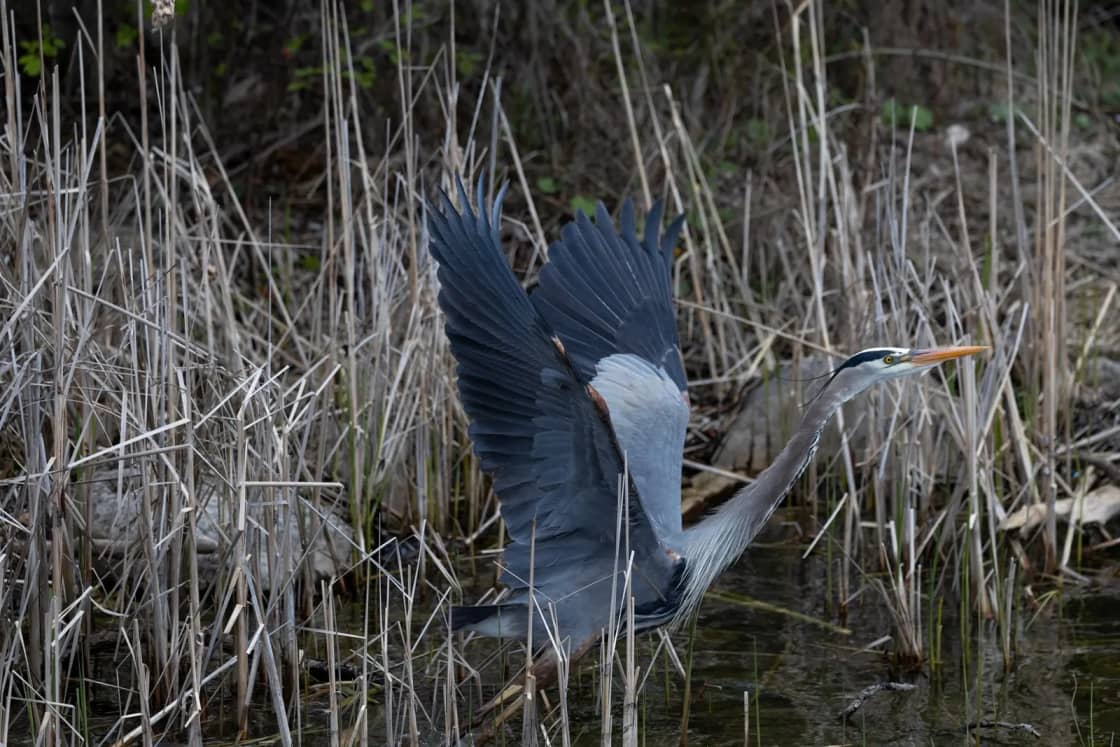
Waders in the shallows. Great blue herons are near-permanent fixtures. Egrets, night-herons and ibis work the margins.
Shorebirds on the mud. This is the group the restoration most directly benefits, and it is the most rewarding to watch during migration, when the mudflat edges fill with birds working the surface.
Marsh birds in the reeds. Heard far more often than seen. Blackbirds are obvious; rails and bitterns are the reward for patience.
Raptors over everything. Harriers quartering low across the marsh, and other raptors using the corridor.
For what is present this week, check recent sightings on a birding platform before you drive out. The composition changes fast during migration, and local birders report promptly.
When to go
Autumn is the best all-round season: migration is running, temperatures are workable, and shorebird and waterfowl numbers build through it. Spring migration is the other peak and brings breeding plumage.
Winter is underrated. Fewer people, different species, and open water that concentrates birds when smaller waters freeze. Dress for wind coming off the lake, which is the real difficulty rather than the temperature.
Summer is the weakest: less variety, hot, exposed, and the mosquitoes at a restored wetland are exactly what you would expect. Early morning is the only comfortable window. Mosquito and weed control are ongoing elements of the project, but this is a marsh, and marshes have mosquitoes.
Time of day matters more than season for activity. Early morning is best across the board, with the hour before dusk second.
What to bring
- Binoculars. Eight or ten power. Any pair beats none, and the tower makes even modest optics work well.
- Wind protection. The lake generates its own weather and there is no shelter.
- Sun protection. No shade anywhere in the delta.
- Insect repellent from late spring through early autumn.
- Boots you do not mind wetting, though the built trails are dry.
- A bird app or field guide, and patience with it.
You do not need a scope. The tower and the channel edges bring things close enough.
Utah Lake sits inside a much bigger system
Birds do not treat Utah Lake as a destination. They treat it as one stop in a chain, and understanding that chain explains why an ordinary-looking marsh south of Provo fills up in September.
Utah Lake drains north via the Jordan River into the Great Salt Lake, and the whole complex sits on a major continental migration corridor. Great Salt Lake and its associated wetlands are among the most important migratory bird staging areas in the interior West, supporting enormous concentrations of waterfowl and shorebirds. Utah Lake is the freshwater component of that same system, upstream and connected.
That matters in two directions. It means birds using the larger system move through here, so the diversity at the delta is far higher than a single 260-acre site would otherwise produce. And it means Utah Lake's condition is not a purely local concern — as water levels on Great Salt Lake have drawn sustained attention in recent years, the freshwater wetlands feeding the same flyway have taken on more significance rather than less.
American white pelicans illustrate the point neatly. They nest on islands in Great Salt Lake and range widely to feed, which is why a landlocked valley an hour south gets pelicans on a summer afternoon.
What the delta looked like before
Worth a paragraph, because the restoration only makes sense against what it replaced.
The lower Provo River was straightened and confined between dikes, with Skipper Bay cut off from the main lake. Water ran through fast and deep, moving efficiently from canyon mouth to lake with almost none of the shallow, braided, vegetated margin a natural delta produces.
That configuration was not an accident or a mistake by the standards of its time. It was drainage and flood-control engineering, done to make land usable and water manageable, and it was applied to river mouths across the West for a century.
The cost only became legible later, when a fish that needed the missing habitat stopped reproducing successfully. Rebuilding it required buying land, moving a great deal of earth, and accepting that a river mouth should be messy. Twenty-two thousand feet of new channel is what "messy, on purpose" costs.
Birding etiquette here specifically
A short list, weighted toward the things that matter at this site rather than generic advice.
Stay on the trails and the tower. The vegetation is young and establishing, and trampled marsh edge is exactly the habitat the whole project was built to create.
Keep dogs leashed where they are permitted, and check whether they are. Three managers, three possible answers. A loose dog in a marsh flushes everything within a few hundred yards and undoes the morning for everyone else present.
Do not play recorded calls to draw birds in. It stresses them during migration and breeding, and it is poor form.
Keep back from feeding flocks. A shorebird pushed off a mudflat repeatedly during migration is a shorebird burning fuel it needs.
Report what you see. Submitting sightings to a public birding platform is useful at a site this new, because the baseline is still being built and monitoring is an ongoing element of the project. Your list is data here in a way it is not at an established location.
The lake's reputation, addressed honestly
Utah Lake has a poor reputation locally — shallow, murky, algal blooms in hot months, carp.
Some of that is fair and some is a misunderstanding of what a shallow desert lake is. It is naturally turbid; it was never a clear alpine lake. Harmful algal blooms are a real seasonal issue, and warnings are posted when they occur. Check current advisories before contact with the water, particularly with dogs, who are more vulnerable than people and less discriminating about drinking.
For birding, none of this is disqualifying, because you are not swimming. A productive shallow lake with extensive marsh is excellent bird habitat almost by definition, and the same nutrient load that troubles swimmers supports the food web the birds are there for.
What is still being finished
Some work continued past the 2024 opening. Provo City opened Delta Gateway Park in June 2025, fishing platforms and non-motorized boat ramps went in on the Old Provo Channel, and in fall 2026 Utah County began repaving the Old Provo Channel trail, with the trail and two small parking areas closed until October 31.
Because that timeline runs close to now, treat trail-surface details on any guide as provisional and check current conditions rather than assuming the paving is done. Monitoring of the restoration itself continues well beyond construction.
Taking children, and taking people who are not birders
This is the site to use for both, and the reasons are structural rather than sentimental.
Flat, short trails mean nobody is negotiating a hike. Restrooms and parking at the trailhead remove the two logistical objections that end family outings early. Interpretive signage gives a non-birder something to read when their attention wanders. And the observation tower supplies the thing that converts people: a moment of elevation where the marsh resolves into something legible and a large bird does something interesting in plain view.
Large, obvious species do the recruiting. A pelican or a great blue heron at reasonable range holds a seven-year-old's attention in a way that a distant sandpiper does not. Lead with those, and treat everything else as a bonus.
Keep the visit short the first time. Forty minutes at the tower on a September morning is a better introduction than a determined two-hour march, and it leaves people willing to come back.
Making a morning of it
The delta works well as one component rather than a whole outing, because it sits inside a cluster of things.
Utah Lake State Park is half a mile south, with the harbor, open-water views and a different bird community. The Provo River Parkway runs the corridor back toward the canyon, which makes a bike-and-birding combination straightforward once the paving from Lakeshore Drive is complete. Downtown Provo is roughly ten minutes away, which means breakfast afterward is easy in a way it is not for most wildlife sites.
The sequence most people would enjoy: arrive early for the light and the activity, spend an hour between the tower and the channel, then drive into town and eat. Our guide to the best breakfast in Provo and Orem covers the second half of that.
Why this is worth your morning
Restoration projects usually ask the public to accept a benefit they cannot see. A fish population recovering in a turbid lake is not something you can go and look at.
This one built the viewing infrastructure into the project — a tower, trails, signage, parking, restrooms — so the public got something legible out of it. That is unusual, and it is the reason a habitat project for an endemic sucker turned into the easiest place in Utah Valley to hand somebody a pair of binoculars and have them see something immediately.
It is ten minutes from downtown Provo, it is free to walk, and until recently it did not exist. Our guides to free things to do in Provo and the Provo River Parkway cover the corridor that connects it back into the city.
Related Guides
- Utah Lake: The Complete Guide
- Lincoln Beach: Utah Lake's Quiet South Shore
- Free Things to Do in Provo
- Utah Fishing and Hunting Licenses
- The Provo River Parkway
- Fishing Near Provo
Frequently Asked Questions
Where is the Provo River Delta and can anyone visit?
Do I need a license to visit the wetlands around Utah Lake?
What is the June sucker and why did they rebuild the delta for a fish?
When is the best time of year for birding at Utah Lake?
What birds can you see at Utah Lake?
Is the Provo River Delta good for beginners?
Can you fish or launch a boat at the delta?
Who manages the Provo River Delta?
Sources
The facts in this guide were checked against these sources. Hours, fees and rules change, so confirm anything time-sensitive with the source before you go. How we make Provo.com.
- Provo River Delta Officially Opens to Public Recreation, U.S. Department of the Interior. Checked October 12, 2026.
- Provo River Delta Restoration Project: FAQ's, Provo River Delta Restoration Project. Checked October 12, 2026.
- Provo River Delta Restoration Project. Checked October 12, 2026.
- Reclassification of the Endangered June Sucker to Threatened, Federal Register. Checked October 12, 2026.
- 2026 Utah Fishing Guidebook, Utah DWR. Checked October 12, 2026.
- Wildlife/Waterfowl Management Areas, Utah DWR. Checked October 12, 2026.