The Natural History Museum of Utah sits on the University of Utah's east bench, up a hill above Salt Lake City, and it is one of the better reasons to make the drive north from Provo with children or with anyone who likes fossils. Adult admission is $24.95, children 3 to 12 pay $20.95, and the museum is open every day of the week, which matters in a part of Utah where many museums close on Sundays. The dinosaur gallery, called Past Worlds, and the Native peoples gallery, called Native Voices, are the two rooms most visitors from Utah Valley will want to plan around, and both are included with admission. This guide covers the admission rules, how to get there, what we could confirm about parking, and a two-hour route through the building.
Everything about prices, hours, tickets and exhibits below comes from the museum's own website, nhmu.utah.edu, read on November 8, 2026. Where the website does not say something, we say so and tell you where to check. We have not described the experience of a visit that we did not have; this is a planning guide built from the museum's published information, not a review.
Quick Facts
| Item | What the museum says | Notes |
|---|---|---|
| Address | 301 Wakara Way, Salt Lake City, UT 84108 | On the University of Utah's east bench |
| Hours | 10 a.m. to 5 p.m. daily; until 9 p.m. Wednesdays | Last admission 30 minutes before closing |
| Adult | $24.95 | Ticketing page |
| Senior 65+ | $22.95 | Same price as young adult |
| Young adult 13 to 24 | $22.95 | Ticketing page |
| Child 3 to 12 | $20.95 | Ticketing page |
| Free | Children 2 and under; members; University of Utah students, faculty and staff | Discounts must be applied at the admission desk |
| Phone | 801.581.6927 | For parking cost, holiday hours, anything not listed |
| From Provo | About 50 miles and about an hour by car | Our estimate from the Salt Lake day-trip guide |
Who This Museum Is For
The museum suits families with elementary-age children, anyone who wants to see Utah's fossils and geology in one building, and adults who like exhibits that ask you to do something, such as a dig or a vote. Several galleries describe hands-on elements. In the Land gallery, the museum says visitors can handle real rock specimens and use interactive exhibits on earthquakes, plate tectonics and erosion. In Past Worlds, visitors can try a dinosaur dig as a paleontologist for a day.
It also suits people who want a long Sunday option. Our guide to dinosaur museums in Utah Valley notes that the Utah Valley dinosaur options are largely closed on Sundays, and this museum, open seven days a week, is the nearest substitute.
It is a poor match for someone who wants a car-free day, which we cover below, and for anyone who expects a quick walk-through of a single gallery to feel worth $24.95. Plan for a real visit.
Getting There From Provo
By car. Our Salt Lake City day trip guide puts the museum at about 50 miles and an hour by car from downtown Provo, based on routing without traffic. Add time for the Point of the Mountain stretch of I-15 at commute hours.
The museum's directions page gives a route from the south. Take I-15 North, exit 304 onto I-80 East toward Cheyenne, then take exit 129 for Foothill Drive (UT-186). Continue straight on Foothill Drive and, past Sunnyside Drive, turn right onto Wakara Way. The page says the museum is visible at the top of the road once you turn. A separate directions page for the parking terrace tells drivers to continue up Wakara Way and onto Colorow Road, and warns against turning left onto the lower parking terrace. The directions pages are older than the rest of the site, so treat them as a guide and let your phone's navigation confirm.
By transit. This is the harder way. The museum's directions page lists UTA routes 228, 455 and 473 stopping at Chipeta and Wakara Way, two blocks west of the museum, and says all three run weekdays only, with no UTA bus service on Saturday or Sunday. It also says to expect an uphill walk from the stop and mentions the University of Utah Black Shuttle for service to the main entrance. A transit day from Provo would mean FrontRunner to Salt Lake Central and then a connection we have not confirmed, so we do not lay out a step-by-step route here. Our FrontRunner guide covers the train half, including the fact that there is no Sunday service. Check UTA's trip planner for the current connection before you rely on it.
What It Costs
The ticketing page lists these prices: adults $24.95; seniors 65 and older $22.95; young adults 13 to 24 $22.95; children 3 to 12 $20.95. Children 2 and under are free, as are museum members and University of Utah students, faculty and staff. Groups of 12 or more qualify for discounts, and homeschool reservations are available.
For a sense of scale, two adults and one child aged 3 to 12 come to $70.85 at the listed prices, before parking, food or any membership. A family of five with three children in that age range would pay $24.95 twice plus $20.95 three times, which is $112.75. That is arithmetic from the listed prices, not a quote.
Two rules are worth knowing. The museum encourages buying tickets online, which it says speeds entry because the tickets arrive by email in advance. And the ticketing page says that if you want to apply a discount to a ticket purchase, it must be done at the museum's admission desk. The page points to a separate promotional page for discounts for select audiences, and we did not find a list of free-admission days on the pages we read. If you hear about a free day, verify it with the museum before you plan around it. Our free museum and attraction days guide is a place to look for programs that apply to families in Utah.
Membership includes free admission for a year, according to the visit page, but the page does not list membership prices. If you expect to come more than once, ask the museum or check its membership page.
Parking: What We Could and Could Not Confirm
The museum's directions page describes two levels of surface parking adjacent to the building, with overflow handled by signs or attendants, and street parking on Colorow Road, one block west. It says it is an uphill walk from the parking lot to the main entrance, along footpaths, stairways and ramps. Drivers can drop passengers at the turnaround and then park, though the page says children under eight should not be left there without an adult chaperone.
What the page does not say is whether parking costs anything. The pages we read do not state a parking fee, a payment method or a free-parking policy for visitors. Another search result, an older museum map, mentioned free parking for guests, but it is a 2015 document and we could not confirm it still applies. Ask when you call 801.581.6927, or look at the museum's visit page the day before. If you drive a motor coach, a separate museum listing mentions designated bus parking west of the museum on Colorow Road, again on a page that looked dated.
The Two-Hour Plan
The museum lists twelve exhibitions in its Rio Tinto Center galleries: Past Worlds, Great Salt Lake, First Peoples, Land, Gems and Minerals, Life, Climate of Hope, Native Voices, Utah Futures, Our Backyard, News from Our Scientists and Poetry Path. You will not do all of them well in two hours. Because the museum's website does not say how long a visit takes, the plan below is our suggestion for how to spend two hours, not the museum's recommendation. Pick three or four galleries and do them properly.
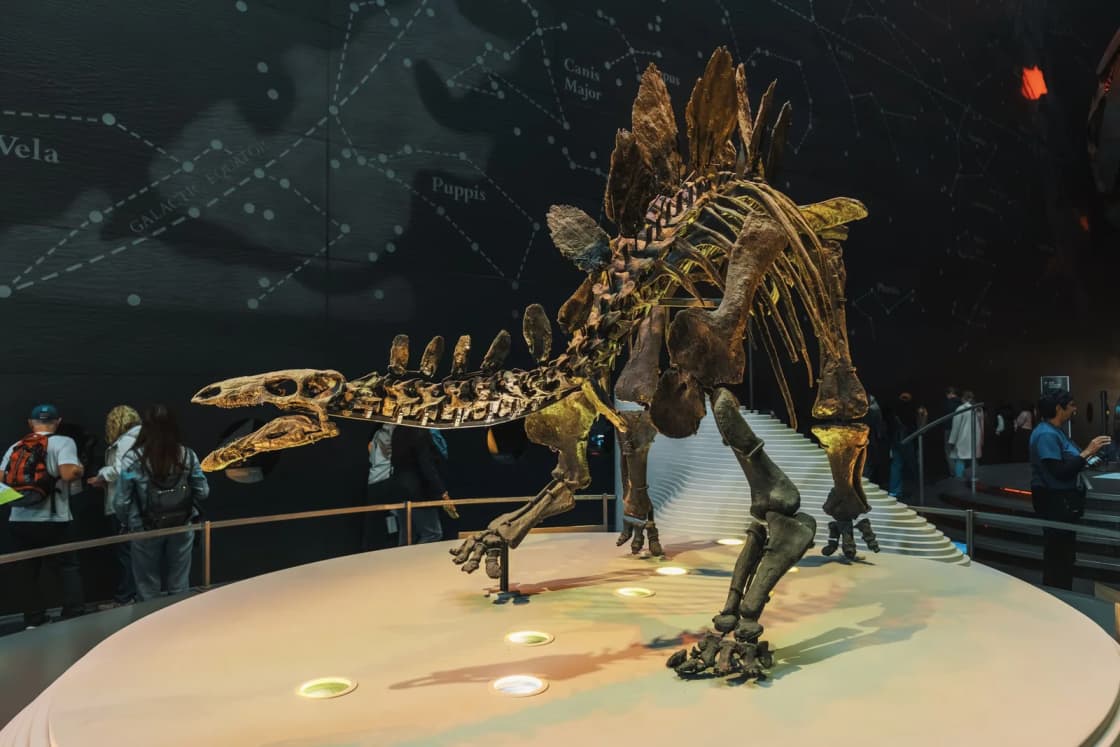
Hour one: Past Worlds. Start with the dinosaurs, since they are what most visitors from Utah Valley come for. The museum describes Past Worlds as a sequence of snapshots spanning hundreds of millions of years, showing Utah's ancient environments and the changing life in them. Displays are meant to recreate the plant and animal diversity and the sights, sounds and smells of long-lost ecosystems.
The museum lists dozens of skeletal reconstructions. Two specimens it names are a Gryposaurus, a duck-billed dinosaur made of original fossil material, and what it calls the world's largest display of horned dinosaur skulls. The gallery has interactive pieces: you can vote on a theory in the Cleveland-Lloyd Dinosaur Quarry mystery, try a dinosaur dig, and attend an Ice Age dinner party. Visitors can also watch staff and volunteers prepare specimens in the S.J. and Jessie E. Quinney Foundation Paleontology Preparation Lab. Whether anyone is working in the lab when you arrive is something we cannot promise.
If you have seen the fossils in Utah Valley, this is a useful comparison. Our guide to dinosaur museums in Utah Valley covers the BYU and Thanksgiving Point options, and the trip to Vernal and Dinosaur National Monument is the long-haul version.
Hour two: Native Voices, then one more. Native Voices is a circular gallery nestled in the hillside at the top of the building. The museum says it depicts Native American art and culture and interprets the deep history and present-day communities of Utah's Native peoples, and that it was designed in consultation with Utah's Indigenous communities. A storytelling circle lets visitors hear origin stories and accounts of connection to the land.
The museum lists Utah's eight federally recognized tribes on the page: the Northwestern Band of Shoshone Nation, the Paiute Indian Tribe of Utah, the San Juan Southern Paiute Tribe, the Skull Valley Band of Goshute, the Confederated Tribes of Goshute, the Navajo Nation, the Ute Indian Tribe, and the White Mesa Community of the Ute Mountain Ute Tribe. An older museum map described the gallery in terms of five Native nations, so if you see that older wording, the current page is the one to trust.
The exhibition page gives no guidance on photography or on how to behave in the gallery, so follow posted signs and staff directions, and ask at the ticket desk if you are unsure.
For the rest of the hour, choose one of these:
- First Peoples, about the prehistoric peoples of the Great Basin, in the R. Harold Burton Foundation Gallery. Visitors play the role of archaeologists. It includes Median Village, a reconstruction of a real 1960s dig site in Sevier County, and the Dry Caves Learning Lab, which explains why Utah preserves archaeological evidence so well. If you want more context, our guide to Fremont culture in Utah covers sites closer to home.
- Great Salt Lake, in the Willard L. Eccles Foundation Gallery, which presents the lake as a remnant of ancient Lake Bonneville, with interactives, sounds, smells and a view of the lake itself.
- Land, about Utah's geology across the Middle Rocky Mountains, Basin and Range, and Colorado Plateau, with an outdoor terrace overlooking the foothills of the Middle Rocky Mountains.
Timing and Season
The museum is indoors, so winter and hot summer days are good times to go. The hours are the same seven days a week, with the Wednesday evening extension to 9 p.m. Last admission is 30 minutes before closing, so a 4:45 p.m. arrival is a bad idea.
On crowds, the museum's accessibility page suggests Monday through Thursday after 1:30 p.m. or Wednesday evenings from 5 p.m. to 9 p.m. as typically quieter times. That page gives no attendance figures. If you want the Wednesday evening, plan the drive home: the museum is about an hour from Provo, so a 9 p.m. closing means a late night. FrontRunner is a separate matter and does not run Sundays; if you plan to use it for part of the trip, check the last southbound train.
The exhibition page also lists a time-limited exhibition, We Carry Stories, with dates of December 5, 2026 to August 8, 2027. The page we read gave no description, so check the museum's site if you are planning a trip around it.
What to Bring
- Tickets on your phone. The museum says online tickets arrive by email in advance and speed entry.
- ID for any discount. Discounts have to be applied at the admission desk, and University of Utah students, faculty and staff get in free. The pages we read do not list what proof the desk accepts, so bring your university ID and ask.
- Comfortable shoes. The walk from the parking lot to the entrance is uphill, and the building has several levels.
- A plan for food. The visit page lists Canyon Cafe and the Museum Store as visitor services. The accessibility page says the cafe, on Level 2, is open to the public without admission. The pages do not list hours, menu or prices, and do not list rules on outside food, drink or bags, so check before you pack a lunch.
- A layer. We found nothing on indoor temperatures, so we are not going to promise anything. A light layer costs nothing.
- Children's gear. Strollers are fine, according to the museum.
Who Should Skip It
Skip it if you will not drive and the weekday bus does not fit your day. Skip it on a day when you can only give it 45 minutes, because the admission price buys many galleries and a short visit sees few. Skip it if your group's main interest is live animals, since this is a collections and exhibits museum; our guide to Hogle Zoo and Tracy Aviary from Provo is the better fit. And if cost is the obstacle, look first at the free options listed in our Provo museums guide, which includes the Bean Museum.
Safety, Conditions and Accessibility
This is an indoor museum, so the safety issues are practical. The walk from the lot is uphill with stairs and ramps. The museum's accessibility page says all exhibitions and entrances are accessible to wheelchair users and visitors with strollers. Wheelchairs are free to borrow at the Ticket Desk on Level 1, first come, first served. There is no ramp between Levels 4 and 5, so people using wheelchairs or other mobility devices should use the elevator between them. Wheelchair-accessible drinking fountains are near the restrooms and elevators on Levels 1, 2, 3 and 5.
For sensory needs, the museum lists free sensory bags with tactile objects, noise-canceling headphones, light-sensitivity glasses and fidget toys at the Ticket Desk, subject to availability. Groups can request touchable specimens or a specialized program, and the museum recommends asking 2 to 4 weeks ahead. Service animals are permitted in all public areas, and if safety prevents entry to a collection or lab space, staff will work on a reasonable accommodation.
What to Check Before You Go
- Hours for your date. Confirm holiday hours on the museum's website. The pages we read give regular hours only.
- Tickets. Buy online if you can, and confirm the price for each person in your group.
- Parking cost. The directions page does not state it. Call 801.581.6927 or check the visit page.
- Your route. Run the drive in your navigation app for the day and hour you plan to go, since I-15 and I-80 conditions change.
- A weekday bus. If you plan to use UTA, check the planner for routes 228, 455 and 473 and remember the museum says they do not run on weekends.
- Any special exhibition. Check whether We Carry Stories or another temporary show changes the price or what is open.
- Food. Check Canyon Cafe's hours if lunch is part of the plan.
Making It a Day
The museum fits into a longer Salt Lake day. The nearby east bench holds other destinations in our Salt Lake City day trip guide, and our day trips from Provo guide puts the trip alongside the other options within a couple of hours' drive. For a rainy-day comparison inside Utah Valley, see our indoor activities guide.
A simple plan for a family: leave Provo mid-morning, arrive for the 10 a.m. opening if you can, spend about two hours in the galleries, eat in the Canyon Cafe or elsewhere, and be back on I-15 before the afternoon commute builds. A Wednesday plan is the opposite: leave after lunch, enjoy the quieter hours after 1:30 p.m. the museum suggests, and stay into the evening.
The Short Version
The Natural History Museum of Utah is at 301 Wakara Way, about an hour from Provo by car. It is open daily from 10 a.m. to 5 p.m. and until 9 p.m. on Wednesdays, with last admission 30 minutes before closing. Adults pay $24.95, children 3 to 12 pay $20.95, and children 2 and under are free. Start with the Past Worlds dinosaur gallery, move up to Native Voices at the top of the building, and add one more gallery if time allows. Confirm parking cost and holiday hours with the museum before you leave.
Related
- Salt Lake City Day Trip From Provo: The FrontRunner Day Trip, Stop by Stop
- Dinosaur Museums in Utah Valley
- Vernal and Dinosaur National Monument From Provo
- Hogle Zoo and Tracy Aviary From Provo
- The Best Museums and Art Galleries in Provo
- Free Museum and Attraction Days for Utah Families
- FrontRunner From Provo
- Day Trips From Provo
- Indoor Activities in Provo
- Fremont Culture in Utah
Frequently Asked Questions
How much does admission to the Natural History Museum of Utah cost?
What are the hours, and when is the last admission?
Is parking free at the Natural History Museum of Utah?
Where are the dinosaurs?
What is the Native Voices exhibition?
Can I get there from Provo without a car?
Is the museum accessible for wheelchairs and strollers?
When is the museum least crowded?
Sources
The facts in this guide were checked against these sources. Hours, fees and rules change, so confirm anything time-sensitive with the source before you go. How we make Provo.com.
- Natural History Museum of Utah: Visit, Natural History Museum of Utah. Checked November 8, 2026.
- Natural History Museum of Utah: Tickets, Natural History Museum of Utah. Checked November 8, 2026.
- Natural History Museum of Utah: Directions, Natural History Museum of Utah. Checked November 8, 2026.
- Natural History Museum of Utah: Accessibility, Natural History Museum of Utah. Checked November 8, 2026.
- Natural History Museum of Utah: Exhibitions, Natural History Museum of Utah. Checked November 8, 2026.
- Natural History Museum of Utah: Past Worlds, Natural History Museum of Utah. Checked November 8, 2026.
- Natural History Museum of Utah: Native Voices, Natural History Museum of Utah. Checked November 8, 2026.
- Natural History Museum of Utah: First Peoples, Natural History Museum of Utah. Checked November 8, 2026.