
There is a version of this guide that lists eleven farms with last year's opening dates. That version is wrong by the second week of October and stays online for years, and it is most of what a search for pumpkin patches in this valley returns.
This one covers three things instead: when the season runs (earlier than you think), what kind of operation you are walking into (there are three, and they price differently), and what the sign at the gate means — because Utah has a specific statute governing farm attractions, and the pumpkin field and the pony ride beside it are not governed by the same one.
The season runs earlier than almost anybody uses it
Utah Valley pumpkins are generally ready from mid-September. One of the earliest large operations to open in 2026 was Cornbelly's Spanish Fork, on 4 September; its Lehi sibling followed on 21 September. Small farms open as their own harvest allows.
Most families in this valley go on the first or second weekend of October.
That is the worst possible timing, and the reasons compound:
- The fields are picked over. A u-pick patch in mid-September is intact. The same field on 11 October has had three weekends of families walking it, and the good pumpkins near the paths are gone.
- It is the peak crowd of the year. Every patch, maze and farm stand in the county is at maximum load in the first half of October.
- The weather is worse. A September afternoon in a field is pleasant. A mid-October one at this altitude is often cold, and after rain the field is mud.
- The season stops dead. Most operations in the valley close around 31 October, regardless of what is left in the field. There is little tapering off.
The whole thing is compressed into about seven weeks, and the useful half of it is the first half. If you can go on a weekday in the last two weeks of September, that is the answer.
Three kinds of operation, priced three different ways
"Pumpkin patch" covers three different businesses in this valley, and knowing which one you are driving to prevents most of the frustration.
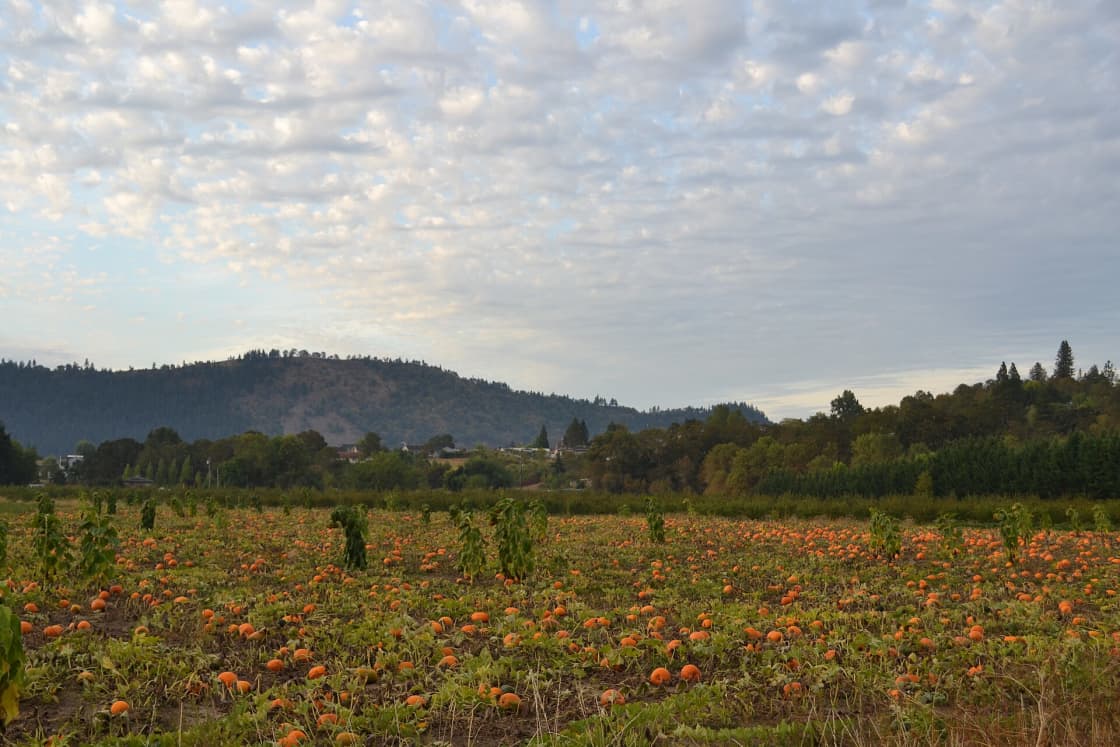
The u-pick field. Pumpkins still on the vine; you walk out and cut your own. Uneven ground, vines, mud after rain, and a real agricultural experience. This is what children remember. It is also the one to think twice about with a toddler in tow or anyone with mobility limits, because a pumpkin field is not a flat surface. Cornbelly's Spanish Fork runs one of these alongside its sunflower fields.
The pumpkin lot. Pumpkins harvested elsewhere and arranged on pallets or straw bales. Flat, tidy, quick, often attached to a shop or a church parking lot. Nothing wrong with it — it is simply a shop, not an outing.
The full agritourism operation. A working farm that has added a maze, a hayride, animals, a slide, food and a ticket booth. Cornbelly's is the valley's largest example at both its sites, but several smaller farms run scaled-down versions.
The pricing models map onto those imperfectly, and this is where people get caught:
- Admission includes a pumpkin. Clean and predictable.
- No admission; pumpkins priced by size or weight. The small-farm and honesty-box model.
- Admission for the attractions, pumpkins priced separately on top. This is the one that surprises families at the register, because the ticket felt like it covered the day.
There is no standard rate across Utah Valley. Ask which model applies before three children have each selected a pumpkin.
Where to look, and why we are not printing a farm list with dates
The south end of Utah Valley — Santaquin, Payson, Salem, Spanish Fork — is the county's produce belt, and it is where the working farms are. Our guide to u-pick orchards in Santaquin and Payson covers the fruit side of the same district in detail, and several of those operations extend into pumpkins and fall produce as the fruit season ends.
Further north, the pattern is different: fewer working farms, more agritourism operations built for volume, and more pumpkin lots attached to shops.
We are deliberately not publishing a table of small farms with 2026 opening dates. Small-farm dates are set by the harvest and by family availability, they are frequently not announced until early September, and they move. A list of dates that is wrong is worse than no list, and the honest instruction is the one that stays true: contact the farm directly, the week before you intend to go. For the operations that have published firm 2026 dates — Cornbelly's at both sites — those dates are in the Cornbelly's guide, sourced from the operator.
The sign at the gate, and what it does
Walk into almost any farm attraction in Utah and there will be a sign near the entrance in plain black letters on white. Most people walk straight past it. It is worth ten seconds, because it is the condition on which the operator's legal protection rests.
Utah Code § 78B-4-512 is Utah's agritourism liability statute. It says that an operator is not liable for injury, illness, death or damage to a participant's personal property resulting from an inherent risk of an agritourism activity — if the operator posts the required signage.
The statute defines those inherent risks concretely, at § 78B-4-512(1)(d). They include the surface and subsurface conditions of the land, vegetation and water; the unpredictable behavior of domesticated or farm animals; the reasonable dangers of structures and equipment ordinarily used where crops are grown or animals raised; the behavior of insects and wildlife the operator does not own or keep; exposure to pathogens from animals, feed or waste; and negligent behavior by someone other than the operator.
Read that list against a pumpkin patch and it maps almost perfectly: the rutted field, the goat, the trailer, the wasps around the cider, the other family's child running into yours.
The signage requirement is exact. Under § 78B-4-512(5), the operator must post and maintain, in a clearly visible location at each entrance to the property where the activity takes place — or at the location of each activity — a sign printed in black letters at least one inch high on a white background, stating the statutory warning that under Utah law an agritourism operator is not liable for injury, illness, death or property damage primarily resulting from the inherent risks of the activity or from a participant's failure to follow instructions or exercise reasonable caution, and that the participant is assuming the risk.
No sign, no limitation. The protection is conditional, and the condition is visible from the parking lot.
What the sign does not cover
This matters as much as what it does. Under § 78B-4-512(3), the limitation does not help an operator who:
- acts or fails to act with gross negligence or willful or wanton disregard for a participant's safety, where that causes the harm;
- knew or should have known of a dangerous condition in the land, facilities or equipment used in the activity, where that causes the harm;
- knew or should have known of an animal's dangerous propensity and did not make it known to the participant, where that causes the harm; or
- intentionally injures the participant.
The subsection also preserves product liability claims and expressly does not negate assumption of risk as an affirmative defense. And § 78B-4-512(4) makes clear the protection sits on top of any other limitation available at law, not instead of it.
One detail is worth noticing precisely because it is absent: plain ordinary negligence is not in that list. The threshold in the agritourism statute is gross negligence. That is a deliberately high bar, and it is the legislature's choice about how much risk a visitor to a working farm is taken to have accepted.
The pony ride is a different statute entirely
Here is the part that surprises people, including plenty of farm operators.
Animals are carved out into their own regime. Utah Code § 78B-4-202 covers equine and livestock activity sponsors — and "equine activity" is defined broadly enough at § 78B-4-201(2)(f) to reach rides, trips and even informal or spontaneous activities, while § 78B-4-201(3)(b) names pony-ride strings among the sponsors covered. A hayride pulled by livestock lands in § 78B-4-201(7)(b), which covers using livestock to pull carts.
So the pony ring at the edge of the pumpkin field is under a different statute from the field.
And the negligence threshold is different. Under § 78B-4-202(2)(d), a sponsor loses protection for an act or omission constituting "negligence, gross negligence, or willful or wanton disregard for the safety of the participant" that causes the injury. Ordinary negligence is enough to defeat the animal-activity protection. It is not enough to defeat the agritourism protection.
There are further exceptions specific to animals under § 78B-4-202(2): where the sponsor provided faulty equipment or tack and the failure was due to the sponsor's negligence; where the sponsor failed to make reasonable efforts to determine whether the animal could behave consistently with the activity with that participant; and where a known dangerous condition on the land existed without conspicuously posted warning signs.
The notice requirement is also looser. Under § 78B-4-203(2), notice for an animal activity may be given either by posting a sign in a prominent location within the area used for the activity or by having the participant — or a minor's guardian — sign a document or release. That is why some farms hand you a waiver at the pony ring even though there is already a sign at the main gate. Under § 78B-4-203(3), the notice is sufficient if it includes the § 78B-4-201 definition of inherent risk and states that the sponsor is not liable for those risks.
None of this is legal advice, and none of it is a reason to avoid a farm. It is a reason to read the paper you are handed, and to understand that "there was a sign" answers a narrower question than most visitors assume.
Practical notes
Wear shoes you can ruin. A u-pick field after rain is mud and vine, and it does not dry out during the visit.
Bring a wagon. Most operations do not have enough of them, and a full-size pumpkin is heavy across a hundred yards of uneven ground with a child attached to your other hand.
Bring cash. Small farms and honesty boxes are not reliably set up for cards.
Do not bring a knife. Most u-pick operations want stems cut with their clippers or their tool, not yours.
Layers, not a coat. A field at three in the afternoon and the same field at six are twenty degrees apart at this altitude.
Check the animal rules. Where there are livestock, there is usually handwashing, and there is usually a rule about food and pacifiers near the pens. Both exist for the pathogen exposure the statute names explicitly.
The short version
The season runs mid-September to 31 October and everyone goes in the wrong two weeks of it. Cornbelly's Spanish Fork opened early, on 4 September. Work out whether you want a u-pick field, a lot or a full agritourism operation, and ask which of the three pricing models applies before anyone chooses a pumpkin. Small farms publish late — call them the week before. And the sign at the gate is a statutory condition under § 78B-4-512, not decoration: it covers the inherent risks of a working farm, it stops at gross negligence, and it does not govern the pony ride at all. Pumpkins bought for crafts rather than carving last into November; see our fall craft ideas.
Choosing a pumpkin that lasts
Most pumpkins bought in Utah Valley are carved between a week and three weeks before Halloween, which means the choice at the field determines whether the thing is still standing on the 31st.
Check the stem first. A pumpkin with a firm, green-tinged stem still attached was cut recently and cleanly. A stem that is dry, gray and loose means the pumpkin has been off the vine a while, and a pumpkin carried by its stem has usually been damaged where it matters most — the stem is not a handle, and breaking it opens the fruit to rot at the top.
Press the base. It should be hard everywhere. Any softness, particularly on the underside where it sat on the ground, is the start of a soft spot that will collapse within days.
Look at the bottom for flatness, not for beauty. A pumpkin that will not stand up straight on a porch step is a nuisance to carve and a nuisance to display.
Color is less important than people think. Uniform deep orange looks best, but a green patch on one side simply means that face was against the ground and it will continue to ripen.
Storage, carving and the thing that ruins a pumpkin early
The single biggest mistake in this valley is carving too early. Once a pumpkin is opened it begins to dehydrate and to rot at the cut edges, and at Utah's humidity that happens faster than people expect. A carved pumpkin outdoors here typically holds for somewhere between three days and a week, and less if the days are warm.
The practical sequence that works:
- Buy early, carve late. Buying in late September and carving in the last week of October is the correct order, not a compromise.
- Store it cool, dry and off concrete. A garage floor draws moisture into the base. A shelf, a board or a doormat under it makes a real difference.
- Bring it in when it freezes. A hard overnight freeze in October will turn the flesh to mush as it thaws, and Utah Valley gets those before Halloween most years.
- Use a battery light rather than a candle if the pumpkin needs to last. A candle cooks the inside of the lid and accelerates the collapse, quite apart from the fire question on a porch with dry leaves on it.
Cut the lid at an angle, wider at the top, so it cannot fall in as the pumpkin shrinks. And scrape the inside wall thin on the carving face — a thinner wall lights better and, counterintuitively, does not shorten the life much.
What to do with the pumpkin afterwards
A carved pumpkin is food waste, and in a valley with this much backyard growing there are better ends for it than a bin bag.
Seeds are worth keeping if the pumpkin was opened cleanly — rinsed, dried and roasted, they are the one useful yield from a carving pumpkin, whose flesh is generally too stringy and watery for cooking. Pie pumpkins are a different, smaller, denser variety and many valley farms sell them alongside the carving stock.
Composting works, provided the pumpkin has not been painted, glittered or coated in preservative spray. Break it up rather than composting it whole; an intact pumpkin takes months and a broken one takes weeks. Our guide to the vegetable garden in Utah Valley covers the wider composting question for this climate and soil.
Do not leave it out for wildlife. It is a well-meant habit and it is a poor one here: it draws animals toward roads and houses, and a rotting pumpkin in a garden is an invitation to rodents ahead of winter. If the intention is to feed something, a farm with livestock may take clean, unpainted pumpkins — but ask first rather than delivering a truckload unannounced.
Related Guides
- Things to Do in Murray and Midvale, Utah, From Provo
- Cornbelly's: the complete guide to both locations
- Halloween in Utah Valley: the October circuit
- U-pick orchards in Santaquin and Payson
- Fall in Provo: the complete autumn guide
- Family activities in Utah Valley
- Thanksgiving Point: the complete visitor guide
- Trunk-or-Treats and Little-Kid Halloween in Utah Valley
- Trick-or-Treat Hours by City in Utah Valley: why nobody sets them, and what each city publishes
- Every Fall Farm Festival in Utah Valley
- The Pumpkin Regatta, WitchFest and the Salt Lake County October
Frequently Asked Questions
When does pumpkin season start in Utah Valley?
What is the difference between a u-pick patch and a pumpkin lot?
How much should a pumpkin cost at a Utah Valley patch?
Are there pumpkin patches in Utah Valley that are not Cornbelly's?
What is the warning sign at the entrance to a farm attraction?
What does that agritourism sign not cover?
Does the same law cover the pony rides and the hayride?
What should I bring to a pumpkin patch?
Sources
The facts in this guide were checked against these sources. Hours, fees and rules change, so confirm anything time-sensitive with the source before you go. How we make Provo.com.
- Utah Code 78B-4-512: Agritourism activity -- Limitations on civil liability -- Signage requirement, Utah State Legislature. Checked October 12, 2026.
- Utah Code 78B-4-202: Equine and livestock activity liability limitations, Utah State Legislature. Checked October 12, 2026.
- Utah Code 78B-4-201: Definitions (equine and livestock activities), Utah State Legislature. Checked October 12, 2026.
- Utah Code 78B-4-203: Signs to be posted listing inherent risks, Utah State Legislature. Checked October 12, 2026.
- Cornbelly's: Corn Maze Pumpkin Fest in Lehi & Spanish Fork, Cornbelly's. Checked October 12, 2026.