Somewhere in Utah County on the last Wednesday of October, a minivan is parked in a church lot with its tailgate up, the interior lined with orange crepe paper and a plastic skeleton wearing a BYU beanie, and a woman in a witch hat is handing fun-size candy bars to a queue of children whose average age is four. Repeat that scene forty times across the valley on the same evening, and again on Thursday, and again on Saturday, and you have understood little-kid Halloween here. This is not a valley of long dark walks with a pillowcase. It is a valley of parking lots, chili, daylight, and a child who has trick-or-treated five times before the actual holiday arrives.
This guide is written for the parent of a child under about six. It explains why the trunk-or-treat circuit exists and how to use it, which daylight and no-scare events fit a toddler, what the cities and shopping centers run, how to plan the actual night for a child who cannot yet climb a porch step, and what changes because 2026's Halloween falls on a Saturday. Our main Halloween in Utah Valley guide covers the whole October circuit, the traffic problem and the Sunday convention; the haunted attractions guide and the Wasatch Front scare-level ranking covers the frightening end of the county, which this page deliberately leaves alone. Dates and times for individual events are set every fall and rarely published more than a few weeks out, so this page describes the pattern and tells you where each event announces itself; it does not pretend to know October's calendar in September.
Why This Valley Runs on Trunk-or-Treats
The trunk-or-treat is a national phenomenon, but Utah County is close to its natural habitat, for three reasons that compound.
The first is the building stock. A Latter-day Saint meetinghouse sits in nearly every neighborhood of every city in the valley, and each one comes with a large paved lot, a cultural hall with a kitchen, and a congregation — a ward — with a calendar of monthly activities and a small budget for them. A trunk-or-treat costs a ward almost nothing: members bring their own cars, their own candy, and, if the activities committee is ambitious, a crock-pot of chili. It is the easiest October activity a ward can run, and most of them run one.
The second is the demographics. Utah County has one of the youngest populations of any county its size in the country, with more than a quarter of residents under fifteen in some cities. Orem has repeatedly turned up at or near the top of a widely circulated ranking of the best cities for trick-or-treating for exactly that reason. A place with that many small children builds its holidays around them.
The third is the weather and the dark. By the last week of October the sun sets around 6:30 p.m. and the evenings are in the 40s; an hour in a parking lot with the cars parked and the trunks lit is a manageable evening for a three-year-old in a way that two hours of sidewalk is not.
The effect is a calendar most newcomers find bewildering: a child in this county can attend a ward trunk-or-treat, a school carnival, a city Main Street event, a shopping-center candy walk and the neighbor's driveway, all in the eight days before Halloween, and still have the holiday itself in reserve. Nobody expects you to do all of them. The point of this guide is to help you pick.
How the Ward Trunk-or-Treat Works
Who runs it. A ward's activities committee, usually on a weeknight in Halloween week or the Saturday before. The flyer goes on the neighborhood board, in the ward's own messaging, and — increasingly — in the city's Facebook parent groups and on Nextdoor, which is how non-members find them.
Who is welcome. Everyone, and you will not be the only non-member family in the lot. The flyers say so; the practice matches. Nobody checks affiliation at a trunk. The only unspoken etiquette is the obvious kind: walk the loop once, twice if it is short, say thank you, do not let a five-year-old fill a bucket from one trunk, and if there is a chili dinner inside and you are invited, eat; if you are not sure you are invited, ask — the answer is almost always yes.
How it runs. Cars arrive around 5:30 and park in a ring or two rows, back-ends toward a walking lane, and the families decorate: crepe paper, lights, a themed trunk (a pirate ship, a spider's web, a dentist's office handing out toothbrushes as a joke). Kids walk the lane, adults stand at their tailgates, and the whole loop takes a small child ten to fifteen minutes. Most of the evening is actually the socializing around the edges and the chili line inside. It ends by 7:30 or 8; toddler bedtime is respected.
What to bring. A costume the child can walk in, a bucket or bag, a flashlight, a jacket over the costume (the lot is cold by 7), and a bag of candy if you want to contribute — the trunk that is running low will take it gratefully. If you have a car and want to work a trunk, tell the organizers a few days ahead; they will put you in the ring.
The chili cook-off. Half the ward trunk-or-treats in the valley are paired with one. It is exactly what it sounds like: a dozen crock-pots on a cultural-hall table, paper bowls, a vote by toothpick or ticket, and a prize that is usually a can of chili with a ribbon on it. It is dinner, and it is the reason the adults come.
Finding them. There is no valley-wide list, and there never will be — the wards do not coordinate. The practical sources, in order: the paper flyers on your street, your city's Facebook parent groups (search "trunk or treat" plus your city in the last two weeks of October), Nextdoor, and the event-listing sites that scrape church calendars, which by mid-October show dozens of ward events with addresses. Ask a neighbor with kids; they will know which lot is good.
The Daylight, No-Scare Events
For a child under four — or any child who does not like masks, the dark, or fog machines — the daylight events are the better Halloween, and the valley has more of them than it gets credit for. The list below is the established pattern; each venue sets its own dates every fall, and we describe what each has run rather than promise this year's schedule.
University Place, Orem. The outdoor plaza at the center of the Orem shopping center has filled with hundreds of carved and painted pumpkins through October — free to walk, open during center hours, lit from late afternoon — and has run a family Night of Fright on a Friday near month's end with bounce houses, costumed trick-or-treating at the shops, and music. For a toddler who is scared of Halloween, the pumpkin display is the gentlest possible introduction: no costumes required, no one jumping out, a stroller-friendly loop, and the Orchard's restaurants and the indoor play area a few steps away. Our University Place guide covers the center.
Thanksgiving Point, Lehi. October at Thanksgiving Point has been branded Spooktober in recent years: seasonal programming across Ashton Gardens, the Museum of Natural Curiosity, the Museum of Ancient Life, the Butterfly Biosphere and Curiosity Farms, all in daylight, all built for small children, with costumes welcome and nothing designed to frighten. Admission to each venue applies; members go free. Our Thanksgiving Point guide has the layout and the membership math. The farm and the Natural Curiosity museum are the two toddler-scaled venues.
The Main Street trick-or-treats in Lehi and American Fork. Both cities have run Halloween-afternoon events on their historic Main Streets — Lehi's Trick or Treat on Main, American Fork's Halloween on Main — with booths from city departments, the police and fire crews, and local businesses handing out candy from about 4 to 6 p.m. They are in daylight, on a closed or slowed street, and short. They are also crowded; go at 4 sharp with a small child, before the school-age wave arrives at 5.
Provo Towne Centre and the Riverwoods. The Provo mall has hosted an indoor Mall-O-Ween trick-or-treat, which is the answer to a rainy or snowy Halloween week, and the Shops at Riverwoods has run a merchant candy walk on its outdoor streets. Both are announced on the properties' own channels in October. The mall's redevelopment is ongoing, so confirm on its site that the event is still running before you go; the Riverwoods guide covers the other.
The Provo River Halloween Cruise. CLAS Ropes Course on West Center Street in Provo runs a twenty-minute lantern-lit boat ride on the river past more than a hundred jack-o'-lanterns, with a story and a joke-telling pirate who hands out candy. It is theatrical rather than scary, the boats hold forty, and it has run nightly through October, evenings, with a modest per-person ticket. It is the one Halloween attraction in the county that works equally for a three-year-old and a grandparent.
Library programs. The Provo City Library and the Orem Library have run costume story times, Halloween parties and craft hours in the last week of October, free, in the middle of the day. For a two-year-old this may be the whole holiday. Our Provo Library guide has the children's-program schedule.
Big Jack's World at Traverse Mountain. The outlet center in Lehi has put up a free outdoor display of pumpkin sculptures — a giant jack-o'-lantern, pumpkin animals — through September and October. A walk-through, not an event; a fifteen-minute stop on the way to Thanksgiving Point.
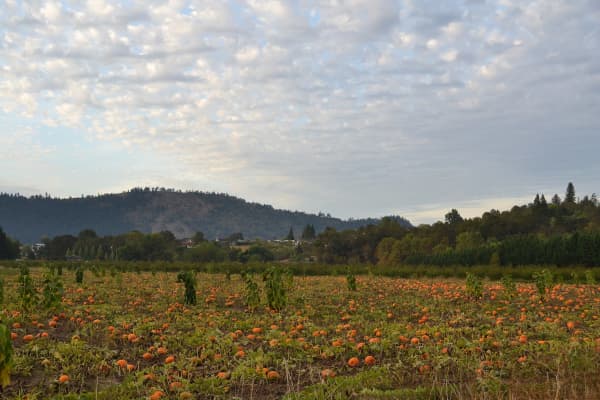
Pumpkin patches in daylight. The pumpkin patches and fall farms guide covers the picking, the wagon rides and the corn mazes, most of which are daytime and fine for toddlers; the same properties' haunted mazes after dark are not.
The City Events
Every city in the county runs something, and the pattern is stable even when the dates move:
- Lehi — Trick or Treat on Main, Halloween afternoon; Legacy Center programming.
- American Fork — Halloween on Main, Halloween afternoon, Main Street between roughly 300 West and 100 East.
- Orem — the police department's trunk-or-treat at the public safety building on West Center; library programs; the University Place events above.
- Provo — a downtown trick-or-treat on Center Street and University Avenue in recent years; Runtastic's Haunted Provo run on Halloween morning (a half marathon, 5K and kids' run, costumes encouraged); library programs.
- Spanish Fork, Springville, Payson, Salem — rec-center carnivals and fire-station or city-park trunk-or-treats, plus the Pirate Yard walk-through in Spanish Fork on two evenings near month's end.
- Saratoga Springs, Eagle Mountain, Vineyard, Pleasant Grove, Lindon, Highland, Alpine, Cedar Hills — some combination of a city trunk-or-treat, a carnival at the rec or community center, and a Main Street or park event.
All of these are announced on the city's own calendar and social feeds in early-to-mid October. Our small-city celebrations guide lists where each city posts, which is more useful than a date that will be wrong by next year.
Planning the Night Itself, by Age
Under two. Halloween is a costume and a photo. Six houses on your own street at 5:30 while it is still light, one trunk-or-treat loop if there is one nearby, and dinner. The child does not eat the candy; you do.
Two and three. One daylight event earlier in the week — University Place, the library, Thanksgiving Point — one ward trunk-or-treat, and a short door-to-door on Halloween itself: your own street and the next one, starting at 5:30, done by 6:30, with a parent holding the bucket on the stairs. Skip the dark, skip the houses with fog machines and animatronics (there is always one), skip anything with a line longer than the child's patience.
Four and five. This is when door-to-door starts to work, and the neighborhood becomes the event. A ward trunk-or-treat earlier in the week for warm-up, a city Main Street event on Saturday afternoon, and then a real hour of trick-or-treating on Halloween evening, 6 to 7:30, on streets you know, with a flashlight, reflective tape on the costume, and a hand held at every crossing. The valley's dense post-war neighborhoods — the Orem and Provo grids, Pleasant Grove's center, Lehi's old town — are the best trick-or-treating streets because the houses are close and the porches are lit; the newer west-side subdivisions have longer walks between doors and more cars.
The traffic point, which matters. Halloween is the most dangerous night of the year for child pedestrians nationally, and the valley's wide, fast collector roads — State Street, University Parkway, Geneva Road, Main Street in every city — are where the risk sits. The trunk-or-treat is, among other things, a way of taking the youngest children off those roads: the cars are parked and off, the lot is lit, and the whole loop is in sight. Our main Halloween guide explains the Utah crosswalk law and who is at fault when a costumed child steps off a curb; read it before Halloween night.
The Sensory-Friendly Version
For a child who dislikes masks, noise, dark or strangers, the order of operations is: daylight first, early second, and skip anything built to frighten.
Go to the ward trunk-or-treat the minute it opens — the first half hour is the calmest, with few masks, short lines and light still in the sky — and leave when the crowd builds. Choose the pumpkin display over the party. Skip the corn mazes after dark, the haunted houses, and any yard with a strobe or a fog machine. Some cities and organizations in the county have run sensory-friendly Halloween hours with the lights up and the scare effects off; they change year to year, so search the Utah County parent groups each October for the current ones rather than trusting a list.
The Teal Pumpkin idea — a teal-painted pumpkin on the porch signaling non-food treats for children with allergies — is well established in Utah County neighborhoods, and the trunk-or-treats increasingly have a non-food trunk of stickers, glow sticks and small toys. Ask the organizer; there usually is one.
Costumes, Candy, Cold
Costumes. The valley's costume economy runs through the seasonal Halloween stores that open in vacant big-box spaces every September, the thrift stores (Deseret Industries in every city is the classic source), and the church-lot swap. Buy a size up so a coat fits under it; the last week of October in Utah Valley is 40s after dark and has snowed on Halloween more than once. Face paint over masks for anyone under five — masks block vision on stairs.
Candy. The trunk-or-treat multiplies the haul. A four-year-old who does three loops in a week and an hour door-to-door will come home with more candy than a child should eat in a year. The local solution, which several dentists in the county run, is the candy buy-back: bring the bag in during the first week of November and trade it for cash, toothbrushes or a prize; the candy goes to troops or shelters. Our dentist guide covers finding a practice; ask yours whether it buys back.
The weather. Check the forecast on the day, dress for the evening low rather than the afternoon high, and have the indoor fallback ready — the mall trick-or-treat, the library party — if the front comes through. Our weather guide explains why late-October cold snaps are normal here.
What Changes Because Halloween Is a Saturday
2026's calendar is the good one. The ward circuit runs Friday the 23rd through Thursday the 29th, the city Main Street events and the neighborhood door-to-door both land on Saturday the 31st in daylight and early evening, and there is no argument about which night the porch lights are on. Expect Saturday itself to be crowded everywhere — a Saturday Halloween brings out the whole valley — and expect the ward events to be slightly earlier in the week than usual because the Friday and Saturday before are also busy with school and city carnivals.
The Sunday convention — the informal valley-wide shift of trick-or-treating to Saturday when October 31 is a Sunday — does not apply this year. It returns in 2027, and our main Halloween guide explains it for anyone planning ahead.
The Short Version
Utah Valley's little-kid Halloween runs on parking lots. Find two ward trunk-or-treats in the last week of October through the neighborhood flyers and the city parent groups (everyone is welcome; bring a bag of candy). Take a child under four to the daylight events — the University Place pumpkins, Thanksgiving Point's October programming, the Lehi and American Fork Main Street afternoons, the Provo River cruise, the library — and skip the haunted end of the county entirely. Keep door-to-door short and light for the under-fours, and on your own streets for the fives. Watch the roads. Halloween is a Saturday this year, so it is all in daylight and early evening with no Sunday question. And confirm every date on the venue's or the city's own page, because none of them are published before October.
Related Guides
- Halloween in Utah Valley: The October Circuit
- Trick-or-Treat Hours by City in Utah Valley: why nobody sets them, and what each city actually publishes
- Haunted Attractions in Utah Valley
- Pumpkin Patches and Fall Farms in Utah Valley
- Thanksgiving Point: The Complete Guide
- University Place, Orem
- Toddler Activities in Utah Valley
- Small-City Celebrations in Utah County
- Día de los Muertos in Utah Valley
Frequently Asked Questions
What is a trunk-or-treat, and why does Utah Valley have so many?
Can we go to a church trunk-or-treat if we are not members?
When are the trunk-or-treats held?
What daylight, no-scare Halloween events are there for toddlers?
How old should a child be before regular door-to-door trick-or-treating?
What about a child with sensory issues or who is scared of costumes?
What are the Utah County cities' own Halloween events?
Does Halloween move when it falls on a Sunday in Utah?