Utah has five national parks and nine national monuments, and the two labels are easy to mix up. Both can protect red-rock country, both can charge entrance fees, and some of today's parks began as monuments. The real differences are who creates them, what they are meant to protect, and which agency runs them. This guide explains each, lists Utah's nine monuments with their agencies and origins, and lays out the 2026 boundary changes at Bears Ears and Grand Staircase-Escalante as the documents describe them.
Quick facts
| Question | Answer | Source |
|---|---|---|
| The law behind most monuments | The Antiquities Act, signed June 8, 1906 | National Park Service |
| Who can create one | The president, by proclamation; Congress can too | 54 U.S.C. 320301; BLM |
| Monuments in Utah | Nine | Utah Public Lands Policy Coordinating Office |
| Utah's first | Natural Bridges, April 16, 1908 | National Park Service |
| Closest to Provo | Timpanogos Cave, about 30 minutes | OpenStreetMap (OSRM) routing |
| 2026 changes | Bears Ears and Grand Staircase-Escalante reduced on July 13, 2026 | Proclamations 11043 and 11044 |
Park or monument: what the labels mean
The Antiquities Act, "signed into law on June 8th, 1906," gave the president the power to set aside national monuments from land the federal government already owns, the National Park Service says. The law, now at 54 U.S.C. 320301, lets the president proclaim "historic landmarks, historic and prehistoric structures, and other objects of historic or scientific interest" as monuments, and says the land reserved "shall be confined to the smallest area compatible with the proper care and management of the objects to be protected."
National parks are a different category. The Park Service describes them as "generally large natural places having a wide variety of attributes," where "hunting, mining and consumptive activities are not authorized." Two of Utah's parks show the path from one label to the other, with Congress making the final step:
- Zion began as Mukuntuweep National Monument, set aside by President William Howard Taft on July 31, 1909. President Woodrow Wilson enlarged and renamed it Zion National Monument in 1918, and on Nov. 20, 1919, signed Sen. Reed Smoot's bill making it a national park, according to Utah's History To Go.
- Arches became a national monument under President Herbert Hoover's Proclamation 1875 on April 12, 1929, and a national park under Public Law 92-155, signed Nov. 12, 1971, the Park Service says.
A monument is not always a Park Service site. The proclamation or law that creates it names the agency, and in Utah three of the nine are run by the Bureau of Land Management, one jointly with the Forest Service. The agency sets the practical rules: fees, permits, camping and where you can drive.
Utah's nine monuments
Utah's Public Lands Policy Coordinating Office lists nine. Drive times are OpenStreetMap (OSRM) routing estimates from downtown Provo without traffic, from our driving-times guide and monument guides.
| Monument | Run by | How it began | From Provo |
|---|---|---|---|
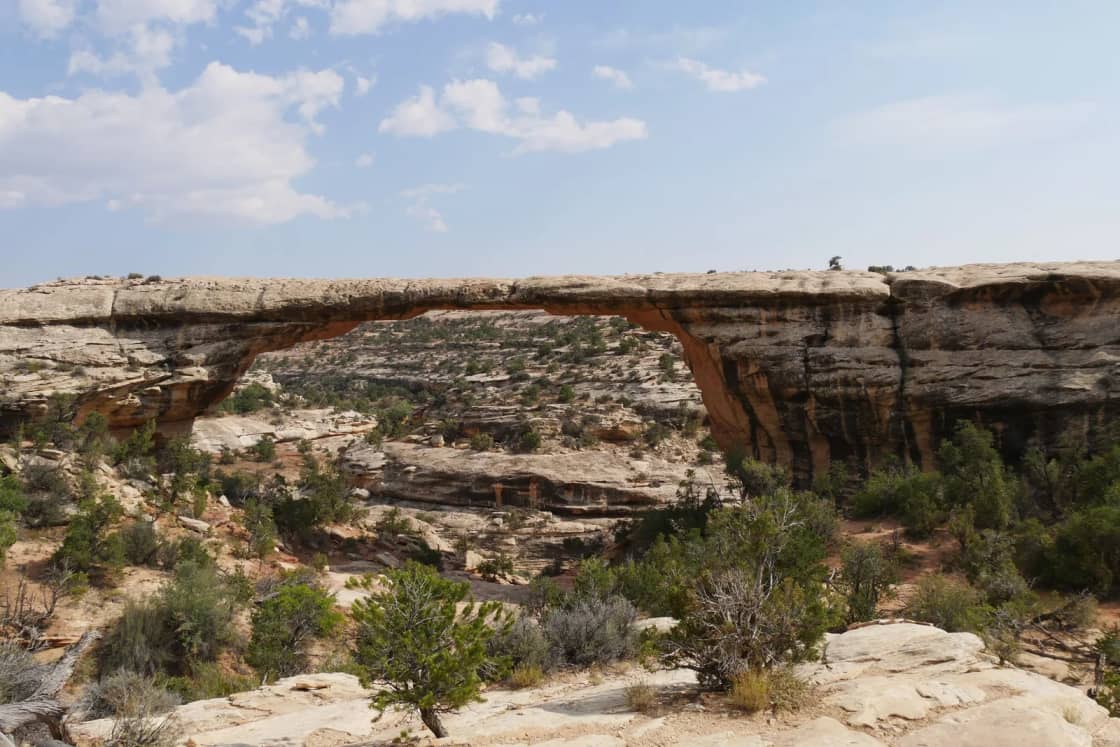
| Natural Bridges | National Park Service | Proclamation 804, Theodore Roosevelt, April 16, 1908 | About 282 miles, 5 hr 50 min |
| Rainbow Bridge | National Park Service | Proclamation by William Howard Taft, May 30, 1910 | Check the Park Service for access |
| Dinosaur | National Park Service | Set aside by Woodrow Wilson, October 1915 | About 172 miles, 3 hr 30 min |
| Timpanogos Cave | National Park Service | Proclamation 1640, Warren G. Harding, Oct. 14, 1922 | About 19 miles, 30 min |
| Hovenweep | National Park Service | Proclaimed by Warren G. Harding, March 2, 1923 | About 311 miles, 6 hr 30 min |
| Cedar Breaks | National Park Service | Named by Franklin D. Roosevelt, Aug. 22, 1933 | About 209 miles, 3 hr 50 min |
| Grand Staircase-Escalante | Bureau of Land Management | Proclamation 6920, Bill Clinton, Sept. 18, 1996 | About 235 miles, 5 hr |
| Bears Ears | BLM and U.S. Forest Service | Proclamation 9558, Barack Obama, Dec. 28, 2016 | See our Bears Ears guide |
| Jurassic | Bureau of Land Management | The Dingell Act, passed by Congress, 2019 | About 104 miles, 3 hr |
A few notes on the list:
- Natural Bridges is the one the Park Service calls "Utah's first."
- Rainbow Bridge covers 160 acres around the bridge, the Park Service says. Taft's 1910 proclamation described it as "three hundred and nine feet high and two hundred and seventy-eight feet span"; the agency's current figures are 291 feet tall and 275 feet wide.
- Timpanogos Cave began with 250 acres; our history of the cave covers its discovery.
- Hovenweep was proclaimed after a 1917 to 1918 survey in which J.W. Fewkes of the Smithsonian Institution "recommended the structures be protected," the Park Service says.
- Jurassic is the one Congress created directly. The BLM says it protects the Cleveland-Lloyd Dinosaur Quarry, where more than 12,000 bones have been removed.
Bears Ears and Grand Staircase-Escalante: the boundary changes
The two largest monuments have changed size three times since 2017. The 2026 proclamations recite the history:
| Date | Action | Source |
|---|---|---|
| Sept. 18, 1996 | Bill Clinton establishes Grand Staircase-Escalante (Proclamation 6920) | Proclamation 11044 |
| Dec. 28, 2016 | Barack Obama establishes Bears Ears, about 1.35 million acres (Proclamation 9558) | Proclamation 11043 |
| Dec. 4, 2017 | Donald Trump excludes about 1.15 million acres from Bears Ears and about 860,000 acres from Grand Staircase-Escalante (Proclamations 9681 and 9682) | Proclamations 11043 and 11044 |
| Oct. 8, 2021 | Joe Biden restores the excluded land; Bears Ears grows to about 1.36 million acres (Proclamations 10285 and 10286) | Proclamations 11043 and 11044 |
| July 13, 2026 | Donald Trump reduces both monuments (Proclamations 11043 and 11044) | Federal Register |
The 2026 proclamations, published in the Federal Register on July 17, set these boundaries:
- Bears Ears: about 121,096 acres, in the Shash Ja'a Unit (about 106,816 acres) and the Indian Creek Unit (about 14,279 acres). The proclamation disbands the Bears Ears Commission, through which Tribes took part in managing the monument, and says the agencies must still consult Tribal Nations under other authorities.
- Grand Staircase-Escalante: about 181,541 acres, in the Canyons of the Escalante Unit (about 172,641 acres) and the Kaiparowits Horizon Unit (about 8,900 acres), which the proclamation calls "a globally important paleontological resource."
Both proclamations say the excluded land opens, 60 days after signing, to the public land laws, mineral and geothermal leasing and the mining laws, "subject to valid existing rights." The excluded land remains federal public land.
What each side says
The White House fact sheet says the changes reduce the monuments to "appropriate sizes that allow for common sense land use" and restore "public access" for uses including grazing, timber harvest and motorized recreation. It says landmarks, structures and objects within the new boundaries remain protected. Utah Gov. Spencer Cox's office welcomed the change. "The question has never been whether to protect them, but how to protect them best," Cox said, and Utah Attorney General Derek Brown said the Antiquities Act "was never meant to be a tool for locking up millions of acres with the stroke of a pen."
Tribes and conservation groups are challenging the changes in the U.S. District Court for the District of Columbia. In October, Judge Tanya Chutkan reopened lawsuits first filed over the 2017 reductions, KSL reported, and required the government to give 48 hours' notice before ground-disturbing activities on the excluded lands. On Nov. 18, five Tribes, represented by the Native American Rights Fund, filed two new suits, ICT reported: the Pueblo of Zuni, the Ute Mountain Ute Tribe and the Hopi Tribe over Bears Ears, and the Kaibab Band of Paiute Indians, the Paiute Indian Tribe of Utah and the Ute Mountain Ute Tribe over Grand Staircase-Escalante. They argue that the Antiquities Act lets a president create monuments but "does not give the president the power to revoke existing monuments," a power they say "lies with Congress alone." The cases were pending when this guide was published.
What it means for a visit
For a trip, the rules come from the agency that runs the ground you are on. In the two reduced monuments, maps, apps and older guides may still show the earlier boundaries, so check the BLM's current map, and the Forest Service's at Bears Ears, before you go. Our guides to Bears Ears and the Escalante slot canyons cover where to start, and the archaeology rules are in our guide to Ancestral Puebloan sites in southeast Utah.
Related reading
- Utah's national parks from Provo, ranked
- Timpanogos Cave guide
- The Utah rock layers explained
- Natural Bridges National Monument
- Bears Ears: visitor etiquette and where to start
Frequently Asked Questions
What is the difference between a national park and a national monument?
How many national monuments are in Utah?
Who manages Utah's national monuments?
What was Utah's first national monument?
Did Bears Ears and Grand Staircase-Escalante change size in 2026?
Which national monument is closest to Provo?
Sources
The facts in this guide were checked against these sources. Hours, fees and rules change, so confirm anything time-sensitive with the source before you go. How we make Provo.com.
- Antiquities Act of 1906, National Park Service. Checked November 27, 2026.
- National Park System designations, National Park Service. Checked November 27, 2026.
- National monuments, Utah Public Lands Policy Coordinating Office. Checked November 27, 2026.
- Presidential Proclamation 804, National Park Service, Natural Bridges. Checked November 27, 2026.
- Park statistics, National Park Service, Rainbow Bridge. Checked November 27, 2026.
- History and culture, National Park Service, Hovenweep. Checked November 27, 2026.
- Jurassic National Monument: learn and explore, Bureau of Land Management. Checked November 27, 2026.
- Arches timeline, National Park Service. Checked November 27, 2026.
- The development of Zion National Park, Utah History To Go, Utah Department of Cultural and Community Engagement. Checked November 27, 2026.
- Proclamation 11043, Modifying the Bears Ears National Monument (91 FR 45169, July 17, 2026), Federal Register, via GovInfo. Checked November 27, 2026.
- Proclamation 11044, Modifying the Grand Staircase-Escalante National Monument, Daily Compilation of Presidential Documents, via GovInfo. Checked November 27, 2026.
- Fact sheet: President Donald J. Trump modifies two national monuments, The White House. Checked November 27, 2026.
- The State of Utah applauds national monuments modifications, Office of the Governor of Utah. Checked November 27, 2026.
- Utah's national monuments and Cedar Breaks' 90th anniversary, Deseret News. Checked November 27, 2026.
- Judge reopens lawsuits challenging cuts of Bears Ears, Grand Staircase-Escalante, KSL. Checked November 27, 2026.
- Tribes sue Trump administration over efforts to shrink Utah national monuments, ICT. Checked November 27, 2026.
- 54 U.S.C. 320301, National monuments, Legal Information Institute, Cornell Law School. Checked November 27, 2026.