
Timpanogos Cave gets mentioned constantly around here — in day-trip lists, in canyon guides, in every conversation about what to do with visiting family in July. It is the closest thing Utah Valley has to a genuine national-park attraction, sitting fifteen minutes up American Fork Canyon. And it is the local outing people most often get wrong, because almost everything about visiting it runs on a system that has to be set up in advance.
This is the practical version: how the tickets work, what the trail demands, and the handful of rules that turn people away at the trailhead.
Start with the tickets, because everything else depends on them
You cannot enter the caves on your own. The only way in is on a ranger-guided tour, and every person needs a ticket — including infants.
Tours are capped at 16 people, and the Park Service is blunt about the consequence: they regularly sell out days or even weeks in advance. Weekends and holidays go first. Visitors who drive up the canyon hoping to buy on arrival are, in the Park Service's own words, often turned away because every tour that day is gone.
Tickets can be booked up to 30 days ahead through Recreation.gov, or by phone at (877) 444-6777, which takes calls between 10:00 a.m. and midnight Eastern. Same-day tickets for tours starting within the hour have to be bought in person at the visitor center, if any remain.
One more piece of logistics that surprises people: the monument is cashless. It does not accept cash or checks — not for tickets, not for passes. Bring a card.
What time is on your ticket, exactly
Here is a genuine ambiguity worth planning around rather than guessing at. The Park Service's own pages describe your ticket time two different ways.
The cave tours page says the time you purchase is the time to begin your hike at the trailhead. The fees page says the time on your ticket is the time you should pick that ticket up at the visitor center, and separately that tickets must be collected at the visitor center before you hike, since they cannot be bought at the cave entrance.
Those are not quite the same instruction, and the gap between them is roughly the 90 minutes it takes to walk up. We are not going to resolve it for you by picking one — the safe move is to treat your ticket time as the moment you need to be moving from the visitor center, arrive with a comfortable margin ahead of it, and confirm with staff when you collect your ticket. If you build in the buffer, either reading works. If you don't, one of them leaves you short by an hour and a half.
The trail is the hard part
People arrive braced for the cave and are surprised by the walk. The only access to the cave system is a paved 1.5-mile trail that climbs 1,092 feet, finishing at 6,730 feet above sea level. The Park Service classes it as strenuous, and that is an accurate description rather than a liability disclaimer.
It is paved the entire way, which sounds gentle and isn't — it is relentlessly uphill, largely exposed, and it hangs on the canyon wall with real drop-offs along the edge. Most people take around 90 minutes to get up.
Midsummer temperatures on the trail can exceed 100°F. There is very little shade. If you are booking a July or August tour and have a choice of times, an early slot is worth more than a convenient one.
Budget 3 to 4 hours for the whole outing: up, the tour, and back down.
Who the trail suits
If you hike Utah Valley trails regularly, this is a manageable morning — comparable in effort to Y Mountain, on pavement instead of dirt. If your recent hiking is more in the Bridal Veil Falls range, the honest comparison is that this is considerably more climbing than that, and there is no shorter option — the cave entrance is where it is.
There is no shuttle, no lift, and no way to shorten it.
What the tour is like
The name is slightly misleading: there are three caves, not one. Hansen Cave, Middle Cave and Timpanogos Cave are connected by two man-made tunnels, and the regular tour walks through all three.
The tour runs 55 minutes underground. The route is paved and lit, with several flights of stairs and sections where you will need to bend and twist through narrow passages. It is not a claustrophobic crawl, but it is not a stroll through a large open cavern either.
The caves average about 45°F. After a strenuous, sweaty climb in the sun, that temperature drop lands hard. A sweater or light jacket is necessary rather than a nicety.
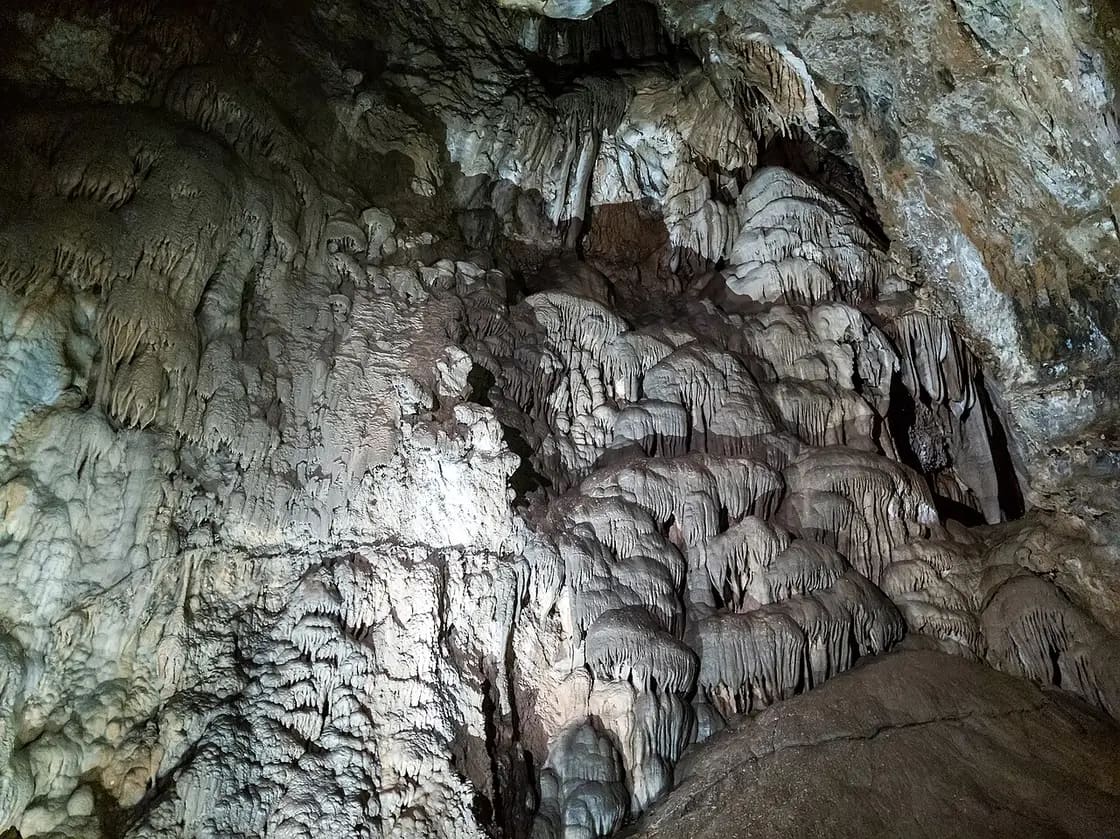
The formations are the reason the monument exists — helictites, anthodites and other mineral deposits in a range of colors, the kind of decoration that makes the caves scientifically notable rather than just locally impressive.
The four tours, and which one you want
Most visitors book the regular tour without realizing there are alternatives. Prices below are the figures the Park Service has published; the fee page carries an older revision date than the tour page, so confirm the current cost on Recreation.gov when you book rather than budgeting off this page.
Regular Cave Tour — around $12 for an adult. The default. Fifty-five minutes through all three caves. Ticket prices run roughly $2 to $12 depending on age, and are half price for the passholder only with a Senior or Access Pass.
Historic Lantern Tour — around $17. Same route, but the only light in the cave comes from a lantern each visitor carries, which the park provides. It is built to reproduce what the early explorers saw, and it is the one that most changes the experience for anyone who has done a lit cave tour before. Ages 7 and up.
Introduction to Caving Tour — around $22. This goes into Hansen Cave in its natural, undeveloped state, back to Hansen Cave Lake, following the route Martin Hansen used for his own tours in the late 1800s. The park supplies helmet, headlamp and knee pads, and teaches basic safe and ethical caving. You will scramble and at points crawl. Rated strenuous, and ages 14 and up.
Hansen Cave Accessibility Tour. Designed for visitors who cannot manage stairs, or who need a shorter underground experience. It begins outside with a ranger for about ten minutes, enters Hansen Cave, and concludes outside. Worth knowing this exists — it is not advertised as prominently as the others, and for some families it is the difference between going and not going.
What it costs, and the fee you probably don't owe
There is no entrance fee for the monument itself. Driving through, using the picnic areas, and hiking within the monument boundaries are all free. The cave tour ticket is the cost of admission to the caves, and nothing else.
The part worth knowing: the monument is surrounded by the Uinta-Wasatch-Cache National Forest, and everyone driving up stops at a Forest Service information station on the way. Visitors going only to Timpanogos Cave National Monument — including the Canyon Nature Trail and the Swinging Bridge Picnic Area — are not required to pay the American Fork Canyon fee.
If you are carrying on past the monument to use Forest Service recreation sites, which most people combining the cave with the rest of the canyon will be, the published rates are $10 for three days, $20 for seven days, and $60 annually. The Forest Service honors the America the Beautiful pass, Senior and Access passes, Every Kid Outdoors, and Military and Veteran passes.
For the wider canyon, the reservoirs and the rest of what is up there, see our American Fork Canyon guide.
The rules that catch people out
The cave-and-mine gear rule. This is the one nobody expects. To limit the spread of White Nose Syndrome, a disease that has killed millions of bats across North America, the monument prohibits any boots, clothing or gear — cameras included — that have been in any other cave or mine at any time. If you have been caving elsewhere, that gear cannot come with you. Not recently: ever.
No wheeled vehicles on the trail. Strollers and wagons are not permitted, with wheelchairs the only exception. You can carry a child up in a backpack carrier — but external-frame packs, baby carriers among them, are not allowed inside the cave. Infants can go through in a front pack.
No pets, on the trail or in the caves.
Under-16s must be accompanied by an adult.
Tickets are collected at the visitor center, not at the cave entrance. There is no way to buy your way in at the top.
Should you bring young children?
The Park Service raises this itself, which is unusual and worth taking seriously. Their framing: the hike is steep, there are significant drop-offs beside the trail, it is frequently hot, and no wheeled help is allowed. The caves are cold and dark, and touching anything in a delicate cave environment is off-limits for the entire 55 minutes.
Their question is the right one — will your child enjoy this, and if not, how will that land for you and for the other fourteen people on the tour?
Plenty of Utah Valley families do this successfully with school-age kids and remember it for years. It is the toddler-in-a-carrier version that tends to go badly. If you land on the "not this year" side, Bridal Veil Falls delivers a waterfall for a fraction of the effort, and there is more in that vein in our family activities guide.
What to bring
The Park Service's own packing note is short and worth following literally.
Water — one liter per person. This is their number, not a generic hiking platitude, and it exists because the trail bakes. There is no water on the route above the visitor center.
A jacket or sweater. For the 45-degree cave, carried up in the heat. Everyone who skips this regrets it in the first five minutes underground.
Real shoes. The trail is paved, so people turn up in sandals. It climbs a thousand feet with drop-offs; hiking shoes or trainers with grip are the sensible minimum.
Sunscreen, because the trail is largely exposed and you will be on it for three hours across the round trip.
A card, not cash. The monument does not accept cash or checks.
A flashlight is on the Park Service's suggested list — useful on the tour and worth having if a late slot puts any of your descent near dusk.
What to leave behind: the stroller, the wagon, the dog, and any gear that has ever been inside another cave or mine.
How it compares to the valley's other big outings
Timpanogos Cave occupies an unusual slot locally. It is the only attraction in Utah Valley that combines a strenuous hike with a ticketed, scheduled, capacity-limited experience at the end — which means it is the one where showing up spontaneously fails.
Against Mount Timpanogos itself, sharing the same mountain: the summit hike is a far bigger day, unticketed and free, and a completely different proposition. The cave is the version you can do with your parents.
Against Thanksgiving Point, the valley's other major ticketed attraction: Thanksgiving Point is flat, indoor-and-outdoor, and forgiving of a change of plan. The cave is neither. They serve the same visiting-family brief in opposite ways, and in July the cave has the significant advantage of a destination that sits at 45 degrees.
Against the rest of the hiking guide: a thousand feet of climbing puts this above the casual tier and below the summit tier, with the added constraint that your turnaround time is fixed by a ticket rather than by how you feel.
When to go
The monument is seasonal, and the season is set by snow rather than by the calendar. The season typically runs from May or June through September or October, depending on snow, staffing and budget, and tours run daily through the summer season. Because the closing date moves with conditions each year, check the monument's own page before planning a shoulder-season visit rather than assuming a date.
Within the season, the variables that matter are heat and crowds, and they push the same direction. Weekends and holidays are the busiest and the first to sell out. A weekday morning is cooler on the climb, easier to book, and quieter on the trail.
If you are timing a canyon trip more broadly, the fall-color window through the first half of October is spectacular up here — though it arrives near the end of the cave season, so book before you count on combining the two. Our fall guide covers the foliage timing in more detail.
Getting there, and what to pair it with
The monument sits at 2038 W. Alpine Loop Road, American Fork, about fifteen minutes up American Fork Canyon and roughly 30 to 40 minutes from most of Provo and Orem. The park's number is (801) 756-5239, extension 202.
The natural pairing is the rest of the canyon. The Alpine Loop scenic drive begins from the same road and connects through to Provo Canyon, with Cascade Springs and Sundance on the far side — a full day if you want one, and the reason the seven-day Forest Service pass sometimes makes more sense than the three-day.
If you are visiting from further out and building a whole day around the canyon, our day trips guide puts it in context with the other options within an easy drive.
The short version
Book ahead — ahead, not the night before. Take the early slot. Bring a liter of water per person, a jacket for a 45-degree cave, and a card rather than cash. Expect the climb to be the hard part and the tour to be the reward. And if you have been in another cave this year, leave those boots at home.
Ticket prices, tour schedules and season dates are set by the National Park Service and change; confirm current details with the monument or on Recreation.gov before you travel.
Why the monument is free and the cave is not
The section above states the practical position accurately: no entrance fee for the monument, a ticket for the cave. The reason those two things differ is a federal statute, and it also explains a fee quirk that catches families with young children.
The governing law is the Federal Lands Recreation Enhancement Act, 16 U.S.C. Chapter 87, rewritten by the EXPLORE Act in January 2025. It sorts federal recreation charges into distinct categories with different rules, and Timpanogos Cave sits astride two of them because two different agencies manage the ground you cross in a single morning.
Entrance fees are a National Park Service power and a Forest Service prohibition. Under 16 U.S.C. § 6802, the Secretary of the Interior may charge an entrance fee for a unit of the National Park System, including a national monument administered by the National Park Service. The same section then states that the Secretary shall not charge an entrance fee for lands managed by the Forest Service, the Bureau of Land Management or the Bureau of Reclamation.
So the monument is a place that legally could charge an entrance fee and does not, while the national forest surrounding it legally cannot charge one at all — its American Fork Canyon charge is a standard amenity fee for the use of developed sites, which is why driving through toward the monument does not trigger it.
The cave tour is an expanded amenity recreation fee. The Act authorizes the Secretary of the Interior to charge an expanded amenity fee at Park Service sites, either in addition to an entrance fee or by itself, where the visitor uses a specific or specialized facility, equipment, or service. A ranger-guided trip into a cave with a hard capacity is the textbook case, and the elsewhere-in-the-statute list for other agencies names participation in an enhanced interpretive program or special tour in the same category.
The under-16 rule, and its limit
This is the part worth knowing before you buy tickets. The Act prohibits charging an entrance fee or standard amenity recreation fee for any person under sixteen years of age, and separately for outings conducted for noncommercial educational purposes by schools or bona fide academic institutions.
Read the categories carefully: that exemption covers entrance fees and standard amenity fees. It does not cover expanded amenity fees. A cave tour ticket is an expanded amenity fee, so a nine-year-old still needs one. The exemption that would get a child into a national park gate free does not get them into the cave, and the difference is structural rather than a local policy decision.
What the statute now requires the agency to tell you
The EXPLORE Act also reworked the rules on how agencies disclose recreation fee revenue and what it pays for. If you want to know where your fee goes, look for the managing agency's posted fee information at the site and on its website.
The Act also authorizes online collection of entrance, standard amenity, expanded amenity and special recreation permit fees, which is the legal underpinning of the advance-booking system this whole visit depends on.
Related Guides
- The Soap Factory in Provo: What It Is and Whether It Is Worth It
- Butterfly Biosphere: Utah's Only Butterfly Conservatory
- Utah Valley Hike Finder — filter every trail by difficulty, length, season, dogs and fees
Frequently Asked Questions
Do you need tickets for Timpanogos Cave?
How hard is the hike to Timpanogos Cave?
How cold is it inside Timpanogos Cave?
Can you bring kids or strollers to Timpanogos Cave?
Do you have to pay the American Fork Canyon fee to visit Timpanogos Cave?
Why is there no entrance fee for Timpanogos Cave National Monument?
Are children under 16 exempt from the cave tour ticket?
Do school groups get in free?
Sources
The facts in this guide were checked against these sources. Hours, fees and rules change, so confirm anything time-sensitive with the source before you go. How we make Provo.com.
- National Park Service, Timpanogos Cave National Monument: Fees & Passes, National Park Service, Timpanogos Cave National Monument. Checked October 12, 2026.
- National Park Service, Timpanogos Cave National Monument: Cave Tours, National Park Service, Timpanogos Cave National Monument. Checked October 12, 2026.
- Operating Hours & Seasons, National Park Service, Timpanogos Cave National Monument. Checked October 12, 2026.
- Timpanogos Cave Trail, AllTrails. Checked October 12, 2026.