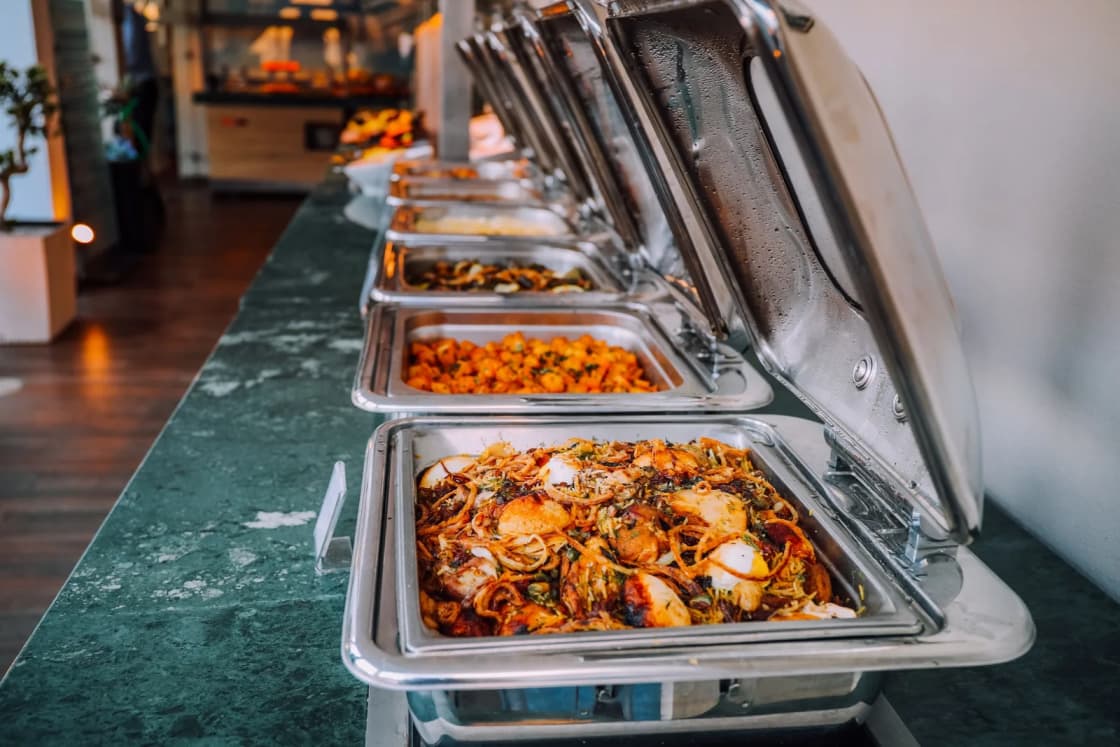
Catering is the wedding cost that multiplies. Whatever a caterer charges a guest, you pay it a few hundred times, and then the service charge and tax land on top. Choosing well is mostly a matter of asking the same questions of every caterer and comparing the totals, not the menu prices.
This guide is the decision side. For the numbers, our wedding catering prices page sets Utah Valley caterers' published menus side by side and works out the real cost per guest. For catering by cuisine and format, see catering in Utah Valley.
Policies quoted here come from each caterer's own website or menu, read on November 1, 2026, unless another date is given. They change, and the contract is what counts. We don't rank caterers, and none paid to be here.
| Decision | What to compare | Where it's written |
|---|---|---|
| Venue rules | Whether outside caterers are allowed, and kitchen limits | Venue contract |
| True cost | Menu price plus service charge, tax, minimums, rentals | Caterer's menu, then the quote |
| Tasting | Cost, and whether it's credited | Caterer's FAQ |
| Headcount | When the final count is due, how you're billed | Contract |
| Staff | Who sets up, serves, buses and cleans | Contract |
| Permits | Health department permit, food handler permits | Ask the caterer |
Step 1: Start with what your venue allows
Before you taste anything, find out who's allowed to cook. Utah County venues range from fully open to in-house only:
- Bravo Event Center in Lindon says any caterer, restaurant, food truck or family-prepared food is welcome, but food must arrive fully prepared, because its kitchen is for serving, not cooking.
- Walker Farms in Lindon allows your own vendors with no fees.
- Copper Creek Event Center in Springville charges a $120 kitchen fee when anyone other than a licensed professional caterer uses its kitchen.
- The Venue at The Ranches in Eagle Mountain lists kitchen access as a $500 add-on.
Our guide to choosing a reception venue covers these vendor rules venue by venue. If your venue has a required or in-house caterer, much of this guide still applies: you're comparing their package against the cost of an open venue plus an outside caterer.
Step 2: Compare the total, not the menu price
A caterer's menu price is the start of the bill. The pieces that come after it:
The service charge. As published:
- Brown Brothers Catering: 19% on events it produces, which it says covers delivery, setup, service and cleanup.
- Greenhollow Catering: 25%, which it says covers staff travel to the venue, setup, event service and takedown.
- Marvellous Catering (Provo): its menu says additional fees apply to all events. In October 2026 it listed a mandatory gratuity of 15% to 25%, with staffing priced separately.
Sales tax, applied to the food and usually the service charge too. Ask.
Minimums. Brown Brothers lists a $1,200 minimum food order. Marvellous Catering prices its menu for a minimum group of 40 and says per-person prices rise 20% to 30% for groups of 20 to 39.
Tableware and rentals. Greenhollow says reception pricing includes tan plates with black or clear plasticware, with china by custom quote. Marvellous Catering lists linens for an added fee. Utah Celebrations Catering says its prices include standard buffet service with plasticware.
The arithmetic matters. Our catering prices page works one published menu through to the real cost per guest: a $14.50 menu price came to about $19.66 once the service charge and tax were added, roughly 36% more. Ask every caterer for a written quote with every fee, then divide the total by your guest count.
Step 3: Taste before you sign
Tastings range from free group events to private sessions with a fee:
| Caterer | Tasting, as published |
|---|---|
| Brown Brothers Catering | Monthly open-house tastings; private tasting $200 |
| Greenhollow Catering | Free monthly tasting |
| Marvellous Catering | $300 custom tasting, booked two weeks ahead (October 2026) |
| Utah Catering by Magleby's | Invites couples to call and book a free tasting (October 2026) |
At the tasting, ask:
- Is this the food exactly as it will be served at a buffet for 300, or plated for 6?
- How will it hold over a two- or three-hour open house? Some dishes don't.
- What can be adjusted for allergies, vegetarians and children?
- Does the tasting fee come off the final bill if we book?
Step 4: Pin down the headcount rules
The final count is where catering bills surprise people.
- When it's due. Brown Brothers finalizes events 10 to 14 days ahead, when headcount and menu changes can still be made, and takes final payment at that point.
- How you're billed. Greenhollow says final charges are based on "the number of guests booked or the number in attendance, whichever is greater." If 250 come and you booked 300, you pay for 300.
For a seated meal, the count is the number of chairs. For a Utah open-house reception, it's harder: guests come and go over the evening, and not everyone eats. Ask the caterer how they estimate food for an open house, what they've seen at similar receptions, and whether they plan food per guest invited or per guest expected.
Then ask what happens if you run short. Will they bring more, and at what cost? Or is the buffet simply finished?
Step 5: Ask what the staff will do
"Staffed" can mean a lot of things. Get it in writing:
- Who sets up and when? Within the venue's rental window, setup time is party time lost.
- Who serves? Buffet attendants, plated servers, or self-serve?
- Who buses tables? Brown Brothers says its wait staff sets up, replenishes food and buses the tables. Some venues make busing the caterer's or the couple's job: Copper Creek says so in its pricing.
- Who cleans up and takes the trash? If the caterer leaves at 9 and the venue closes at 10, someone has to do it.
- How many staff for your count? And for how many hours?
Step 6: Understand service charges vs tips
A service charge and a tip are different things, and the difference decides whether you should tip on top.
The IRS draws the line clearly: a payment is a tip only if the customer voluntarily decides to pay it and determines the amount. Automatic charges and required gratuities in a contract or invoice are service charges, even when they're labeled "gratuity." If you add more on top, only the extra voluntary amount is a tip.
So a 19% or 25% service charge may or may not reach the servers. Brown Brothers and Greenhollow both describe theirs as covering setup, service and cleanup. Ask each caterer:
- What does the service charge pay for?
- Does any of it go to the staff working the event?
- Is tipping expected on top, and if so, how do you handle it?
Then decide on a tip with the full picture.
Step 7: Ask about permits and food safety
A caterer is a food business, and in Utah County that means a permit from the Utah County Health Department. The county's commissary agreement for caterers says a caterer must work out of a permitted commercial kitchen, a commissary, and warns that a mobile or catering business permit will be suspended if the caterer operates without one. The point, the form explains, is that food isn't prepared or stored in a private home, where inspectors can't make unannounced checks.
Food handlers need permits too. Under Utah Administrative Code R392-103-4, a person working as a food handler must get a food handler certificate within 14 days of starting and a permit within 30 days. Permits are valid statewide for three years. At a temporary event, at least one person present must be able to show a current permit to a health inspector.
What to ask:
- What's your health department permit, and from which county?
- Where's your commercial kitchen?
- Does everyone serving at our event have a current food handler permit?
- How do you keep hot food hot and cold food cold over a long open house?
None of this applies to your aunt making the funeral potatoes. But if you're paying a business to cook, these are fair questions, and a professional caterer will have quick answers.
Step 8: Settle leftovers, payments and cancellation
Leftovers. Brown Brothers says it will pack leftovers for you if you ask when you finalize the event; otherwise it donates them to the Food and Care Coalition. Some caterers don't release leftovers because of food safety rules. Ask, and bring containers if the answer is yes.
Deposit and payment. Brown Brothers takes a $295 deposit after you approve the menu and final payment when the event is finalized.
Cancellation. Brown Brothers says the deposit can be transferred or applied later, but not if the event is canceled within 30 days. Other caterers keep terms in the contract. Read for what you owe if you cancel, postpone or lower the count late, and what happens if the caterer cancels. Our guide to wedding vendor contracts in Utah covers the clauses.
Alcohol. Many Utah County venues don't allow alcohol. If yours does and you plan to serve it, our catering guide explains the Utah rules for private events.
The questions to ask every caterer
- Are you allowed at my venue, and have you worked there before?
- What's the full per-guest cost with service charge, tax, rentals and staffing?
- Is there a minimum order or minimum group size?
- What does the tasting cost, and is it credited if we book?
- When is the final count due, and how are we billed if fewer guests come?
- How do you plan food for an open-house reception?
- How many staff, for how many hours, and what do they do?
- What does the service charge cover, and does any go to the staff?
- What's your health department permit, and do all servers have food handler permits?
- What happens to leftovers?
- What's the deposit, and what are the cancellation terms?
Related guides
- Wedding catering by cuisine
- Wedding catering prices in Utah Valley
- Catering in Utah Valley
- How to choose a reception venue
- The luncheon vs the reception
- What a wedding cake costs
- Wedding vendor contracts in Utah
- The Utah County Wedding Cost Study
Frequently Asked Questions
How do I choose a wedding caterer in Utah County?
How much does a catering tasting cost in Utah County?
When is the final guest count due to a caterer?
Is a catering service charge the same as a tip?
How much is a catering service charge in Utah County?
Do Utah caterers have a minimum order?
What permits does a caterer need in Utah County?
What happens to the leftover food?
Sources
The facts in this guide were checked against these sources. Hours, fees and rules change, so confirm anything time-sensitive with the source before you go. How we make Provo.com.
- Mobile caterer commissary agreement, Utah County Health Department. Checked November 1, 2026.
- Utah Admin. Code R392-103-4: Food handler permit issuing procedure, reciprocity and renewal, Legal Information Institute, Cornell Law School. Checked November 1, 2026.
- Tip recordkeeping and reporting, Internal Revenue Service. Checked November 1, 2026.
- Brown Brothers Catering: FAQ, Brown Brothers Catering. Checked November 1, 2026.
- Reception menu (PDF), Greenhollow Catering. Checked November 1, 2026.
- Marvellous Catering: Menu (PDF), Marvellous Catering. Checked November 1, 2026.
- Lunch and dinner packages, Utah Celebrations Catering. Checked November 1, 2026.
- Utah Catering by Magleby s, Magleby s. Checked November 1, 2026.
- Bravo Event Center: FAQs, Bravo Event Center. Checked November 1, 2026.
- Copper Creek Event Center: Pricing, Copper Creek Event Center. Checked November 1, 2026.
- The Venue at The Ranches: Pricing, The Venue at The Ranches. Checked November 1, 2026.
- Walker Farms: Pricing, Walker Farms. Checked November 1, 2026.