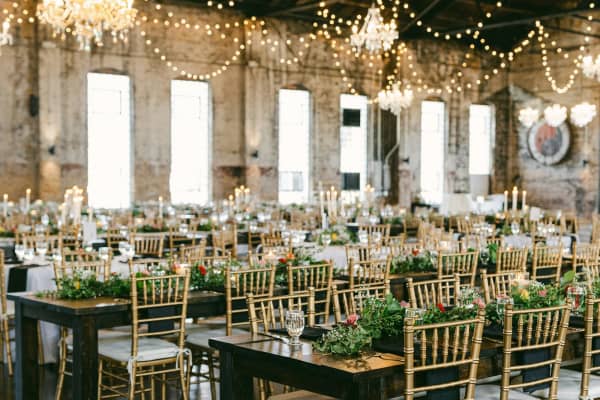
The familiar Utah Valley temple wedding day has two events: a seated luncheon for the people who were in the sealing room, then an evening reception for everyone else. That is a custom, not a rule. Nothing in Church policy or Utah law requires either event, and most of the decision comes down to one comparison: how big is your sealing guest list next to your whole guest list?
If the two lists are very different sizes, two events are usually right. If they are close to the same size, one event can do both jobs and save a day of logistics.
Our guide to wedding luncheon venues covers where to hold the meal, and our open-house reception explainer covers how the evening event works. This page is the decision that comes before both.
Why there are two events at all
The two-event day grows out of who can attend a sealing. The Church's General Handbook (27.3.4) says couples "should invite only close family members and friends to a temple sealing," and that accountable members "must be endowed and have a current temple recommend to attend." That produces a small group inside the temple and a much larger circle outside it: neighbors, ward members, coworkers, friends who are not members, younger cousins.
The luncheon is the meal for the small group. The reception is the party for the large one. They solve different problems, and the trouble starts when a family plans one as if it were the other.
The four shapes a wedding day can take
| Shape | Who it suits | The main cost | The main risk |
|---|---|---|---|
| Luncheon, then evening reception | Most temple weddings with a big guest list | Two venues or two blocks, two setups | A long afternoon gap for guests from out of town |
| One midday reception right after the sealing | Couples who want the day done by mid-afternoon | Feeding a large group at lunchtime | Guests who work Saturdays or travel far miss it |
| One evening dinner for everyone | Smaller weddings, families who want one seated meal | A full meal for every guest | The sealing family waits hungry all afternoon |
| Luncheon only, no reception | Very small weddings, second marriages, couples on a tight budget | Hurt feelings among people not invited | Neighbors and the ward have nowhere to celebrate |
Our luncheon rooms comparison lists ten rooms with published capacity.
Two events: the default for a reason
The two-event day is the default because it scales. A luncheon of 25 to 50 people fits a restaurant's private room or a family home, and an open-house reception can welcome several hundred people who drop in, go through a line and eat cake. Our open-house explainer has the math for estimating who comes.
The cost of this shape is the afternoon. After the luncheon there are usually several hours before the couple has to be ready again. That gap is rest for the couple and a problem for an aunt who flew in from Ohio with nowhere to be until 6 p.m. Plan it: a hotel near the reception, a short list from our 48 hours in Provo guide, or a relative's house with the air conditioning on.
The second cost is the venue bill. Some event venues price in blocks of hours, and a noon luncheon plus an evening reception at the same place can be billed as a full day. Ask for the number before assuming one venue for both is cheaper.
One midday reception
Some couples fold the luncheon into the reception: the sealing in the morning, photos on the temple grounds, then an early-afternoon reception for everyone with a real lunch instead of cake and punch. The day ends by late afternoon, nobody waits around, and there is one setup and one cleanup.
The catch is that it feeds the whole guest list at lunchtime, which costs more per head than cake, and it lands in the middle of a Saturday when some guests are working, traveling or at a child's game. It works best when most guests are family or close friends who will clear the day.
One evening dinner
The mirror image: no luncheon, and a seated dinner in the evening for everyone. This is the familiar sit-down wedding reception, and it suits a smaller guest list. If 90 people are coming, a single dinner may cost less than a luncheon for 40 plus a reception for 300.
Its weak point is the afternoon. The family that was at the temple at 10 a.m. needs to eat something before 6 p.m. A simple catered lunch at a parent's house, or a standing order at a sandwich shop near the temple, solves it without becoming a second event.
Luncheon only
The smallest version: the sealing, the luncheon, and no reception. It is the least expensive and the most intimate, and it skips the receiving line entirely.
It also leaves out the people a Utah Valley open house exists to include. Ward members, neighbors and old family friends often expect to come by. If you choose this shape, a short announcement and an open invitation to a casual gathering later (a backyard dessert night a few weeks after the honeymoon, say) keeps the goodwill.
A quick way to decide
Write two numbers on a piece of paper:
- The sealing list: the people who will be in the sealing room.
- The full list: every household you would invite to a reception.
Then look at the ratio.
- The full list is many times the sealing list. Two events. The luncheon stays small and the reception stays open.
- The full list is about twice the sealing list. Either shape works. Choose based on budget and whether you want one seated meal or a come-and-go party.
- The two lists are nearly the same. One event. A single seated meal after the sealing, or a single dinner that evening, can do everything two events would.
Two more questions settle most ties. Do a lot of guests need to travel? Then a single event at a predictable time is kinder than a day with a long gap. Is someone in the family eager to host a luncheon? Then let them, because the luncheon is the easiest part of the day to hand off.
The meetinghouse route: both events in one building
Many Utah Valley families hold a luncheon, a reception or both in a ward building's cultural hall. It is the one venue with no rental fee, and it is also the one with the most rules, so know them before you plan around it.
The General Handbook sets the conditions:
- Who to ask. Members may request to use a meetinghouse within their stake for personal or family activities by contacting a member of the bishopric of a ward that meets in that building, or someone he designates (35.5.3).
- Supervision and cleanup. The use must be supervised in person by a responsible adult member of a ward that meets there, must not interfere with scheduled Church activities, and the family must clean up and restore the building (35.5.3). Users carry full responsibility for damage or injury.
- No rentals. Church property is not rented, and "renting space for weddings or wedding-related events" is listed as a commercial use that is not approved (35.5.6.1). You are borrowing the building through your ward, not booking it.
- Not the chapel. Receptions may not be held in the chapel unless it is a multipurpose area (38.3.4).
- Not Monday night. Receptions and similar activities may not be held in Church facilities on Monday nights (20.5.3).
- The kitchen. Kitchens may be used to serve meals and keep food warm or cold, but in the United States food should be prepared elsewhere and brought in (35.5.7.3). Plan on a caterer or family cooking at home.
None of that prevents a luncheon at noon and a reception at 6 in the same cultural hall. It does mean the family is doing the setup, the serving and the cleanup, twice, on the same day. That labor is the real price of the free room, and it lands on the people you most want to celebrate with. If you go this way, recruit a crew that is not in the wedding party.
Where the ring ceremony fits in each shape
Many families add a ring ceremony so relatives who could not attend the sealing can see the couple exchange rings. The Handbook's rules (27.3.2.7) apply whichever shape you pick:
- Rings may be exchanged in the sealing room after the sealing, and "should not exchange rings at any other time or place in a temple or on temple grounds."
- Couples who are married and sealed in the same ceremony "may exchange rings at a later time to accommodate family members who are unable to attend."
- That later exchange "should not replicate any part of the sealing ceremony," and "the couple should not exchange vows after being sealed in the temple."
In a two-event day, the ring ceremony usually happens at the start of the reception or just before it, when the wider family has arrived. In a one-event day it slots in after the meal. Our ring ceremony guide covers who leads it and what to say.
Sample schedules
These are illustrations, not recommendations; your temple appointment time sets everything else. The General Handbook says couples schedule a sealing by contacting the temple after meeting with their bishop, and the temple provides instructions when the appointment is made.
Two events (sealing at 11 a.m.)
- 11:00 sealing; 11:45 to 12:45 photos on the grounds
- 1:15 luncheon for 35
- 3:00 to 5:30 rest, change, travel
- 6:00 ring ceremony; 6:30 to 9:00 open-house reception
One midday reception (sealing at 10 a.m.)
- 10:00 sealing; 10:45 to 11:45 photos
- 12:30 to 3:00 reception with lunch for everyone, ring ceremony at 12:45
One evening dinner (sealing at 1 p.m.)
- 1:00 sealing; 1:45 to 2:45 photos
- 3:00 light lunch for the sealing family at a parent's house
- 6:00 dinner reception for 90
Notice what changes: in the first plan, the photos are squeezed between the sealing and lunch, so the luncheon must allow for them running long. Our luncheon venues guide explains why that hour of photos almost always overruns.
Check the calendar before you choose a shape
Whatever you decide, the temple's own calendar comes first. Each temple's page lists closure dates, and they shift every year. Some examples from the Church's temple pages as listed in October 2026: the Provo City Center Temple is closed Saturday, April 3, 2027 (general conference weekend) and from May 31 to July 5, 2027, and nearly every Utah Valley temple is closed Saturday, July 24, 2027 for Pioneer Day. Our temple-by-temple pages, starting with sealings at the Provo City Center Temple, list the full closure weeks.
Related Guides
- Wedding Luncheon Venues in Utah Valley
- The Open-House Reception, Explained
- Reception Center or Backyard?
- Getting Married in Utah Valley on a Budget
- Just Engaged in Utah Valley: The First 30 Days
Frequently Asked Questions
Do we have to have both a wedding luncheon and a reception?
What is the difference between a wedding luncheon and a wedding breakfast?
Can we hold our reception in a church cultural hall?
Can we cook the reception food in the meetinghouse kitchen?
If we only have one event, where does the ring ceremony go?
Is a dinner reception more expensive than a luncheon plus an open house?
How long should the gap between the luncheon and the reception be?
Do civil weddings in Utah Valley have a luncheon too?
Sources
The facts in this guide were checked against these sources. Hours, fees and rules change, so confirm anything time-sensitive with the source before you go. How we make Provo.com.
- General Handbook, 27: Temple Ordinances for the Living, The Church of Jesus Christ of Latter-day Saints. Checked October 20, 2026.
- General Handbook, 35: Care and Use of Meetinghouses, The Church of Jesus Christ of Latter-day Saints. Checked October 20, 2026.
- General Handbook, 38: Church Policies and Guidelines (38.3.4), The Church of Jesus Christ of Latter-day Saints. Checked October 20, 2026.
- General Handbook, 20: Activities (20.5.3 Monday Nights), The Church of Jesus Christ of Latter-day Saints. Checked October 20, 2026.
- Provo City Center Temple (closures), The Church of Jesus Christ of Latter-day Saints. Checked October 20, 2026.
- Mount Timpanogos Utah Temple (closures), The Church of Jesus Christ of Latter-day Saints. Checked October 20, 2026.