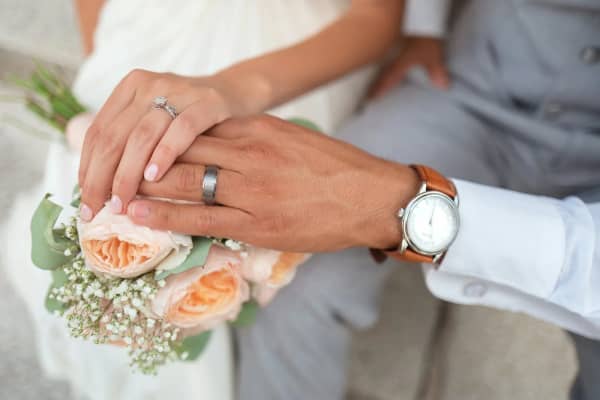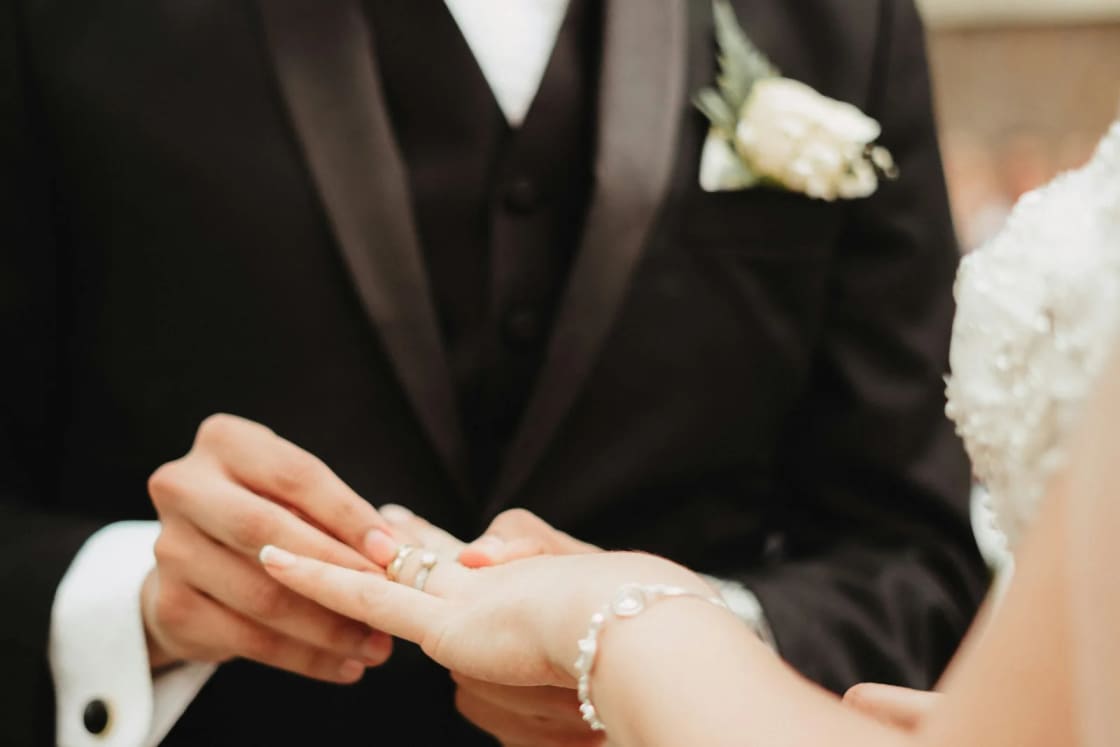

A ring ceremony is a short moment at a Utah Valley reception when a couple who were sealed in the temple that morning exchange rings in front of the people who could not be inside. It is often for a non-member mother, a grandfather who does not hold a recommend, siblings too young to attend. Done well, it gives those people a moment that belongs to them. Done carelessly, it imitates the sealing in a way the Church's own handbook asks couples not to.
This page explains what the Church says, who holds one, and how to plan one that does its job. For the bigger picture of the day, start with Just Engaged in Utah Valley: The First 30 Days.
Why ring ceremonies exist here
In a temple sealing, only endowed members with a current recommend attend. The Church's General Handbook asks couples to "invite only close family members and friends," and every accountable guest must hold a recommend. Family members who are not members, or who are members without a recommend, wait outside on the grounds.
In much of the world, a couple can marry civilly first, with everyone present, and be sealed later. In Utah, the law allows a temple sealing to be the legal marriage too, so many couples are married and sealed in one ceremony. That leaves a gap for the family outside, and the ring ceremony is one way couples fill it.
What the Church's handbook says, exactly
Section 27.3.2.7 of the General Handbook, "Exchanging Rings after a Temple Sealing," is short. Every sentence matters:
- "Exchanging rings is not part of the temple sealing ceremony."
- "However, couples may exchange rings after the ceremony in the sealing room."
- "Couples should not exchange rings at any other time or place in a temple or on temple grounds."
- "Couples who are married and sealed in the same ceremony may exchange rings at a later time to accommodate family members who are unable to attend a temple sealing."
- "The ring exchange should be consistent with the dignity of a temple sealing."
- "The exchange should not replicate any part of the sealing ceremony."
- "The couple should not exchange vows after being sealed in the temple."
- "Couples who are married civilly before their temple sealing may exchange rings at their civil ceremony, at their temple sealing, or at both ceremonies."
Read plainly, that gives you four rules for a ring ceremony after a sealing:
- It happens somewhere other than the temple or its grounds.
- It is dignified.
- It does not copy the sealing, in words, setting or structure.
- No new vows.
What it is not
A ring ceremony is not a wedding. Nothing legal happens; the marriage was solemnized at the temple, and the officiant there handles the license. It is not a religious ordinance. And under the handbook, it is not a place for vows, which is the line couples most often cross by accident, usually because a well-meaning friend writes a script modeled on a civil wedding.
Who does one
- Couples with non-member parents or close family. This is the most common reason.
- Couples with family members who are members but do not hold a recommend.
- Couples with young siblings or nieces and nephews who waited outside.
- Couples who want the reception guests to see the rings exchanged, even when everyone close was inside.
Who usually does not: couples who married civilly first. The handbook lets them exchange rings at the civil ceremony, at the sealing or both, and the civil ceremony, open to everyone, already gave the family a wedding to witness. Our civil and non-temple weddings guide covers that path, including the handbook's note that it "may also be followed when a temple marriage could cause parents or immediate family members to feel excluded."
A program that stays inside the lines
There is no Church script for a ring ceremony, and that is the point: it should not sound like the sealing. Here is a shape many families use, with the handbook's limits built in:
- Welcome (a parent or the person conducting): who is here, why this moment matters.
- Remarks (one or two people, brief): a parent, a grandparent, a sibling. Stories about the couple, words of love and counsel.
- The rings. The couple place the rings on each other's hands. Some say a single sentence of affection; keep it from sounding like a vow or a promise of marriage.
- A song or a prayer, if the family wishes.
- A kiss and applause.
Ten to fifteen minutes is plenty.
Things to leave out, because they edge toward replicating the sealing or exchanging vows: "Do you take..." questions; a pronouncement of marriage; any wording that describes the temple ceremony; a staged "altar." When in doubt, ask your bishop.
Who leads it
No officiant is required, because nothing legal is happening. Families often ask:
- A parent or grandparent, which keeps it personal.
- A bishop or family friend who knows the handbook's limits.
- A non-member parent, which some families find especially meaningful, as long as the script stays clear of vows.
Give whoever leads it this page, or the handbook section, ahead of time.
Where and when
Not on the temple grounds. The handbook is explicit. Photos on the grounds are routine; the ring exchange is not.
At the luncheon or the reception. Most couples choose the start of the evening reception, before the receiving line opens, so the people the ceremony is for see it before the crowd arrives. Others put it at the wedding luncheon, which is smaller and more intimate.
At a venue that can stage it. Several Utah Valley reception centers plan for it. Sleepy Ridge in Orem quotes a couple on its homepage thanking staff for helping set up "the floor plan of our dinner and ring ceremony." The Ivory Hall in downtown Provo includes ceremony arches in its decor library. Ask any venue whether it can flip the room from rows of chairs to reception tables, and how long that takes; the Northampton House in American Fork lists a "room flip" as an add-on. Our reception centers by city list covers the field.
At a church building, if your bishop approves. The handbook's rules for weddings in Church buildings say marriages may be held in the chapel, the cultural hall or another suitable room, that "receptions may not be held in the chapel unless it is a multipurpose area," and that weddings should not be held "on the Sabbath or on Monday evenings." Follow the same limits for a ring ceremony and ask your bishop where in the building it can go.
Tell the right people when
Put the ring ceremony time on the invitation or in a separate note to family. The worst outcome is the non-member grandmother it was planned for arriving at 7:30 for a 6:30 ring ceremony at a 6:30 to 8:30 open-house reception.
For guests
If you are attending a ring ceremony: arrive at the time the couple gave you, sit or stand where you are pointed, and enjoy it. It is a short, warm moment, not a formal service. Our guide for out-of-town guests covers the rest of the day.
Related Guides
- Getting Sealed at the Provo City Center Temple
- Engagement Rings in Utah Valley
- How to Plan a Utah Valley Wedding: A Month-by-Month Timeline
- A Newcomer's Guide to Provo's Faith Communities
Frequently Asked Questions
What is a ring ceremony?
Does the Church allow ring ceremonies?
Can a couple say vows at a ring ceremony?
Can we exchange rings on the temple grounds after the sealing?
Who officiates a ring ceremony?
What if we have a civil wedding first and are sealed later?
How long is a ring ceremony?
When in the reception should the ring ceremony happen?
Sources
The facts in this guide were checked against these sources. Hours, fees and rules change, so confirm anything time-sensitive with the source before you go. How we make Provo.com.
- General Handbook, 27: Temple Ordinances for the Living (27.3 Sealing of Husband and Wife), The Church of Jesus Christ of Latter-day Saints. Checked October 20, 2026.
- General Handbook, 38: Church Policies and Guidelines (38.3 Marriage), The Church of Jesus Christ of Latter-day Saints. Checked October 20, 2026.
- Sleepy Ridge Weddings: Home, Sleepy Ridge Weddings. Checked October 20, 2026.
- The Ivory Hall: 2026 Pricing, The Ivory Hall. Checked October 20, 2026.
- Northampton House: Add-ons, Northampton House. Checked October 20, 2026.