
If you grew up outside Utah, a Utah Valley wedding reception can be a surprise. The invitation says "6:30 to 8:30 p.m." instead of "dinner at 6." People drift in, hug the couple, take a plate of something sweet and drift out twenty minutes later. Some never sit down. That is the open house, and in this valley it is a common reception format, especially after a temple sealing.
This guide explains how it works, then does the planning math: how long the window should be, how fast a line moves and how much cake to buy. The numbers below are worked examples, not statistics; plug in your own.
Why the format exists
The open house fits a wedding day that already has two other events in it. After a temple sealing in the morning and a wedding luncheon for close family at midday, the evening reception is for everyone else: the ward, the neighbors, the roommates, coworkers, parents' friends. That list can be long, and feeding all of them a plated dinner would cost more than many young couples or their families can spend. A come-and-go reception lets a couple welcome a very large circle without seating them.
It is also why the open house pairs naturally with a ring ceremony, for the family members who waited outside the temple. And it is why many Utah Valley reception centers quote two capacities, one for a seated dinner and a larger one for a "flowing" or "open-flow" reception. Sleepy Ridge in Orem, for example, lists 250 for formal dinners and 700 for flowing receptions in the same room.
What happens, start to finish
A typical shape, which every family adjusts:
- Doors open. Have the line, the guest book and the first round of refreshments ready before the posted start; some guests always arrive on the minute.
- The receiving line. The couple, often both sets of parents, sometimes the wedding party. Guests move down the line, say congratulations, sign a guest book or drop a card.
- Refreshments. A dessert table, a drink station, sometimes a light buffet. Guests eat standing, at cocktail tables or at a few round tables. (Rented cocktail and round tables run $8 to $10 each on local rental price lists.)
- Moments. A cake cutting, a first dance, a short slideshow. Some couples put a ring ceremony at the very start, before the line opens.
- The send-off. In the last minutes of the window, with sparklers or bubbles where the venue allows.
The Ivory Hall in downtown Provo, for instance, includes a sparkler send-off kit in its rental; the Northampton House in American Fork sells one as an add-on. Ask your venue what it allows before you buy.
Setting the time window
The window is the first decision and the one that most affects the guest experience. Too short, and the line backs up out the door. Too long, and the room feels empty in the last hour. Whether to hold a separate luncheon at all is its own decision; see the luncheon vs the reception.
Work it out from the line, not from habit.
- Estimate how many households (not individuals) will come. Families come through the line together.
- Estimate how long each household spends with the couple. A quick hug and congratulations is short; a grandparent who wants to talk is long.
- Divide.
Worked example. Suppose you expect 250 households and each spends about 40 seconds in the line. That is 250 × 40 = 10,000 seconds, or a little under 3 hours of line time if the couple stood there the whole window. If you want the couple free for the last half hour (cake, dance, send-off), a 2.5-hour window will mean a line most of the time, and a 3-hour window will give it room.
Change one number and the answer changes. Fewer households, or a faster line, and two hours is plenty. A big family network that lingers, and you need more.
Ways to speed the line without being rude:
- Keep the line short in people. Every extra person standing in it adds handshakes.
- Put the guest book and card box after the line, not before it.
- Have a parent or friend gently move the line along when it bunches.
Estimating who comes
Open-house invitations usually go without RSVPs, so you are estimating. Do not borrow a percentage from the internet; there is no reliable Utah County figure for how many invited guests attend. Your own data is better:
- Ask family how many came to the last wedding reception in the same family and ward network, and how many invitations went out.
- Count distance. Guests who live minutes away come in larger numbers than guests who would drive an hour.
- Count the calendar. A Friday or Saturday evening draws differently from a weekday; a reception during BYU or UVU finals draws fewer students.
- Count overlaps. In peak months, neighbors may have two receptions the same night.
Then plan for a range. Order refreshments for the middle of the range, and have a plan (an extra sheet cake in the freezer, a store run) for the high end.
The cake math
Our wedding cakes guide covers bakers and styles; here is the arithmetic for an open house.
Step 1: Attendees, not invitations. Start from your attendance estimate, in people.
Step 2: The share who take cake. If cake is the only dessert, most will. If there is a cookie bar, a candy table and a hot chocolate station, fewer will. The cake guide notes that bakers and planners often suggest sizing for roughly 75 to 100 percent of guests depending on what else is on the table.
Step 3: Servings. Attendees × share = servings.
Worked example. You estimate 500 people. There is a cookie table too, so you plan for 75 percent to take cake: 500 × 0.75 = 375 servings.
The common local solution: a small, decorated cutting cake on display for photos and the cake cutting, plus sheet cakes in the kitchen, cut and plated out of sight. It costs less per serving and lets the kitchen refill steadily across the window. Local bakers' published sheet-cake and tier prices are in our wedding cake prices guide.
The other refreshments follow the same logic, with one difference: they have to last the whole window. A table piled high at 6:30 and empty at 7:45 is the most common open-house failure. Plan refills in batches and give one person the job of watching the table.
Where it happens
Food. Because guests are not sitting down to a meal, an open house is usually fed with a dessert, a drink and a few light bites. Published reception menus from Utah Valley caterers start at $12.50 a guest; our wedding catering prices guide has them, with the service charge and tax that follow.
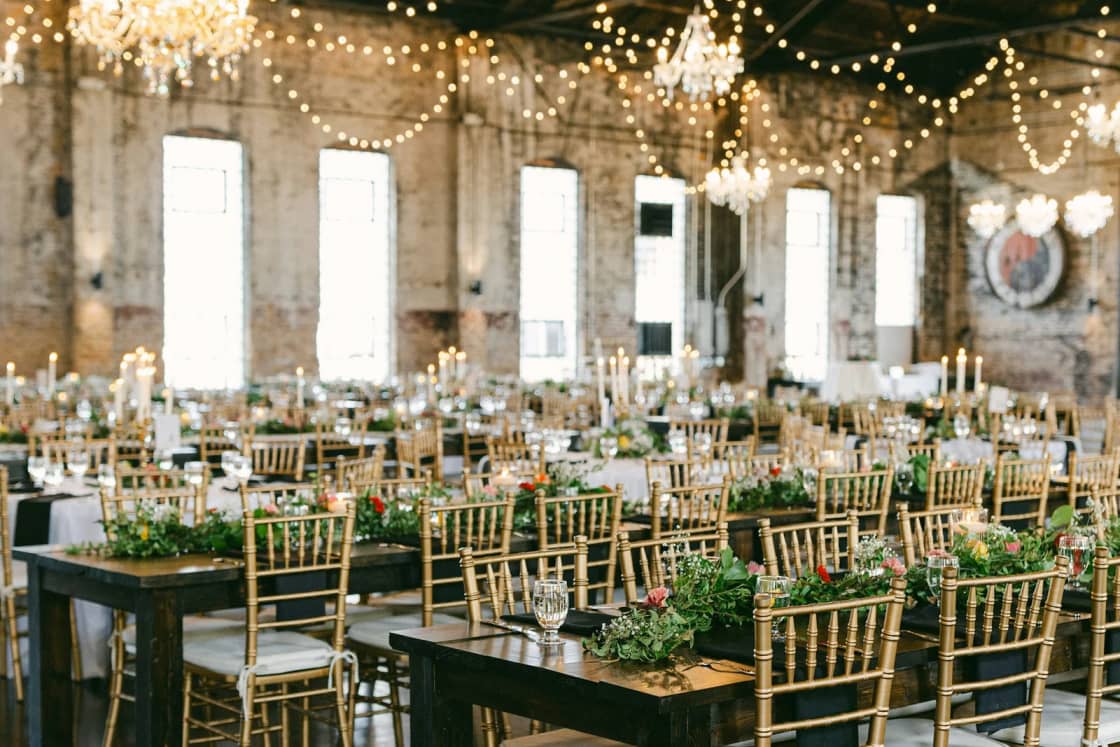
Reception centers. Most of the valley's reception centers are built for this format, with a big open room, a kitchen for caterers and a parking lot. Our reception centers by city list and venues guide cover the field. Parking is the constraint people forget: a few hundred guests arriving across the evening still need spaces.
The church building. Many members ask their bishop about the meetinghouse cultural hall. The Church's handbook says "receptions may not be held in the chapel unless it is a multipurpose area," that weddings in Church buildings "should not be held on the Sabbath or on Monday evenings," and that use must follow the Church's rules for proper use of the meetinghouse. Ask your bishop and the building scheduler early, and ask about the local rules on decorations and cleanup.
At home. Possible for smaller lists. Our reception center or backyard comparison covers parking, noise and the hidden labor.
Etiquette, for guests new to the format
- Arrive any time in the window. You do not need to be there at the start. Out-of-town guests will find hotels, dress and Sunday notes in our wedding guest's guide.
- Dress: what you would wear to church or a nice dinner is safe.
- Gifts: bring a card or gift to the reception, or ship it ahead if the couple has a registry.
- Staying: twenty minutes is normal; staying the whole time is fine too, especially for family.
- Kids: usually welcome, unless the invitation says otherwise.
Our guide for out-of-town guests covers the rest of the day.
Related Guides
- Just Engaged in Utah Valley: The First 30 Days
- Getting Married in Utah Valley on a Budget
- Wedding DJs and Bands in Utah Valley
- Wedding Rentals in Utah Valley
Frequently Asked Questions
What is an open-house wedding reception?
How long should an open-house reception be?
Do guests RSVP for an open-house reception?
How much cake do we need for an open house?
What do people serve at an open-house reception?
Can we hold an open-house reception at our church building?
Is an open house the same as a ring ceremony?
Should the receiving line be the whole time?
Sources
The facts in this guide were checked against these sources. Hours, fees and rules change, so confirm anything time-sensitive with the source before you go. How we make Provo.com.
- General Handbook, 38: Church Policies and Guidelines (38.3 Marriage), The Church of Jesus Christ of Latter-day Saints. Checked October 20, 2026.
- General Handbook, 27: Temple Ordinances for the Living (27.3 Sealing of Husband and Wife), The Church of Jesus Christ of Latter-day Saints. Checked October 20, 2026.
- Sleepy Ridge Weddings: Sunset Room, Sleepy Ridge Weddings. Checked October 20, 2026.
- The Ivory Hall: Weddings, The Ivory Hall. Checked October 20, 2026.
- Northampton House: Add-ons, Northampton House. Checked October 20, 2026.