Utah Valley is one of the few metropolitan areas in the United States where the question "which airport?" has a genuinely close answer.
Twenty minutes away sits Provo Airport, a small commercial field with three airlines, a single terminal, and a nonstop list that has grown remarkably over the past few years. An hour north sits Salt Lake City International, a full Delta hub with a new terminal, hundreds of daily departures and service to most of the world.
The valley's instinct is to default to Salt Lake because that is what everyone did for decades. That instinct is now wrong about half the time.
Provo Airport, honestly
Provo Municipal Airport — PVU on your boarding pass — sits about two miles west of the city at 1331 South Sky Way. It is owned by the City of Provo and it has spent the last several years turning from a general-aviation field with a few commercial flights into something considerably more serious.
Three airlines fly commercially from Provo:
- Allegiant Air, which committed to a multi-aircraft base here
- Breeze Airways, the Utah-founded carrier that likewise established a base at Provo
- American Airlines, whose Provo flying is operated by SkyWest under the American Eagle brand
That base commitment matters more than the airline count. An airline that bases aircraft at an airport overnights crews and planes there, which produces early departures, later arrivals and a deeper schedule than a carrier that simply flies in and out.
The airport handled roughly 889,000 passengers in 2024, with something in the region of a dozen-plus departures on an average day to a nonstop list in the high teens to low twenties depending on the season. The destinations skew leisure — California, Arizona, Texas, the Pacific Northwest — with the American connection at a hub opening onward options.
One terminal. One arrival and departure level. You can walk in either set of doors and be at your gate within minutes. For anyone who has walked the length of a modern hub, this is not a small thing.
Salt Lake City International, honestly
SLC is a genuine hub. It is Delta's western hub, it has been rebuilt at enormous expense, and it flies to Europe and Asia as well as across the country.
The things it gives you that Provo cannot:
Frequency. Multiple daily departures on major business routes. If your ten o'clock is canceled there is often a two o'clock.
Airline choice. All the major domestic carriers, which means competition on price and the ability to use whichever loyalty program you have actually invested in.
International. Provo is a domestic airport. If you are leaving the country, this is not a comparison.
Recovery. This is the underrated one and we will come back to it.
The things it costs you:
An hour of driving each way, plus whatever the freeway is doing that day. Parking, at hub prices, at hub distances. A large terminal to walk. And, if someone is dropping you off and collecting you, four hours of somebody else's life rather than one.
How to actually decide
Start with whether the route exists
If Provo flies nonstop where you are going, Provo starts well ahead. If it does not, the comparison is usually over — a connection through a hub to reach a city that Salt Lake serves nonstop is rarely worth it for a domestic trip.
Check the current nonstop list on the airlines' own sites. Routes at leisure-focused carriers come and go seasonally, more so than at legacy airlines, and any list printed in an article ages badly.
Then price the whole trip, not the fare
This is where people go wrong in both directions.
Allegiant and Breeze are unbundled carriers. The headline fare buys the seat and very little else — bags, seat assignment and extras are priced separately, and a fare that looks dramatically cheaper than the Salt Lake alternative can converge on it once a family's checked bags are added.
The other half of the calculation runs the other way. Two hours of driving, hub parking for a week, and possibly a second car's worth of dropping off and collecting are real costs that never appear in a fare comparison. For a family of four leaving on a Tuesday, they can easily exceed the fare difference.
Price the whole thing. Then decide.
Then ask what happens if it goes wrong
This is the argument that should decide close cases.
At a hub with many daily departures on your route, a cancellation is usually an inconvenience measured in hours. At a small airport with three carriers and roughly a dozen daily departures, a cancellation can mean the next day — because there may not be another flight to rebook onto, and the alternative carriers do not serve your city.
So the question is: can this trip slip by a day?
A leisure trip with flexible dates: fine, take the convenience. A wedding, a funeral, a closing, a connection to an international flight, a first day at a new job: the hub's resilience is worth an hour of driving.
Getting to each one
Provo
Drive. It is ten to twenty minutes from most of the valley, the lots are close to the terminal, and the first two hours in the long-term lot are free — which makes collecting someone genuinely painless in a way that is not true at a hub.
Rideshare works and is cheap because the distance is short. A taxi is viable. For a car-free household this is the airport that makes flying easy, a point we get into in living in Provo without a car.
Salt Lake City
Driving is the default. Budget an hour plus a margin for I-15, and remember that parking at a hub is both a cost and a walk.
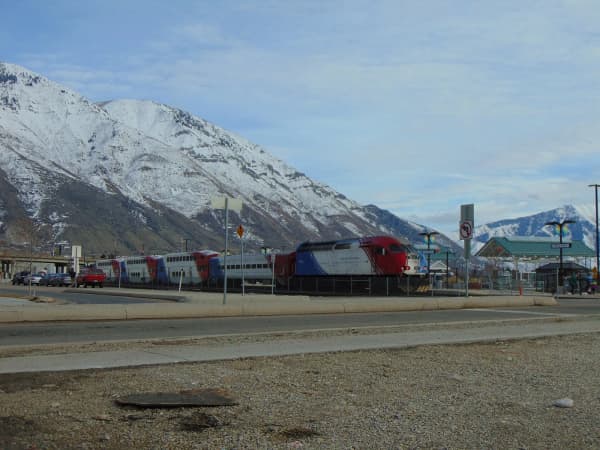
FrontRunner plus TRAX is the transit route and it genuinely works: commuter rail north from Provo Central Station to Salt Lake Central, then the TRAX Green Line to the airport. It is inexpensive, and BYU and UVU students ride the whole thing free on a student ID.
Two constraints, both important:
- Budget generously. Two vehicles, one transfer, and luggage. This is not a trip to cut fine.
- There is no Sunday service. FrontRunner does not run on Sundays at all. A Sunday departure from SLC cannot begin with the train from Provo, and this catches people out with some regularity.
We cover the ground route in both directions in our guide to getting from SLC airport to Provo, and the rail leg in FrontRunner from Provo.
Practical notes for flying from Provo
Arrive two hours early anyway. The terminal is small and security is usually fast, but the airlines ask for two hours and the counter timings are built around it.
Watch the bag cutoff. Breeze closes checked-bag acceptance forty-five minutes before departure, when the ticket counter closes. At a big airport a late bag drop is a scramble; at a small one where the counter simply shuts, it is a missed flight.
The counters are in one place. Breeze checks in beside Allegiant at the far right of the single hall. There is no terminal to choose and no train to ride between concourses.
Book directly with the airline where you can. Provo City is explicit that reservations cannot be booked, changed or canceled through the city — the airport operates the building, not your ticket.
Seasonal routes are genuinely seasonal. A destination that flew last winter may not fly this summer. Confirm before building a trip around it.
Three scenarios, worked through
The general rules are easier to apply against concrete cases.
A family of four flying to Southern California in July
Four fares, probably four checked bags, a week of parking, and two adults whose time has value.
Provo wins this comfortably if the route exists, and it usually does — California is exactly the market Provo's carriers serve. The parking saving alone over a week is meaningful, the drive is twenty minutes rather than an hour each way, and a family with small children benefits enormously from a terminal you can walk across in two minutes.
The one thing to check: price the bags. Four checked bags on an unbundled carrier is a real number, and it is the variable most likely to close the gap.
A consultant flying to Chicago on Monday morning, back Thursday
Salt Lake wins this, and it is not close.
The route has multiple daily frequencies from SLC on more than one carrier. Business travel does not tolerate a cancellation that costs a day. Loyalty programs matter to people who fly weekly. And the traveler is likely to be expensing parking anyway, which removes the cost argument entirely.
The hour of driving is the price of resilience, and for a trip with a fixed meeting at the far end, resilience is what you are buying.
A student flying home for Christmas
Usually Provo, if the route exists, and the reasoning is different from the family case.
Students are price-sensitive, often traveling with one bag, frequently without a car of their own, and going to leisure markets that Provo's carriers actually serve. Getting to Provo Airport from campus is a short rideshare split between roommates; getting to Salt Lake City is an hour of somebody's day or a train plus a transfer with luggage.
The caveat is December weather. A cancellation in a holiday travel period is the worst-case version of the small-airport problem, because every alternative is also full. If the trip is a hard deadline — a family event on a fixed date — factor that in.
What "basing aircraft" actually buys you
This is worth explaining because it is the structural reason Provo's schedule is better than its size suggests.
When an airline simply serves an airport, the aircraft arrives from somewhere else, turns around, and leaves. The schedule is dictated by what the aircraft was doing before and will do after, which usually means mid-day departures and no early or late options.
When an airline bases aircraft at an airport, planes and crews overnight there. That produces a first departure early in the morning and a last arrival late at night, because the aircraft starts and ends its day in that city.
Both Allegiant and Breeze have based aircraft at Provo. That is why the airport supports early departures that get you somewhere for a working day, rather than only the middle-of-the-day flying that a spoke airport typically gets.
It also means the airport has a stake in those two airlines' health that a hub does not have in any single carrier — which is the flip side of the same coin, and part of why the nonstop list moves around more than a legacy airline's would.
Security, terminals and the experience gap
The difference in how the two airports feel is larger than the difference in how they perform.
Provo is one hall. You park close, walk in either set of doors, find your airline's counter along one wall, clear a short security line and sit down near your gate. The whole sequence can take fifteen minutes on a quiet day. There is very little to do once you are through, which is the trade — a small airport has a small concessions footprint.
Salt Lake City is a modern hub with the amenities that implies and the walking distances that come with them. The rebuilt terminal is genuinely good, and it is also large, with meaningful distance between the curb and some gates. Budget the walk.
For travelers with mobility needs, elderly relatives, or several small children, the size difference is not a minor convenience factor — it is often the deciding one.
The rule of thumb
Fly from Provo when:
- there is a nonstop to where you are going
- the dates are flexible enough to survive a cancellation
- you are traveling light, or the bag math still works
- convenience is worth something to you, which for most people it is
Fly from Salt Lake when:
- you are leaving the country
- the trip cannot slip a day
- you need a specific airline or alliance
- the route only exists there, which is most business destinations
- you are connecting onward and want the shortest chain of things that can fail
And whichever you choose, price the total — fare plus bags plus parking plus the driving, on both sides. The answer flips more often than people expect, and the habit of automatically driving north is a habit rather than a calculation.
One thing that is not a factor
It is worth naming something that people raise and should not weigh heavily: the size of the airport says nothing about safety. Provo is a full commercial airport with the certification, air traffic control and airline oversight that implies, flown by the same carriers under the same rules as anywhere else. The genuine differences between these two airports are schedule depth, route map, resilience after a disruption and convenience — not risk.
What is changing
Provo's trajectory has been upward. Two airlines have based aircraft here. A terminal replaced a much smaller facility. Passenger numbers have grown into the high hundreds of thousands. Every additional nonstop moves more trips into the "just fly from Provo" column, and the airport's own pitch leans on the connection options that make a small field reach a large map.
None of that makes it a hub, and it will not be one. What it makes it is a real alternative for a meaningful share of the trips people in this valley actually take — which, for an airport twenty minutes from downtown Provo, is a substantial thing to have.
The argument that actually decides it: what happens when the flight does not go
Everything above compares the two airports on a day when things work. The comparison that changes people's minds is the one on the day things do not, because that is where a small airport and a hub diverge most sharply, and it is the factor most travelers discover only once.
Rebooking depth is a function of frequency. If a route is served several times a day, a cancellation is an inconvenience — you are moved to a later departure and you lose part of an afternoon. If a route is served once a day, a cancellation is a lost day, and the recovery option may be a seat tomorrow rather than a seat later. That difference has nothing to do with how well the airport is run. It is arithmetic about how many alternatives exist, and it is the single biggest structural difference between flying out of a small airport and flying out of a hub.
The same asymmetry applies to connections. A misconnection at a hub where your airline has many daily departures is usually recoverable within hours. A misconnection that has to be recovered onto a once-daily flight into a small airport routinely means a night somewhere unplanned, or a long drive at the end of it.
And it applies to the equipment. Smaller markets are served by smaller aircraft, which means fewer seats available to absorb displaced passengers, and it means weather and maintenance events have less slack to absorb them.
How to use this rather than be surprised by it
Match the airport to the consequence of being late. This is the whole decision compressed into a sentence. For a trip where arriving a day late is annoying — visiting family, a flexible holiday, a conference you have already presented at — the convenience of a nearby airport is a real and recurring benefit and the tail risk is acceptable. For a trip where arriving a day late destroys the purpose — a wedding you are in, a cruise departure, a court date, a connection to an international flight you bought separately — the depth of alternatives is worth more than an hour of driving.
Build the buffer into the itinerary, not into the morning. Flying out the day before matters far more than leaving for the airport earlier. The risk being managed is the flight not operating, and no amount of early arrival addresses that.
Separately-purchased tickets are the trap. If your onward international flight is on a different booking, nobody is responsible for getting you to it. That is the scenario where a once-daily departure is most expensive, and it is worth paying real money to avoid.
Check frequency, not just price, when comparing fares. Two fares to the same destination are not the same product if one route runs four times a day and the other runs once. The cheaper fare on the thinner route is carrying a risk the price does not display.
None of this argues against the nearer airport. It argues for choosing deliberately, using the right question — which is not "which is more convenient" but "what does it cost me if this particular trip goes wrong."
Related Guides
- Provo Airport expansion timeline update — when PVU actually gets bigger
- Car Ownership in Utah Valley 101: Registration, Emissions & Winter Reality
- Buses From Provo to Vegas, St. George & Beyond: The Intercity Guide
- Provo vs Salt Lake City: Where Should You Live in Utah? (2026)
- Scooters & Bike Share in Provo: What's Actually on the Street (2026)
- The UVX Is the Best Thing About Getting Around Provo
- Flying from Provo Airport (PVU): The Complete Guide
- Cracked Windshields in Provo: The Utah Rule Everyone Quotes Wrong
- The Provo DMV, Decoded: Two Agencies, Two Buildings
- Getting Around Provo: FrontRunner, UTA & Commuting Guide (2026)
Frequently Asked Questions
Which airlines fly out of Provo Airport?
How many places can you fly nonstop from Provo?
Is it cheaper to fly out of Provo or Salt Lake?
How far is Provo Airport from downtown Provo?
Can I get to Salt Lake City airport without driving?
Is parking easier at Provo?
How early should I arrive at Provo Airport?
What if my flight from Provo is canceled?
Should I fly out of Provo or drive to Salt Lake City?