
The problem with hiking guides and small children is that "easy" is written by adults. A trail described as an easy two-mile walk with three hundred feet of gain is a pleasant stroll for a grown-up and an ordeal for a four-year-old, and the guides that say so are rare.
This sorts the trails near Provo by what matters when the walker is under eight: how far it really is, whether there is something at the end, whether you could push a stroller, and whether you will end up carrying someone. It also says plainly which well-loved local hikes are not suitable, because being wrong about that is how a family day gets ruined.
Trail conditions, closures and fee rules change with the season and with the year. Check current conditions with the Forest Service or the relevant city before you drive.
The stroller test, defined
The test is simple: could you push a standard stroller from the trailhead to the destination without lifting it over anything?
Almost no mountain trail passes. Paved paths pass. Boardwalks mostly pass. Wide gravel doubletrack sometimes passes with a rugged stroller and does not with an umbrella one. Anything with steps, roots, loose rock or a creek crossing fails, regardless of how gentle the gradient is.
Knowing which you are dealing with before you leave is the difference between a good morning and carrying a toddler and a folded stroller a mile back to the car.
Passes the test: the Provo River Parkway
The Parkway is the workhorse. It is paved, it follows the river, it runs for miles, and you can join and leave it at many points, which means you set the distance rather than the trail setting it.
For families with a child in a stroller and another on a balance bike, this is the default. There is water beside you the whole way, which does most of the entertainment work, and the surface takes any wheels you own. It is not a mountain hike and does not pretend to be — it is the reliable option when you want outdoors without a project.
Passes the test: Bridal Veil Falls
The paved route to Bridal Veil Falls in Provo Canyon is the single best combination of low effort and high payoff near Provo. It is flat, it is paved, and it ends at a large and dramatic waterfall.
For a four-year-old this is close to ideal: minimal walking, a spectacular thing to reach, and the option to turn around at any point without having failed at anything. It is also busy, particularly on summer weekends, so early is better.
Mostly passes: Cascade Springs
Cascade Springs, off the Alpine Loop, is a boardwalk system through spring-fed pools and terraces. Much of it is accessible, and it is one of the few interesting natural features in the area you can see without a real hike.
Two caveats. The Alpine Loop road is seasonal and closes in winter, and this sits inside the American Fork Canyon fee area, so you need a pass. Check the loop is open before committing to the drive, because the alternative approach is long.
Fails the test but works anyway: Battle Creek Falls
Battle Creek, above Pleasant Grove, is the standard first real hike for Utah Valley children and it deserves the reputation.
It is short, it climbs steadily rather than steeply, and it ends at a waterfall you can get close to. The trail is dirt with rocky sections, so no stroller — a carrier for anyone under about three. For a five- or six-year-old it is an achievable objective that feels like a proper hike, which is precisely what you want for a first one.
Fails the test but works anyway: The Grotto
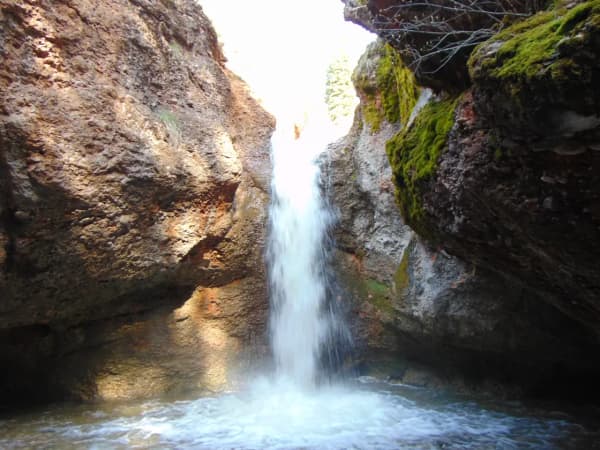
The Grotto, off the Nebo Loop in Payson Canyon, is the shortest waterfall hike in the area — a brief walk ending at a falls in an alcove.
It is the option for the child who does not want to hike. The distance is small enough that resistance rarely has time to develop, and the destination is unambiguous. It involves creek crossings and uneven ground, so expect wet feet and no wheels. The Nebo Loop is a seasonal road, so check it is open.
Big Springs and South Fork
The South Fork of Provo Canyon, and Big Springs Park at the end of it, gives you shaded picnic ground with easy walking around it and a creek children can get into.
This is the low-ambition option and it is underrated. Sometimes the correct hike with small children is barely a hike at all — a shaded place with running water and space to wander, twenty-five minutes from Provo.
Rock Canyon, but only the first part
Rock Canyon starts wide and gradual before it becomes a serious canyon trail. The first stretch is a genuine option with small children if you treat it as an out-and-back with a turnaround point you decide in advance.
The mistake is going in without that decision, because the trail keeps offering "just a bit further" and the walk back is longer than anyone remembers. Pick a landmark, make it the destination, and treat reaching it as success.
Not for under-eights: Stewart Falls
Stewart Falls is one of the best short hikes in the state and it is not a small-child hike. It runs several miles round trip with real elevation change and exposed sections.
Strong seven- and eight-year-olds who hike regularly manage it. A five-year-old will not, and the last mile back is where family hikes go wrong. Save it for a couple of years.
Not for under-eights: Timpanogos Cave
The trail to the cave entrance is a paved switchback climb of roughly a mile and a half gaining over a thousand feet, at altitude, with a timed tour at the top and the same descent afterwards.
It is a superb outing for older children and a hard day for small ones. There is no shade for much of it, and turning around partway means forfeiting the tour you booked. Wait until eight or nine.
Not for under-eights: the Y
The Y trail is short in distance and brutal in gradient, gaining rapidly on exposed switchbacks with no water and little shade.
It is a Provo rite of passage and it is not a family hike for young children. People do carry toddlers up it; they mostly do not enjoy the experience.
How far a small child can really go
Ignore distance as the primary measure. A one-mile trail with a stream, boulders and a waterfall will hold a child longer than a flat three-mile path with nothing on it.
As rough planning figures: about a mile round trip for a three-year-old, one to two for a four- or five-year-old, and two to three for a six- or seven-year-old — all assuming something worth reaching. Halve those numbers if the trail is dull or the child is tired before you start.
Plan to carry someone
The single most useful piece of preparation is deciding in advance who carries the small child when they stop walking, because they will.
A framed carrier is worth owning if you intend to do this regularly. For occasional outings, choose trails short enough that carrying a child back is annoying rather than serious. Every experienced parent here has misjudged this once.
Snacks are trail infrastructure
This sounds like a joke and is not. With children under eight, food is the single most effective pacing tool available, and experienced parents plan it into the route rather than carrying it in case.
The pattern that works is small and frequent rather than one stop. A snack at the halfway point converts a turnaround into an event. A snack held back for the walk out gives you something to offer when enthusiasm collapses, which it will, usually within sight of the car.
Bring more than you think and bring things that survive a backpack. This is also the reason a short hike with a picnic at the end outperforms a longer one without.
Let them set the pace, within reason
Small children do not hike the way adults do. They stop constantly, examine things, run ahead, then refuse to move. Fighting that rhythm is what makes family hikes miserable.
Budget roughly double the time the guidebook suggests and treat stopping as the activity rather than an interruption. A three-year-old who spends twenty minutes moving rocks in a creek had a better morning than one marched to a viewpoint.
The corollary is that you should not plan anything after the hike. A family hike with a hard finish time is a family hike that ends badly.
Trail etiquette worth teaching early
Uphill traffic has right of way. Stay on the trail rather than cutting switchbacks, which is both a safety point and an erosion one. Pack out everything including fruit peel.
Children absorb this readily if it is framed as how it works rather than as rules, and the canyons near Provo see enough traffic that the difference shows. Teaching it at five is considerably easier than correcting it at fifteen.
What to carry
Water for everyone plus extra. Snacks. Sun protection applied before leaving. A layer, because canyon shade and altitude make mornings colder than the valley floor. Basic first aid for scrapes.
A carrier if anyone is under about four. Closed-toe shoes rather than sandals for anything rocky. And a phone with a downloaded map, because canyon signal is unreliable and several of these trailheads sit where coverage fails.
Water, sun and altitude
Provo sits around 4,500 feet and canyon trailheads climb well above that. Children dehydrate and burn faster than adults, and both happen before anyone complains.
Bring more water than you think you need, put sun protection on before you leave, and go in the morning in summer. Afternoon thunderstorms build fast over the Wasatch and canyon trails are a poor place to be caught in one.
Fees, passes and the watershed rules
American Fork Canyon and the Alpine Loop sit inside a fee area requiring a recreation pass or an America the Beautiful pass. Provo Canyon's paved trail and most city trailheads are free.
Dog rules deserve their own attention. Several canyons here are protected watershed supplying culinary water, and dogs are prohibited outright in some drainages. This is not a technicality and it is enforced. Check the specific canyon before bringing a dog, because "it's a hike, dogs are fine" is wrong here more often than elsewhere.
Wildlife, and the sensible level of concern
Utah County canyons hold deer, moose, the occasional rattlesnake, and — rarely and mostly unseen — larger animals. The realistic risk to a family on a busy trail is low, and the one worth briefing children on is moose.
Moose are common in these canyons, are far larger than people expect, and are dangerous when startled or when a cow has a calf nearby. The rule is simple and worth teaching: stop, back away, put distance and ideally a tree between you, and never approach for a photograph. A dog off-lead near a moose is the classic way this goes badly.
Everything else is ordinary caution — stay on the trail, look before putting hands on rocks in warm weather, and keep small children in sight near water.
Parking, and arriving early
The popular trailheads here fill. Bridal Veil, Battle Creek and the Timpanogos Cave area all reach capacity on summer weekend mornings, and the overflow parking is frequently a walk that adds meaningful distance before the hike starts.
With small children that extra half mile is not neutral — it can be a third of their total range. Arriving early is worth more with young children than with adults, because it buys the walk you planned instead of the walk plus an approach.
The turnaround rule
Decide the turnaround before you start and say it out loud. "We're walking to the bridge and then going back" gives a child a finish line, and reaching it is a success rather than a stopping point negotiated under duress.
Open-ended hikes with small children almost always end in a negotiation nobody wins. A named destination, however modest, converts the whole outing from endurance into achievement.
Seasons, and what each one gives you
Late spring is waterfall season. Snowmelt drives the falls at Bridal Veil, Battle Creek and the Grotto to their strongest, and the canyons are green. It is the best window for the water-based hikes in this guide, though high trails can still hold snow and creek crossings run faster and colder than they look.
Summer means mornings only. By midday the exposed trails are hot and afternoon storms build over the Wasatch with little warning. The upside is that the high country opens and the Alpine Loop is reliably passable.
Early fall is arguably the best time to hike with children here — cooler, stable, and the canyon color draws children's attention in a way that does half the motivational work for you. It is also busy on weekends for exactly that reason.
Winter shuts the seasonal roads, including the Alpine Loop and the Nebo Loop, which removes Cascade Springs and the Grotto from the list. The paved valley trails stay usable, and a clear cold morning on the Provo River Parkway is a good outing.
When it goes wrong
It will, eventually. A child will refuse to walk, or fall in the creek, or be sick of it a quarter mile in.
The useful response is to abandon the plan early rather than late. The hike is not the point; the point is that they associate being outdoors with a good time. Turning around cheerfully at the halfway mark costs you a morning. Dragging a miserable five-year-old to a viewpoint costs you the next two years of them agreeing to come.
Building the habit
The goal with young children is not distance, it is that they want to come again. That means ending while everyone is still enjoying it, choosing trails with water, and treating a half-mile walk that went well as a better outcome than a two-mile one that went badly.
Utah Valley makes this easy. Within thirty minutes of Provo there are waterfalls, boardwalks, paved river paths and short canyon trails. Our guide to every paved trail in Utah Valley covers the wheeled options in more detail, and the destination playgrounds beyond Provo and Orem pair well with a short canyon walk on the same morning.
A short list to start with
If you want four trails and no deliberation: Bridal Veil Falls for the first outing with a stroller, the Grotto for the shortest real hike with a waterfall, Battle Creek Falls for the first proper trail, and Cascade Springs for a boardwalk day when the Alpine Loop is open.
Those four cover most of what a family with children under eight needs within an hour of Provo, and none of them will end with you carrying a child further than you can manage.
Related Guides
- The Alpine Loop With Kids: The Short-Legs Version — the car-based version, for days when nobody is walking a trail
- Every Paved Trail in Utah Valley
- Destination Playgrounds of Utah Valley
- Battle Creek Falls Hike Guide
- Rock Canyon Trail Guide
- Toddler Activities in Utah Valley
- Hikes You Can Take Your Dog On Near Provo
- Family Sunday Activities in Utah Valley (the Sabbath-Keeping Version)
- Big Springs Park and the South Fork: Provo Canyon's Quiet Side
Frequently Asked Questions
What is the stroller test?
Which hike near Provo is best for a five-year-old's first real trail?
Is Timpanogos Cave suitable for small children?
Do I need a fee or pass?
How far can a small child walk?
What about altitude?
Are dogs allowed on these trails?
When is the best season?
Sources
The facts in this guide were checked against these sources. Hours, fees and rules change, so confirm anything time-sensitive with the source before you go. How we make Provo.com.
- Hike the Cave Trail, National Park Service, Timpanogos Cave National Monument. Checked October 12, 2026.
- Rules & Ordinances, Salt Lake City Department of Public Utilities. Checked October 12, 2026.
- Timpanogos Cave Trail, AllTrails. Checked October 12, 2026.
- Cascade Springs Interpretive Trail, AllTrails. Checked October 12, 2026.
- Battle Creek Falls Trail, AllTrails. Checked October 12, 2026.