The Utah State Capitol is one of the best free outings within an hour of Provo. The building is open seven days a week, a guided tour costs nothing, the art inside spans more than a century of Utah painting, and the grounds look down State Street over the whole Salt Lake Valley. Guided tours start on the hour from 10 a.m. to 3 p.m., Monday through Friday, except state holidays, and run about 40 to 45 minutes, according to the Capitol Preservation Board. Weekends and holidays are for walking it on your own, which the board encourages. From downtown Provo it is about 46 miles and just under an hour by car. On weekdays you can also get there by FrontRunner and a city bus.
This guide covers what to see inside, how the tours work, where to park, how the trip works from Utah Valley, and what is worth adding on Capitol Hill. Everything here was checked on Saturday, Nov. 14, 2026, against the Capitol Preservation Board's tours, field trip, parking, history and art pages, its official tour flashcards, the Legislature's site, UTA's current Route 200 and FrontRunner timetables, the Utah Historical Society, Salt Lake City's parks department and the Utah Office of Tourism. Tour schedules change around holidays, so check the Capitol's tours page the week you go.
| Item | Details | Source |
|---|---|---|
| Address | 350 N. State St., Salt Lake City | Capitol Preservation Board |
| Capitol Building hours | Mon.-Thu. 7 a.m.-8 p.m.; Fri.-Sun. and holidays 7 a.m.-6 p.m. | Capitol tours page |
| Guided tours | On the hour, 10 a.m.-3 p.m., Mon.-Fri., except state holidays | Capitol tours page |
| Tour length | About 40-45 minutes | Capitol tours page |
| Cost | Free | Capitol tours page |
| No guided tours | Nov. 25-27, 2026, and Dec. 7, 2026-Jan. 1, 2027 | Capitol tours page |
| Where tours meet | Visitor Center, just inside the east entrance | Capitol tours page |
| Parking | Public lots on the east and northeast sides; free per the Museum of Utah | Capitol parking page; Utah Historical Society |
| Visitor Services | 801-538-1800 | Capitol Preservation Board |
| Tour scheduling | 801-538-3074 | Capitol Preservation Board |
| 2027 legislative session | Jan. 19-March 5, 2027 | le.utah.gov |
| Drive from Provo | About 46 miles, about 56 minutes | OpenStreetMap (OSRM) routing |
| Transit | FrontRunner, then weekday UTA Route 200 from North Temple Station | UTA timetables |
How the tours work
There are three ways to see the building, and the board lists all three on one tours page.
Guided tours begin on the hour from 10 a.m. to 3 p.m. on weekdays, which makes six start times a day: 10, 11, noon, 1, 2 and 3. They meet in the Visitor Center just inside the east entrance and last about 40 to 45 minutes. A family or a couple can show up for the next one. Groups must submit the board's tour request form to guarantee a spot, and tours can be booked up to a year ahead. The page adds a caution worth taking seriously on a busy day: depending on how many docents are working, guests may be asked to join another group.
Self-guided tours can happen any time the building is open, and the board sets no limit on group size. The board's teacher and visitor activities page collects printable materials, and the Capitol's tour flashcards are posted as a free PDF. The flashcards are the same room-by-room notes the guides draw on, and they make a good printed companion for a weekend visit. One line on them matters for self-guided visitors: some locations may not be accessible without a Visitor Services guide.
Virtual tours run over Zoom with a live guide for groups of 10 or more. They need a request at least two weeks ahead, and pre-recorded versions are available by email request. These suit a classroom or a home-school co-op that cannot make the drive.
Blackout dates. The board lists no guided tours Nov. 25 to 27, 2026, the Thanksgiving week, and none from Dec. 7, 2026, through Jan. 1, 2027. There is also no 3 p.m. tour on Jan. 12, 2027, because of docent training. The building stays open on those days, so a December visit works fine as a self-guided walk.
Small extras. The board's FAQ says the penny press under the east stairwell on the first floor costs 51 cents and takes only quarters and one penny, with change under $5 available in Suite 120. The same desk inside the east doors stamps the State Capitol Passport. The building's free Wi-Fi network is "Utah Guest."
What you will see inside
The Capitol was designed by Richard K.A. Kletting, a German-born architect who won the state's competition for the job. Construction began in 1912, and the building was finished in 1916. According to the tour flashcards, about 40,000 people came to the public reception on Oct. 9, 1916. A restoration from 2004 to 2008, which the flashcards put at $227 million, restored the interior and installed a base isolation system meant to protect the building in an earthquake. The Capitol was rededicated in January 2008. (Kletting also designed Provo's Hines Mansion, if you want a local connection.)
The flashcards give the outside numbers: 250 feet to the top of the dome, 410 feet long and 220 feet wide, with 52 granite Corinthian columns. The granite came from Little Cottonwood Canyon.
The rotunda and the dome
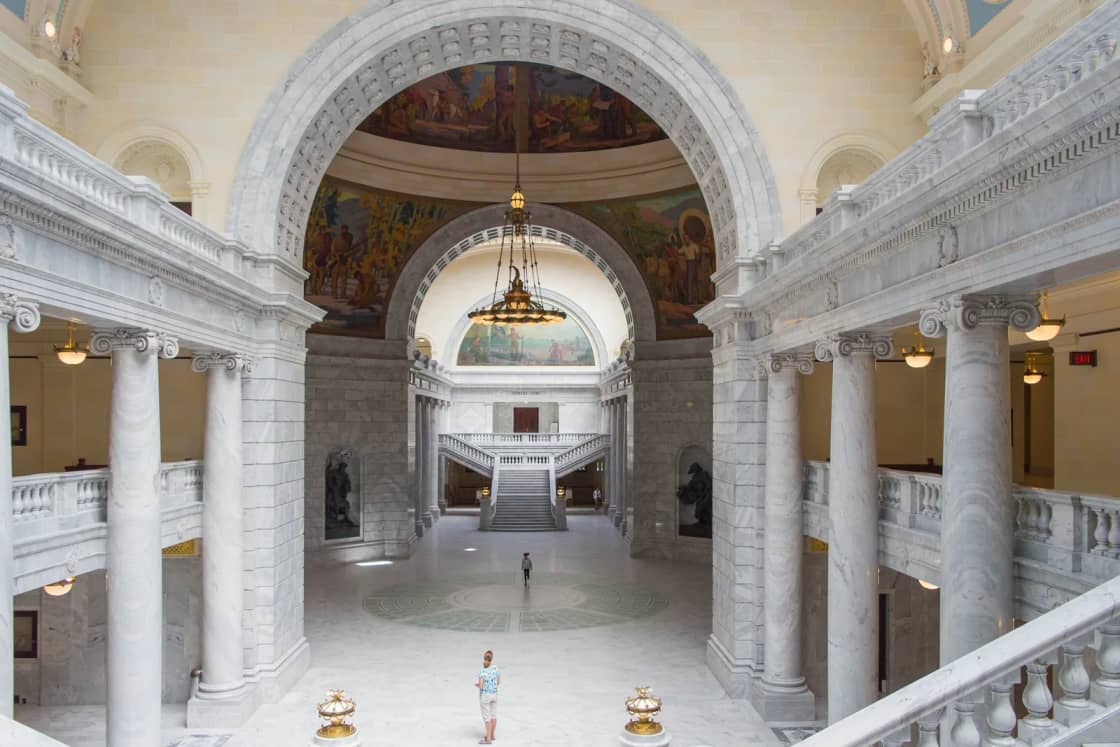
The rotunda is the center of the building and the place from which, the flashcards point out, you can see all three branches of government. Its 24 marble columns were carved in Georgia and shipped by rail, and each weighs about 25,000 pounds. Look straight up and you will see the original chandelier, about 1,000 pounds, hanging from a 95-foot chain that weighs 5,000 pounds. The flashcards say replacement glass shades came from the Arkansas State Capitol, which has an identical fixture.
At the top, 165 feet above the rotunda floor, is Seagulls and Clouds, a ceiling mural of California gulls flying through sunset-colored clouds. The largest birds have wingspans of about six feet. The Capitol's art page credits the Philip Dern Decorating Company, 1915, in fresco, while the flashcards name painter William Slater. Either way, conservators repaired the whole ceiling in the 2004 to 2008 restoration and removed birds that had been painted in after the original.
Below the dome are the Depression-era paintings most visitors remember. The four pendentives, the triangular supports under the dome, each 14 by 20 feet, show explorers entering the region: Father Escalante Discovers Utah Lake, 1776; Peter Skene Ogden at Ogden River, 1828; Fremont First Sees Great Salt Lake, 1843; and Brigham Young and Pioneers Entering the Valley. Above them runs the cyclorama, eight scenes of 19th-century Utah with more than 100 figures, many over 10 feet tall, including The Gulls Save the Wheat Fields, Driving the Golden Spike, Pony Express and the Stagecoach and Naming Ensign Peak.
The board's art page says the rotunda sat unfinished for nearly 20 years until the federal Public Works of Art Project paid for the work. Lee Greene Richards planned and sketched each scene, with help from Gordon Cope, Waldo Midgley and Henry Rasmusen. The flashcards say the canvases were painted at the Utah State Fair Grounds and installed in 1935, and they give a practical tip: the best view of the cyclorama is from the fourth floor.
The Gold Room
Officially the State Reception Room, the Gold Room is on the second floor next to the governor's offices. The flashcards say it gets its nickname from real gold leaf on the upper walls and ceiling. The governor uses it for press conferences, ceremonial bill signings and visiting dignitaries. Its walls are Birdseye marble, quarried near Birdseye, Utah, and the same stone appears in the House chamber and the old Supreme Court. The four French chandeliers hold 1,125 crystals each, and the ceiling mural, Children at Play, was painted in New York by Louis Schaettle and installed after it was finished. Because the governor's office uses the room, it is one of the spaces a guided tour gets you into more reliably than a walk-in visit.
The Senate and House chambers
The Senate has 29 members, and the flashcards note that it still votes by voice roll call at 28 original roll-top desks refurbished in the restoration. The cream-colored stone on its walls is Utah Honey Onyx from Aragonite, about 70 miles west. When the chamber was enlarged, matching onyx had to come from Pakistan by way of Italy. The original mural on the north wall is Utah Lake, 1916, by Lee Greene Richards and Alma B. Wright: the lake Provo looks across every day, hanging over the state Senate. Keith Bond's Orchards Along the Foothills and Ancestral Home were added in 2007.
The House has 75 members serving two-year terms and votes electronically. The Latin vox populi, "voice of the people," is over the speaker's seat. Its two original murals are Alonzo Earl Foringer's Jim Bridger and the Discovery of the Great Salt Lake and Vincent Aderente's Dream of Brigham Young. David Koch added two in 2007: Engen Brothers Bring Skiing to Utah and Seraph Young Votes, which shows the Feb. 14, 1870, Salt Lake municipal election in which the flashcards say Seraph Young became the first woman to vote in the continental United States.
The Supreme Court chamber and the Hall of Governors
The Utah Supreme Court moved to the Matheson Courthouse in 1998, but the old chamber was kept as it was and is still used at least once a year, according to the flashcards. Look for the electric stoplight, a gift in 1916 from the family of Lester Wire, the Salt Lake police officer credited with inventing the electric traffic light. It times each side's 20 minutes before the justices. The chamber's mural, Henry L.A. Culmer's 1905 Augusta Bridge, shows a span now in Natural Bridges National Monument.
The Hall of Governors holds the official portraits, starting with Heber Manning Wells in the northeast corner and running clockwise. The Great Seal of Utah was set into the floor there in 2016 for the building's 100th anniversary. Near the west entrance stands a Liberty Bell replica, one of 55 commissioned by the U.S. Treasury in 1950 and cast in France.
The North Capitol Building and the Museum of Utah
The newest building on the hill is the North Capitol Building at 450 N. State St. Its ribbon was cut on Jan. 16, 2026, according to the state's Government Operations department. Its atrium has a 25-foot stained-glass laylight by Holdman Studios, with more than 14,000 pieces of glass and sand from all 29 Utah counties. The building sits on 89 seismic base isolators.
Inside is the Museum of Utah, the state's first state history museum, run by the Utah Historical Society. Admission is free. Its four permanent galleries are Becoming Utah, Connecting Utah, Building Utah and Inspiring Utah, and the temporary exhibit The Past is Personal runs through spring 2027. The museum's gallery hours are 11 a.m. to 8 p.m. Monday, 9 a.m. to 8 p.m. Tuesday through Thursday, and 9 a.m. to 6 p.m. Friday through Sunday. It is closed Nov. 26 for Thanksgiving and on federal holidays except July 4, July 24 and Veterans Day. Our Salt Lake City day trip guide lists it among the free stops on a Salt Lake day.
The grounds
The flashcards say the grounds were laid out by the Olmsted Brothers, the firm of Central Park fame, and cover 40 acres. The memorial pathway is a tree-lined loop of about 0.7 mile around the Capitol, past monuments, statues and views of the valley and mountains. The Capitol says 433 Yoshino cherry trees line it, and the board's cherry tree page says they bloom in April. The Mormon Battalion Monument on the southeast side, dedicated in 1927, was the first monument on the hill.
Getting there from Provo
Driving
OpenStreetMap routing puts the Capitol about 46 miles and 56 minutes from downtown Provo. The route is I-15 north for about 41 miles, off at the 600 South exit into downtown Salt Lake, then State Street north through downtown until the Capitol fills the windshield at the top of the street. Drive times through Point of the Mountain vary a lot by hour, so treat the hour as a best case and check UDOT's road conditions on a winter morning.
Parking
The Capitol's maps and parking page lists three options:
- Public lots on the east and northeast sides of the complex.
- Underground parking northeast of the North Capitol Building, part of more than 315 new stalls the North Capitol project added.
- Street parking around the Capitol's perimeter, unless signs say otherwise.
The Museum of Utah says free parking is available on the Capitol Complex. School and charter buses can parallel park on the southbound side of East Capitol Boulevard.
The pages checked did not say how parking changes during the legislative session or give time limits. If you are driving up on a session weekday, call Visitor Services at 801-538-1800 first.
About the entrances. The main entrance is on the east side, and that is where tours meet. The parking page's map, however, is captioned "Directions for North entrance to the Capitol during east entrance construction," and the board's FAQ mentions first-floor flooring work. If you arrive and the east doors are fenced off, look for the north entrance and ask the first staff member you see where the tour desk is.
FrontRunner and the bus
The transit trip works on weekdays only. FrontRunner runs Monday through Saturday, every 30 minutes at weekday peaks and hourly midday and on Saturdays, according to UTA. Ride north from Provo Central past Salt Lake Central to North Temple Station at 500 W. North Temple. UTA's timetable notes that some trains end at Salt Lake Central, so check that yours continues one more stop.
At North Temple, catch UTA Route 200. Its timetable, effective August 2026, shows a State Capitol East Entrance stop and says plainly: "Service to Capitol Loop Weekdays Only." The route then runs south down State Street through downtown toward Murray. Check the Transit app or rideuta.com for the day's times.
On Saturday the 200 does not climb the hill. The alternative is to take TRAX into downtown from Salt Lake Central and walk north up State Street, a steep few blocks that our Salt Lake City day trip guide describes as a climb that pays off in the view. Fares, FAREPAY and fare capping are covered in our UTA fares guide, and the train itself in FrontRunner from Provo.
Visiting during the legislative session
The 2027 General Session runs Jan. 19 to March 5, 2027, according to the Legislature's site. Utah has a part-time citizen legislature that meets for 45 days a year, the flashcards explain, and from April to November legislators meet once a month for interim days.
Those seven weeks are the most interesting time to visit and the busiest. The flashcards say the House gallery is open to the public during the session on a first-come, first-served basis, and the press boxes are for news media. The Legislature's site posts upcoming agendas, committee room maps, a decorum rules document and live video of floor debates, so you can see what is on the calendar before you choose a day.
A few cautions for session visits:
- Virtual tours are blacked out during the session; last year's field trip page listed no virtual tours Jan. 20 to March 6, 2026. The page has not yet posted 2027 dates.
- Lots and hallways fill with lobbyists, staff and school groups. Allow extra time to park and get to the tour desk.
- If you want to see a specific bill heard, check the agenda the morning of, since schedules move.
Presidents' Day, Monday, Feb. 15, 2027, falls during the session. It is a state holiday, so there are no guided tours that day, but the building opens 7 a.m. to 6 p.m. Our February family night ideas build a self-guided holiday visit around it.
School groups and field trips
The board has a separate field trip page for schools, with the same three formats. Guided and virtual tours are for fourth graders and up; younger classes should plan a self-guided visit. Self-guided groups have no size limit, and guided and self-guided visits can be booked up to a year ahead.
The most useful line for a Utah County teacher is about money: schools visiting the Capitol can apply for transportation cost reimbursement after submitting the field trip form. Students can eat lunch on the grass, weather permitting, or at tables on the first floor in bad weather. Buses parallel park on the southbound side of East Capitol Boulevard. The Museum of Utah books its own school programs separately.
Accessibility
The maps and parking page says two wheelchairs are available through Suite 120 and can be reserved by phone at 801-538-1800 or by email. Elevators have been part of the building since it opened, according to the flashcards. The board's pages did not describe accessible parking or entrances in detail, and with the east entrance construction noted on the parking map, a call to Visitor Services before the drive is the best way to learn which door to use. The Museum of Utah asks visitors with accommodation requests to contact its Guest Experience Team.
Nearby on Capitol Hill
Pioneer Memorial Museum. The Daughters of Utah Pioneers' museum is across the street and west of the Capitol at 300 N. Main St. The Capitol's own visitor page describes it as free and as holding "the world's largest collection of artifacts on one subject." The DUP site lists hours of 9 a.m. to 4:30 p.m., Monday through Friday, so it is a weekday pairing only.
Council Hall. The building was built in 1865-66 as Salt Lake's original City Hall, designed by William H. Folsom, and was moved to Capitol Hill in 1962, according to the Utah Office of Tourism. The Capitol says the territorial legislature met there from 1866 to 1894, and that Seraph Young cast her 1870 vote there. Do not plan on it as a stop: the tourism office says it housed the state's welcome center from 1963 until 2026, and the Capitol's visitor page lists it as closed for construction.
Memory Grove. In lower City Creek Canyon, beside Capitol Hill, Memory Grove was dedicated as a memorial park in 1924, according to Salt Lake City's parks department. Its marble Pagoda was the first memorial there, and the small Meditation Chapel dates to 1948. The city lists a restroom, a walking path, drinking fountain, picnic tables and an off-leash dog area. The city page did not list hours.
City Creek Canyon and Ensign Peak. City Creek Canyon continues north from the Capitol area, and Ensign Peak rises above the neighborhood. Both are covered in our Ensign Peak and Salt Lake foothill walks guide.
The neighborhood. Capitol Hill is a hillside residential district of narrow, steep streets. Our guide to Salt Lake City neighborhoods describes it, and it suggests testing those streets in winter, which applies to visitors parking on them too.
A sample weekday from Provo
- Leave Provo around 8:30 a.m. by car, or catch a morning FrontRunner north toward North Temple.
- Take the 10 or 11 a.m. guided tour. Arrive 15 minutes early to find the tour desk.
- Climb to the fourth floor afterward for the cyclorama view and the rotunda from above.
- Walk to the North Capitol Building for the Museum of Utah and the stained-glass laylight.
- Lunch in downtown Salt Lake, or a packed lunch on the grounds in good weather.
- Cross to the Pioneer Memorial Museum before 4:30 p.m., or walk the memorial pathway and drop into Memory Grove.
- Head home by 3 or 3:30 p.m. to get ahead of the traffic at Point of the Mountain, or check the last southbound train if you rode FrontRunner.
Who should go, and who should skip it
Good fit: families with children in fourth grade and up, when Utah history is in the curriculum; anyone interested in art, architecture or how laws get made; visitors on a budget, since nearly everything on the hill is free; and anyone who wants a December outing that does not depend on the weather.
Think twice: if your only free day is a Sunday, because there is no train and no guided tour, though the building and museum are open. Very young children may last through the rotunda and not much more, so a self-guided half hour can beat a 45-minute tour. Session weekdays are crowded and harder to park. And if you need the guided tour, avoid Thanksgiving week and Dec. 7 through New Year's Day.
Closer to home: For a free history stop in Utah County, our free museum and library outings list starts in Provo.
Before you go
- Check the Capitol tours page for blackout dates the week you visit.
- Groups: submit the tour request form, or call scheduling at 801-538-3074.
- Riding transit: confirm your train continues to North Temple and that it is a weekday for Route 200.
- Session visit: check agendas on le.utah.gov the morning you go.
- Need a wheelchair or the best entrance? Call Visitor Services at 801-538-1800.
- Download the Capitol's tour flashcards for a self-guided weekend visit.
Sources: Utah State Capitol Preservation Board pages for tours, field trips, visiting, maps and parking, history, the art collection (pendentives and cyclorama, Seagulls and Clouds, Senate and House chamber murals), the FAQ and the 2026 tour flashcards; Utah Legislature (le.utah.gov); UTA's FrontRunner page and Route 200 and FrontRunner 750 timetables; the Utah Historical Society's Museum of Utah page; Utah Government Operations; Daughters of Utah Pioneers (isdup.org); Salt Lake City Public Lands; the Utah Office of Tourism; and OpenStreetMap (OSRM) routing. All checked Nov. 14, 2026.
Related Guides
- Things to Do in Salt Lake City From Provo
- Ensign Peak and Salt Lake Foothill Walks
- This Is the Place Heritage Park
- Christmas in Salt Lake From Utah Valley
- The Temple Square Visitors' Center
- FrontRunner From Provo
- FHE Day Trips From Utah Valley
Frequently Asked Questions
Are Utah State Capitol tours free?
Do I need a reservation for a Capitol tour?
When are there no guided tours?
What are the Utah State Capitol's hours?
Where do you park at the Utah State Capitol, and is it free?
Can you get to the Capitol from Provo without a car?
Can you watch the Legislature in session?
Is the Capitol wheelchair accessible?
Sources
The facts in this guide were checked against these sources. Hours, fees and rules change, so confirm anything time-sensitive with the source before you go. How we make Provo.com.
- Utah State Capitol Preservation Board: Tours, Utah State Capitol Preservation Board. Checked November 14, 2026.
- Utah State Capitol Preservation Board: Field Trips, Utah State Capitol Preservation Board. Checked November 14, 2026.
- Maps and Parking, Utah State Capitol Preservation Board. Checked November 14, 2026.
- Things to See and Do, Utah State Capitol Preservation Board. Checked November 14, 2026.
- State Capitol History, Utah State Capitol Preservation Board. Checked November 14, 2026.
- Pendentives and Cyclorama, Utah State Capitol Preservation Board. Checked November 14, 2026.
- Seagulls and Clouds, Utah State Capitol Preservation Board. Checked November 14, 2026.
- Senate Chamber Murals, Utah State Capitol Preservation Board. Checked November 14, 2026.
- House Chamber Murals, Utah State Capitol Preservation Board. Checked November 14, 2026.
- Utah State Capitol Preservation Board: FAQ, Utah State Capitol Preservation Board. Checked November 14, 2026.
- Tour Flash Cards 2026, Utah State Capitol Preservation Board. Checked November 14, 2026.
- Utah State Legislature home (2027 General Session dates), Utah State Legislature. Checked November 14, 2026.
- Museum of Utah, Utah Historical Society. Checked November 14, 2026.
- Utah's New North Capitol Building Opens Its Doors, Utah Department of Government Operations. Checked November 14, 2026.
- Route 200 schedule, effective August 2026, Utah Transit Authority. Checked November 14, 2026.
- FrontRunner 750 schedule, fall 2026, Utah Transit Authority. Checked November 14, 2026.
- Utah Transit Authority: FrontRunner, Utah Transit Authority. Checked November 14, 2026.
- Salt Lake City Public Lands: Memory Grove, Salt Lake City Public Lands. Checked November 14, 2026.
- Utah History (Council Hall), Utah Office of Tourism. Checked November 14, 2026.
- Pioneer Memorial Museum, International Society Daughters of Utah Pioneers. Checked November 14, 2026.