
Most people who stay in Utah Valley stay in a chain hotel near a freeway exit, and for most trips that is the sensible thing to do. But the valley does have an alternative, and its centerpiece is a Victorian mansion in downtown Provo built in 1895 by a mining family and attributed to the architect who designed the Utah State Capitol.
The alternatives here are narrower than in southern Utah — there is no cluster of desert glamping resorts, no treehouse hotels. What there is: one significant historic inn, the canyons, and a short-term rental market carrying most of the genuine oddities.
The short answer
The Hines Mansion in downtown Provo is the valley's landmark historic stay — an 1895 Victorian house, converted to lodging in 1995, aimed squarely at couples. Beyond that, the interesting options are canyon lodges and cabins, state park cabins and yurts, and short-term rentals with settings hotels cannot match.
None of these are family-of-five options in the way a hotel suite is. That is the main structural limitation of the category here.
The Hines Mansion
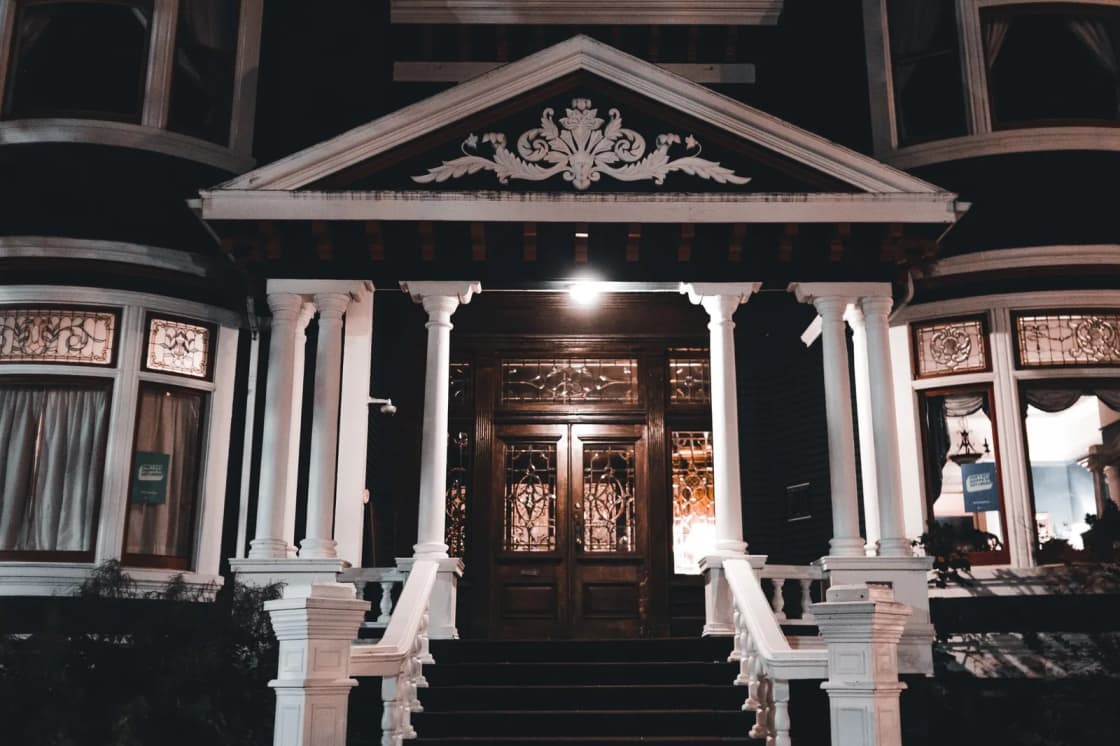
The house was built in 1895 by Russell Spencer Hines and his wife Kitty, on money he made in local mining, business and real estate. It went up as a showpiece during Provo's recovery from a boom-and-bust cycle in the area's early economy — one of the first homes built by what the inn's own history calls Provo's first-generation gentry.
The design is attributed to Richard Kletting, the Utah architect best known for the State Capitol. That attribution is the single most interesting thing about the building and the reason it registers as more than a pretty old house.
It sits at 383 West 100 South, on a corner in downtown Provo, and it became lodging in 1995 — a hundred years after it was built.
Inside, the character is Victorian and deliberately so: a parlor with a marble fireplace, individually styled suites, high ceilings, period detail. Rooms carry private bathrooms, two-person soaking or jetted tubs, smart TVs and wireless internet. Some rooms have been renovated toward a more modern finish; others have been left closer to original, which is a real difference in feel between bookings.
Three things to know before booking the Hines Mansion
Worth stating plainly, because each of them surprises someone.
The room count is genuinely unclear. Some sources — including pages on the inn's own site — say eight suites; others say nine. This is not a distinction that changes your stay, but it is a good illustration of why you should confirm specifics directly at booking rather than trusting any single listing, including this one.
Every room is designed for a maximum of two guests. This is the constraint that matters most. The property is positioned toward honeymoons, anniversaries, romantic getaways and adult retreats. If you are traveling with children, this is not your option, and no amount of charm changes the occupancy.
It is not operating as a traditional bed and breakfast, by its own description. The current operators state that they offer a light continental breakfast and explicitly distinguish that from a full bed-and-breakfast service. If your mental image is a cooked breakfast served at a communal table, adjust it. Guest reviews on this point are mixed, and it is the most common source of disappointment.
Also practical: in-person check-in runs a narrow late-afternoon window, with instructions sent by text for later arrivals, and a hold is placed on the card for incidentals. Neither is unusual; both are worth knowing.
The location, which is the underrated part
The Hines Mansion's setting does a lot of work that gets less attention than the architecture.
It is downtown, within a short walk of the Provo City Center Temple and the Utah Valley Convention Center, and roughly a mile and a half from BYU. That puts Center Street's restaurants, the Rooftop Concert Series and most of downtown's evening life within walking distance — which is unusual in a valley where almost everything requires a car.
For a couple visiting for a weekend, the walkability is arguably worth more than the period detail. Our guides to downtown Provo parking and the best restaurants in Provo cover what is within range.
The Butch Cassidy story, handled honestly
You will encounter a claim that Butch Cassidy frequented the mansion. The inn presents it as rumor rather than record, and that framing is the correct one.
It is a good story and there is no documentation behind it that anyone has produced. Treat it as folklore attached to a beautiful old building, which is what nearly every beautiful old building in the West has. Enjoy it; do not repeat it as fact.
What a historic property costs you, in trade
Reviews of historic inns everywhere share a pattern, and the honest version is worth reading before you book rather than after.
Sound. Buildings from 1895 were not constructed with sound isolation in mind. Guests at historic properties routinely report hearing neighboring rooms. If you are a light sleeper, this is the risk you are accepting.
Room variation. In a chain hotel, rooms are interchangeable. In a converted house they are not — one suite may be substantially larger, brighter or better appointed than another at a similar rate. Read reviews of the specific room, and look at the gallery rather than the headline photo.
Fixture quirks. Guests have flagged things as basic as confirming whether a given room has a shower rather than only a tub. That is not a criticism of the property so much as a feature of period conversions. Ask.
What you get in exchange is a building nobody else can build now, in a location a chain would not choose, at a price that is usually not far off a good hotel.
The canyons: cabins and lodges
The valley's other genuine category is elevation.
Provo Canyon and the mountains around it carry lodges, cabins and resort accommodation, including the well-known property up toward the top of the canyon. These are the stays where the setting is the entire point — mountains outside the window, aspen and scrub oak, and a night sky the valley floor does not offer.
State parks and national forest in the area carry cabin and yurt rentals, which are the inexpensive end of this category and book furthest in advance. Autumn color weekends and summer Saturdays are the hardest dates.
Practical notes. Canyon roads in winter want proper tires and a realistic assessment of your vehicle — our guide to winter driving in the canyons covers it. Cell coverage thins as you climb. And the drive that takes twenty minutes in July can take considerably longer in February.
For what to do once you are up there, American Fork Canyon and the Alpine Loop cover the two main routes.
Short-term rentals, where the real oddities live
If you want something genuinely unusual in Utah Valley, the rental market is where it is, not the hotel market.
Converted spaces, houses with serious mountain views, properties with features no hotel carries — the inventory changes constantly, which is exactly why a guide cannot usefully list specific properties. What is durable is the advice: search by the feature you actually want rather than by price, and read recent reviews rather than the listing copy.
Two structural notes. Short-term rental regulation varies city by city across Utah County and has been actively contested in some of them, so book through a platform with a real cancellation policy rather than an informal arrangement. And group size is where rentals decisively beat both hotels and inns — five or more people, or a stay past about five nights, and the arithmetic usually favors a house.
Managing expectations set by southern Utah
Worth saying directly, because it is a recurring disappointment.
Utah's famous unusual accommodation — the desert domes, the luxury glamping resorts, the slickrock-view cabins — is almost entirely in the southern part of the state, four to five hours away near the national parks. Utah Valley does not have an equivalent cluster and is not trying to.
What Utah Valley has instead is a genuine nineteenth-century downtown, real mountains fifteen minutes from a city, and a set of canyons with cabins in them. That is a different offer. It is a good one, but if you arrived expecting Moab's inventory you will find the valley thin.
What the Hines Mansion is good for, specifically
Rather than a general recommendation, the occasions where it is clearly the right choice — because it is a property with a narrow and well-defined fit.
Anniversaries and honeymoons. This is the core market and the property is built around it. Two-person rooms, soaking tubs, a parlor, no children in the building.
Temple weddings. The Provo City Center Temple is a short walk away, and couples and out-of-town family members use the mansion for exactly this reason. Our guide to temple wedding logistics covers the surrounding arrangements.
A downtown weekend without a car. Park once and walk to dinner, to Center Street and to whatever is on that evening. In Utah Valley that is a genuinely scarce proposition.
Quiet adult retreats. People book it to read and do nothing, which the building supports well.
Where it is the wrong choice: families, groups needing more than two people per room, anyone wanting hotel-standard consistency, and anyone who has decided in advance that a full cooked breakfast is part of the deal.
Staying up Provo Canyon versus staying in town
If you are choosing between the valley floor and the mountains, the trade is straightforward and worth making deliberately.
In town gets you restaurants, walkability, shorter drives to everything, reliable cell service and lower prices. It also gets you a view of mountains rather than a position in them.
Up the canyon gets you the setting, the quiet, the night sky and immediate access to trails and, in winter, to skiing. It costs you convenience: every meal is a decision, every errand is a drive, and winter weather is a genuine variable rather than an inconvenience.
The pattern that works for most visitors: town for a short trip, canyon for a long one. A two-night stay spends too much of itself driving; a five-night stay absorbs the drives easily and the setting pays off daily.
The exception is autumn. For a leaf weekend in late September or early October, the canyon is worth the inconvenience even on two nights, because being in the color at dawn is the entire point and you cannot drive up in time for it.
Booking a canyon cabin, practically
The mechanics here differ enough from hotel booking to be worth spelling out.
Book far ahead for the two peaks — summer weekends and autumn color. State park cabins and yurts in particular open on a reservation window and the good dates go the day they become available.
Check what "cabin" means at that property. The word covers everything from a fully equipped house to a bunk structure with no plumbing. Look for whether it lists a bathroom, a kitchen, heating and bedding, because the assumption gap between the two ends is enormous.
Confirm road access in winter. Some access roads are not maintained through the season, and a booking that works in July may require a different vehicle in February.
Plan food before you arrive. There is no shop up there. The Shops at Riverwoods at the canyon mouth is the practical last stop for anything you forgot.
Where the valley's other historic buildings are
If the appeal is the architecture rather than the bed, several of the valley's best historic buildings are visitable without staying in one.
Downtown Provo carries a stock of late-nineteenth and early-twentieth-century buildings, several on the National Register, and the downtown Provo neighborhood is walkable in an hour. Springville, Payson and American Fork each retain older cores with buildings from the same era.
This is worth knowing because it separates two different desires that often get bundled. If you want to see Victorian Provo, walk it for free. If you want to sleep in it, there is essentially one option, and it is the Hines Mansion.
Accessibility, honestly
The category as a whole is weaker on accessibility than chain hotels, and it is better to know that in advance than to discover it at check-in.
Historic properties were built before accessibility standards existed. Converted houses commonly have stairs to upper floors, narrow doorways, period bathrooms and no elevator. Some rooms will work and others will not, and the only reliable path is to call and describe your specific needs rather than filtering on a booking site.
Canyon cabins vary wildly and often involve gravel, steps and uneven ground even where the interior is fine.
Short-term rentals are the most variable of all, and listing descriptions are written by owners rather than audited.
If accessibility is a firm requirement, a modern hotel is the reliable answer, and that is a real limitation of this category rather than something to work around.
When to book, and what it costs
The peak-date logic that governs Provo hotels governs these too, with an amplifier: there are far fewer of them.
A valley with one significant historic inn and a limited stock of canyon cabins runs out much faster than a valley with dozens of chain hotels. On Freedom Festival week, graduation weekends and autumn color weekends, the unique inventory is gone well before the hotels are.
On pricing, a historic room generally sits above a limited-service chain on an ordinary week and the gap narrows on peak weeks when the chains spike. For a couple the premium is usually modest. For a group it is rarely the economical answer. If budget is the governing constraint, our guide to cheap hotels in Provo is the better starting point.
The honest assessment
For a couple visiting Provo for an anniversary, a temple wedding, a graduation weekend or a downtown weekend, the Hines Mansion is a genuinely good answer and there is nothing else quite like it in the valley. Book a specific room, read that room's reviews, and go in understanding that breakfast is light and the walls are old.
For anyone with children, the historic-inn category here is effectively closed, and the honest recommendation is a hotel suite or a rental.
For anyone whose priority is setting rather than architecture, go up. A canyon cabin fifteen minutes from Provo delivers more difference from ordinary life than any building on the valley floor, and in late September or early October it is the best accommodation decision available in Utah County.
Related Guides
- Haunted Places in Utah Valley: The Stories, and the History Underneath Them
- Hines Mansion: Provo's Victorian Landmark, and the B&B That Says It Isn't One
- Inside Oxford Road Estate: the 26,000-Square-Foot Provo Mansion Stealing the 2026 Parade of Homes
Frequently Asked Questions
Is there a bed and breakfast in Provo?
How old is the Hines Mansion and who built it?
How many rooms does the Hines Mansion have?
Can children stay at the Hines Mansion?
Are there cabins or lodges near Provo?
What should I expect from a historic property versus a hotel?
Is a unique stay more expensive than a hotel in Provo?
Are there unusual stays besides inns and cabins?