
For a decade, the Rooftop Concert Series was the thing people meant when they said downtown Provo had changed. Then it stopped, for six years. It came back in 2026, and the questions people ask about it are almost all logistical: which Fridays, where exactly, does it cost anything, and is it really on a roof.
Short answers: five of them, Nu Skin Plaza, no, and no.
The short answer
Five free outdoor concerts at Nu Skin Plaza, 100 W Center Street, downtown Provo. Music starts at 7:00 p.m. Admission is free and untickered — you walk up. The 2026 season ran May 15, June 26, July 24, August 21 and September 18, all Fridays.
Bring a blanket. Eat downtown first. Do not look for a roof.
The dates, and why "third Friday" is wrong
This is the single most common piece of misinformation about the series, and it appears in otherwise careful event listings.
The shows are not on a fixed weekly pattern. Look at the 2026 spacing: May 15 is the third Friday, June 26 is the fourth, July 24 is the fourth, August 21 is the third, September 18 is the third. There is no rule you can apply, and the gap between the May opener and the June show is six weeks while the rest are roughly monthly.
The practical advice is unglamorous: get the dates from the series directly each spring rather than deriving them. Anyone who put "third Friday, May through September" in their calendar in 2026 missed two shows.
Where Nu Skin Plaza is — and the address that is circulating wrong
Nu Skin Plaza sits at the corner of Center Street and 100 West, in the heart of downtown Provo. The street address is 100 W Center Street.
Worth flagging because it has propagated: some event calendars list the venue at 75 W Center Street. That is incorrect. Provo City's own announcements, the series' official site and its contact page, and the Daily Herald's coverage all give Center Street and 100 West. If you are navigating by a listing rather than by the corner, check which address you have.
In practice, the corner is what matters. Downtown Provo's core is small enough that anyone standing on Center Street on a concert night can see where several thousand people are pointed.
What the name is actually about
The series launched in 2010 staging shows on a rooftop downtown. That is where the name comes from, and for the original run it was literal — part of the appeal was the oddity of climbing up to a concert above street level with the mountains behind the stage.
The revived series is at Nu Skin Plaza. The name carried over; the elevation did not.
This trips up first-timers often enough that it is worth saying plainly: you are not going to be on a roof, there is no stairway to find, and nothing has gone wrong if you end up at plaza level. The name is heritage, not a direction.
The six-year gap
The original series ran from 2010 to 2019 and then stopped. It did not fade out quietly — it had become one of the defining things about summer in Provo, and its absence was noticed continuously for six years.
The return was announced after Mayor Marsha Judkins took office, and organizers have been candid that it came together quickly once several pieces aligned: the city's support, the availability of the team, and a benefactor. Rooftop CEO and co-founder Sarah Wiley described the effort as fast rather than long-planned, and city staff have said the same.
Wiley has also framed the reason for the revival in terms that go beyond nostalgia — the argument being that a free, unticketed, all-ages gathering does something for a community that a ticketed show does not, particularly at a moment that feels culturally divided. Whether or not that lands for you, it explains a real design choice: the series could charge and does not.
Who is behind it
Three co-founders returned for the reboot: Sarah Wiley, Mindy Gledhill and Justin Hackworth. Gledhill is a musician; Hackworth is a photographer; the series has always had a distinctly local, distinctly creative-class fingerprint rather than a promoter's one.
It runs in partnership with Provo City, with the McGowan family as benefactors and Nu Skin providing the venue. Production is handled by a small team — Nate Draschil has been named as production manager in the series' announcements.
The relevant point for an attendee: this is not a touring package that happens to stop in Provo. The people programming it live here, and the booking reflects that.
What a show night looks like
The rhythm is consistent, and knowing it changes how you plan.
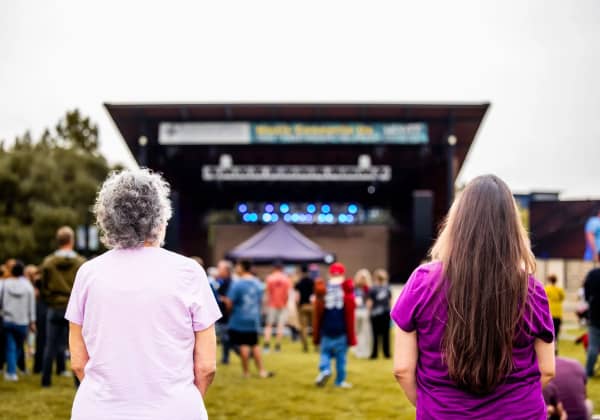
By around 6:00 p.m. the plaza starts filling with people staking out blanket space. The restaurants and shops along Center Street are busy — this is by design, and organizers explicitly encourage arriving early to eat downtown. Between 6:30 and 7:00 the crowd thickens noticeably.
Music starts at 7:00. Typically the bill runs multiple acts, with the headliner later in the evening. Between sets people move — this is a very fluid crowd, not a seated one, and the mix of standing near the front and sitting toward the back sorts itself out without much friction.
The whole thing is over well before late night. This is a family-hours event that happens to have real bands on it.
Where to stand
Three zones, roughly.
Close to the stage is standing-only in practice, and it fills first. If you want it, be there by 6:15.
The middle is the blanket zone and where most people end up. Sightlines are fine because the plaza is not deep in the way a park lawn is.
The edges and the back are where families with small kids and anyone who wants to be able to talk end up. You can hear everything; you can also leave without climbing over anyone, which with a toddler is the entire calculation.
There is no bad spot for sound. It is a plaza, not an amphitheater, and it is not large.
Parking downtown on a concert Friday
Downtown Provo has more parking than visitors expect and less than a crowd of several thousand needs at exactly 6:45 p.m.
What works: the public lots and street parking spread across the downtown grid, with a walk of a few blocks. What does not work: circling Center Street looking for something adjacent to the plaza.
The better move for anyone coming from the north or south end of the valley is transit. UVX runs along the downtown corridor and drops you within a short walk of Center Street, which removes the parking problem entirely on the one night it is a problem. Our UVX guide covers how the route and hours work.
If you drive, park once and stay for the evening rather than moving the car between dinner and the show.
Eating around it
The organizers' pitch to arrive early and eat downtown is genuinely the right play, and Center Street has the density to support it.
Reservations are worth having on a concert Friday for anywhere that takes them. Walk-in waits at the busier spots between 5:30 and 6:45 are longer than a normal Friday, because several thousand people have the same idea within the same hour. Our guides to the best restaurants in Provo and parking downtown both cover the block.
The alternative that a lot of regulars use: eat after. The crowd disperses fast once music ends, and the wait at 9:30 is nothing.
With kids
This is one of the better family evenings on the Provo calendar, with a couple of practical notes.
Younger kids do best at the back or the edges where there is room to move and the volume is lower. Bring a blanket rather than chairs so they have floor space. Ear protection for toddlers is a reasonable call and you will not be the only family with it.
The event's hours help — a 7:00 p.m. start means you can catch a full set and still be home at a defensible hour. Families who stay for the headliner tend to be the ones with older kids.
What it costs, and how that is possible
Nothing. No admission, no ticket, no suggested donation at the gate.
The funding comes from sponsorship, civic partnership and the benefactor relationship rather than from attendees, and the series has been structured that way since 2010. It is worth understanding because it explains the character of the event — there is no incentive to maximize capacity or upsell, and the crowd is genuinely mixed in a way that ticketed shows in the valley are not.
If you want to support it, the organizers' consistent ask is to spend money downtown on concert nights. That is the mechanism that makes the case to the businesses and the city that the series is worth continuing.
What the original run actually did for downtown
Worth a short detour, because it explains why a free concert series gets talked about in Provo the way infrastructure gets talked about elsewhere.
When Rooftop started in 2010, downtown Provo was not the place it is now. Center Street had vacancies. The restaurant density that makes the "eat downtown first" advice work did not exist yet. Wiley has said plainly that the original goal was revitalization — the series was trying to give people a reason to be downtown on a Friday night at a time when many did not have one.
That worked well enough that the goal has since changed. Organizers now describe the aim as gathering rather than revitalizing, on the reasoning that downtown no longer needs the help. Whether the concerts caused the change or rode alongside it is the kind of question nobody can settle cleanly, but the sequence is not in dispute: thousands of people came downtown monthly for a decade, and the block filled in around them.
The reason this matters to an attendee is that it shapes what the event feels like. Rooftop is not staged for tourists and does not behave like a festival with a gate. It is closer to a town showing up in its own downtown, which is also why the crowd skews so heavily local.
How the lineups work
The booking pattern is worth understanding if you are deciding which show to go to.
Lineups are announced show by show, not as a full season in the spring. That is a deliberate choice and it has a downside for planning — you generally cannot look in April and pick the one night whose bill you like best. The announcements land on rooftopconcertseries.com and on Instagram at @rooftopconcerts, usually with a few weeks of notice.
The programming leans Utah and regional. The 2026 opener is a fair sample: I Don't Know How But They Found Me is the nationally known name on that bill, and Sego and Pinguin Mofex are both acts with real history in the original run. That mix — one act with reach, two with local roots — has been the shape of a Rooftop bill for most of its existence.
Two consequences for an attendee. First, the crowd size varies a lot by who is playing, and the biggest nights are genuinely crowded in a way the quieter ones are not. Second, if you go to a show without knowing the bill, you are very likely to hear at least one band you have never heard of and would not have sought out, which for a lot of people is the actual point of the series.
Accessibility and comfort, honestly
A plaza is easier than a park lawn on this front, and there are still things worth knowing.
The surface is hard and flat, which is good for wheels and bad for sitting without padding. There is no tiered seating, so sightlines from a wheelchair depend heavily on where you position, and the edges are better than the middle for that reason. Arriving early matters more if you need a specific spot.
Restrooms are a downtown-business question rather than an event-infrastructure one. Plan around that with small children.
Weather is the other variable. Provo evenings drop quickly once the sun goes behind the west side of the valley, and a May or September show can be genuinely cold by the time the headliner finishes even after a warm afternoon. Layers, every time. Summer thunderstorms are a real possibility in July and August; the series posts updates rather than leaving people guessing.
Where it fits in a Provo summer
The Rooftop Concert Series is the anchor of downtown Provo's summer Friday, and it slots alongside a fairly full calendar: the Provo Farmers Market on Saturday mornings at Pioneer Park, outdoor concerts across the valley, and the Freedom Festival week in early July.
The July show lands on the 24th, which in Utah is Pioneer Day — a state holiday with its own set of traditions and a lot of competing events. That is a busy evening downtown by any measure.
Is it worth it?
For anyone new to Provo: yes, and it is close to the top of the list of things that will tell you what the town is actually like. Free, outdoors, all ages, thousands of people, no gate. There is not much else in Utah Valley that does all of those at once.
For people who went during the original run: the honest note is that expectations are doing work here. The 2026 revival is at a different venue with a different feel, and some of what people are nostalgic for was the specific strangeness of climbing to a roof in 2012. The series is very good; it is not a re-creation.
For anyone with one Friday in Provo and a choice to make: if a Rooftop date lands on it, take it.
When a free plaza concert becomes a regulated event
A free show on a downtown plaza feels like the least regulated thing imaginable — no ticket, no gate, no bag check, walk up and sit down. There is a state rule that governs events like it anyway, and where the line falls is genuinely interesting, because a plaza is the exact kind of space the rule was written about.
The rule is Utah Admin. Code R392-400, Temporary Mass Gathering Sanitation, authorized under Utah Code §§ 26B-7-402 and 26B-1-202 and enforced by the local health officer rather than by the city.
The definition, which has three parts and no reference to money
R392-400-3(14) defines a "temporary mass gathering" as an actual or reasonably anticipated assembly of 1,000 or more people, which continues or can reasonably be expected to continue for two or more hours a day, at a site or sites for a purpose different from the designed use and usual type of occupancy.
Three separate tests, all of which must be satisfied, and admission price is not one of them. A free event that draws a thousand people for an evening is inside the definition; a ticketed event that draws four hundred is not.
The third test is the one that does the real work at a plaza. A plaza is designed as a plaza — a place people cross, sit in and pass through. It is not designed as a concert venue. Put a stage on it and hold a crowd there for an evening and the site is being used for a purpose different from its designed use, which is precisely the clause the definition turns on.
Compare R392-400-2(2), the exclusion: the rule does not apply to an assembly of people at a location with permanent facilities designed for that specific assembly, unless the designed occupancy levels are exceeded. A purpose-built theater holding an audience is doing exactly what it was built for, so the rule passes over it. An open plaza holding the same audience is not.
Who the rule actually addresses
R392-400-3(7) defines the operator as the person representing the group, corporation, partnership, governing body, association or other organization legally responsible for obtaining the necessary permits for the overall operation of the gathering. Not the venue owner, not the performers — the entity running the event.
Two duties attach to that person and they are more concrete than most people would guess. R392-400-5(1) requires the operator to establish a headquarters at the gathering site. R392-400-5(2) requires the operator or a designee to be present at the gathering during operating hours.
There is a reason those are written as rules rather than left to good practice. A gathering with no identifiable person on site is a gathering where nobody can be told to fix anything, and the rest of R392-400 — closure powers, inspection access, waste and water requirements — depends on there being someone to address.
What to actually take from this at a free downtown show
Three things worth knowing when you walk up to one.
The bigger the crowd, the more infrastructure the law expects. Once a plaza event is reasonably anticipated to hold a thousand people for two hours, the water and restroom provisions of the rule attach with specific numbers rather than general expectations. A visibly larger crowd year over year is the thing that moves an event across that line.
There is an operator, and finding their table is the fastest route to an answer. The rule requires a headquarters on site. That is where a lost child, a medical question, or a complaint about an amplification problem is meant to go, and it exists whether or not the event advertises it.
Free does not mean unregulated, and regulated does not mean unpleasant. The practical consequence of R392-400 at a well-run plaza concert is invisible: the bins get emptied, there is water, and there is someone in charge. That is what compliance looks like when it works.
For the other end of the spectrum — a ticketed show in a purpose-built outdoor venue, where the exclusion at R392-400-2(2) does the opposite work — see the SCERA Shell guide. For an event that fills a city park rather than a plaza, see the Colonial Heritage Festival.
Dates, start times and the location of any given season are worth confirming with the series directly rather than from a guide.
Related Guides
- The Timpanogos Storytelling Festival: What It Is and How to Do It Right
- Balloon Fest at Fox Field: Provo's Best Free Morning of the Year
- Stadium of Fire: How Provo's Fourth of July Actually Works
- Nu Skin: The Provo Apartment That Built the Building Downtown Is Named After
- Utah County's free summer concerts, city by city
Frequently Asked Questions
When is the Rooftop Concert Series in 2026?
Where is the Rooftop Concert Series held?
Is the Rooftop Concert Series free?
Is it actually on a roof?
What time should I get there?
Can you bring chairs and blankets?
Is it family friendly?
Who performs at the Rooftop Concert Series?